
In brief
- A new hospital in the state-funded robotic surgery programme. Miercurea-Ciuc County Emergency Hospital enters at position 18 on the list of public healthcare units that can have robotic surgery procedures covered from the budget of the Ministry of Health, from 12 October 2026.
- Harghita becomes the ninth county with a unit in the programme. Counting Bucharest, the programme reaches 10 of the country’s 42 administrative units, and 32 counties are left without a single nominated hospital.
- The money comes from the state budget, not from the insurance fund. The „AP-ROBOTICĂ” programme pays separately for the consumables, the instruments and the maintenance of the robots, that is for precisely those costs that the hospital’s contract with the health insurance house does not cover.
- The county’s request sat for 265 days. The Harghita Public Health Directorate, the county’s health authority, asked for the hospital to be included in a letter registered at the ministry on 20 January 2026, and the order appeared on 12 October 2026.
Published: Official Gazette of Romania, Part I, no. 853 of 12 October 2026, pages 15-16
In force from: 12 October 2026, the date of publication, because the act sets no later date and ministerial orders enter into force on publication
From 12 October 2026, patients in Harghita and in the neighbouring counties have a hospital where surgery with a surgical robot is paid for out of public money, with no journey to Cluj-Napoca or Bucharest. An order with a single operative sentence adds Miercurea-Ciuc County Emergency Hospital to the list of public healthcare units nominated to carry out the priority action „AP-ROBOTICĂ”. The text confines itself to inserting, after point 17 of the list, „18. Spitalul Județean de Urgență Miercurea-Ciuc.”, the Miercurea-Ciuc County Emergency Hospital.
The brevity of the act hides what changes for a whole county. The list being supplemented is the one approved by Order no. 1.124/2026 of the Minister of Health, published in the Official Gazette of Romania, Part I, no. 344 of 29 April 2026, and the rules the hospitals have to observe sit in Order no. 991/2026 of the Minister of Health, published in Official Gazette of Romania (Monitorul Oficial) no. 290 of 9 April 2026. Entering the list opens access to a separate financing line, from the state budget, for the specific costs of robotic surgery, so it is not an honorary title.
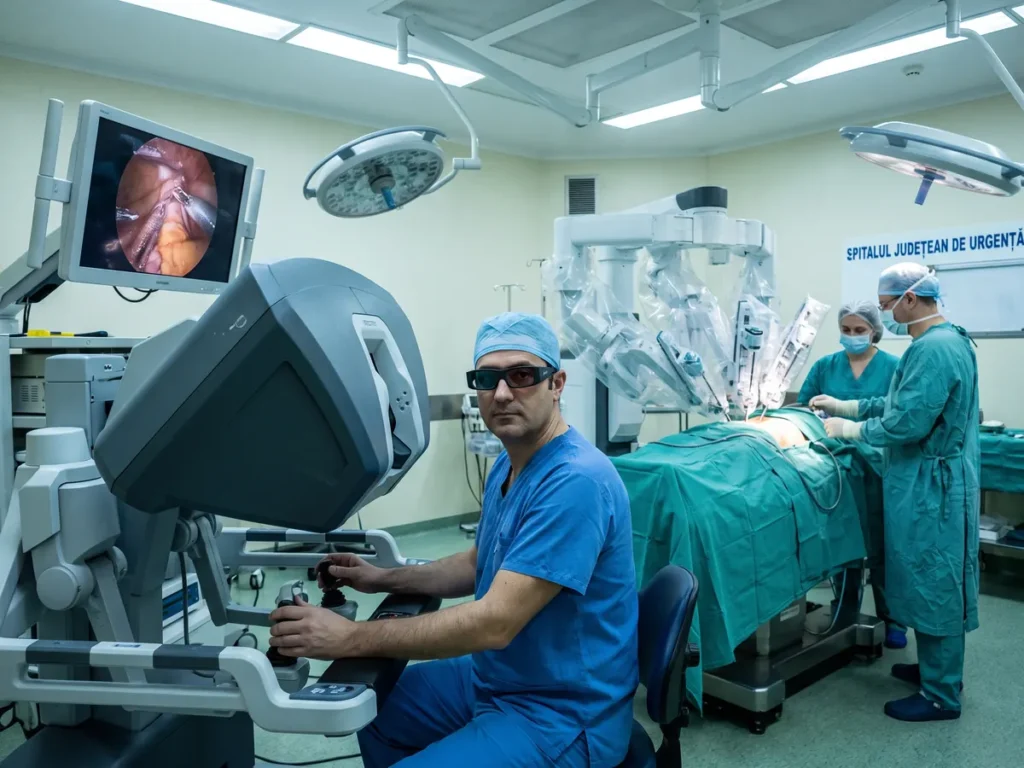
Robotic surgery does not mean a machine that operates on its own. The surgeon sits at a console a few metres from the operating table and manoeuvres articulated arms that introduce instruments through incisions of a few millimetres, following the operating field on a three-dimensional screen. The advantage invoked in medical practice is precision in narrow spaces, such as the pelvis or the mediastinum, plus a shorter recovery than in open surgery. The cost, however, does not sit in the robot, which has already been bought, but in the single-use consumables, in the instruments that have a limited number of uses and in the service contracts, and this is where the programme comes in.
The phrase „acțiune prioritară”, priority action, has a precise technical meaning in the financing of healthcare in Romania. Under Article 1(2) of Order no. 991/2026, the programme is addressed to patients with urgent conditions and to those with chronic conditions who need procedures using robotic surgery equipment, children or adults, and it finances „the specific costs for the treatment of these patients which cannot be covered from the funds obtained on the basis of the contracts with the health insurance houses”. Put differently: the admission and the surgical act continue to go, as before, through health insurance, while the extra cost of the robotic technology is paid from the state budget, through the budget of the Ministry of Health, from budget titles 20 „Goods and services” and 51 „Transfers between units of public administration”, in accordance with Article 6 of the same order.
What it changes in practice
From 12 October 2026, Miercurea-Ciuc County Emergency Hospital can conclude with the Harghita Public Health Directorate the contract provided for in Article 7(1) of Order no. 991/2026 and can apply monthly for financing for the consumables, the medicines and the instruments specific to robotic surgery, and for service and maintenance, including kits and spare parts, the activities listed in Article 20. The reasoned application is sent to the Emergency Medicine Directorate of the ministry, electronically, by the 5th of the month for which the money is requested at the latest. An application filed later is put off to the following month and requires a fresh request.
The hospital also takes on obligations. It has to keep a nominal record of the beneficiaries, based on the personal identification number, under Article 5, to report quarterly and annually the indicators in Article 22, among them the number of patients treated and the average waiting time, and to designate a programme coordinator, approved by the national working group. The manager has, under Article 23(3), five days in which to notify the ministry if the hospital no longer meets the eligibility criteria, that is if it loses the ward, the multidisciplinary oncology committee or the qualified staff.
For the patient, the practical effect is that the robotic extra cost no longer has any reason to end up in their pocket. Settlement is made by the Public Health Directorate, in the chronological order of the documents filed and within up to 60 calendar days, under Article 9(2). Inclusion in the list opens the right to financing without guaranteeing that the procedure can be done tomorrow: the actual pace depends on the contract concluded, on the sums allocated each month and on the hospital’s scheduling.
The order also confirms, indirectly, something about the architecture of the programme: the list can be supplemented by a plain ministerial order, without touching the framework set out in Order no. 991/2026. Article 24 of that order says only that the list of nominated units „is approved by order of the minister of health”, so each new hospital enters through an act of a few lines, exactly like this one.
What has changed compared with the previous situation
The list started out, on 29 April 2026, with 16 units. On 6 July 2026 it gained position 17, Bihor County Emergency Clinical Hospital, through Order no. 575/2026 of the Minister of Health, published in Official Gazette of Romania no. 552 of 6 July 2026. Now it reaches 18. In the 166 days between the publication of the initial list and 12 October 2026, the programme grew by two hospitals, that is by one hospital roughly every 83 days.
The full list of nominated public healthcare units, in the order given in the order, is as follows:
- Iași Regional Oncology Institute (Iași county)
- „Prof. Dr. N. Oblu” Emergency Clinical Hospital, Iași (Iași county)
- Craiova County Emergency Clinical Hospital (Dolj county)
- „Pius Brînzeu” County Emergency Clinical Hospital, Timișoara (Timiș county)
- „Louis Țurcanu” Emergency Clinical Hospital for Children, Timișoara (Timiș county)
- Bistrița County Emergency Clinical Hospital (Bistrița-Năsăud county)
- Cluj-Napoca Municipal Clinical Hospital (Cluj county)
- „Sf. Apostol Andrei” County Emergency Clinical Hospital, Constanța (Constanța county)
- „Bagdasar-Arseni” Emergency Clinical Hospital, Bucharest
- „Sf. Maria” Clinical Hospital, Bucharest
- „Dr. Constantin Andreoiu” County Emergency Hospital, Ploiești (Prahova county)
- „Foișor” Clinical Hospital of Orthopaedics, Traumatology and Osteoarticular TB, Bucharest
- Bucharest Emergency Clinical Hospital
- „Grigore Alexandrescu” Emergency Clinical Hospital for Children, Bucharest
- Fundeni Clinical Institute, Bucharest
- „Dr. Carol Davila” Central Military Emergency University Hospital, Bucharest
- Bihor County Emergency Clinical Hospital (added from 6 July 2026)
- Miercurea-Ciuc County Emergency Hospital (added from 12 October 2026)
On the map, the 18 units gather in nine counties plus the municipality of Bucharest: Iași, Dolj, Timiș, Bistrița-Năsăud, Cluj, Constanța, Prahova, Bihor and Harghita. Romania has 41 counties and the municipality of Bucharest, so the programme reaches 10 of the 42 administrative units, nearly a quarter, and leaves 32 counties without a single nominated unit. The concentration is visible: 7 of the 18 hospitals, that is 38.9%, are in Bucharest, while Iași and Timișoara have two each. The other seven counties have one each.
Harghita is the first county in the eastern centre of Transylvania to enter the programme. Until 12 October 2026, a patient from the area had Bistrița, Cluj-Napoca or Bucharest as points of access, all more than 200 kilometres away by road, even though Brașov, Mureș, Sibiu and Covasna are much closer. The Miercurea-Ciuc hospital thus becomes the nearest unit on the list for patients from Covasna, from southern Mureș and from the mountain areas of Bacău and Neamț too, not only for those from Harghita.
A second thing changes in the structure of the list. Miercurea-Ciuc is only the second unit that is not a clinical hospital, after the one in Ploiești: the other 16 are clinical hospitals, institutes or university hospitals, that is units tied to medical education. With this order, the programme comes down from the level of university centres towards an ordinary county hospital.
Advantages and disadvantages
What it improves
- It shortens the journey for patients from an area that had no unit in the programme at all, Harghita and the neighbouring counties, where the nearest option was more than 200 kilometres away.
- It places the extra cost of the technology on the state budget rather than on the hospital’s contract with the health insurance house, so the robot does not compete with the rest of the hospital’s activity for the same money.
- It also covers the service, the maintenance, the kits and the spare parts, under Article 20 of Order no. 991/2026, not only the consumables, which prevents the situation of an expensive machine standing idle for want of parts.
- It applies to eight surgical fields listed in Article 21, from general surgery, thoracic surgery, neurosurgery, gynaecology, urology and orthopaedics to ENT with oral and maxillofacial surgery and paediatric surgery, so children are included too.
- It requires a nominal record based on the personal identification number and quarterly reporting, so the real number of patients operated on can be known, not merely estimated.
- The mechanism for adding to the list is light: an order of a few lines adds a hospital, without rewriting the framework of the programme.
What remains a problem
- 32 counties are left without a single nominated unit, and for patients there access to robotic surgery paid for out of public money still means travelling to another county.
- The order does not show why this hospital was admitted, nor whether there are rejected applications: the eligibility criteria in Article 23 of Order no. 991/2026 are not accompanied by a public evaluation procedure or by a list of pending requests.
- The duration is hard to explain to a patient: from the registration of the county’s letter at the ministry, on 20 January 2026, to publication, 265 days passed.
- Nomination does not guarantee the money. Financing is provided monthly, on a reasoned application, and an application filed after the 5th of the month is automatically put off to the following month, under Article 7(8).
- The deadlines are not symmetrical: the hospital has 5 days in which to report the loss of eligibility, while settlement of expenditure already incurred can take up to 60 calendar days, twelve times as long.
- The average waiting time is an evaluation indicator under Article 22, but no text requires it to be published per unit, so the patient cannot compare hospitals with one another.
- The concentration in Bucharest, with 38.9% of the units, is left untouched by this order, and large medical centres such as Brașov, Sibiu, Mureș, Galați or Arad do not appear on the list at all.
Practical advice
- If you have been advised to have an operation, ask the doctor treating you whether your procedure appears on the list in Article 21 of Order no. 991/2026. The list is long and very concrete, from colorectal resections and radical prostatectomy to knee arthroplasty or the implantation of brain electrodes, and being covered by it is the condition for the robotic extra cost to be paid from the programme.
- Ask in writing, on admission, what is covered and what is not. The consumables, the specific instruments and the robot kits are part of the programme, so they are not an expense for the patient. If you are asked to buy a kit or an instrument, ask for the document the request is based on.
- If the request persists, notify the county Public Health Directorate and the Emergency Medicine Directorate of the Ministry of Health, the body that endorses hospitals’ financing applications under this programme.
- If your county has no unit on the list, choose the nearest of the 18 and ask your family doctor or your specialist for a referral to it. The programme addresses both urgent cases and chronic ones, so a condition that can be scheduled does not rule you out.
- Ask the hospital’s programme coordinator, not just the secretariat: under Article 4(2) of Order no. 991/2026, every nominated unit has a coordinator designated by the manager to run and monitor the action.
- Check before travelling that the hospital has an active contract for the current year. Nomination is permanent until the list is amended, but the financing is renewed monthly, and a hospital may have moments when it has no sums available for this purpose.
Frequently asked questions
What does it mean that a hospital has been „nominated” to carry out AP-ROBOTICĂ?
Do I have to pay anything for an operation with a robot at Miercurea-Ciuc?
From when can operations actually be carried out there under the programme?
What kind of operations are carried out with a surgical robot under this programme?
Can I go to any hospital on the list, even if it is not in my county?
How many counties now have a hospital in the programme and how many do not?
Who decides whether a hospital enters the list, and how long does it take?
Editorial analysis
The act is clean from a legal point of view and there is nothing to fault in it technically: a single provision, a new position on a list, a correct legal basis invoked in Article 24 of Order no. 991/2026 and in Article 7(4) of Government Decision no. 144/2010. The problems lie in what does not appear in the text and in the arithmetic behind the dates.
The first figure that says something comes from laying the two acts side by side. The letter from the Harghita Public Health Directorate is dated 15 January 2026 and was registered at the ministry on 20 January 2026, that is 79 days before the programme itself was published, on 9 April 2026. The county asked, in other words, to enter a mechanism that did not yet exist, and the answer came 265 days after registration. Between the publication of the initial list, on 29 April 2026, and this order, 166 days passed, in which the list grew by two units. At that pace, covering the remaining 32 counties would take well over a decade, and nothing in the current framework suggests that the pace is planned, because it results from individual requests rather than from a map.
The second observation becomes visible only by combining Article 23(2) of Order no. 991/2026 with the date of this order. The text requires the manager of a nominated hospital to send the ministry the declaration on fulfilment of the eligibility criteria „within 30 days of the date of entry into force of this order”, that is from 9 April 2026. The deadline fell on 9 May 2026, 156 days before the nomination of the Miercurea-Ciuc hospital. For a unit that entered the list in October, the obligation is therefore framed with a deadline that has already expired, and the nomination act gives it no other reference point. It is a defect in the anchoring of the deadline, not a contradiction that would prevent application, but it leaves each newly admitted hospital to decide for itself from when the 30 days run.
The third observation concerns the relationship between what is asked of the addressee and what the administration allows itself. The hospital has 5 days in which to report that it no longer meets the criteria, under Article 23(3), and has to file its financing application by the 5th of the month, or it loses the month. The Public Health Directorate, by contrast, has up to 60 calendar days in which to settle expenditure already incurred, under Article 9(2), a deadline twelve times longer than the one imposed on the hospital. For a county hospital that buys single-use consumables with money from its own account until settlement, that difference is not a matter of drafting style but of cash flow, and it explains why an existing machine can stand unused even in a nominated unit.
What should be changed
- The nomination order should contain a two-line statement of reasons, with the equipment held, the specialties covered and the date of the manager’s declaration on the eligibility criteria. The reader would learn why that hospital is entering, and any challenge would have something to rest on.
- The 30-day deadline in Article 23(2) of Order no. 991/2026 should run from the date on which each unit is nominated, not from the entry into force of the framework order. Otherwise, every hospital added after 9 May 2026 receives an obligation with an expired deadline.
- The ministry should publish the list of nomination requests filed and the stage each of them has reached, with the date of registration. A county that is waiting would know where it stands, and the 265 days in this case could be compared with others.
- The indicators in Article 22, in particular the number of patients treated and the average waiting time, should be published quarterly per healthcare unit. They are reported anyway, so the cost of publishing is zero, and the patient could choose between two hospitals on a figure rather than on hearsay.
- The 60 calendar days for settlement should be shortened or accompanied by an advance mechanism for the hospitals entering the programme, so that a county unit does not finance two months of consumables from its own funds.
- The programme should be accompanied by an official map of the nominated units, with the specialties of each, published on the page of the Ministry of Health and updated at every supplementation of the list. Without one, the information useful to the patient remains scattered across three successive orders.
Original text of the legal act
The text below is reproduced in Romanian, the official form of publication.
The full text, as published in the Official Gazette of Romania
Official Gazette of Romania no. 853 of 12 October 2026, pages 15-16 16 pages PDF, 157 KB the act starts on page 15
Open the official PDFDownload the PDF
The viewer is not shown on small screens. Use the buttons above to open or download the file.
This article is for informational purposes only and does not constitute legal advice. For specific situations, consult a licensed attorney or tax advisor.