
In brief
- The maps, aerial photomaps and urban layout plans of Suceava county, kept secret since the communist period, become ordinary archive documents. Government Decision no. 778/2026 declassifies the information in 316 documents issued between 1949 and 2002 and held in the archive holdings of Suceava County Council. Each of them is to be marked with the date of declassification and the words „NECLASIFICAT”, unclassified, while the old secrecy marking is to be cancelled with an oblique stroke. The documents stay with Suceava County Council and come under National Archives Law no. 16/1996.
- Who is concerned. Anyone, not only the institution. Declassification takes these documents out of the category for which Law no. 544/2001 on free access to information of public interest refuses access where the information is classified, and so opens the door to requests for consultation from historians, architects, landowners, local administrations and any citizen. More directly, it concerns those looking for documents about their own locality: 100 of the 316 entries are urban layout plans and sketches, and 73 are aerial photomaps of villages and neighbourhoods around Suceava.
- The figures and the deadlines that matter. The annex has 316 entries numbered from 1 to 316, with no gaps and no duplicates, amounting to 2,174 document sheets and 646 plates, in 342 copies. 303 entries carried the level „secret”, and 13 the level „strict secret”, top secret. The oldest document is dated 1949, so it stayed classified for 77 years, and the most recent is dated 10 December 2002. Of the 316 documents, 312 had already passed the 30-year term after which Law no. 16/1996 allows archives to be consulted, and the other four reach it between 2030 and 2032. The decision enters into force on 30 September 2026, the date of publication.
Published: Official Gazette of Romania, Part I, no. 828 of 30 September 2026, pages 4-26
In force from: 30 September 2026, the date of publication
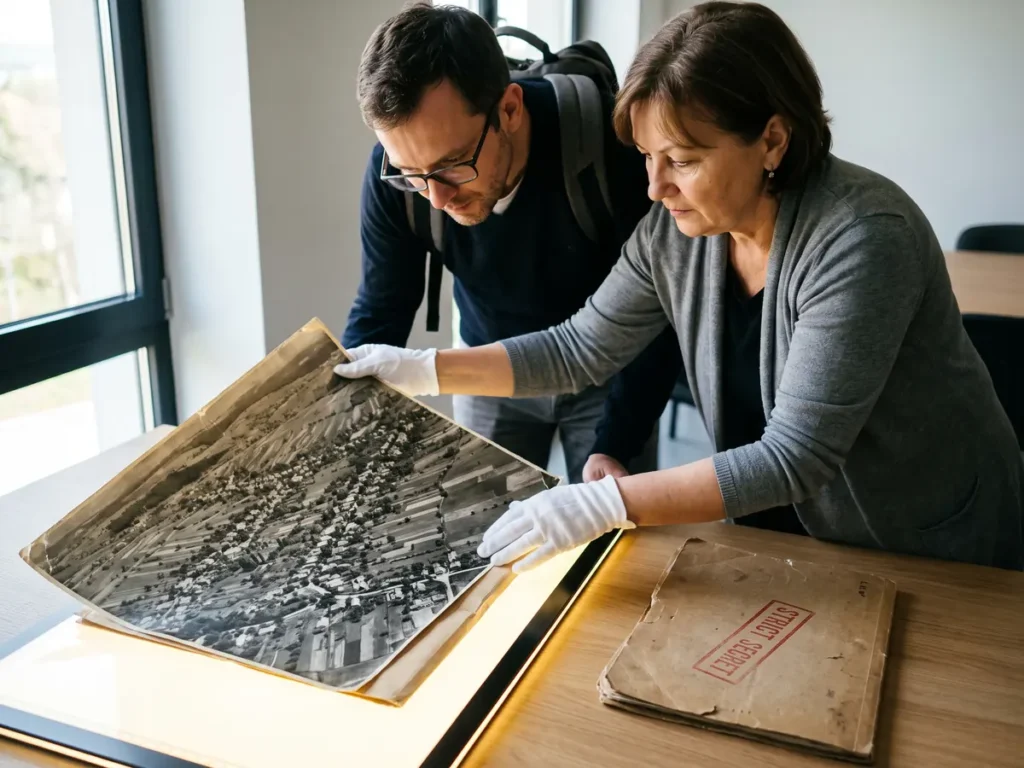
An aerial photomap of the village of Lisaura, made in 1980, was a State secret for 46 years. From 30 September 2026 it is a sheet of archive paper that anyone may ask for. Government Decision no. 778/2026 declassifies the information contained in 316 documents issued between 1949 and 2002, held in the archive holdings and in the keeping of Suceava County Council. The act has three articles and an annex that fills almost all of the 23 pages it occupies in the Official Gazette of Romania, and the whole point lies in the annex: the complete list, entry by entry, of what is being opened up.
The legal basis is Article 108 of the Constitution and Article 24(4) and (10) of Law no. 182/2002 on the protection of classified information. Paragraph (4) states that information classified as a State secret may be declassified by government decision, at the reasoned request of the issuing body. Paragraph (10) states that declassification is carried out by the persons or authorities competent to approve classification. The three levels of secrecy for State secrets are defined in Article 15(f) of the same law: top secret of special importance, top secret and secret, in descending order of the gravity of the damage that disclosure would cause.
Article 1 approves the declassification and states the substantive condition: disclosure of the information „nu mai poate prejudicia securitatea națională, apărarea țării, ordinea publică ori interesele persoanelor de drept public sau privat deținătoare”, can no longer harm national security, the defence of the country, public order or the interests of the public or private persons holding it. The physical operation is described in Article 2: on the declassified documents the date of declassification and the words „NECLASIFICAT” are to be entered, above or below the old inscription, which is to be cancelled by drawing an oblique stroke through it. Under Article 3(1), the documents stay in the keeping of Suceava County Council, under National Archives Law no. 16/1996, and paragraph (2) refers, for consultation, to Article 28(1) and Article 30 of that same law and to Article 12 of Law no. 544/2001.
The annex is the list of the classified information, with twelve columns for each entry: the serial number, the number given by the issuing body, the date, the issuing body, the short description, the number of copies, the number of sheets, the number of annexes and of their sheets, the level, the reason for declassification and remarks. The numbering runs from 1 to 316 without a single break and without a single repeated entry.
What the 316 documents actually contain. The greater part is cartography and town planning. 100 entries are urban layout plans, sketches or maps, almost all of them of the city of Suceava, but also of the towns of Fălticeni, Rădăuți, Gura Humorului, Siret and Solca. 73 entries are aerial photomaps, flown in 1980 (42 of them), in 1968 (23) and in 1967 (7), covering areas named in the annex one by one: Lisaura, Sfântul Ilie, Șcheia, Ițcani, Prelipca, Salcea, Plopeni, Bosanci, Tișăuți. Another 59 entries are topographic surveys and plans, 11 are inventories, 6 contain inventories of coordinates and 5 concern triangulation points. By medium, 125 entries are diazo prints, 39 are drawings on tracing paper, 16 are plates on film and 48 are files.
The 13 documents classified „strict secret”, that is at the level immediately above, say the most about what the administration was afraid of. Five are from 1972 and all of them concern the city of Suceava: entries 155, 162, 172 and 192, sketches, a map and an urban layout plan, plus entry 193, with proposals for water and sewerage works. Another four are the topographic plan of the town of Fălticeni, of 28 November 1952, the urban layout of the same town, of 31 August 1954, the urban layout sketch of the city of Suceava, of 16 July 1967, and the topographic surveys in the Gemenea area, of 29 April 1984. Two are internal documents of a commercial company, the framework structure of the programme for preventing leaks of classified information of S.C. Proiect Bucovina S.A. Suceava, of 20 April 2000, and the supplement to it of 20 June 2001.
The other two fall right outside the cartographic series. Entry 71 is a „Tabel nominal 1950-1958 Regionala partid regiunea Suceava”, a nominal roll of the Suceava regional party organisation, a file of 43 sheets, top secret. Entry 72, dated 2 November 1957, is called „Lucrări de M.L. pe anul 1958 secțiunea agricolă, regiunea Suceava” and has 277 sheets, which makes it the bulkiest document in the whole annex. They are the only two entries that contain no maps, plans, inventories or calculations, and the only ones in which, judging by the description, the names of people appear.
There are four issuing bodies. The People’s Council of Suceava County appears at 187 entries, plus one where the name is truncated, the People’s Council of the Suceava Region at 117, S.C. Proiect Bucovina S.A. Suceava at 9, and Suceava County Council itself at 2, both dated 13 September 1993. Neither of the two majority issuers still exists: the regional people’s councils disappeared with the administrative reform of 1968, and the county people’s councils were abolished in the early 1990s.
What it changes in practice
The first effect is that, from 30 September 2026, the 316 documents can no longer be refused on grounds of classification. Article 12(1)(a) of Law no. 544/2001 takes out of free access information in the field of national defence, security and public order, but only „dacă fac parte din categoriile informațiilor clasificate, potrivit legii”, if it belongs to the categories of classified information under the law. Once declassified, the documents lose that quality, so the ground for refusal disappears. That is the real opening the act produces, and that is why the decision concerns everyone, not only the institution keeping the files.
The second effect is that access becomes possible without becoming automatic. The decision refers expressly to Article 30 of Law no. 16/1996, which states that documents are not released for research where their consultation may affect national interests or the rights and freedoms of citizens, nor those in a poor state of preservation or not yet processed archivally. For 125 diazo prints and 39 drawings on tracing paper, media that deteriorate, the preservation filter is not theoretical: the condition is established by a specialist committee and recorded in a report. And Article 12(1)(d) of Law no. 544/2001 continues to protect personal data, which bears directly on entry 71, the nominal roll of 100 sheets.
The third effect is one of record-keeping. On each document an operation has to be performed, under Article 2: writing the date of declassification and the words „NECLASIFICAT”, plus cancelling the old inscription with an oblique stroke. There are 316 documents, in 342 copies, so the marking has to be applied 342 times. Until the operation is finished, a document requested at the counter still carries the old inscription, and the proof that it has been declassified lies in the Official Gazette of Romania, not on the paper itself.
The fourth effect concerns the 30-year term. Article 28(2) of Law no. 16/1996 allows documents in the National Archive Holdings to be consulted on request, by Romanian and foreign citizens, 30 years after they were created, while for more recent ones research may be carried out only with the approval of the management of the creating or holding body. 312 of the 316 entries were issued in 1996 or earlier, so that term has already passed. Four were not: entries 297 and 299, of 20 April and 21 September 2000, entry 298, of 20 June 2001, and entry 294, of 10 December 2002. They reach 30 years in 2030, 2030, 2031 and 2032 respectively.
The fifth effect is that ownership of the documents and responsibility for them do not move. Article 3(1) leaves everything with Suceava County Council, which becomes, in practice, both the recipient of requests and the body deciding what falls under the exceptions in Article 30. There is no transfer to the National Archives and no obligation to publish, to scan or to put anything online.
What has changed compared with the previous situation
Until now these 316 documents were State secrets, and their regime was that of Law no. 182/2002: access only on the basis of a written authorisation, after security vetting, in designated premises and under designated conditions. A request for information of public interest about their content was rejected on the basis of Article 12(1)(a) of Law no. 544/2001, with no discussion about age or historical interest. The decision undoes exactly that, and nothing more.
What has not changed is the original classification. The markings „secret” and „strict secret” were put on the papers under the regime in force before 2002, some of them more than seven decades ago. The law that produced them no longer exists, the levels referred to in Article 15(f) of Law no. 182/2002 are today’s levels, and the match between the old inscription and the new level is explained nowhere in the act. The annex takes the inscription as it stands on the document, abbreviated as „S” at 303 entries and written out in full as „Strict secret” at 13.
The practical calendar of research has changed too. Before, the age of the document did not matter, because classification overrode any archive term. From now on the benchmark becomes the 30-year term in Law no. 16/1996, and it has already been met at 312 of the 316 entries. For the first 312, a refusal can no longer rest on age; for the other four, until 2030, 2031 and 2032, research remains conditional on the approval of the holder’s management.
One detail that shows how old the file is: the reason for declassification is, at all 316 entries, the same sentence. „Nu mai poate prejudicia siguranța națională, apărarea țării, ordinea publică ori interesul CJ Sv.”, it can no longer harm national security, the defence of the country, public order or the interest of Suceava County Council, repeated 315 times, with the same sentence at entry 1 but with the abbreviation written out. Two wordings for 316 documents, so no differentiation at all between an aerial photomap of a village and the nominal roll of a party organisation.
Advantages and disadvantages
What it improves
- The list is public, complete and verifiable. The annex sets out all 316 entries, with the issuer’s number, the date, the description, the number of sheets and the medium, instead of a general formula about the documents in the county archive. A researcher can ask for a specific document and cannot be sent from pillar to post with the answer that nobody knows what exists.
- The effect works in anyone’s favour, not an institution’s. Declassification removes the very ground for refusal on which rejections had rested so far, and the benefit does not depend on who is asking: Article 28(2) of Law no. 16/1996 speaks of Romanian and foreign citizens, with no further condition after 30 years.
- Historical material that barely exists anywhere else is being opened up. 73 aerial photomaps from 1967, 1968 and 1980 and 100 urban layout plans show how whole localities in the county looked and how they were to be rewritten. For the history of Romanian town planning, for land registry disputes and for reconstructing old boundaries, plans of this kind are a primary source.
- The documents are neither moved nor dispersed. They stay in the keeping of Suceava County Council, so whoever is looking for them has a single address, not a route between two institutions.
- The numbering of the annex is clean. 316 entries, from 1 to 316, with no gap and no repetition. In a list of this length, drawn up from inventories made by hand, that is not something to be taken for granted, and it makes the list usable as it stands.
What remains a problem
- The decision does not refer to the paragraph that actually governs consultation. Article 3(2) invokes Article 28(1) of Law no. 16/1996, which lists the uses of archive documents, and skips over paragraph (2), the only one that says who may consult, after how long and with whose approval. For the four documents less than 30 years old, the difference decides whether a request can be refused.
- The issuing bodies are identified inconsistently, across four decades. The People’s Council of the Suceava Region appears as issuer for documents dated up to 1987, and the People’s Council of Suceava County for documents dated from 1949 to 1992, even though the two structures followed one another and did not coexist. At entry 99, a document from 1949 is attributed to a county council that did not exist, and at entry 259 the name of the issuer is truncated.
- The dating is incomplete at almost a quarter of the list. 79 entries have only the year in the „Data” column, and two have a broken separator. For an archive document the date is one of the few elements of identification, and the 30-year term is counted from it.
- The reason for declassification is not reasoned. The same sentence is repeated identically at all 316 entries, even though Article 24(4) of Law no. 182/2002 requires a reasoned request from the issuing body. A nominal roll with personal data and an aerial photomap of a village receive exactly the same justification.
- Physical marking has no deadline. Article 2 says what is to be written on the document, but not by when. Until the operation is complete, the old secrecy inscription stays on all 342 copies, and an official who sees it has every reason to hesitate.
- Nothing requires the documents actually to be made available. There is no obligation to scan, to publish the inventory on the website of Suceava County Council, or to answer within a set time. Access stays within the logic of the individual request, in a single place in the country.
- The substantive condition in Article 1 looks at the holder, not at the people in the documents. The text checks whether disclosure may still harm „interesele persoanelor de drept public sau privat deținătoare”, the interests of the public or private persons holding the documents. The interest of those named in the documents, that is precisely of the people in the roll at entry 71, does not fall within that wording.
Practical advice
- Ask for the document by its entry number in the annex, not by its description. The descriptions repeat, especially for the urban layout plans of the city of Suceava, and some are identical at different entries. The serial number, the number given by the issuing body and the date are the only unambiguous identification.
- If you are interested in your own locality, look for the photomaps. The 73 aerial photomaps, from 1967, 1968 and 1980, are the only overall images of those villages and neighbourhoods as they then were. They are named in the annex by area, and a photomap is easier to read than an urban layout plan if what interests you is how the place looked, not how it was to be changed.
- Ask about the state of preservation from the outset. 125 entries are diazo prints and 39 are on tracing paper, media that fade and tear. Article 30 of Law no. 16/1996 allows refusal on grounds of poor preservation, so ask whether a security copy exists before you make the journey.
- If consultation is refused, ask for the exact legal basis, by paragraph and by letter. After declassification, the ground of classification is no longer available. A refusal can rest only on Article 30 of Law no. 16/1996, on the 30-year term in Article 28(2) for the four documents from 2000 to 2002, or on Article 12 of Law no. 544/2001, and each of those is challenged differently.
- For documents with personal data, ask for partial access. At entry 71, the nominal roll from the period 1950-1958, Article 12(1)(d) of Law no. 544/2001 may justify protecting the names, but not refusing the whole document. An extract with the personal data redacted is the answer that respects both interests.
- Do not rely on the inscription on the paper. Until the words „NECLASIFICAT” required by Article 2 are applied, the document still looks like a secret one. The proof of declassification is the decision published in the Official Gazette of Romania, with the entry number from the annex.
- If you are preparing a case in court or at the land registry, check first whether the document is of use to you as evidence. Many entries are single plates, with no file attached, and the number of sheets in the annex tells you in advance whether it is a single plate or a file with several documents.
Frequently asked questions
Can I ask for any document on the list from tomorrow?
Where are the documents to be found?
What do „S” and „Strict secret” in the level column mean?
Why were maps secret in the first place?
Can the more recent documents be consulted straight away?
What is a photomap?
Do the documents contain names of people?
Who asked for the declassification?
Can they be reclassified?
Errors and inconsistencies in the published text
- Article 3(2) refers, for consultation, to the paragraph that does not govern consultation. The text states that „consultarea documentelor declasificate potrivit art. 1 se va realiza în conformitate cu prevederile art. 28 alin. (1) și ale art. 30 din Legea nr. 16/1996”, that is, that consultation of the declassified documents is to take place in accordance with the provisions it names. Article 28(1), however, lists the uses of documents in the National Archive Holdings: scientific research, the handling of administrative work, briefings, educational activities, the production of publications and the issue of copies, extracts and certificates. The rule on consultation is in the following paragraph, Article 28(2): documents „pot fi consultate, la cerere, de către cetățeni români și străini, după 30 de ani de la crearea lor”, may be consulted, on request, by Romanian and foreign citizens, thirty years after they were created, while for more recent ones „cercetarea se poate face numai cu aprobarea conducerii unității creatoare sau deținătoare”, research may be carried out only with the approval of the management of the creating or holding body. Being an exhaustive enumeration of the conditions of consultation, the wording permits two incompatible readings: either the 30-year term and the approval of the management are not among the conditions, or they apply in any event, as the general law. The difference is not academic and it can be counted: entries 297 and 299, of 20 April and 21 September 2000, entry 298, of 20 June 2001, and entry 294, of 10 December 2002, reach 30 years only in 2030, 2031 and 2032. For those, a request filed tomorrow gets a different answer depending on the reading the holder chooses.
Editorial analysis
The decision does a good thing and does it in the most useful form possible: it does not declassify „the county archive”, it lists, entry by entry, 316 documents, with the issuing body, the date, the description, the number of sheets and the medium. For anyone who has tried to ask for an archive document in Romania, the difference between a list and a general formula is the difference between a request that can be written and one that comes back. The numbering from 1 to 316 is, moreover, without gap or duplicate, which in a list drawn up from old inventories written by hand was not something to be taken for granted.
What cannot be seen from reading the act is what exactly was kept secret, and here the figures say more than any comment. 100 of the 316 entries are urban layout plans and sketches, concentrated in 1971 and 1987, and 73 are aerial photomaps, 42 of them from 1980 and 23 from 1968. Taken together, the two categories make 173 entries, that is 55% of the list: the documents that showed how the territory looked and how it was to be rewritten. Not military networks, not shelters, not mobilisation plans, with two exceptions. Most are single plates: 125 diazo prints, 39 drawings on tracing paper, 16 plates on film. Secrecy protected, for the most part, the shape of the towns and villages from their own inhabitants.
The second observation comes out of combining the date column with the issuer column, and it shows that the list was not checked. The People’s Council of the Suceava Region appears as issuer for documents dated between 1950 and 1987, and the People’s Council of Suceava County for documents dated between 1949 and 1992. The two structures did not exist in parallel: the regions were replaced by counties through the administrative reform of 1968, and the people’s councils were abolished in the early 1990s. The result is a string of impossible attributions: 17 entries put down to the regional people’s council documents clearly dated after February 1968, four of them in the 1980s, while six entries attribute to the county people’s council documents from before 1968, including entry 99, from 1949. In the other direction, 12 entries attribute to the county people’s council documents dated between 1990 and 1992, whereas entries 88 and 89, of 13 September 1993, correctly name Suceava County Council. For the legal effect of the declassification this changes nothing, because the documents are identified by entry, number, date and description. For a historian starting from this list, it changes everything.
The third observation concerns the relationship between the deadlines the law imposes on the citizen and those the administration allows itself. Law no. 16/1996 opens the archives after 30 years, through Article 28(2). 312 of the 316 documents had already passed that term at the moment of declassification, and the oldest, entry 99, from 1949, had passed it by 47 years: it stayed classified for 77 years. Of the photomaps from 1980, which are the largest batch on the list, each stayed secret for 46 years, that is half a century, even though the archive term had expired in 2010. The delay has no explanation in the act, and nothing in the law obliged anyone to make it up sooner.
The fourth observation concerns the reasoning. The „Motivul declasificării” column contains 315 times exactly the same sentence, „Nu mai poate prejudicia siguranța națională, apărarea țării, ordinea publică ori interesul CJ Sv.”, and at entry 1 the same sentence with the abbreviation written out. Declassification is conditional, under Article 24(4) of Law no. 182/2002, on a reasoned request from the issuing body, and here that request is replaced by a formula repeated 316 times. This does not mean that the decision is wrong, but that it was not taken document by document. The same shows in the condition in Article 1, which checks whether disclosure may still harm „interesele persoanelor de drept public sau privat deținătoare”, that is the interests of whoever keeps the file, not of those who appear in it. For 314 entries that does not matter, since they are maps and plans. For entry 71, the file of 43 sheets with the nominal roll of the party organisation from the period 1950-1958, the test applied by the decision does not touch the interest at stake at all, and protection for those named has to be found elsewhere, in Article 12(1)(d) of Law no. 544/2001 and in Article 30(2)(b) of Law no. 16/1996.
Two things were weighed and left out of the errata section. One is the date that Article 2 requires to be written on the documents: „the date of declassification” can be read as 24 September 2026, the day of adoption, or as 30 September 2026, the day of publication and of entry into force, and two people marking the same file may write two different dates. The legal effect remains a single one, however, because declassification operates from the entry into force of the decision, whatever is written on the paper. The other is the absence of a deadline for the marking operation, which causes practical confusion but contradicts nothing in the act.
What should be changed
- The reference in Article 3(2) should be to Article 28(2) of Law no. 16/1996, not to paragraph (1), or to both. That would close the only ambiguity in the act with a practical effect and would say plainly that, for the four documents from 2000 to 2002, research requires the approval of the holder’s management until 2030 to 2032.
- The issuer column should be corrected against the dates of the documents. A list published in the Official Gazette of Romania becomes the source for every later citation. If a document from 1949 remains attributed to a county council that did not exist, the error propagates into every piece of work that starts from this annex.
- Incomplete dates should be completed or marked as such. 79 entries have only the year. The 30-year term is counted from the date the document was created, so where the day is missing it ought to be stated expressly from what date it is taken to run, otherwise the decision falls to the official at the counter.
- Article 2 should be given a deadline and someone responsible. Marking 342 copies with no deadline means that, for an undefined period, a declassified document still looks like a secret one. A deadline of 90 days and an obligation to report completion would solve the problem at no cost.
- The inventory in the annex should be published by the holder, in searchable form. The decision imposes nothing after declassification. A table on the website of Suceava County Council, with the 316 entries and their state of preservation, would turn an opening on paper into real access and would spare the institution half the requests it is going to receive.
- Declassifications of this kind should be carried out in periodic batches, not on a chance request. If the photomaps from 1980 waited 46 years, while the archive term had expired in 2010, the problem is not in Suceava; it comes from the absence of a procedure that lifts expired classifications periodically. A compulsory review every ten years, in every holding, would take decisions of this kind out of the realm of administrative chance.
Original text of the legal act
The text below is reproduced in Romanian, the official form of publication.
The full text, as published in the Official Gazette of Romania
Official Gazette of Romania no. 828 of 30 September 2026, pages 4-26 32 pages PDF, 176 KB the act starts on page 4
Open the official PDFDownload the PDF
The viewer is not shown on small screens. Use the buttons above to open or download the file.
This article is for informational purposes only and does not constitute legal advice. For specific situations, consult a licensed attorney or tax advisor.