
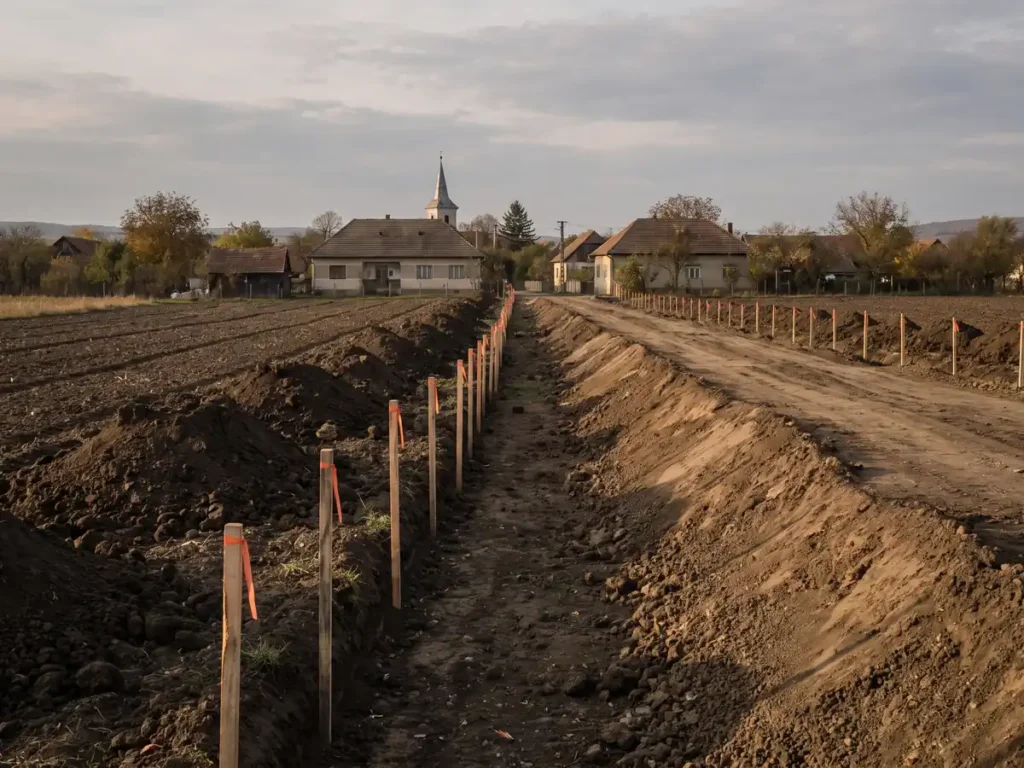
In brief
- The Government is putting another 165,800 lei into the expropriations along the Rădăuți bypass. The money comes from the State budget, through the budget of the Ministry of Transport and Infrastructure, and is added to the 216 thousand lei approved in 2020 for the same corridor.
- Those affected are the owners of 169 entries in Annex no. 2 to Government Decision no. 794/2020. The land lies in the municipality of Rădăuți and in the communes of Volovăț, Horodnic de Jos and Horodnic de Sus, Suceava County. Twenty-three of the entries stood in 2020 under „Proprietar neidentificat”, unidentified owner, and now have a name.
- The annex adds up to 287,214 lei for 30,933 square metres. On the 99 recalculated entries the surface falls by 6,297 square metres against 2020, while the compensation rises by 94,075 lei, so the average price per square metre climbs from 4.78 lei to 11.30 lei.
Published: Official Gazette of Romania (Monitorul Oficial), Part I, no. 825 of 29 September 2026, pages 5-12
In force from: 29 September 2026, the date of publication, because the decision does not itself lay down a later date
The Rădăuți bypass is growing dearer again on the compensation side. By the decision adopted on 24 September 2026, the Government is supplementing by 165,800 lei the sum set aside in 2020 for the land taken from people on the additional site of the road, that is on the strip added in order to move the pipes, the cables and the other utilities. The operation is not a one-off: the same mechanism was used on the motorway between Târgu Mureș and Târgu Neamț, there too with more money for less land.
The decision has four articles and an annex. The first approves the sum. The second rewrites the list in Annex no. 2 to Government Decision no. 794/2020, published in Official Gazette of Romania, Part I, no. 890 of 30 September 2020. The third says how the money moves, and the fourth leaves responsibility for the accuracy of the data with the Ministry of Transport and Infrastructure, through the National Company for Road Infrastructure Administration, CNAIR.
The old list had 233 entries, each with an owner, a parcel and a sum. The new decision amends 99 of them, removes one and adds 70 new entries, which appeared once the cadastral documentation had been drawn up and the original parcels had been subdivided. After these three operations the additional corridor comes to 302 entries and to 381,563 lei, recalculated from the two annexes.
What it changes in practice
The money does not reach the owners directly. The Ministry of Transport and Infrastructure transfers it into a treasury account opened in the name of the National Company for Road Infrastructure Administration, and the individual compensation is paid out from there. The time limit is at most 30 days from the date on which the request for the opening of budget credits is approved, and that approval has, in its turn, a time limit of 30 days from the publication of the decision, under Article 4(8) of the Implementing Rules approved by Government Decision no. 53/2011. Added together, the two time limits take the payment of the sums into the account as far as 28 November 2026 in the slowest case.
For the owner, the procedure for collecting the money remains the one in Law no. 255/2010 on expropriation for a cause of public utility. The list of the properties is posted at the town hall in whose area the land lies and on the expropriator’s website, and from the date of that posting a time limit of 10 days runs, within which the person entitled must lodge the payment claim, together with the documents proving the right of ownership. The verification committee may ask for the file to be completed, in which case the applicant has another 15 days. Once the decision fixing the amount has been issued, payment is made within at most 90 days.
The annex holds 169 rows. Sixty-four are in the municipality of Rădăuți, 37 in Volovăț, 32 in Horodnic de Jos and 36 in Horodnic de Sus. By land-use category, 161 entries are arable land, 7 are pasture and a single one is entered under „curți-construcții”, the yards-and-buildings category. The largest individual compensation is 20,489 lei, at entry 130 of the old list, for three parcels inside the built-up area at Rădăuți. The smallest is 11 lei, at entry 1621 in Volovăț, for 3 square metres.
What has changed compared with the previous situation
The first change is in the money. In 2020 the 233 entries added up to 215,775 lei, and the decision of the time rounded that to 216 thousand lei. The 99 entries the new decision rewrites were worth 121,083 lei then and reach 215,158 lei now. The new entries bring in 72,056 lei, and the deleted entry takes away 343 lei. The net difference is 165,788 lei, that is exactly the 165.8 thousand lei in Article I, with a deviation of 12 lei which comes from rounding to a tenth of a thousand. The figure in the act adds up.
The second change is in the surfaces, and it runs the other way. On the 99 recalculated entries, the land expropriated falls from 25,341 to 19,044 square metres, 24.8% less. Even so, the sum paid for them rises by 77.7%. The average price moves from 4.78 to 11.30 lei per square metre, 2.36 times more. The legal explanation lies in Article 11(7) of Law no. 255/2010: before that committee begins its work, an authorised valuer draws up a new report, for each administrative-territorial unit and for each land-use category. The 2026 report values the land differently from the one of 2020.
The third change concerns the people. In the 2020 annex, 28 entries were listed under „Proprietar neidentificat”. Twenty-three of them are among the 99 rewritten now and have been given a holder: either a person, or the private domain of a town hall. These are people who in 2020 had land inside the corridor and appeared nowhere under their own names.
Lastly, both the route of the money and the budget line have changed. The 2020 decision sent the sums into a bank account, within at most 30 days from the date they were requested. Now the account is a treasury one, and the time limit runs from the approval of the request for the opening of budget credits, that is from a moment later than the mere request. And the sum no longer sits on the same budget position: in 2020 it stood under chapter 84.01 „Transporturi”, transport, sub-chapter „Transport rutier”, road transport, on the article for European funds, whereas now it is entered under sub-item 58.01.03 „Cheltuieli neeligibile”, non-eligible expenditure. In other words, this is money the Romanian State no longer recovers from the European Union.
Advantages and disadvantages
What it improves
- Twenty-three entries which in 2020 stood under „Proprietar neidentificat” are given a holder, so people who appeared nowhere can claim the money in their own name.
- The surface actually taken from owners falls by 6,297 square metres on the recalculated entries, a sign that the route was tightened after the cadastral measurements.
- The compensation is brought to a new valuation, and the average price per square metre more than doubles against that of 2020, which lowers the risk of people ending up in court over sums left behind.
- The sum declared in Article I matches the figures in the annex, with a deviation of 12 lei coming from rounding, so the owner can check the arithmetic himself.
What remains a problem
- The money goes on the budget line for non-eligible expenditure, that is it is borne entirely by the State budget, with no European reimbursement.
- The calendar is asymmetrical: the administration has up to 60 days merely to move the money into the account, while the owner has 10 days to lodge the payment claim, documents and all.
- The annex does not say into which entry entry 188 was merged, the one removed by Article II point 2, and the owner has to work out for himself where his 343 lei from 2020 ended up.
- Four entries change their commune between the two annexes, and the column for built surfaces stays empty on all 169 rows.
Practical advice
- Check the list posted at the town hall in Rădăuți, Volovăț, Horodnic de Jos or Horodnic de Sus and on the website of the National Company for Road Infrastructure Administration. The 10-day time limit for the payment claim runs from the posting, not from publication in the Official Gazette of Romania.
- Look for yourself in the annex by the entry number from Government Decision no. 794/2020, not by the current number. The second column of the new list keeps the old entry number, and the entries added now carry a superscript index, for example 1683.
- Compare the expropriated surface with the one from 2020. If it has fallen, less is being taken from your land, and if the sum has risen, the square metre has been revalued.
- If there are buildings on your land, ask the expropriator in writing for the built surface taken into account. The column in the annex which should have held it is empty.
- Gather the ownership documents in good time, including the certificate of heir if the land comes from an inheritance. The committee may ask for additions, and then you have only 15 days left.
- If the sum seems small to you, you can challenge it in court within the general limitation period, which runs from the notification of the decision fixing the amount. The challenge stops neither the passing of the land into State ownership nor the works.
Frequently asked questions
I own land on the Rădăuți bypass. Do I get the money automatically?
How long before the money is actually in my hands?
In 2020 my land appeared under „Proprietar neidentificat”. What does it mean that my name appears now?
My entry from the old annex has disappeared. What do I do?
Why is more being paid for less land?
Can I refuse the sum and ask for more?
Errors and inconsistencies in the published text
- Article II point 1, set against the annex: four entries change their commune. The article says that the entries listed are amended „în sensul actualizării, în condițiile legii, a suprafețelor construcțiilor, respectiv a categoriei de folosință a terenului și a sumelor individuale aferente despăgubirilor”, that is by updating, under the law, the surfaces of the buildings, the land-use category and the individual sums of compensation, so by a closed list of three elements. In the annex, however, entries 207, 208, 209 and 214 appear in Horodnic de Jos, although in Annex no. 2 to Government Decision no. 794/2020 they were listed in Horodnic de Sus. At entry 214 it is the same owner, Ichim Domnica, and the same total surface, 3,536 square metres, so the same property moved administratively from one commune to the other. The difference is not theoretical: the list is posted at the town hall in whose area the property lies, and from that posting runs the 10-day time limit within which the owner must claim payment. An owner who watches the notice board in Horodnic de Sus has no way of learning that his name has moved to Horodnic de Jos. From the text it cannot be established whether the 2020 annex was wrong and is being corrected silently now, or whether the error is in the new annex.
- The annex, entry 125, the „Extravilan/Intravilan” column, which says whether the land lies outside or inside the built-up area. Current row 53, Torac Gabriela-Amalia, cadastral number 56933, arable land of 5,200 square metres of which 54 are expropriated, with compensation of 657 lei, is the only one of the 169 with nothing written in the classification column. The 2020 list entered it under „Intravilan”. The updating of the land-use category, announced in Article II point 1, has produced here a classification wiped out instead of one brought up to date. Since the price per square metre differs widely between land inside and land outside the built-up area, in the same annex neighbouring entries inside it reach 76.7 lei per square metre while those outside it stand at about 11 lei, the owner cannot check on which grid his sum was worked out.
- The column of built surfaces, set against Article II point 1. The text says that the entries are amended including „în sensul actualizării a suprafețelor construcțiilor”, by updating the surfaces of the buildings, yet the column „Suprafața de expropriat construcții (mp/ml)”, the surface of buildings to be expropriated, is empty on all 169 rows of the annex. This is not a loss in the extraction from electronic format: on the printed page the cells are genuinely blank, while in the 2020 annex the same column carried the value 0 at each of the 233 entries. The case matters at least at entry 61, the only one in the list classed under „curți-construcții”, with 16,412 lei in compensation, the second largest in the annex. The reader cannot establish whether the built surface is zero, is unchanged or was simply left out.
Editorial analysis
The figure worth remembering from this decision is not the one in Article I, but the ratio between it and the surface. On the 99 recalculated entries the State takes 6,297 square metres less than in 2020 and pays 94,075 lei more. The average price climbs from 4.78 to 11.30 lei per square metre, 2.36 times, in six years. For arable land in northern Bukovina, the passage of time explains only part of that increase. The rest comes from the fact that the 2020 valuation started from the notarial appraisals of the day, and the 2026 one from others. The difference lay for six years with the owners who accepted the first offer.
The second observation concerns the place in the budget. Six years ago the sum sat on the article for programmes financed from the European Regional Development Fund, with nothing further said. Now it is placed explicitly on sub-item 58.01.03 „Cheltuieli neeligibile”, that is on the line of expenditure the European Union does not reimburse. The supplement of 165,800 lei is therefore Romanian money in its entirety, and the mechanism repeats itself: supplements of compensation land on the non-eligible line precisely because they go beyond what had been budgeted in the approved project. At 76.8% of the initial sum, the supplement is no longer a correction of detail but almost a second expropriation, paid in full by the Romanian taxpayer.
The third observation has to do with the calendar. The decision enters into force on 29 September 2026. The Ministry of Finance has 30 days to approve the opening of credits, and the Ministry of Transport and Infrastructure another 30 days to move the money into the road company’s account. Almost two months, then, merely for a transfer between two accounts of the State. The owner, by contrast, has 10 days from the posting of the list to lodge the claim with the ownership documents, and if the file is incomplete he is given another 15. The ratio is six to one in the administration’s favour, in an operation in which the administration moves money on paper while the person has to obtain documents from the notary, from the land book and, in inheritance cases, from the court.
Lastly, it is worth saying what does work. The sum declared in Article I closes with the annex: 215,158 lei on the amended entries, minus the 121,083 lei they were worth in 2020, plus 72,056 lei on the new entries, minus 343 lei on the deleted entry, give 165,788 lei, and the act writes 165.8 thousand. The deviation of 12 lei comes from rounding and hides nothing. In the same way, the 169 rows of the annex correspond exactly to the 99 entries amended and the 70 added by Article II, one by one, in order. It is a list done properly, which makes all the more visible the three columns and boxes left unexplained.
What should be changed
- The annex should show the old sum as well, beside the new one. One more column, with the compensation approved in 2020, would let the owner see at a glance by how much his sum has risen and why, without hunting through the Official Gazette of Romania of 2020 and comparing two tables of over two hundred rows.
- The merger should say into which entry the deleted entry goes. Article II point 2 deletes entry 188 „ca urmare a operațiunii tehnice de comasare”, as a result of the technical merging operation, without saying where. The wording „poziția 188 se comasează cu poziția X”, that entry is merged with entry X, would close the matter in a single sentence and spare the owner a deduction from the table.
- The list in Article II point 1 should cover everything that changes in the annex. The text authorises the updating of the built surfaces, of the land-use category and of the sums, but the annex also changes the administrative-territorial unit and the identity of the owner. Adding those two elements to the list would make the amendment verifiable and would put an end to the argument about its basis.
- The change of commune should be flagged explicitly. When a property passes from one town hall to another between two decisions, the act ought to say so in its own terms, and the list ought to be posted, for a time, at both town halls. Otherwise the 10-day time limit runs for a person who is looking at the wrong notice board.
- The owner’s time limit should be brought into line with the administration’s. Ten days for gathering the ownership documents, against 60 for moving money between two budget accounts, is an asymmetry that the nature of the operations does not justify. A 30-day time limit for the payment claim would align the obligations without delaying the works.
- The empty columns should be filled in with zero, not left blank. The 2020 annex entered 0 for the built surface at every entry, while the 2026 one enters nothing. An explicit zero says there is no building, whereas a blank box says nothing at all.
Original text of the legal act
The text below is reproduced in Romanian, the official form of publication.
The full text, as published in the Official Gazette of Romania
Official Gazette of Romania no. 825 of 29 September 2026, pages 5-12 16 pages PDF, 132 KB the act starts on page 5
Open the official PDFDownload the PDF
The viewer is not shown on small screens. Use the buttons above to open or download the file.
This article is for informational purposes only and does not constitute legal advice. For specific situations, consult a licensed attorney or tax advisor.