
In brief
- The State is handing over free of charge the pumping stations and irrigation pipelines at Bărăganu, Brăila County, into the ownership of the two water users’ organisations set up in April 2026.
- The transfer covers 11 items with a combined value of 53,373.89 lei, among them almost 20 kilometres of supply pipeline.
- Ownership passes subject to a resolutory condition: if the organisations fail to meet their obligations under the land reclamation law, the minister can withdraw their ownership within 30 days.
Published: Official Gazette of Romania (Monitorul Oficial) no. 705 of 25 August 2026
In force from: 25 August 2026
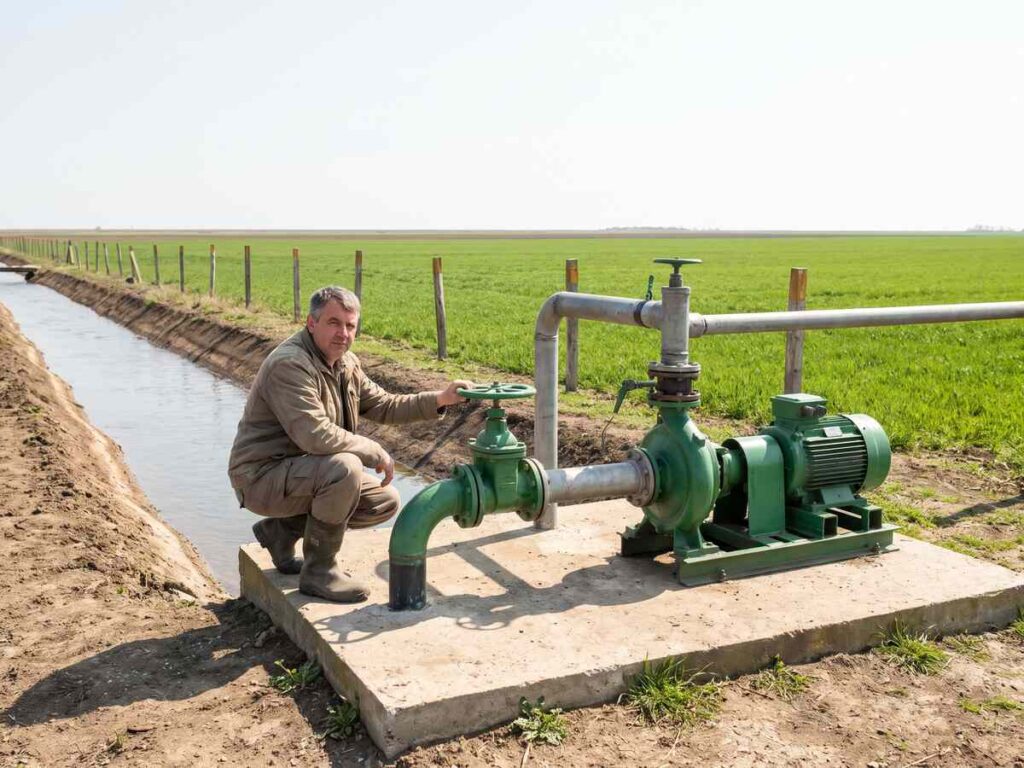
The farmers of Bărăganu are getting, on paper and without paying anything, the pumps and pipes they water their crops with: the State is transferring the secondary irrigation infrastructure to the organisations that already use it. Orders no. 238 and 239/2026 of the Minister of Agriculture and Rural Development, published in Official Gazette of Romania no. 705 of 25 August 2026, approve the passing of these assets out of the private domain of the State and into the ownership of the irrigation water users’ organisations Chiaburu PL 27 and Chiaburu PL 28. It is the same ministry that, earlier this summer, also reworked the system of penalties applied to payment applications at APIA.
The mechanism comes from Article 27 of Land Reclamation Law No 138/2004. The State may transfer secondary irrigation infrastructure free of charge to water users’ organisations, on condition that they maintain it and use it for irrigation.
The two organisations were entered in the National Register of Land Reclamation Organisations on 21 April 2026 and have their seat in the commune of Dudești, village of Tătaru, Brăila County. The assets being transferred, however, lie within the administrative-territorial unit of Bărăganu, in the same county.
What it changes in practice
The first effect concerns the Chiaburu PL 27 organisation. Order no. 238/2026 transfers four assets to it: three pumping stations on platforms 1, 2 and 3 of plot 27, valued at 6,009.00, 5,760.00 and 4,564.40 lei, plus the pipeline feeding the branch lines, 10,476 metres long and valued at 20,207.88 lei. The total comes to 36,541.28 lei.
The second effect concerns the Chiaburu PL 28 organisation. Order no. 239/2026 transfers seven assets to it: three pumping stations at 1,105.05 lei each, three pumping station plots of 34 square metres each, valued at 42.17 lei apiece, and the 9,426 metre supply pipeline, valued at 13,390.95 lei. The total comes to 16,832.61 lei.
The third effect is the condition attached. The transfer is made subject to the resolutory conditions laid down in Article 27(1) of Law No 138/2004, so ownership is not final if an organisation fails to comply with its legal obligations.
The fourth effect is the handover deadline. Delivery and receipt take place in the physical condition existing at the moment the assets are requested, on the basis of a protocol between the interested parties, within 5 days of the orders entering into force.
The fifth effect is an accounting one. The assets of the National Agency for Land Reclamation are reduced by the inventory value of the transferred items, and responsibility for the accuracy and correctness of the figures rests with the agency.
The sixth effect is the sanction. If an organisation is found not to be complying with the obligations under Article 27(1), the Minister of Agriculture approves, on a proposal from the agency, the withdrawal of the ownership right within 30 days of that finding, by applying Article 29^3 of the same law.
The seventh effect is in fact a clarification of ownership. The assets were already in use by these organisations, but they belonged to the State. From 25 August they have an owner of their own, which changes the regime governing maintenance and investment.
What has changed compared with the previous situation
The first change is the holder of the ownership right. Until now, the pumping stations and the pipelines sat in the private domain of the State and were administered by the National Agency for Land Reclamation. From now on they belong to the water users’ organisations.
The second change is one of responsibility. Maintenance and repairs pass to the organisations, and so do investment decisions.
The third change is one of inventory. The agency reduces its assets by 53,373.89 lei, the sum of the two orders.
What does not change is the purpose. The infrastructure remains irrigation infrastructure, and using it for anything else brings withdrawal of the ownership right.
Advantages and disadvantages
What it improves
- Farmers who have organised themselves become the owners of the infrastructure they use, so they can invest in it without an agency’s consent.
- The transfer is free of charge and the inventory values are small, so no significant tax burden arises.
- The State is relieved of maintaining assets it does not use directly.
- The resolutory condition protects the public interest: if the infrastructure is abandoned, the State can take it back.
- The handover deadline is short, 5 days, so the procedure does not stall.
What remains a problem
- Delivery is made in the existing physical condition, with no obligation on the State to repair anything beforehand.
- The inventory values, 42.17 lei for a plot of 34 square metres for instance, are old accounting entries rather than current valuations.
- The organisations were registered in April 2026, so they are taking over the infrastructure with no track record of managing it.
- The annex to the order for PL 28 carries the name of the other organisation and a repeated description, errors that could complicate registration in the land book.
- The orders say nothing about the technical condition of the stations and pipelines being taken over.
Practical advice
- If you are a member of one of the two organisations, ask its management for the handover protocol. The deadline is 5 days from 25 August 2026.
- Check the physical condition of the assets before the protocol is signed. Delivery is made in the existing condition, and repairs are down to the new owner.
- Note the classification codes and the MFP numbers from the annex. They identify each asset in the State records and will be needed when entering the assets in your own accounts.
- If the mismatch over the organisation’s name in the annex to the order for PL 28 comes up, report it to the National Agency for Land Reclamation before starting the formalities.
- Keep in mind the obligations under Article 27(1) of Law No 138/2004. Failing to meet them leads to withdrawal of ownership within 30 days of the finding.
- If you are another water users’ organisation, the procedure is the same: the request to take over is addressed to the National Agency for Land Reclamation, and the transfer is approved by order of the minister.
Frequently asked questions
Who receives the infrastructure?
What exactly is being transferred?
What is it worth?
Is anything paid?
What does a resolutory condition mean?
When does the handover take place?
What happens to the State’s assets?
Errors and inconsistencies in the published text
- The annex to Order no. 239/2026, the column for the beneficiary legal person. It reads „Organizația utilizatorilor de apă pentru irigații Chiaburu PL 27”, the irrigation water users’ organisation Chiaburu PL 27, even though the title of the annex, the title of the order and the tax identification code in the same cell are those of the Chiaburu PL 28 organisation. The annex that establishes who becomes the owner names, in plain words, the other organisation.
- The annex to Order no. 239/2026, item 6. It describes „Teren stație pompare plot 28 platforma 2”, land for the pumping station on platform 2 of plot 28, a wording identical to the one at item 4, even though the series of pumping stations in the same order runs as far as platform 3. The three plots have the same area, 34 square metres, and the same inventory value, 42.17 lei, so the description is the only thing that tells them apart.
Editorial analysis
The mechanism behind the two orders is a sound one and would deserve to be used more often: the irrigation infrastructure that farmers use anyway passes into their ownership, free of charge, while the State keeps a lever of control through the resolutory condition. A canal maintained by the people who use it costs the budget nothing and works better than one administered from a distance.
The problem is not the decision, it is how little the orders say about what is actually being transferred. The inventory values are old accounting entries: 42.17 lei for a plot of 34 square metres and 1,105.05 lei for a pumping station describe nothing of the reality on the ground in 2026. Delivery is made „in the existing physical condition”, without any document recording what that condition is. An organisation set up in April 2026 can therefore take over stations that do not work and, along with them, the legal obligation to maintain them, on pain of losing the ownership right within 30 days of the failure being established.
The two errors in the annex to Order no. 239/2026 are not drafting slips without consequences. The annex is the document on which the handover protocol is signed and the entry in the land book is made. An act that names an organisation other than the one in its own title, and that describes the same plot of land twice, gives the notary and the land book registrar good reason to ask for a correction before registering anything.
What should be changed
- Correcting the annex to Order no. 239/2026. A correction published in the Official Gazette of Romania, setting out the right name of the organisation and telling the three plots apart, would spare the organisation an exchange of letters with the National Agency for Land Reclamation during exactly the 5 days in which the protocol has to be signed.
- A report establishing the technical condition, annexed to the order. If it is set down in black and white what works and what does not at the moment of handover, the organisation knows what it is taking over and the State knows what it can ask back when it checks that the obligations are being met. Without it, „the existing physical condition” can mean anything.
- An explicit statement that the values in the annex are accounting figures, not market ones. These amounts end up in the organisation’s own accounts and can be used as a basis for insurance or for a guarantee. A one sentence note prevents that.
- Cadastral identifiers for the land being transferred. The annex gives only the area and the Ministry of Finance inventory number. The cadastral number and the land book number would turn registration of title into a formality.
- A single order with two annexes, when the transfers are simultaneous and in the same village. The two orders were signed on the same day, for two neighbouring organisations, with the same text. It was precisely the duplication of that text that produced the copying error in the second annex.
- A public register of transfers of secondary infrastructure. Today, the only way to find out what has been transferred and to whom is to read the Official Gazette of Romania order by order. A public list kept by the National Agency for Land Reclamation would show, at any given moment, how much of the secondary network has reached farmers and how much the State still administers.
Original text of the legal act
The text below is reproduced in Romanian, the official form of publication.
The full text, as published in the Official Gazette of Romania
Official Gazette of Romania no. 705 of 25 August 2026 16 pages PDF, 111 KB the act starts on page 2
Open the official PDFDownload the PDF
The viewer is not shown on small screens. Use the buttons above to open or download the file.
This article is for informational purposes only and does not constitute legal advice. For specific situations, consult a licensed attorney or tax advisor.