
In brief
- Romania has reported 30 new sheep pox and goat pox outbreaks to the European Commission, notified between 8 September and 9 October 2026, and the map of restricted zones is being rewritten from top to bottom. The official list of active outbreaks rises from 20 to 49, and the number of counties with protection and surveillance zones goes up from 8 to 11. In Ialomița, Giurgiu, Teleorman and Vrancea the disease appears for the first time, while Vâlcea drops out of the list altogether, because the dates attached to the outbreak there expired on 12 October 2026.
- Deadlines are being pushed back everywhere, and furthest of all in the counties where the disease spread during September. In Constanța the protection zone used to run until 26 September 2026 and now runs until 16 November 2026, 51 days longer. In Tulcea the date moves from 7 October to 19 November 2026, 43 days longer. The restrictions covering the whole territory of 13 counties are extended from 7 November to 10 December 2026, and the areas in Annex II cover 17 counties between 11 December 2026 and 9 January 2027.
- The zones are not described by locality, but by 49 pairs of geographical coordinates and two radii, of 5 and of 20 kilometres. A farmer cannot find out from the text of the decision whether his holding falls inside any of the circles, and the act does not list the actual measures either: those are the ones in Delegated Regulation (EU) 2020/687, applied by the county veterinary directorates. The only practical way of knowing what you are allowed to do remains the county veterinary and food safety directorate.
Published: Official Journal of the European Union, L series, 2026/2321 of 16 October 2026
Who is affected: sheep and goat farmers in 13 counties, hauliers of live animals, slaughterhouses, milk and meat processors, the county veterinary and food safety directorates
Takes effect: 16 October 2026, the date of publication in the Official Journal of the European Union; the decision is addressed to Romania and was notified under document C(2026) 7327
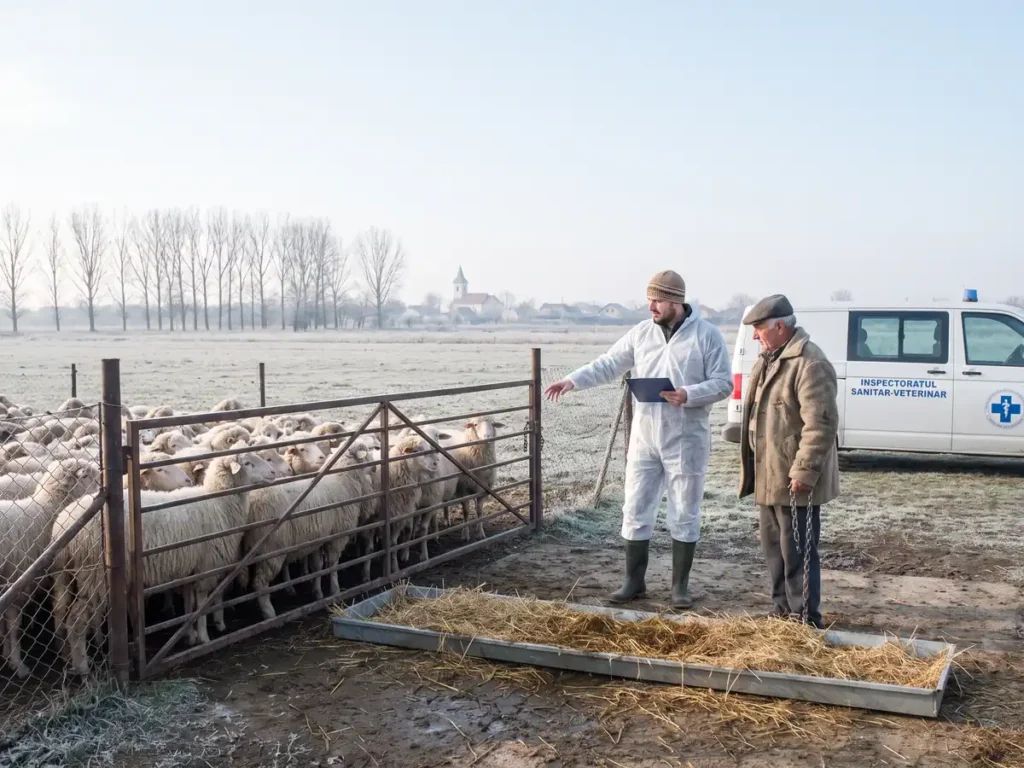
Sheep pox and goat pox is a viral disease that does not pass to humans, but once it reaches a flock it brings the whole machinery of veterinary emergency with it: circles drawn on a map, animals that can no longer be moved, markets and fairs closed, milk and meat that cannot leave the area. In Romania the disease was first confirmed in the spring of 2026, in Mureș. On 16 October 2026 the European Commission published in the Official Journal of the European Union the third restriction map of the year, and it shows a disease that has come down from Transylvania into the whole southern and eastern half of the country.
Implementing Decision (EU) 2026/2321 changes neither the measures nor the rules of the game. Its Article 1 contains a single statement: the Annexes to Implementing Decision (EU) 2026/1108 are replaced by the text in the Annex to the new decision. All that changes is the list: which counties are in, inside which circles, and until when. And the list has grown from 20 outbreaks to 49.
What it changes in practice
Three kinds of zone, three regimes. The mechanism comes from Commission Delegated Regulation (EU) 2020/687, whose Article 21 requires, where an outbreak of a category A disease occurs, the establishment of a restricted zone made up of a protection zone, a surveillance zone and, if necessary, further restricted zones around or adjacent to them. The protection zone is the tight circle, with a radius of 5 kilometres around the outbreak, and it carries the harshest obligations. The surveillance zone is the wide circle, with a radius of 20 kilometres, from which the protection zone is subtracted. The further restricted zones are the whole county territories lying outside those two circles.
The small circle changes character; it does not disappear with the protection zone. Each county in Annex I, Part A has three rows in the table: the 5-kilometre protection zone, the 20-kilometre surveillance zone and, third, the same 5-kilometre circle, but from the day after the protection zone expires. In other words, the lighter measures take the place of the heavy ones, until the date on which the surveillance zone is lifted as well. For a farmer right next to an outbreak, that means two successive regimes, not one that stops abruptly.
The dates, county by county. The 5-kilometre circle applies until 20 October 2026 in Teleorman, 23 October in Giurgiu, 25 October in Buzău, 27 October in Iași, 12 November in Gorj, 16 November in Constanța, 19 November in Tulcea and 22 November 2026 in Brăila, Galați, Ialomița and Vrancea. The surveillance zone is lifted, in every county, exactly 18 days later: 7 November in Teleorman, 10 November in Giurgiu, 12 November in Buzău, 14 November in Iași, 30 November in Gorj, 4 December in Constanța, 7 December in Tulcea and 10 December 2026 in the other four.
On top of the circles come two layers that cover entire counties. Annex I, Part B places the whole territory of the counties of Ialomița, Buzău, Brăila, Iași, Neamț, Gorj, Hunedoara, Teleorman, Tulcea, Constanța, Galați, Giurgiu and Vrancea, excluding the areas inside the circles, under the regime of further restricted zones, until 10 December 2026. Annex II lays out, between 11 December 2026 and 9 January 2027, a second layer of areas, which adds four more counties to those 13: Mureș, Cluj, Bistrița-Năsăud and Vâlcea. The two periods are joined end to end, with no free day in between.
How long it lasts, all told. A farmer inside the 5-kilometre circle in Tulcea goes through the protection zone until 19 November 2026, then through the surveillance zone until 7 December, then through the county-wide further restricted zone until 10 December, and finally through the areas in Annex II until 9 January 2027. From the publication of the decision on 16 October 2026 to the last of those dates there are 85 days.
What the reader will not find in the decision. The act does not say what is actually prohibited. It delimits the zones and sets the dates, while the content of the measures stays in Delegated Regulation (EU) 2020/687, to which Article 1 of Implementing Decision (EU) 2026/1108 and recital (2) of the new decision both refer. In practice, enforcement and control are in the hands of the county veterinary and food safety directorates, and movement authorisations are applied for there.
What has changed compared with the previous situation
The earlier version of the Annexes came from Commission Implementing Decision (EU) 2026/2075 of 10 September 2026, published in the Official Journal of the European Union on 14 September 2026. 32 days separate the two texts, and the differences can be read row by row.
The number of outbreaks. The September 2026 Annex had 20 entries, with ADIS reference numbers from RO-CAPRIPOX-2026-00005 to RO-CAPRIPOX-2026-00024. The new Annex has 49 entries, from 00005 to 00054, without 00009. The arithmetic is exact: the 30 outbreaks notified between 8 September and 9 October 2026 are entries 00025 to 00054, while entry 00009, the only outbreak in Vâlcea, has left the list because its dates expired on 12 October 2026.
The counties. In September the protection and surveillance zones covered Buzău, Iași, Gorj, Tulcea, Vâlcea, Constanța, Brăila and Galați, that is, 8 counties. There are now 11: Vâlcea is out, while Ialomița, Giurgiu, Teleorman and Vrancea are in, four counties in which, according to recital (5), the disease had not been reported before. Two counties account for more than half of the active outbreaks: Tulcea has 15 of the 49 and Brăila 11, together 53 per cent.
The protection zone dates, old against new. Buzău moves from 19 October to 25 October 2026, 6 days longer. Iași, from 16 September to 27 October, 41 days. Gorj, from 19 October to 12 November, 24 days. Tulcea, from 7 October to 19 November, 43 days. Constanța, from 26 September to 16 November, 51 days, the longest extension on the list. Brăila, from 20 October to 22 November, 33 days. Galați, from 13 October to 22 November, 40 days. Each of those extensions passes identically to the surveillance zone, because of the fixed 18-day gap.
The county-wide layers. The further restricted zones used to apply until 7 November 2026 in 12 counties, Vâlcea among them. They now apply until 10 December 2026, 33 days longer, in 13 counties: Vâlcea is out, Teleorman and Giurgiu are in. The areas in Annex II shift by exactly the same 33 days, from the period 8 November to 7 December 2026 to the period 11 December 2026 to 9 January 2027, keeping the same duration of 30 days. Their list grows from 15 counties to 17.
Advantages and disadvantages
What it improves
- The restriction map is redrawn 32 days after the previous version, so the zones track the disease in good time rather than months behind it. The 30 outbreaks notified up to 9 October 2026 enter the act on 16 October, a week after the last notification.
- Vâlcea drops out of every list, including the further restricted zones, so restrictions do not stay stretched over an area where the outbreak has burnt out. The mechanism cuts as well as adds.
- The fixed 18-day gap between the protection zone and the surveillance zone makes the dates predictable: anyone who knows the first date can plan for the second without waiting for a new act.
- The two county-wide layers are joined end to end, with no empty day between 10 and 11 December 2026, so no window opens in which animal movements would be free through a simple drafting slip.
- Decisions of this kind are published in all the official languages of the European Union, and the Romanian version is just as official as the others, so a farmer and a haulier read exactly the same text, not a courtesy translation.
What remains a problem
- The zones are defined solely by geographical coordinates and radii. No farmer can establish his own position from the published text: for the 49 circle centres there is not a single locality, no list of communes and no map annexed.
- The act does not say what is prohibited and what is allowed. The content of the measures sits in another European act, and a reader who opens the decision to find out whether he can take 20 lambs to the slaughterhouse leaves without an answer.
- Two dates in Annex I contradict the protection zones in the same table, in Iași and in Tulcea, and one of them is earlier than the date of publication of the decision. The details are below, under errors.
- Annex II lists 17 counties in the region column and only 16 in the column describing the areas, so a whole county is left with uncertain status for the period from 11 December 2026 to 9 January 2027.
- The Annexes are replaced in full rather than amended point by point, so the version of Implementing Decision (EU) 2026/1108 currently in force can only be reconstructed by opening both the basic act and every amending act.
- Two protection zones expire on 20 and 23 October 2026, that is, four and seven days after publication. Part of what is published is, in practice, almost spent by the time it reaches the reader.
Practical advice
- Check with the county veterinary and food safety directorate whether your holding is in the protection zone, in the surveillance zone or only in the further restricted zone. Ask for the answer in writing: the three regimes carry different obligations, and the coordinates in the act will not tell you on their own which one you are in.
- Remember the date that concerns you, not the nearest one in the news. If you are inside the 5-kilometre circle you have two dates, one for leaving the protection zone and one, 18 days later, for leaving the surveillance zone.
- Do not move sheep or goats out of the zone without prior authorisation from the county veterinary directorate, not even between two holdings of your own. An unauthorised movement inside a restricted zone is precisely the act that the emergency measures penalise.
- Call the veterinarian immediately at any suspicious sign: skin nodules, fever, nasal and ocular discharge, a sudden drop in milk yield. A new outbreak enters the next amendment of the Annexes and extends the dates for all the neighbours, not only for the affected holding.
- If you supply milk or meat, ask the processor and the slaughterhouse in writing which documents they will require from you for the restriction period. Supply chains seize up more often over a missing document than over the prohibition itself.
- Hauliers of live animals should check their route against the 13 counties in Annex I, Part B and against the 17 counties in Annex II: the county-wide restrictions apply outside the circles too, until 10 December 2026 and 9 January 2027 respectively.
- Keep a record of losses, of animals killed and of cancelled deliveries, with dates and documents. Compensation for animals removed under disease control measures is claimed on the basis of records, and rebuilding them a few months later is far harder.
Frequently asked questions
Can sheep pox and goat pox be passed to humans?
How do I find out whether my farm is in a restricted zone?
Which counties are concerned?
How long do the measures apply?
Does the decision say what I may do with my animals?
Why does Vâlcea still appear, but only in Annex II?
How often do these Annexes change?
Errors and inconsistencies in the published text
- Annex I, Part A, Iași County, the third row of the surveillance zone. The period entered is “28.9.2026-14.11.2026”, even though the protection zone over the same 5-kilometre circle applies until 27 October 2026, according to the first row for the same county. It follows that between 28 September and 27 October 2026 the same areas are simultaneously a protection zone and a surveillance zone, under two different sets of measures, and that the start date precedes the publication of the decision. In the other ten counties in the table the period begins without exception on the day after the protection zone expires, so the expected entry was 28.10.2026.
- Annex I, Part A, Tulcea County, the third row of the surveillance zone. The period entered is “20.10.2026-7.12.2026”, even though the protection zone over the same circle applies until 19 November 2026. Here the overlap of the two regimes lasts a full month, and the expected entry, following the same pattern used throughout the table, was 20.11.2026.
- Annex II, the region column against the areas column. The region column lists 17 counties, Hunedoara among them, while the column describing the areas lists only 16 and does not include Hunedoara. The county does appear both in the region column and in the enumeration in Annex I, Part B. It cannot be established whether the whole territory of Hunedoara County falls under the measures in Annex II between 11 December 2026 and 9 January 2027.
Editorial analysis
The decision does what a veterinary emergency act has to do: it tracks the disease with a one-week lag behind the last notification and cuts restrictions where the outbreak has burnt out, as the complete exit of Vâlcea County shows. Its problem is not speed. It is written for the administration, not for the people who bear the measures. An act that binds farmers in 13 counties identifies them through 49 pairs of coordinates and two radii, without a single locality, and never once says what becomes prohibited. The reader who keeps sheep in Tulcea and wants to know whether he can deliver to the slaughterhouse closes the text exactly where he opened it.
Checking the lists also reveals a mismatch between the reasoning and the Annex. Recital (5) states that the 30 new outbreaks are in the counties of Brăila, Buzău, Constanța, Giurgiu, Gorj, Ialomița, Iași, Teleorman, Tulcea and Vrancea, ten counties. Comparing the two Annexes, however, does not come out at ten: the September 2026 Annex had ADIS entries from 00005 to 00024, so 20 outbreaks, while the new one has 49, from 00005 to 00054, without 00009. The entries added are exactly those from 00025 to 00054, and among them is RO-CAPRIPOX-2026-00051, in Galați County. That gives eleven counties with new outbreaks, not ten. The difference changes no obligation, since the protection zone in Galați is established by the Annex in any case, but a reader who counts the affected counties from the recital arrives at a different figure from one who counts them in the table.
The second point that emerges only from the arithmetic is how regular the dates are. In all eleven counties the surveillance zone is lifted exactly 18 days after the protection zone, without a single exception. The gap is therefore a formula, not a case-by-case assessment, and that is precisely why the two wrong dates in Annex I, in Iași and in Tulcea, stand out: both are month errors, 9 instead of 10 and 10 instead of 11, and both open a period in which the same ground sits under two regimes at once. A formula written as a formula, “the day following the date in the first row”, could not have been mistyped.
The third thing visible only through comparison is the relationship between the pace of the administration and the pace imposed on the farmer. The European Commission has rewritten the Annexes twice in 32 days, and each rewrite extends the dates by between 6 and 51 days. For a farmer in Constanța, the protection zone was due to be lifted on 26 September 2026 and will now be lifted on 16 November, 51 days later, without any new outbreak on his holding. At the same time, two protection zones in the new Annex, those in Teleorman and Giurgiu, expire four and seven days after publication, so the information reaches its addressee almost after it has spent its effect. An instrument updated every month needs, if it is to be of use, a channel of information updated every day, and the European act does not create one.
What should be changed
- A list of localities alongside the coordinates. Each circle in Annex I should be accompanied by the communes it covers, as is done in other lists of zones. In practice the farmer would learn his position from the act rather than from a telephone call to the county directorate, and the haulier could plan a route without seeking confirmation county by county.
- Correction of the two dates in Annex I, for Iași and for Tulcea. Replacing them with 28.10.2026 and 20.11.2026 removes a month in which the same 5-kilometre circle is, on the letter of the act, a protection zone and a surveillance zone at once. The county authority would no longer have to choose between two contradictory regimes, and anyone penalised would no longer have a defence built on the obscurity of the text.
- Completion of the areas column in Annex II with Hunedoara County, or its removal from the region column. That would close the uncertainty over a whole county for the period from 11 December 2026 to 9 January 2027, the stretch with the heaviest animal movements before the holidays.
- Writing the gap as a rule, not as a date. The third row for each county should read “from the day following the date set out in the first row”, instead of repeating a date calculated by hand. The kind of error that appeared in Iași and Tulcea would become impossible, and the table would get shorter.
- Simultaneous publication of the consolidated version of Implementing Decision (EU) 2026/1108. The Annexes are replaced in full rather than point by point, and Annex II refers to Article 1b of the basic decision, a text reproduced nowhere in the amending decision. The reader of the act published on 16 October 2026 would then see what obligations apply, without reassembling the text from three pieces.
- Naming the new outbreaks in the recital by their reference numbers. The enumeration of counties has proved incomplete, and the ADIS numbers are in the Annex in any case. Comparing two successive versions of the Annexes would become verifiable by anyone, and the number of active outbreaks would no longer depend on a count of one’s own.
Original text of the legal act
The text below is reproduced in Romanian, the official form of publication.
The full text, as published in the Official Gazette of Romania
Official Journal of the European Union, L series, 2026/2321 of 16 October 2026 11 pages PDF, 556 KB
Open the official PDFDownload the PDF
The viewer is not shown on small screens. Use the buttons above to open or download the file.
This article is for informational purposes only and does not constitute legal advice. For specific situations, consult a licensed attorney or tax advisor.