
In brief
- Craftspeople and artisans can receive a free stand at the National Fair for Handicrafts and Crafts (Târgul Național pentru Artizanat și Meșteșuguri), plus 2,500 lei for accommodation and travel, and the places are allocated in the order of registration, not on the basis of any score. Registration is electronic only, within a window that opens at 10:00 on the first day and closes at 20:00 on the last, with the possibility of extension until the places run out. The money is transferred only after the fair, on the basis of a reimbursement claim and of the record of attendance, and being absent on a single day of the fair means losing the entire amount.
- Who is affected. Small and medium-sized enterprises with wholly private capital, cooperative societies, including mixed craft cooperatives, authorised self-employed persons, individual enterprises and family enterprises, professional associations and foundations, all registered and active in Romania, with an activity in crafts, folk art or handicrafts. A cooperative, an association or a foundation may register a maximum of 10 exhibitors, each with their own 2,500 lei. Primary production in fisheries, aquaculture and agriculture, certain forms of processing and marketing of agricultural and fishery products, and export-related aid all remain outside the scheme.
- The figures and deadlines that matter. The budget for 2026 is 1 million lei, for around 100 beneficiaries, an average of 10,000 lei per beneficiary, of which only 2,500 lei reaches them in cash. The de minimis ceiling invoked is 300,000 euro over three years at the level of the single undertaking. The agency checks the documents within 5 working days, a request for clarification is answered within 2 days, an appeal is lodged within no more than 2 calendar days of receiving the rejection and is settled within 3 working days, and the reimbursement claim is submitted within a maximum of 10 working days of the close of the fair. The scheme remains valid until 31 December 2027, with payments until 31 December 2028.
Published: Official Gazette of Romania, Part I, no. 836 of 2 October 2026, pages 2-16
In force from: 2 October 2026, the date of publication, because the order does not set a later date
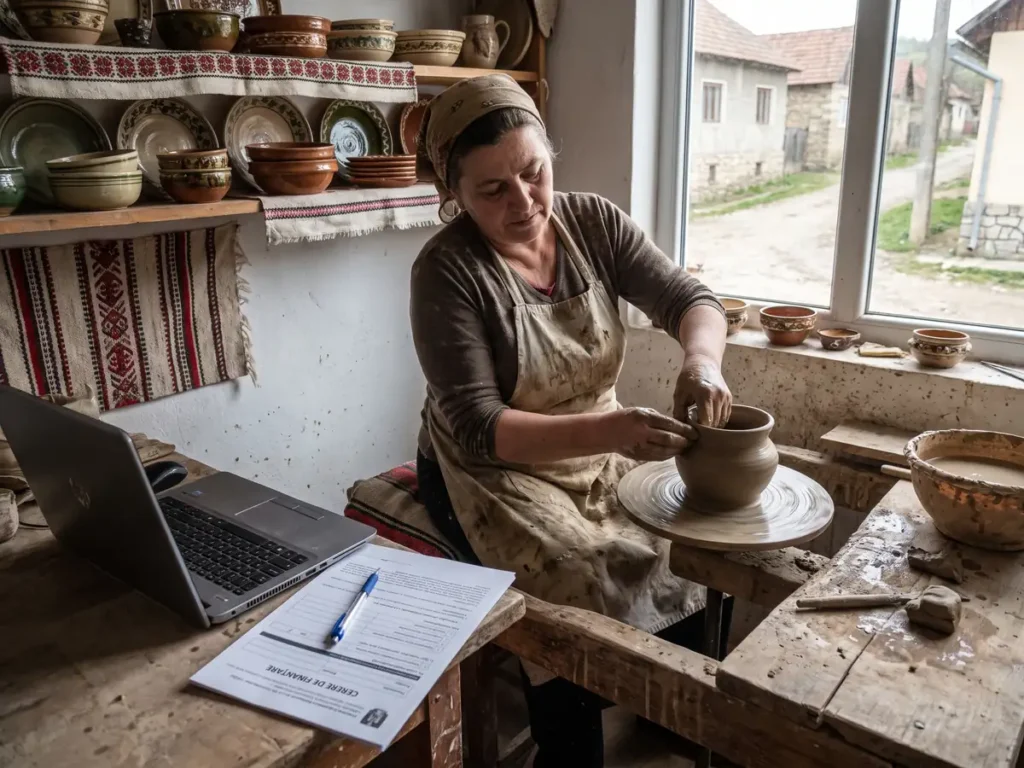
A potter from Horezu, a weaver from Maramureș or an egg-painting workshop from Bukovina can get to the largest craft fair organised by the State free of charge, with their products, and can collect 2,500 lei for travel and accommodation. Order no. 1.577/2026 of the Minister of the Economy, Digitalisation, Entrepreneurship and Tourism, published in the Official Gazette of Romania, Part I, no. 836 of 2 October 2026, says who is entitled, which documents have to be uploaded and, above all, that the places are shared out in the order of registration. This is the second de minimis aid scheme for small companies to reach the Official Gazette in less than a week, after the one through which the State covers 75% of the cost of the cyber security assessment of small companies. The difference in mechanism is instructive: there, co-financing is required and the application is submitted by a consortium; here, no own contribution is required, but the place goes to whoever presses the button first.
The programme itself is not new. It exists as a multiannual programme of the Ministry of the Economy, Digitalisation, Entrepreneurship and Tourism (MEDAT), run through the agencies for small and medium-sized enterprises and tourism, and each edition receives its own implementing procedure. What is being approved now is the procedure for the 2026 edition, with a budget of 1 million lei and an estimate of 100 beneficiaries.
The content of the programme is a single event: the National Fair for Handicrafts and Crafts, held over a minimum of 3 and a maximum of 5 days. The dates and the venue are not in the order; they are posted on the ministry’s website and on that of the organising agency before the event. In 2026 the organiser is the Agency for Small and Medium-Sized Enterprises and Tourism in Ploiești, which is at the same time the provider of the aid, the administrator of the scheme, the verifier of the applications and the host of the committee that settles appeals.
What a beneficiary actually receives is two things. The first is free participation in the fair, that is, the stand and everything that goes with the organisation, from fitting out and utilities to promoting the event. The second is a lump sum of 2,500 lei per beneficiary, for their accommodation and for transporting them and their products to the event and back. The amount is fixed, not a budget of expenditure proven with documents: under the expenditure plan, the registration form asks for exactly the same figure, 2,500 lei of eligible value.
For the organisations that represent craftspeople the rule is different, and more generous. A cooperative society, including a mixed craft cooperative, a professional association or a foundation may apply on behalf of its members and may register up to 10 exhibitors, each with their own 2,500 lei. At the maximum, a single organisation can draw 25,000 lei out of the scheme.
The eligibility conditions are checked at the date of electronic registration and all of them have to be met: wholly private share capital, classification as a small or medium-sized enterprise under Law no. 346/2004, an activity connected with producing, marketing or promoting hand-made products, registration and activity on Romanian territory, a form completed in the electronic application together with the documents required, and not having reached the de minimis ceiling of 300,000 euro over the last three years at the level of the single undertaking. The ceiling comes from Commission Regulation (EU) 2023/2831, which in Article 3(2) sets precisely that value, 300,000 euro, for any three-year period, whatever the form of the aid and whether the money is national or European.
The application is a list of eight items, all uploaded online: the standard participation request, the declaration on the State aid and de minimis aid received, the declaration of classification as a small or medium-sized enterprise with the calculation annex for partner or linked enterprises, the declaration that there are no debts to the general consolidated budget, a copy of the identity document of the legal representative and of the craftsperson who will exhibit, the power of attorney if someone else signs, at least three photographs of products, and the declaration that the company has no aid declared unlawful to repay. Once registration closes, the list of applicants is published on the agency’s website.
Next comes the check, carried out by the programme implementation unit within the agency, within 5 working days of the list being posted. The agency may ask for clarification, with a response deadline of 2 days. Rejected applications receive a rejection letter on four possible grounds: incorrect documentation, information not matching reality, eligibility criteria not met, or an activity and products that fall outside the scope of the programme. Those accepted receive a letter by email, and the list of those admitted and those rejected is published, keeping the order of registration.
An appeal is lodged with the agency, through the application or by email, within no more than 2 calendar days of receiving the rejection letter, and is settled within 3 working days by a committee set up within the same agency. Beyond that step, the only route left is the one in the Administrative Litigation Law no. 554/2004.
The money comes at the end. The standard reimbursement claim is submitted to the organising agency within a maximum of 10 working days of the close of the fair, and the substantive condition is presence throughout the event. The text is categorical: absence on any of the days of the fair leads to the amount not being granted. Payment is made into the treasury account containing the group of digits 5070 or, for those who cannot open such an account, into a commercial bank account. The aid is deemed granted when both parties sign the record of attendance at the fair, not when the application is approved and not on the date of payment.
What it changes in practice
The first effect is that the clock becomes a selection criterion. The procedure contains no scoring formula, no grid for assessing the products and no tie-breaking criterion in the event of excess demand. Photographs of at least three products are required, but they are not marked: they serve to verify that the applicant does what they declare, with no role in the ranking. The only ordering rule is the sentence in point 8.4, „admission to the Programme will be made in the order of registration”, reinforced by the obligation to publish the lists „keeping the order of registration in the Programme”. For a craftsperson without a good internet connection, or without someone to sit at a computer on the first day at 10:00, that is a real filter.
The second effect is that the financial risk sits entirely with the beneficiary until the last day of the fair. The 2,500 lei are not paid as an advance: they are reimbursed after the event, and payment hangs on uninterrupted attendance. A craftsperson who packs up their goods, closes the workshop and travels to another town for three to five days pays for the journey, the accommodation and the meals out of their own pocket, and if on one of those days they fall ill or have to leave, they lose the whole amount. Neither force majeure nor partial reimbursement appears in the text of the procedure.
The third effect is the consumption of the de minimis ceiling. Participation is recorded at the level of the single undertaking and counts towards the 300,000 euro over three years, checked on the basis of a declaration made on the applicant’s own responsibility. The practical problem is how much exactly is consumed. The registration form records a value of the non-repayable financial allocation of no more than 2,500 lei, but the beneficiary also receives free participation, which is just as much an economic advantage. Nowhere in the procedure is it said how the stand is to be valued, so a craftsperson who has other funding as well cannot work out on their own how much room is left under the ceiling.
The fourth effect concerns the organisations. With 10 exhibitors allowed to each of them and an estimate of 100 beneficiaries, ten well-organised cooperatives or associations could in principle take up the entire estimated population of the scheme. No place is reserved for individual applicants, and the share of organisations in the total is not capped. Anyone applying alone competes, on the same chronological list, with entities that register ten applications.
The fifth effect shows up in the administration’s calendar, not in the applicant’s. The scheme has to be uploaded into the Electronic Register of State Aid Granted in Romania within no more than 10 working days of entry into force, that is, by 16 October 2026, and it has to be sent for information to the Competition Council within 15 days of adoption, that is, by 13 October 2026. The contracts enter the register within 7 working days of signature, and the records are kept for ten years, by the provider as well as by the beneficiary. A craftsperson who collects 2,500 lei is left, formally, with an archiving obligation until 2036.
What has changed compared with the previous situation
The previous edition of the same programme was governed by Order no. 2.193 of 27 October 2025 of the same ministry, published in the Official Gazette of Romania, Part I, no. 995 of 29 October 2025, with the procedure in the bis edition of the same issue. Before it came Order no. 2.731 of 19 August 2024, at the time of the Ministry of the Economy, Entrepreneurship and Tourism, published in the Official Gazette of Romania, Part I, no. 834 bis of 21 August 2024.
The first change, and the only one visible in money, is the budget: 900,000 lei in 2025, 1 million lei in 2026, an increase of 11.1%. The estimated number of beneficiaries has stayed at 100 in both editions, so the average amount per beneficiary rises from 9,000 to 10,000 lei. The lump sum per exhibitor has not moved: it was 2,500 lei in 2024 and in 2025, and it stays 2,500 lei now. For someone who paid for their own journey in 2024, the inflation accumulated since then is recognised nowhere in the text.
The second change is the move of the agency. In 2025, the provider, the administrator of the scheme and the organiser of the fair were the Agency for Small and Medium-Sized Enterprises and Tourism in Brașov, and appeals were addressed to Brașov. In 2026 all these roles pass to the agency in Ploiești. An applicant who has taken part before has to remember that the address, the email and the appeals committee are different, even though the telephone number of the contact centre, 021-9059, is the same for all three agencies.
The third change is one of visibility, and it works in the reader’s favour. The 2024 and 2025 procedures were published in bis editions, which are harder to find and do not enter the current numbering. The present procedure takes up pages 2 to 16 of issue 836, an ordinary edition.
Otherwise the text has stayed almost identical. The ceiling of 300,000 euro, the limit of 10 exhibitors per organisation, the 2 calendar days for an appeal, the 3 working days for settling it, the validity of the scheme until 31 December 2027 and the payments until 31 December 2028 are all found word for word in the 2025 edition. So is the budget estimate for the „2024-2027 period”, of 4 million lei, which was written for the first edition and has not been updated since. None of the three orders repeals the one before it.
Advantages and disadvantages
What it improves
- No co-financing is required. Unlike the de minimis schemes in which the beneficiary puts up part of the money, here participation is free and the 2,500 lei are added on top, they do not top anything up. The „co-financing percentage” field in the registration form is marked „where applicable”, and the procedure describes no case in which it would be.
- The application is short and contains no documents from third parties. Seven of the eight documents are the applicant’s own declarations, copies of identity documents or photographs. No tax clearance certificate is required, only a declaration on the applicant’s own responsibility that there are no debts to the general consolidated budget, which spares the applicant a trip to the tax office and its own deadlines.
- The amount is a lump sum, so it calls for no supporting invoices. It is claimed with a standard request and a record of attendance. Someone who sleeps at a relative’s house in the town of the fair and comes in their own car has nothing to prove and runs no risk of having an invoice rejected.
- Organisations can bring the craftspeople who have no company of their own. The possibility for a cooperative, an association or a foundation to register up to 10 member exhibitors opens the programme to folk artists who are not registered as economic operators but are members of a structure that is.
- The administration’s deadlines are short and written down. Five working days for the check and three for an appeal are short deadlines for a public funding procedure. If they are observed, less than two weeks pass from the close of registration to the final list.
What remains a problem
- There is no assessment of the craft itself. A workshop practising a dying technique and a trader who merely „promotes products with a traditional character” go onto the same list, separated by the second at which they registered. The objective declared in point 1.3, protecting the trades with many manual operations, has no instrument at all in the selection part of the procedure.
- The rural objective has no lever. Point 1.3 says that the programme is aimed at small craftspeople „especially in rural localities”. No reserved place, no quota and no geographical criterion appears in the chapters on eligibility and selection. Electronic registration at exactly 10:00 favours precisely the environment with the better internet.
- Being absent for one day costs the whole amount. Attendance throughout the fair, between 3 and 5 days, is a condition of reimbursement, with no exception for illness or force majeure and with no pro rata payment. A craftsperson who leaves on the last day loses 2,500 lei for which they stood for four.
- The 2 days for an appeal can be used up over a weekend. The deadline is measured in calendar days, not working days. A rejection letter received on a Thursday leaves a deadline that expires on Saturday, and one received on a Friday expires on Sunday. The administration, in the same procedure, takes 3 working days to reply.
- The appeal is judged in the house of the body that rejected it. The settlement committee is set up within the same agency to which the unit that issued the rejection belongs, and the number of its members and its powers are determined by the agency’s director general. No check from outside the institution intervenes before the administrative litigation court.
- The dates and the place of the fair are not in the act. The period, the venue and the opening date for registration are announced on the website. Anyone who wants to secure a place has to follow a web page, not the Official Gazette, even though their right arises from a normative act.
Practical advice
- Have the complete application ready before registration opens. The window begins at 10:00 on the first day, admission is in the order of registration, and all eight documents are uploaded into the application at the moment the form is submitted. A missing document in the first hour means a lost place, not a deadline for completing the file.
- Follow the agency’s page and the ministry’s for the opening date. The procedure requires it to be announced on the website „before the date on which the registration process proper begins”, without saying how long before, so the preparation window may be short.
- Take the photographs of the minimum three products in advance, in good light and against a clean background. They are not marked, but they are the only evidence the verifier sees that your products fall within the definition in the procedure, and an application rejected because the activity „does not fall within the scope of the programme” has to be appealed within 2 calendar days.
- Work out your de minimis ceiling before you declare it. The declaration in Annex no. 3 covers the last three financial years, including the current one, at the level of the single undertaking, that is, including the companies to which you are linked through control or voting rights. An omission here is not a simple mistake: the procedure allows payment to be stopped and the aid to be recovered with interest if the information turns out to be incorrect.
- If you are a partner or linked enterprise, ask the agency in writing to confirm which financial year you are filling in the tables in Annex no. 4.2 for. The published forms carry the note „Reference period, year 2023”, while point 8.5 letter c) asks for the data for the previous financial year. A question asked before you upload is settled in two days; the same uncertainty discovered during the check costs you the application.
- If you are a member of a cooperative, a professional association or a foundation, ask whether the organisation is registering a group. It can apply for up to 10 exhibitors, and each of them receives their own 2,500 lei, so one collective application lodged in the first hour is faster than ten individual ones.
- Block out all the days of the fair in your calendar, including the last one. The amount is not reimbursed pro rata, and the record of attendance is the document that makes the aid granted. Arrange a stand-in as well, but first check with the agency whether a person other than the declared exhibitor is accepted, because the form asks for the exhibitor’s name and identification details.
- Open the treasury account containing the group of digits 5070 in good time, or make clear that you cannot open one. Reimbursement is made into this account, and the commercial bank option is reserved for those who, under Government Emergency Ordinance no. 146/2002, have no access to the treasury.
Frequently asked questions
How much do I actually receive?
Do I have to put in money of my own?
How are the participants chosen?
Can I take part if I am an authorised self-employed person or have an individual enterprise?
What happens if I miss one day of the fair?
How long does an application wait and what do I do if it is rejected?
Does this amount use up my de minimis aid ceiling?
When am I considered to have received the aid?
How long does the scheme run?
Errors and inconsistencies in the published text
- Point 6(7), the reference to Regulation (EU) 2023/2832. The paragraph limits cumulation with the de minimis aid under Regulations (EU) No 1408/2013 and No 717/2014 „to the relevant ceiling laid down in Article 3(2) of Regulation (EU) 2023/2832”. Article 3(2) of Regulation (EU) 2023/2832 sets 750,000 euro, however, and concerns exclusively undertakings providing services of general economic interest. The regulation the scheme applies is 2023/2831, and Article 5(2) of that regulation refers to „Article 3(2) of this Regulation”, that is, to the ceiling of 300,000 euro. The wrong reference is not harmless, because the article cited does exist and contains a figure two and a half times higher than the one that point 5(1) letter f), point 6(2) and (3) and point 11.6(1) repeat four times in the same text. An applicant with de minimis aid in agriculture or fisheries can read, in good faith, two different ceilings for the same situation. The same reference also appears in the 2025 procedure, so the defect is reproduced for the second year.
- Annexes nos. 4.1 and 4.2, the reference year for classification as a small or medium-sized enterprise. Point 8.5 letter c) asks for the declaration of classification „for the previous financial year”, and note 2 of Annex no. 4.1 says that the data are those „achieved in the last financial year”. The three tables in Annex no. 4.2, including the partnership sheet and the sheet on the link between enterprises, carry at the top the note „Reference period, year 2023”, verified on pages 12, 13 and 14 of the edition, so it is not an extraction error. Since the totals from Annex no. 4.2 have to be transcribed into the table in Annex no. 4.1, the result is that an autonomous enterprise declares the financial year just ended, that is, 2025, while a partner or linked enterprise declares 2023, on the same eligibility criterion and in the same application. Classification as a small or medium-sized enterprise is an eligibility condition under point 5(1) letter b), and the note in Annex no. 2 warns that any change to the content of the forms compared with the version published in the Official Gazette leads to the funding being rejected. The year 2023 was correct in the 2024 procedure, for which it was indeed the previous financial year, and it has stayed unchanged in 2025 and in 2026.
Editorial analysis
The real problem the act addresses is one of distribution, not of production: a craftsperson who makes knotted rugs or decorates eggs sells their goods in their own village, at village prices, and has neither the money, nor the time, nor the commercial skills to reach a public that pays differently. A national fair paid for out of the public budget, with a free stand and the journey covered, is exactly the right instrument for that problem, and the procedure is written simply enough for someone without a consultant to read it to the end. An application of eight items, seven of which are the applicant’s own declarations, is a rarity in Romanian public funding.
The scale of the problems begins, however, where the good intentions end, and it is clearest if we divide the budget by the beneficiaries. The million lei allocated for 2026 and the 100 estimated beneficiaries give 10,000 lei per beneficiary. Of that, 2,500 reaches the craftsperson’s pocket, that is, 25%. All 100 beneficiaries taken together receive 250,000 lei in cash, a quarter of the scheme; the remaining 750,000 lei goes on the organisation, and the list in point 2.5 shows on what exactly: television and radio advertising, the visual identity of the event, a video spot, promotion on social media, fees for trainers, hospitality expenses, artistic performances. None of these items is illegitimate for a fair, but the ratio of three to one between what the shop window costs and what the exhibitor receives deserves to be said out loud, all the more so as the lump sum has not moved from 2,500 lei either in 2024, or in 2025, or now.
The second observation comes from putting two points of the procedure side by side. Point 1.3 declares that the programme seeks to strengthen the class of small craftspeople „especially in rural localities”, while point 8.4 provides that admission is in the order of electronic registration, within a window that opens at 10:00. Between the objective and the mechanism there is no connection at all: no place is reserved for rural areas, there is no quota, no tie-breaker and no alternative to online registration. A criterion of speed on a web platform predictably selects those with a good connection and someone free at a computer on a working morning, that is, precisely those who need the programme least. The same tension appears between the objective of protecting the trades with many manually executed operations and the fact that, under point 5(1) letter c), anyone who merely „promotes” products with a traditional character is eligible too.
The third observation concerns the asymmetry of the deadlines, and it is simple arithmetic. A rejected applicant has 2 calendar days to appeal. The committee has 3 working days to reply, and checking the application takes 5 working days. A rejection letter received on a Thursday leaves a deadline that lapses on Saturday, one received on a Friday lapses on Sunday, so the deadline can in fact be zero working days. For a craftsperson who does their own paperwork, between the workshop and the fair, the difference between „calendar” and „working” is not a drafting detail but the very possibility of defending themselves. On top of that, the appeal is judged by a committee set up within the same agency to which the unit that rejected the application belongs, with its membership determined by the agency’s director general, so the only check from outside the institution is the administrative litigation court, where the deadlines are measured in months, not in days.
The fourth observation concerns the legislative hygiene of the series. The present procedure is the third edition of the same programme in three years, and none of the three orders repeals the one before it. All three say, in the same point 3.1, that the scheme is valid until 31 December 2027. Formally, three procedures of the same programme thus coexist in the Official Gazette, with three different organising agencies and different annual budgets, all with a validity date in the future. Article 64(1) of Law no. 24/2000 requires provisions contrary to a new regulation of the same level to be repealed, and here that has not been done in any of the three editions. The signs of copying show in the figures as well: the estimate in point 3.3, of 4 million lei for the „2024-2027 period”, was written for the first edition and has not been touched since, even though 1 million lei was actually allocated in 2024 in that period, 900,000 in 2025 and a million now, that is, 2.9 million lei, which would leave a remainder of 1.1 million lei for 2027 that nothing in the text confirms. The same category includes Competition Council opinion no. 9.202 of 16 July 2024, invoked in the preamble: 804 days passed between it and the signing of the order, on 28 September 2026, and the budget of the scheme changed twice in the meantime.
What should be changed
- The order should expressly repeal the previous procedure. A single sentence in the operative part, repealing Order no. 2.193/2025, would close the overlap of the three procedures that all declare themselves valid until 31 December 2027. The practical effect: an applicant looking for the applicable rule would find one text, not three, and an agency could not invoke a provision from the old edition.
- The reference year in the annexes should be replaced with a formula. Instead of the fixed note „year 2023” it should read „the last financial year ended”, as in note 2 of Annex no. 4.1. In practice, the contradiction between point 8.5 letter c) and the published forms disappears, and the annexes no longer have to be corrected at every edition.
- The reference in point 6(7) should be corrected to Regulation (EU) 2023/2831. Article 5(2) of the regulation the scheme applies refers to its own ceiling, of 300,000 euro. In practice, an applicant with de minimis aid in agriculture or fisheries no longer has two possible ceilings in the same document.
- The value of the free participation should be expressed in money. If the stand and the organisation are de minimis aid, and they are, the beneficiary has to know by how much their ceiling is reduced. A unit value per exhibitor, set in the procedure or communicated when the aid is granted, would allow anyone to work out for themselves how much room is left under the 300,000 euro before they apply for other funding.
- The appeal deadline should be in working days and at least equal to the committee’s. Three working days for the applicant, the same three the committee takes, would take the weekend out of the equation and would remove the situation in which someone rejected on a Friday has, in fact, zero working days available.
- The rural objective should be given a lever or taken out of the text. Either a share of the places is reserved for applicants based in rural localities, or an assisted registration route is allowed at the county agency’s counter, or the phrase „especially in rural localities” in point 1.3 is dropped. A declared objective without an instrument guides no decision and, in exchange, makes the programme look fairer than it is.
- The overlap between the organiser’s expenditure and the lump sum should be settled. Under point 2.5, the programme budget may bear „expenditure relating to the travel and accommodation of artisans and craftspeople”, while under point 4.2 the same cost is covered by the lump sum paid to the beneficiary. A sentence saying that the two are not cumulative for the same exhibitor would close a double-funding loophole that the text leaves open.
- The lump sum should be indexed. The amount has stayed the same since 2024 and covers three to five nights of accommodation, the return journey and the transport of the goods. An annual updating formula, tied to a public index, would spare the procedure from restarting each edition with a figure that is losing its purchasing power.
Original text of the legal act
The text below is reproduced in Romanian, the official form of publication.
The full text, as published in the Official Gazette of Romania
Official Gazette of Romania no. 836 of 2 October 2026, pages 2-16 16 pages PDF, 114 KB the act starts on page 2
Open the official PDFDownload the PDF
The viewer is not shown on small screens. Use the buttons above to open or download the file.
This article is for informational purposes only and does not constitute legal advice. For specific situations, consult a licensed attorney or tax advisor.