
In brief
- The cap on commercial mark-ups for 17 basic foods, introduced by Government Emergency Ordinance no. 67/2023, applies until 30 June 2027 inclusive; the deadline in force until now was 31 December 2026.
- Retailers may add a mark-up of at most 20% in retail and cash & carry sales, and distributors at most 5% cumulatively across the whole chain, on products such as white bread, milk, eggs, cooking oil, sugar, chicken and pork, and loose vegetables and fruit.
- Imports of wheat, maize, rapeseed and sunflower seeds, flour, sugar, eggs and chicken meat from Ukraine remain subject to the approval of the Ministry of Agriculture until 31 December 2027.
Who is affected: consumers, food shops and distributors, issuers of meal, gift and social vouchers, and companies that import agricultural products from Ukraine.
The commercial mark-up on bread, milk, eggs, cooking oil and other basic foods stays capped for another six months. Government Emergency Ordinance no. 46 of 26 November 2026, published in Official Gazette of Romania (Monitorul Oficial) no. 984 the same day, moves the end date of Emergency Ordinance no. 67/2023 from 31 December 2026 to 30 June 2027 inclusive.
The act has two articles and grants two extensions. Under Article I, the cap on food mark-ups continues until 30 June 2027. Under Article II, the mechanism through which the Ministry of Agriculture and Rural Development approves imports of agricultural products from Ukraine, regulated by Emergency Ordinance no. 84/2023, applies until 31 December 2027 inclusive, one year beyond the previous deadline of 31 December 2026.
The product list and the mark-up rates remain those of Emergency Ordinance no. 67/2023, as last amended by Law no. 105/2026. The Government justifies the extension by noting that consumer price indices fell while the measure was in place and that the population still needs to buy basic foods at low prices. The preamble also cites the effects of the armed conflicts in Ukraine and Iran on the cost of energy, fuel and agricultural inputs.
What it changes in practice
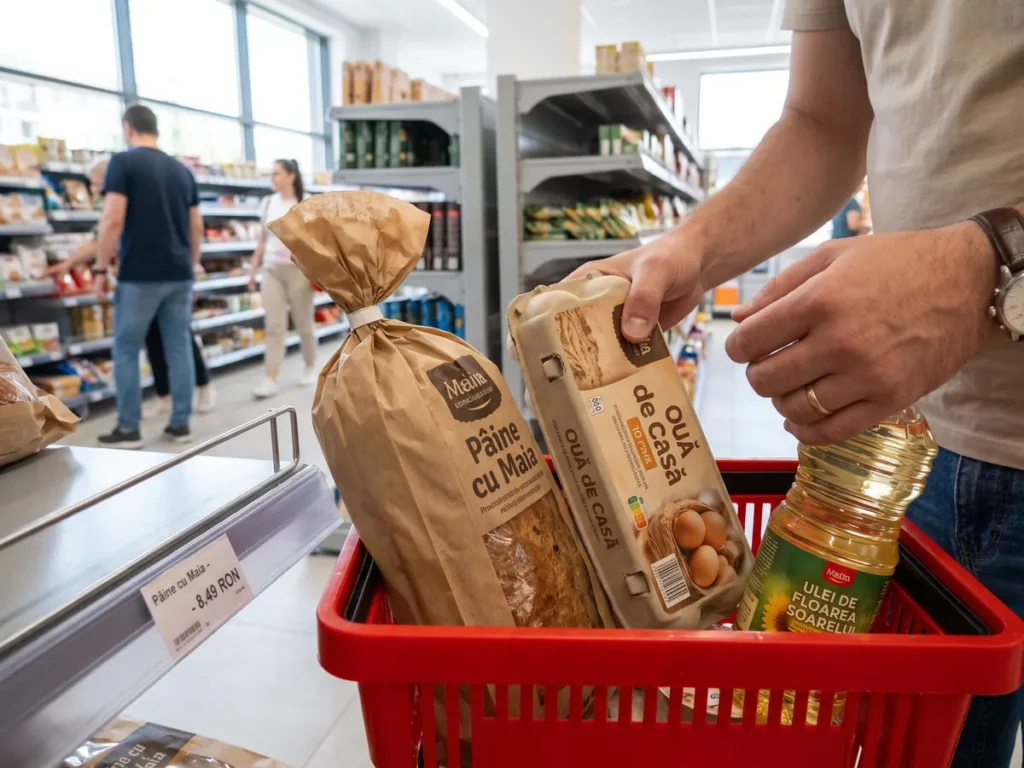
Which products stay capped. The list in the annex to Emergency Ordinance no. 67/2023 has 17 items: plain white bread of 300-500 grams, 1-litre cow’s drinking milk with 1.5% fat (UHT milk excluded), loose cow’s-milk telemea, a brined white cheese, plain yoghurt with 3.5% fat in pots of up to 200 grams, type 000 white wheat flour and maize meal in packs of up to 1 kilogram, size M hen’s eggs, sunflower oil in bottles of up to 2 litres, fresh chicken and pork, loose fresh vegetables and fruit, loose white potatoes, white granulated sugar in packs of up to 1 kilogram, sour cream with 12% fat, butter of up to 250 grams and magiun, a traditional plum butter, in jars of up to 350 grams.
The annex defines some categories strictly. Chicken means whole chicken, soup packs, whole bone-in legs and wings, in the standard version. Pork means pork trimmings, bone-in and boneless leg, and shoulder. Loose vegetables are tomatoes, onions, cucumbers, dried beans, carrots, Bianca bell peppers, capia peppers and garlic, while loose fruit means red and golden apples, plums, pears and table grapes.
How much mark-up is allowed. Distributors may apply, cumulatively across the whole distribution chain and regardless of how many there are, a mark-up of at most 5% on the purchase price, plus operating costs. In retail and cash & carry sales, the retailer’s mark-up is at most 20% on the purchase price, plus direct and indirect costs, and discounts and rebates also count towards this cap. The mark-up is calculated on the value excluding VAT. For cooking oil, sugar, flour, maize meal, and pork, chicken and beef that enter the country unprocessed, in packaging larger than 5 kilograms or 5 litres, the cap is 5%.
Obligations that continue. Retailers may sell the listed products only with proof of the mark-up applied, in the form of declarations on their own responsibility signed by their legal representatives. Re-invoicing of the annex products and of the services linked to their delivery remains prohibited. Operators must keep these products available in sufficient quantities. Issuers of meal, gift and social vouchers may charge retailers a commission of at most 2% when settling vouchers used for the annex products.
Penalties. Exceeding the mark-up rates, prohibited re-invoicing and a voucher commission above 2% are each punishable by a fine of 100,000 to 2,000,000 lei. Enforcement lies with the National Agency for Fiscal Administration and the Competition Council, each within its own remit.
Imports from Ukraine. Until 31 December 2027, wheat and meslin, maize, rapeseed and sunflower seeds, wheat or meslin flour, sugar, eggs and chicken meat originating in Ukraine may be imported only on the basis of an approval issued by the Ministry of Agriculture and Rural Development, for a quantity set for each operator. Approval is granted only to companies with their registered office and place of business in Romania that operate in the sectors listed by the ordinance: oil production, milling, animal feed, livestock farming, bakery, sugar, ice cream and meat products. The goods undergo quality and quantity checks.
What has changed compared with the previous situation
The only change concerns the deadline. Article 8 of Emergency Ordinance no. 67/2023, as worded by Law no. 105/2026, said the ordinance applied until 31 December 2026 inclusive; from 26 November 2026, the date is 30 June 2027. Article 13(1) of Emergency Ordinance no. 84/2023, as worded by Law no. 8/2026, set its application until 31 December 2026; the deadline is now 31 December 2027.
The substance of the cap remains the one applied since 27 June 2026, when Law no. 105/2026 repealed the 20% cap for processors, calculated on the production cost. Since then, the limits have covered only distribution and retail. The ordinance of 26 November 2026 does not reinstate that cap and does not change the list in the annex either.
The cap started in 2023 as a measure for 90 days from its entry into force. Through successive extensions, it has now been applied for almost four years.
Advantages and disadvantages
What it improves
- The extension comes 35 days before the old deadline expires, so prices of the listed products cannot jump suddenly on 1 January 2027 on the grounds that the cap has lapsed.
- The rules stay the same, so retailers, distributors and voucher issuers do not need to change their contracts or calculation procedures.
- Romanian farmers and processors keep the import filter on cereals, oilseeds, sugar, eggs and chicken meat from Ukraine for another year.
What remains a problem
- The act presents no figures on the effect of the measure: the preamble says consumer price indices fell, without showing by how much, for which products or over what period.
- The two mechanisms expire on different dates, 30 June 2027 and 31 December 2027, and the ordinance does not explain why the mark-up cap gets only six months.
- Through repeated extensions, a measure declared temporary is becoming a lasting rule of the food market, with no written criterion for when it ends.
Practical advice
- If you are a consumer, check whether the product matches the description in the list: the cap covers, for example, 1-litre milk with 1.5% fat but not UHT milk, yoghurt of up to 200 grams and butter of up to 250 grams.
- If you suspect a shop of exceeding the cap on listed products, the authorities that establish the offence are the National Agency for Fiscal Administration and the Competition Council.
- If you are a retailer or distributor, keep the declarations on your own responsibility about the mark-up for every delivery of annex products until 30 June 2027: without them, the product cannot be sold legally.
- Issuers of meal, gift and social vouchers continue to charge a commission of at most 2% when settling annex products, until 30 June 2027.
- If you import one of the covered products from Ukraine, request the Ministry of Agriculture’s approval before the transaction: the rule applies until 31 December 2027.
- Plan for 30 June 2027: if the Government does not extend the cap again, from 1 July 2027 the mark-up on these products will no longer be limited by this ordinance.
Frequently asked questions
Do food prices go down from 26 November 2026?
Which foods are capped?
How much mark-up can a shop add?
Does the cap also apply to the shop’s own-brand products?
What fines does a retailer face?
What changes for imports from Ukraine?
What happens after 30 June 2027?
Editorial analysis
The ordinance achieves its immediate aim: without it, the mark-up cap would have lapsed on 31 December 2026, and the import approval for agricultural products from Ukraine would have expired the same day. The text is legally sound: both amended articles exist, the references to Official Gazette of Romania no. 602/2023 and no. 929/2023 match the basic acts, and the old deadlines it replaces, both 31 December 2026, appear in the versions of the two ordinances currently in force. There is nothing to report as an error.
The problem lies in how long the measure has lasted. Emergency Ordinance no. 67/2023 was designed for 90 days from its entry into force on 30 July 2023. With the new deadline of 30 June 2027, it will have been applied for 1,431 days, almost 16 times the original period. Such a long intervention in price formation should rest on data, yet the preamble settles for the statement that consumer price indices fell, without a single figure from the National Institute of Statistics for the 17 products.
A second point is not visible from the text. Emergency Ordinance no. 84/2023 already allows, in Article 13(2), the deadline to be extended by Government Decision, on a proposal from the relevant ministries. The Government nevertheless chose an emergency ordinance for both measures, which ties them to the approval procedure in Parliament. And the different horizons, six months for the mark-up cap and twelve for imports, show that the decision on food prices will come back for discussion before summer 2027, independently of the one on imports.
What should be changed
- A public assessment before 30 June 2027. The Ministry of Agriculture and the Competition Council should publish the price trend for each of the 17 items, compared with uncapped foods, so that the next decision can be checked against figures.
- An exit criterion written into the ordinance. A food inflation threshold below which the cap ends automatically would replace the six-monthly extensions by emergency ordinance and give retailers a predictable horizon.
- A worked example for the 20% rate. The formula “20% on the purchase price, plus direct and indirect costs” can be read in two ways: with the costs included in the calculation base, or added on top of the mark-up. A numerical example in the act would reduce disputes at inspections.
- The same extension mechanism for both measures. A clause like Article 13(2) of Emergency Ordinance no. 84/2023, added to Emergency Ordinance no. 67/2023 as well, would allow the deadline to be adjusted by Government Decision, on the basis of data, well before it expires.
- Reporting on inspections. Annual publication of the number of inspections and of the fines imposed by the National Agency for Fiscal Administration and the Competition Council would show whether the cap is respected in practice.
Original text of the legal act
The text below is reproduced in Romanian, the official form of publication.
The full text, as published in the Official Gazette of Romania
Official Gazette of Romania no. 984 of 26 November 2026, pages 2-3 8 pages PDF, 75 KB the act starts on page 2
Open the official PDFDownload the PDF
The viewer is not shown on small screens. Use the buttons above to open or download the file.
This article is for informational purposes only and does not constitute legal advice. For specific situations, consult a licensed attorney or tax advisor.