
In brief
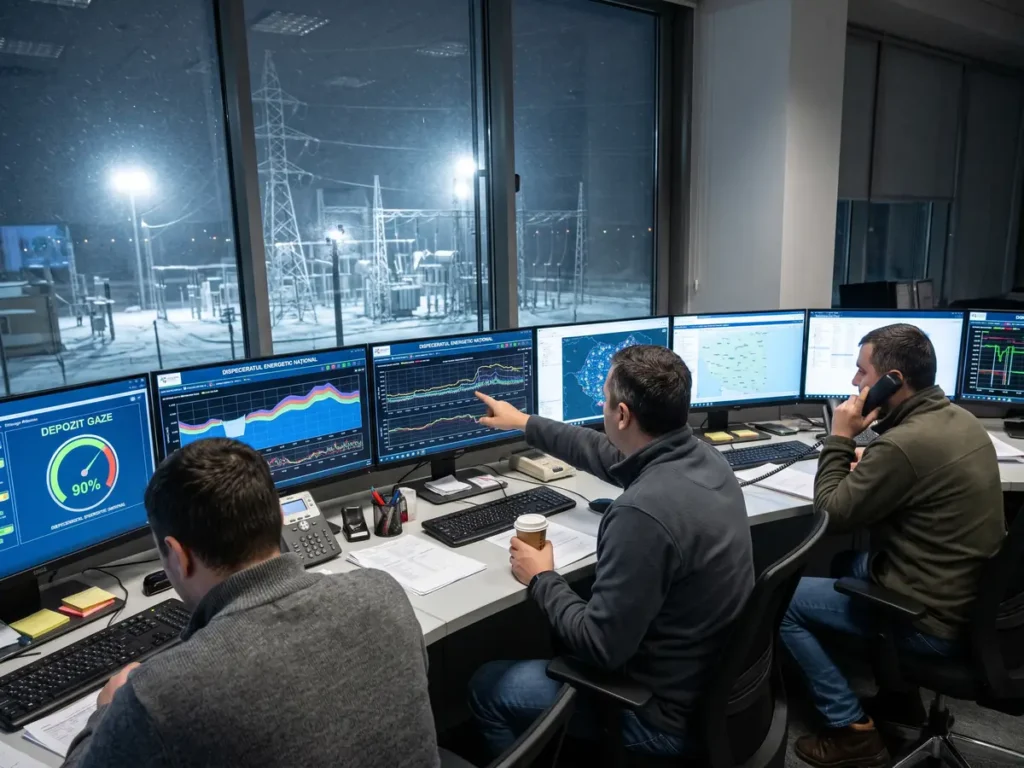
- The Government sets up the Winter Energy Command for the period 1 November 2026-31 March 2027, with 24 institutions and companies from the power and gas sectors, each sending no more than 2 representatives. The Command monitors the National Power System and the gas transmission system, decides on operational measures and keeps the Government informed.
- Annex no. 2 approves 27 measures for the winter, among them gas in storage at 90% of the capacity of the storage facilities, safety stocks of coal, water reserves in hydropower reservoirs, the commissioning of the gas turbines at Mintia, and steps with the European Commission regarding 4 lignite-fired units of Complexul Energetic Oltenia.
- The Minister of Energy sets the named membership of the Command by order within 5 days of entry into force, that is by 4 November 2026. Network operators must report supply interruptions without delay to the emergency authorities as well.
Published: Official Gazette of Romania (Monitorul Oficial), Part I, no. 914 of 30 October 2026, pages 7-10
In force from: 30 October 2026, the date of publication, since the decision does not set a later date
The energy system enters the 2026-2027 winter with a dedicated command structure, set up by Government Decision no. 945/2026, which operates between 1 November 2026 and 31 March 2027. The decision comes right after the National Committee for Emergency Situations extended the state of energy alert for another 30 days from 29 October 2026, because units 1 and 2 at Cernavodă cannot be restarted in November. The Command brings together the Ministry of Energy, the Ministry of Development, Public Works and Administration, the National Administration „Apele Române”, the National Energy Regulatory Authority (ANRE) as an observer member, the two transmission and system operators, Transelectrica and Transgaz, 16 producers, distributors and suppliers of electricity and gas, plus OPCOM and the Romanian Commodities Exchange.
The Command’s role is set out in Article 1: it follows the operation of the National Power System and of the National Natural Gas Transmission System, identifies malfunctions that may arise, decides on operational measures, „altele decât cele administrative” (other than administrative ones), including on fuel stocks, and informs the Government whenever necessary. The operational measures are implemented by the public authorities and institutions with responsibilities in the energy sector that are named in the Command.
Annex no. 2 contains three groups of measures. The first, and the longest, has 27 points drawn up on the basis of Transelectrica’s assessment, ranging from fuel and gas stocks to snow-clearing contracts and diesel generators for sensitive consumers. The second sets out how supply interruptions are reported, and the third restates the protected-customer regime for gas as it applies to heat producers.
What it changes in practice
For energy producers, the decision sets preparedness targets. Natural gas in storage must reach 90% of the capacity of the storage facilities, and withdrawal is to be carried out „gradual uniform” (gradually and evenly), so that stocks in February-March 2027 remain „satisfăcător” (satisfactory). Coal-fired plants build up safety stocks, hydropower plants keep a minimum energy reserve in their reservoirs, and CET Paroșeni undergoes maintenance so that it can run during the winter season.
For gas-fired plants, the decision names the concrete risk: if daily withdrawal from storage falls, pressure in the transmission network may deteriorate, and the plants at Brazi (830 MW, OMV Petrom), Iernut (150 MW, Romgaz), Mintia (135 MW, Mass Global, with a possible increase to more than 1,000 MW in the first quarter of 2027) and the Electrocentrale București combined heat and power plants (420 MW) could be left without fuel. Measure no. 12 provides for the commissioning of the gas turbines at Mintia, of approximately 1,500 MW, together with the gas they need.
For Complexul Energetic Oltenia, the authorities must step up their efforts with the European Commission to keep 4 lignite-fired units in commercial operation, in the context of the investigation opened by Commission Decision C(2026) 1186 final of 27 February 2026 concerning the amendment of the company’s restructuring plan.
For the capital, the decision provides for speeding up repairs at CET Vest, after the fires and breakdowns of spring 2026, so that the combined-cycle plant can start up, and for a faster pace of modernisation of Bucharest’s district heating network, to reduce losses of heat and of make-up water.
For network operators, part B introduces a reporting obligation: whenever a situation makes it impossible to supply electricity to an area, the transmission and system operator and the concessionaire distribution operators must inform, without delay, the grantor and, at the same time, the National Integrated Command Centre, the Department for Emergency Situations and the General Inspectorate for Emergency Situations. The notification must include at least the affected areas, the estimated number of consumers, the consumers with an essential role (hospitals, social care facilities, water supply systems), the cause, the measures ordered and the estimated restoration time, and it must be updated until the problem is fixed.
For consumers, part C confirms that gas-fired heat producers supplying household customers, small and medium-sized enterprises or essential services have protected-customer status under Order of the Minister of Energy no. 692/2018. If market measures do not cover the gas shortfall, administrative measures apply, including curtailing the consumption of non-protected customers. In each county, the Ministry of Energy identifies the filling stations essential to the emergency services, which become priority consumers when electricity supply is restored.
What has changed compared with the previous situation
The Winter Energy Command is a temporary structure: Decision no. 945/2026 sets it up for only 151 days, from 1 November 2026 to 31 March 2027, and it applies against the background of a nationwide state of energy alert that is in force.
- Membership: 24 entities, including 16 economic operators from the power and gas sectors, plus Apele Române, OPCOM and the Romanian Commodities Exchange; ANRE takes part only as an observer member.
- Deadline for the named membership: an order of the Minister of Energy, within 5 days of 30 October 2026, that is by 4 November 2026.
- Generation measures named explicitly for this winter: the gas turbines at Mintia, the restart of CET Vest after the spring breakdowns, gas-fired cogeneration at CET Palas (about 50 MW), CET Brazi (about 35 MW) and CET Arad (about 30 MW), and the unit at CET Paroșeni.
- Essential filling stations: identified county by county by the Ministry of Energy and included among priority consumers when supply is restored.
On the same day, the Government also adopted Emergency Ordinance no. 43/2026 on support for heating in the 2026-2027 cold season, which deals with the financing of heating fuel, a matter this decision does not touch.
The ordinance lets local authorities with district heating borrow from a 300 million lei State Treasury fund, with a cap of 75 million lei per city for fuel for the 2026-2027 winter.
The Command works alongside two crisis regimes extended at the end of October: Transelectrica’s safety measures, including export cuts and consumption limits, until 30 November 2026, and the fuel mark-up cap, with the reduced diesel excise, until 1 February 2027.
Advantages and disadvantages
What it improves
- It brings together in a single structure the ministries, the transmission operators, the major producers, the distributors and the energy exchanges, so operational decisions are taken with all the players at the table.
- It names concrete risks, with specific plants and installed capacities, not just general formulas about system security.
- It sets a minimum content for reporting interruptions and requires the emergency authorities to be informed at the same time as the grantor.
- It includes essential filling stations among priority consumers, which matters in a prolonged power cut.
What remains a problem
- Most of the 27 measures have neither a designated person responsible nor a deadline; only the stock programme has a reference point, „până la intrarea în sezonul de iarnă” (before the start of the winter season), that is two days after the decision was adopted.
- Under Article 1(2), the operational measures are implemented only by public authorities and institutions, that is by 4 of the 24 members, even though the stocks, plants and networks belong to the companies.
- The annex does not mention the unavailability of the Cernavodă nuclear power plant, even though Nuclearelectrica is a member of the Command.
- Mass Global, which operates Mintia, and the operators of the cogeneration plants in Constanța and Arad are not part of the Command, even though two measures depend on them.
Practical advice
- If you lose power during the winter, notify the distributor in your area: the decision requires it to report to the authorities the affected areas, the estimated number of consumers and the estimated restoration time, and to update the notification until the problem is fixed.
- If you run a hospital, a social care facility or a water supply system, check your own backup source: the decision provides for interruptions at these facilities to be reported separately, but does not give them priority for restoration, as it does for essential filling stations.
- If you are a gas-fired heat producer supplying homes or essential services, check your classification as a protected customer under Order of the Minister of Energy no. 692/2018: the status shields you from consumption cuts at the emergency level.
- If you operate a filling station that is important for the county’s emergency services, prepare an alternative power source: the decision provides for this equipment to be promoted together with the station operators.
- If you are an industrial gas consumer without protected-customer status, factor into your business continuity plan the possibility of consumption cuts in the event of a supply shortfall.
Frequently asked questions
What is the Winter Energy Command?
Who sits on the Command?
When will the members’ names be known?
How much gas must be in storage?
What happens if there is not enough gas?
Does the decision provide money for heating?
Editorial analysis
The decision is more concrete than a mere statement of principles: it names plants, installed capacities and risks, and the text contains no contradictions or cross-references that would make it inapplicable, so it gets no errata section. Its weakness lies in its construction. The 27 measures in part A are worded as objectives („amplificarea demersurilor”, stepping up efforts; „creșterea ritmului”, increasing the pace; „susținerea proceselor”, supporting the processes), with no one responsible and no deadline, and the only time marker, the stock programme „până la intrarea în sezonul de iarnă 2026-2027” (before the start of the winter season), falls two days after the decision was adopted, on 1 November 2026. A stock target set two days before its deadline can only be observed, not reached.
Reading Article 1 together with annex no. 1 reveals a second problem. The Command decides on operational measures, including on fuel stocks, but Article 1(2) entrusts their implementation only to „autorităților și instituțiilor publice” (public authorities and institutions), while 20 of the 24 members are companies, from Transelectrica and Transgaz to producers, distributors, OPCOM and the Romanian Commodities Exchange, and the stocks, plants and networks are theirs. On top of that, the players behind two measures are missing from the Command: Mass Global, on which the Mintia turbines depend, and the operators of the cogeneration plants in Constanța and Arad, which are under the authority of the local councils. Nor are the emergency authorities, to which part B sends the notifications, members.
The figure that cannot be seen from reading the act: the four gas-fired plants named in measure no. 6 total 1,535 MW (830 + 150 + 135 + 420), roughly 18% of the evening consumption peak of up to 8,500 MW estimated for November when the state of alert was extended by CNSU Decision no. 25/2026. These are precisely the plants that depend on pressure in the gas network. At the same time, the decision says nothing about Cernavodă, even though units 1 and 2 remain shut down in November and the state of energy alert was extended from 29 October itself. For a winter that begins without the output from Cernavodă, the lack of a dedicated measure is the act’s biggest omission.
What should be changed
- Every measure in part A with a person responsible and a deadline. The Command could check what has and has not been done, and the Government would receive reports it could compare from one month to the next.
- Article 1(2) extended to the member economic operators. Operational measures on stocks and plant operation would reach those who can actually apply them, not just the ministries.
- An explicit measure for the unavailability of Cernavodă. Imports, reserves and the start-up order of the units replacing nuclear output would be settled in advance, not decided under the pressure of the first cold spell.
- Mass Global, Termocentrale Constanța, CET Hidrocarburi Arad and the General Inspectorate for Emergency Situations included in annex no. 1. Those on whom measures no. 12 and no. 13 depend, and those who receive the notifications, would take part in the decision instead of learning about it afterwards.
- The decision adopted at least one month before 1 November. The stock target and the membership of the Command would be known in time for them to be met, and the deadline for the appointment order would no longer run past the start of the period.
Original text of the legal act
The text below is reproduced in Romanian, the official form of publication.
The full text, as published in the Official Gazette of Romania
Official Gazette of Romania no. 914 of 30 October 2026, pages 7-10 16 pages PDF, 171 KB the act starts on page 7
Open the official PDFDownload the PDF
The viewer is not shown on small screens. Use the buttons above to open or download the file.
This article is for informational purposes only and does not constitute legal advice. For specific situations, consult a licensed attorney or tax advisor.