
In brief
- The fine for driving a vehicle with major defects stays in the law exactly as it is, without the legislature having defined what „major” means and what „minor” means when a car is pulled over in traffic.
- The Constitutional Court dismissed, as inadmissible, the plea raised by a driver from Sibiu who complained precisely about the missing criteria. Inadmissible does not mean constitutional: the Court did not validate the text, it said that what it was in fact being asked to do was to complete the law, which only Parliament can do.
- Who is concerned: any driver pulled over in traffic because of the technical condition of the vehicle. The administrative offence is punished by the class I fine. The decision is final and generally binding from 24 July 2026.
Published: Official Gazette of Romania (Monitorul Oficial) no. 606 of 24 July 2026
In force from: 24 July 2026
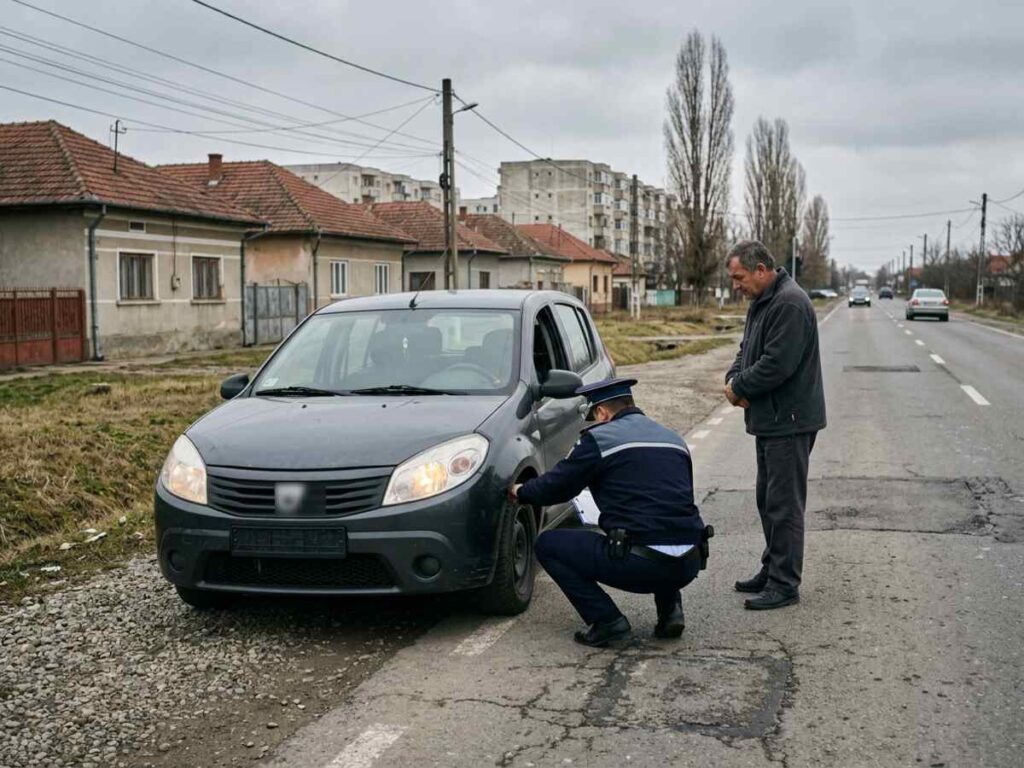
What a „major defect” means on a car pulled over in traffic still rests with the judgment of the officer who records the offence, and the Constitutional Court declines to set the criteria itself. The plea raised by Alexandru Csiki in File no. 6.309/257/2019 of the Sibiu Tribunal was dismissed as inadmissible because, as the Court read it, what was being sought was the completion of the law, not the review of it. This is the second time in recent months that the Court has declined to step into road traffic matters, after it already held that a court cannot shorten the length of a driving licence suspension. Decision no. 615 of 20 November 2025 was published in Official Gazette of Romania no. 606 of 24 July 2026.
The text at issue is Article 99 para. (1) point 18 of Government Emergency Ordinance no. 195/2002 on traffic on public roads. It punishes with the class I fine the driving on public roads of a vehicle with major defects other than those covered by Article 101 para. (1) point 11, that is, other than defects of the braking system, of the steering mechanism, of the lighting system or of the audible warning device, or the absence of these, which are punished separately and more severely.
The problem raised is easy to state and hard to solve. The law speaks of major defects, so, conversely, minor defects do not amount to an administrative offence. Only that the text does not say where the boundary between them lies, and the officer who pulls the car over decides on the spot. The author of the plea argued that, without criteria, neither the driver can adjust his conduct nor the judge has any benchmark when ruling on the challenge against the offence report, invoking Article 1 para. (5) of the Constitution and CCR Decision no. 152 of 6 May 2020 on the quality of the law in administrative offence matters.
What is unusual is that the referring court agreed with him. The Sibiu Tribunal, Second Division for civil, administrative and tax litigation, took the view that the plea was well founded and added an argument of its own: the criteria should be measured not only against the nature of the defect, but also against the actual traffic conditions. The Public Ministry asked for the plea to be dismissed. The presidents of the two Chambers of Parliament, the Government and the Ombudsman submitted no views.
What it changes in practice
The first effect is the one that has to be read correctly. The solution is one of inadmissibility, not a dismissal on the merits. The Court did not say that Article 99 para. (1) point 18 is clear enough or that it meets the requirements as to the quality of the law. It said that it cannot examine the criticism, because its concrete purpose was to complete or amend the text.
The second effect is procedural. The decision is final and generally binding from publication, and the same plea can no longer be raised, under Article 29 para. (3) of Law no. 47/1992. Pending challenges against offence reports lose this argument, but not the other defences.
The third effect concerns the division of roles between institutions and is worth keeping in mind. The Court pointed out, by reference to Article 2 para. (3) of Law no. 47/1992, that it rules only on the constitutionality of the acts referred to it, without being able to amend or complete them. Amending the content of a rule is the exclusive prerogative of Parliament, under Article 61 para. (1) of the Constitution, a principle restated from Decision no. 225 of 15 April 2014.
The fourth effect points to where one can go instead of the Court. For the meaning of a rule applied inconsistently by the courts there are the appeal in the interest of the law and the preliminary ruling on a point of law, both before the High Court of Cassation and Justice. For this distinction the Court refers to Decision no. 317 of 11 May 2021, paragraph 25.
The fifth effect is practical and concerns every driver pulled over in traffic. The task of showing that the defect was not major remains a matter of evidence before the court ruling on the challenge, not a matter of constitutionality. The judge has, in the Court’s words, the instruments needed to identify the applicable rule, to analyse its content and to fit it to the facts established, according to Decision no. 838 of 27 May 2009.
What has changed compared with the previous situation
In law, nothing changes. The text remains in the form it had, and the practice of recording offences remains what it was. What does change is the procedural position of the drivers who hoped that the absence of criteria would lead to the administrative offence being struck down.
It is worth saying plainly what has been left unresolved, because that is where the stakes lie. The Road Traffic Code does not define the major defect and does not refer, within Article 99 para. (1) point 18, to any list of criteria. A classification of defects into minor, major and dangerous does exist, however, in the rules on the periodic technical inspection, RNTR 1, approved by Order of the Minister of Transport no. 2133/2005, which transpose Directive 2014/45/EU. That classification is designed for the inspection station, with equipment and procedures, not for a roadside check, and the Court did not discuss it, since it never reached the substance of the criticism.
The distinction that the law does draw is the one between point 18 of Article 99 and point 11 of Article 101 para. (1). Defects of the braking system, the steering, the lighting and the audible warning device, or their absence, are carved out of the first text and treated separately, as more serious. The remaining major defects fall under sanction class I.
A useful benchmark for the amount: under Article 98 of Government Emergency Ordinance no. 195/2002, class I means 2 or 3 penalty points, and one penalty point, which here is a unit for calculating the fine and not a mark on the driving licence, represents 10% of the gross national minimum wage, set by Government decision. The value in lei therefore changes together with the minimum wage, without the text of the offence being touched.
The precedent on which the author of the plea relied, Decision no. 152 of 6 May 2020, concerned the requirements as to the quality of the law and the presumption of innocence in administrative offence matters. The Court did not examine it against the text at issue here, precisely because it stopped the examination at the admissibility stage.
Advantages and disadvantages
What it improves
- It draws a clear line between constitutional review and legislating, in a field where the request to add criteria to the law comes up often.
- It points to the real remedies for inconsistent case law: the appeal in the interest of the law and the preliminary ruling, both before the High Court.
- It is a reminder that the judge hearing the challenge against the offence report has the instruments needed to assess whether the act exists as described in the report.
- Being a solution of inadmissibility, it does not validate the text, so a better constructed criticism or an intervention by the legislature remain possible.
What remains a problem
- The underlying problem is left untouched: the law does not say where the minor defect ends and the major one begins, and the assessment is made at the roadside.
- The referring court had found the plea well founded, so the signal that the text is unclear came from a tribunal itself, not only from a disgruntled driver.
- The time elapsed is considerable. The Sibiu Tribunal referred the matter to the Court in February 2021, the decision was handed down in November 2025 and published in July 2026, that is, more than five years after the referral.
- It is still for the driver to prove in court, often through an expert report, that the defect was not major, which can cost more than the fine.
- Without statutory criteria, the risk of the text being applied differently from one officer to another and from one county to another remains intact.
Practical advice
- Ask for the offence report to describe the defect found in concrete terms, rather than merely repeating the wording of the law. A vague description is exactly the weak point you can attack in court, as a question of fact.
- Record your objections in the box provided for them, on the spot. It is the only moment when your version enters the document without depending on anyone’s memory.
- Photograph the vehicle on the spot, from several angles, including the part complained of. A dated photograph carries far more weight than a description drawn up a month later.
- Check whether the defect complained of actually falls under Article 101 para. (1) point 11, that is, under braking, steering, lighting or the audible warning device. There the legal basis is a different one, and a wrong classification can be contested.
- Keep the report from the last periodic technical inspection and, where relevant, the repair estimate. They show the technical condition of the vehicle in relation to the time of the check.
- File the challenge within the 15-day time limit from the handing over or notification of the offence report and build it on the facts, not on the unconstitutionality of the text, which can no longer be invoked after this decision.
Frequently asked questions
What did the Constitutional Court actually decide?
Why inadmissible and not unfounded?
Does this mean the text was declared constitutional?
What does a major defect mean, after all?
How much is the fine?
What happens if the defect is in the brakes or the steering?
Can I still contest the fine?
From when does the decision produce effects?
Original text of the legal act
The text below is reproduced in Romanian, the official form of publication.
The full text, as published in the Official Gazette of Romania
Official Gazette of Romania no. 606 of 24 July 2026 16 pages PDF, 117 KB the act starts on page 2
Open the official PDFDownload the PDF
The viewer is not shown on small screens. Use the buttons above to open or download the file.
This article is for informational purposes only and does not constitute legal advice. For specific situations, consult a licensed attorney or tax advisor.