
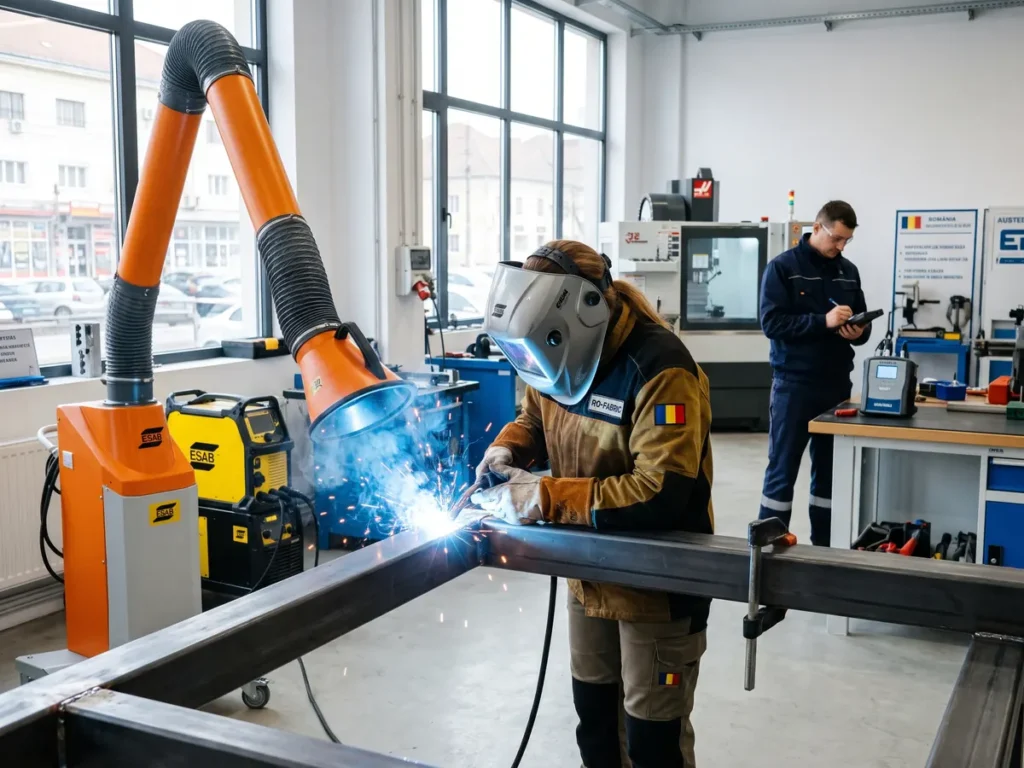
In brief
- Welding fume joins the EU list of carcinogens. Work in which employees breathe welding fume containing category 1A or 1B carcinogens, mutagens or reproductive toxicants is added to Annex I to Directive 2004/37/EC.
- New workplace limit values. Polycyclic aromatic hydrocarbon (PAH) mixtures get 0.00007 mg/m³, measured as benzo[a]pyrene, cobalt 0.01 mg/m³ (inhalable fraction) and 0.0025 mg/m³ (respirable fraction), isoprene 8.5 mg/m³, and 1,4-dioxane 7.3 mg/m³ plus a biological limit value. Foundries, aluminium producers, coking plants and six other sectors have transitional values until 2032 and 2033.
- Respiratory protective masks only as a last resort, and a right to breaks. Personal protective equipment is used only when exposure cannot be reduced by other means, it must be chosen and adjusted for each worker, and anyone wearing it is entitled to regular breaks in an uncontaminated area.
Who is affected: employers in foundries, steelmaking, aluminium, carbon and graphite production, coking plants, refractories, railway track welding, chemicals and any welding workshop, their workers and occupational physicians. The directive is addressed to the Member States: the obligations reach companies through the national transposing act.
Published: Official Journal of the European Union, L series, 2026/2450 of 30 October 2026
In force from: 19 November 2026, the twentieth day following publication; Member States must transpose it by 20 November 2028
The European Parliament and the Council have once again amended the directive that protects workers from carcinogens, mutagens and reprotoxic substances. Directive (EU) 2026/2450, published in the Official Journal of the European Union on 30 October 2026 and in force since 19 November 2026, adds welding fume to the list of carcinogenic work processes, sets occupational exposure limit values for cobalt, PAHs, isoprene and 1,4-dioxane, and specifies when employers may rely on personal protective equipment: only once technical and organisational measures can no longer reduce exposure.
Because it is a directive, the act does not bind Romanian companies directly. The state has until 20 November 2028 to adopt the national measures, which is 732 days from entry into force. In Romania, Directive 2004/37/EC is transposed by Government Decision no. 1.093/2006, and the most recent EU values, those for lead, were added to that decision by Government Decision no. 40/2026, published in the Official Gazette of Romania no. 86 of 3 February 2026. The new directive will require an amendment of the same kind.
For welding fume, the directive relies on the classification by the International Agency for Research on Cancer, which lists it as “carcinogenic to humans”, and on the opinion of the Advisory Committee on Safety and Health at Work, which recommended including in Annex I only work involving exposure to welding fume. The note attached to the new point 9 of Annex I sets the practical rule: exposure must not exceed the limit value of each Annex III substance released during welding.
What it changes in practice
Once the directive is transposed, employers will have to treat any work in which welding fume contains substances classified as 1A or 1B as exposure to carcinogens. That brings in the full regime of Directive 2004/37/EC: risk assessment, replacement of the process where possible, a closed system or reduction of exposure to the lowest technically feasible level, a register of exposed workers and health surveillance.
The new limit values in Annex III, part A, are as follows, all as 8-hour time-weighted averages:
- PAH mixtures, particularly those containing benzo[a]pyrene: 0.00007 mg/m³, measured as benzo[a]pyrene, with a “Skin” notation. Until 20 November 2033 a value of 0.00014 mg/m³ applies, but only in nine sectors: steel and iron foundries, including ferroalloy manufacturers; aluminium manufacturers; carbon and graphite manufacturers; coking plants; coal tar distillation; refractory products manufacturers; train track welding; other non-ferrous metallurgical processes; metal casting.
- Cobalt and inorganic cobalt compounds: 0.01 mg/m³ for the inhalable fraction and 0.0025 mg/m³ for the respirable fraction, measured as cobalt, with a notation for dermal and respiratory sensitisation. Until 20 November 2032, 0.02 mg/m³ and 0.0042 mg/m³ apply, in all sectors.
- Isoprene: 8.5 mg/m³, or 3 ppm.
- 1,4-dioxane: 7.3 mg/m³ (2 ppm) over 8 hours and 73 mg/m³ (20 ppm) short-term, with a “Skin” notation.
- Mercury and divalent inorganic mercury compounds: the value remains 0.02 mg/m³, but it applies only to the compounds that fall within the scope of the directive, meaning those classified as reprotoxic.
Annex IIIa, which contains the biological limit values, is replaced in full. For lead, the figures set in 2024 remain: 30 μg Pb/100 ml blood until 31 December 2028 and 15 μg Pb/100 ml from 1 January 2029, with regular health surveillance for workers who exceed the value because of exposure that occurred before 9 April 2026. 1,4-dioxane is added, with a binding biological limit value of 45 mg HEAA ((2-hydroxyethoxy)acetic acid) in urine/g creatinine, measured at the end of exposure or shift.
Article 5(5) gains a new subparagraph: personal protective equipment, in particular respiratory protective equipment, is used “as a last resort”, when exposure cannot be avoided or adequately reduced by other means, and it must be correctly chosen, individually adjusted to the wearer and maintained, in accordance with Directive 89/656/EEC. Article 10 gains paragraph 3: workers wearing personal protective equipment are entitled to regular breaks in an area with no risk of contamination, with the duration and frequency set on the basis of the risk assessment.
The European Commission receives a new task in Article 18a(12): to assess, on the basis of new scientific data and the opinion of the European Chemicals Agency, whether additional limit values should be set for the substances contained in welding fume.
What has changed compared with the previous situation
Until this directive, welding fume did not appear in Annex I to Directive 2004/37/EC. The recitals explain that the absence of a harmonised classification under Regulation (EC) No 1272/2008 left it unclear whether the directive applied to welding fume; listing it in Annex I settles the question at Union level.
PAH mixtures were already in Annex III, but only with a “Skin” notation and no numerical value. Cobalt, isoprene and 1,4-dioxane had no limit value in this directive. The mercury entry covered, as worded, all divalent inorganic mercury compounds, even though not all of them are classified as reprotoxic.
The definitions in Article 2 are also broadened: a carcinogen, mutagen or reprotoxic substance now also includes a substance or mixture released by a process listed in Annex I. Until now, the text referred to the substance, mixture or process as such.
Article 5 already set out a hierarchy of protective measures, but the directive did not state expressly that personal protective equipment comes last, nor did it grant a right to breaks to those who wear it. The values for lead do not change: they were set by Directive (EU) 2024/869 and already apply in Romania through Government Decision no. 40/2026.
Advantages and disadvantages
What it improves
- Welders explicitly come under the regime for workers exposed to carcinogens, with risk assessment, a register and health surveillance, without depending on each employer’s interpretation.
- For PAHs and cobalt, this directive now contains, for the first time, a figure that labour inspectors can measure and enforce.
- The rule that personal protective equipment is a last resort prevents employers from replacing ventilation and process enclosure with a cheap mask.
- The right to breaks in an uncontaminated area applies to all workers who wear personal protective equipment, whatever the sector.
- Sectors whose technology is hard to change have transitional values, so they can plan their investments.
What remains a problem
- The duration and frequency of breaks have no minimum: the employer sets them through the risk assessment.
- For welding fume, the directive refers only to the values for the Annex III substances, so a company must know which substances each process and material releases.
- The PAH value of 0.00007 mg/m³ requires very sensitive sampling and analysis methods, which not every laboratory has.
- The Commission has no deadline for assessing additional values for welding fume.
Practical advice
- Update the risk assessment for each welding workstation: the process, the base metal, the filler material and the coatings can release 1A or 1B substances. The safety data sheets of the consumables are the starting point.
- If your company belongs to one of the nine sectors with a PAH transition, document that classification: the value of 0.00014 mg/m³ applies only there, while all other sectors move straight to 0.00007 mg/m³ after transposition.
- Schedule cobalt measurements for both fractions, inhalable and respirable, because the directive sets a separate value for each.
- Review the biological monitoring programme with your occupational physician: for lead, 15 μg Pb/100 ml applies from 1 January 2029, and for 1,4-dioxane an end-of-shift HEAA urine test will be needed.
- For respiratory protective equipment, keep evidence of how it was chosen, adjusted to each worker and maintained. Set out in writing the breaks and where they are taken, in an area with no risk of contamination.
- Plan investment in local exhaust ventilation, general ventilation and process enclosure by 20 November 2028, the date by which the state must transpose the directive; the transitional periods cover only PAHs and cobalt.
Frequently asked questions
Do Romanian companies have to comply with the new values from 19 November 2026?
Does all welding become carcinogenic work?
Can I give workers masks instead of installing ventilation?
How long are the breaks for workers who wear protective equipment?
Do the blood lead values change?
Until when do the transitional values apply?
Editorial analysis
The directive solves a real and long-standing problem: the International Agency for Research on Cancer classified welding fume as carcinogenic to humans, yet EU occupational health law did not say whether it fell under the carcinogens regime. The text is coherent: the definitions in Article 2, the new title of Annex I and point 9 cross-refer correctly, and the transitional deadlines match the six- and seven-year periods announced in the recitals. We found no defect that would allow two legal readings.
The transitional periods are shorter than they look. The recitals speak of six years for cobalt and seven years for PAHs, but both run from the directive’s entry into force on 19 November 2026, and the first two years are taken up by the transposition deadline. For a company, the transitional value becomes binding only with the national act, so the real adjustment window is four years for cobalt, between 20 November 2028 and 20 November 2032, and five years for PAHs. Any delay in transposition in Romania comes straight out of those years.
The second point concerns Annex IIIa. Although it is replaced in full, the part on lead reproduces word for word the text of Directive (EU) 2024/869, including the date of 9 April 2026, which was that directive’s transposition deadline. Romania transposed it through Government Decision no. 40/2026, published on 3 February 2026, 65 days ahead of the deadline. To transpose the new directive, the national annex needs only the entry for 1,4-dioxane, and the 2026 precedent shows that the deadline of 20 November 2028 can be met.
The obligations are unevenly balanced: the Member States have a fixed deadline, while the Commission has none for the additional welding fume values in Article 18a(12). Until then, welding fume remains controlled indirectly, through the values for each Annex III substance.
What should be changed
- Transposition by amending Government Decision no. 1.093/2006 in 2027, ahead of the deadline. Companies in the nine sectors would gain real time from the transitional period, which otherwise shrinks with every month of delay.
- A national minimum for breaks for workers wearing respiratory protective equipment. The right in Article 10(3) would become verifiable during inspections, rather than depending on each employer’s assessment.
- Labour Inspectorate guidance on welding fume, listing the processes and materials that usually release 1A or 1B substances. Small workshops would know whether the regime applies to them without paying for an expert assessment.
- A public list of laboratories able to measure benzo[a]pyrene at 0.00007 mg/m³ and cobalt in the respirable fraction. Employers and inspectors would have comparable measurements, and the limit values could actually be enforced.
- A deadline for the Commission’s assessment under Article 18a(12). The sector would know when a specific value for welding fume might appear and could plan its investments once.
Original text of the legal act
The text below is reproduced in Romanian, the official form of publication.
The full text, as published in the Official Gazette of Romania
Official Journal of the European Union, L series, 2026/2450 of 30 October 2026, ELI: http://data.europa.eu/eli/dir/2026/2450/oj 13 pages PDF, 937 KB
Open the official PDFDownload the PDF
The viewer is not shown on small screens. Use the buttons above to open or download the file.
This article is for informational purposes only and does not constitute legal advice. For specific situations, consult a licensed attorney or tax advisor.