
In brief
- The town hall has to find out who manages the hunting on its own territory. From 14 November 2026, the manager of a hunting ground has at most 30 days from the signing of the management contract, and the same again from every addendum to it, to notify each administrative-territorial unit the ground extends over.
- Three ways of sending it, each one leaving a written trace. Registered letter with acknowledgement of receipt, electronic mail, or filing it directly with the town hall’s registry. The law places all three at the manager’s disposal without preferring any of them.
- A fine of 500 to 1,500 lei. Failing to notify becomes an administrative offence and lands in the same penalty band as part of the hunting breaches, the second lowest of the six bands in Article 48 of the hunting law.
- It counts when game causes damage. The compensation claim for a ruined crop is filed with the town hall itself, and the assessment committee has 72 hours to establish the damage. For damage caused inside the hunting ground and inside built-up areas by the species listed in Annex no. 1, the manager pays, provided it has failed to meet its prevention obligations.
- Contracts already running stay outside the rule until their first addendum. A management contract is concluded for 16 years, and the new law lays down no rule whatsoever for those signed before 14 November 2026.
Published: Official Gazette of Romania, Part I, no. 865 of 15 October 2026, page 2
In force from: 14 November 2026, 30 days after publication, a deadline set by the law itself in Article II and not by the general 3-day rule
Until now, a mayor could quite legitimately have no idea who was looking after the game on the territory of his commune. No provision of the hunting law obliged anyone to tell him, even though it is at the town hall that a compensation claim is filed by the man whose maize has been trampled by wild boar, and even though the money comes, in some situations, from the very body that manages the hunting ground. Law no. 196/2026, published in the Official Gazette of Romania, Part I, no. 865 of 15 October 2026, closes that gap with one short obligation and a fine.
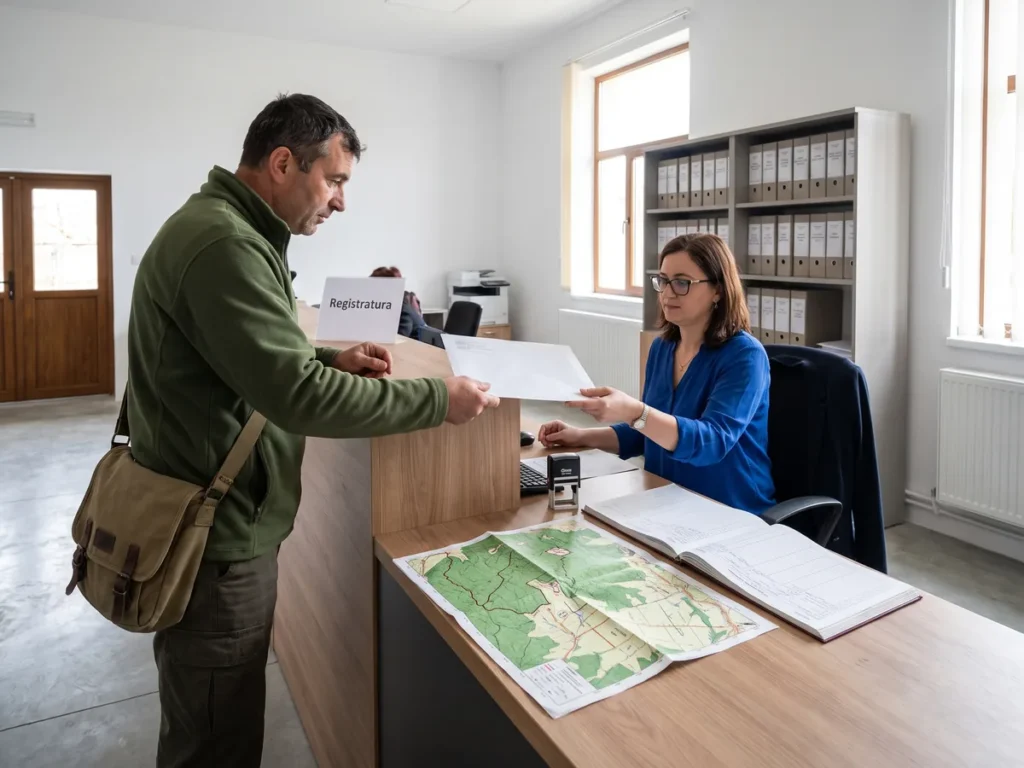
From 14 November 2026, the manager of a hunting ground, meaning the licensed legal person that has been assigned the management of the game of hunting interest in that ground, must notify the administrative-territorial units on whose territory the ground is situated. The deadline is at most 30 days from the date on which the management contract is concluded and at most 30 days from the date of each addendum to it. The notification is sent by registered letter with acknowledgement of receipt, by electronic mail or by being filed directly with the town hall’s registry.
The law contains only two amending points. The first introduces the obligation as a new paragraph, paragraph (12), in Article 9 of Law no. 407/2006 on hunting and the protection of hunting grounds, published in the Official Gazette of Romania, Part I, no. 944 of 22 November 2006. The second makes it punishable, by rewriting point (b) of Article 48(1), where the administrative offences sanctioned with a fine of 500 to 1,500 lei are listed. The law was promulgated by Decree no. 808/2026, signed by the President of Romania on 14 October 2026 and published on the same page of the Official Gazette of Romania (Monitorul Oficial).
On 16 October 2026 a correction swapped two analysis methods in the wastewater penalties annex.
On 16 October 2026 the Commission redrew the restricted zones for sheep pox and goat pox in Romania.
What it changes in practice
The obligation falls on the manager, not on the hunter and not on the town hall. By the definition in the law, the manager is a licensed Romanian legal person, so in practice a hunting association, a state-owned public undertaking or a body that administers forests. It is the manager that has to announce itself, while the town hall is the one that receives the announcement, with no obligation of its own to reply or to confirm.
A hunting ground usually extends across several communes, because it is delimited according to the needs of the game rather than according to administrative borders, and it covers the land whoever owns it. The notification therefore does not go to a single address: it goes to every administrative-territorial unit on whose territory the ground lies. The more communes the ground crosses, the more letters leave for one and the same contract.
The second event that starts the clock is the addendum, and this is the part with the greatest practical effect. Under Article 9(5) of the hunting law, exchanges of management rights between managers and the assignment of contracts to other licensed managers are carried out through addenda concluded between the administrator and the managers concerned. So the very situation that interests a mayor most, a change in who answers for the game in the area, falls automatically under the notification regime.
Failing to notify becomes an administrative offence. Until now, point (b) of Article 48(1) referred only to breaches of Articles 23 and 39, that is to prohibitions aimed at people out in the field. From 14 November 2026, the same point opens with a reference to Article 9(12), while the fine stays as it was, 500 to 1,500 lei. The offence is established and the sanction applied by the staff with game management duties of the administrator and of the managers, by the staff of protected natural areas, by police officers, by border police officers, by gendarmes and by other persons empowered by the head of the central public authority responsible for hunting.
What has changed compared with the previous situation
Until 14 November 2026, the link between the manager and the town hall did exist in the law, but only as a possibility. Since 10 January 2020, when Law no. 13/2020 was published, the central public authority responsible for hunting has been under a duty to lay down the framework model of the collaboration agreement between the manager of the hunting ground and the administrative-territorial units on whose territory the ground lies. That framework agreement must contain clear provisions on cooperation and on periodically informing town halls about the assessment of the populations of mammals listed in Annex no. 2, about the fulfilment of the harvest quota, about supplementary feeding, about the measures to drive wildlife away requested by the user of the agricultural land and about the situations in which damage may occur.
The difference is that such an agreement is concluded, and an agreement calls for two wills and for a moment at which somebody proposes it. No provision obliged the manager to initiate it, gave the manager a deadline or penalised the manager for not concluding it. The town hall, for its part, had no way of finding out whom to conclude it with. Law no. 196/2026 does not touch the collaboration agreement, but it settles its premise: from 14 November 2026 the town hall knows, within at most 30 days, who is sitting across the table.
The second change concerns the nature of the duty. The notification does not depend on anybody’s consent, it has a fixed deadline and a fine behind it, and the manner of sending is left to the manager, who chooses among three options that all leave proof. Neither the old nor the new law provides for a public register of hunting grounds and their managers. The hunting law publishes the cancellation of a person’s hunting permit in the Official Gazette of Romania, Part III, but it publishes nowhere who manages a hunting ground.
The third new element is smaller, yet it is visible in the published text. The rewritten point (b) refers to „art. 39 alin. (1) lit. h), k), n) și r)”, with the paragraph spelled out, while points (a), (c) and (d) of the same paragraph have kept the shorter reference, „art. 39 lit.”, without the paragraph. The clarification was made only in the point that was being amended anyway.
Advantages and disadvantages
What it improves
- Within at most 30 days the town hall holds the name of whoever answers for the game in the area, and the injured party no longer has to track that name down alone.
- The obligation also catches changes of manager, because exchanges of management rights and the assignment of contracts are carried out through addenda, and every addendum starts a fresh deadline.
- All three ways of sending leave proof, so the manager can show that it has complied and the town hall can show that nothing arrived.
- Electronic mail is placed on the same footing as the registered letter, which makes the obligation cheap to perform even for an association whose ground stretches across seven communes.
- The obligation finally gives a starting point to the collaboration agreement provided for since 2020, which the town hall had nobody to conclude with.
What remains a problem
- The law does not say what the notification has to contain. A one-line letter announcing that a contract has been concluded discharges the obligation just as well as one carrying contact details and the number of the ground.
- Contracts already running are not mentioned at all. A management contract is concluded for 16 years, so a commune whose hunting neighbourhood sees no addendum may stay uninformed for many years to come.
- The mayor is not among those who may establish the offence. Whoever would be first to notice that no notification arrived has to turn to somebody else for the fine to be applied.
- The information that actually helps the landowner, namely the population assessments, the harvest quotas, the supplementary feeding and the measures to drive animals away, still travels only through the collaboration agreement, which has remained optional.
- The fine, 500 to 1,500 lei, is the second lowest of the six bands in Article 48(1) and stays below the one for entering a hunting ground with snares or with greyhounds, which runs from 3,000 to 6,000 lei.
Practical advice
- If you are a manager, draw up a list of all the administrative-territorial units each of the grounds you manage extends over, and do it before 14 November 2026. The 30-day deadline runs from signing, not from the moment you work out how many town halls have to be told.
- Send the notification by a route that leaves the proof in your hands: the acknowledgement of receipt for a registered letter, the proof of sending and of delivery for electronic mail, or the registration number from the registry. The fine is imposed for the absence of a notification, and absence is proved by the lack of any trace at all.
- Write more in the notification than the law asks for: the name and registered office of the manager, the licence number, the name and number of the hunting ground, the term of the contract, a contact person and a telephone number that can be rung when an animal turns up in the village. A bare-minimum text complies with the law, but it will not spare you a call out of the blue on a Sunday.
- If you sign an addendum, whether for the assignment of the contract or for an exchange of management rights, notify again. The law places the addendum on the same footing as the conclusion of the contract, and an assignment is precisely the situation in which the town hall has an outdated name on file.
- If you work at a town hall, open a file for each hunting ground on your territory and record the notifications received there, with their registration dates. When a compensation claim comes in, the assessment committee has 72 hours, and hunting for the manager within that window is time thrown away.
- If you own agricultural land or livestock and you have suffered damage, file the written claim with the town hall on whose territory the damage occurred and ask there for the manager’s details. After 14 November 2026, the town hall has a reason to have them.
- If you also care about being kept informed, not just about the manager’s name, ask the town hall to propose the conclusion of the collaboration agreement provided for by the hunting law since 2020. The notification gives you somebody to talk to; it is the agreement that brings the data on assessments, harvest quotas and measures to drive animals away.
Frequently asked questions
Who has to send the notification?
How many town halls does the notification go to?
What does the notification have to contain?
The management contract was signed in 2022. Does the town hall have to be notified?
How big is the fine and who imposes it?
What happens when the manager of a ground changes?
A wild boar destroyed my crop. How does this law help me?
From when does the obligation apply?
Editorial analysis
The law settles a real gap and it settles it cheaply. The hunting law makes the town hall the entry point for any compensation claim for damage caused by game and, for damage caused inside hunting grounds and inside built-up areas by the species listed in Annex no. 1, it makes the manager the payer, provided the manager has failed to meet its prevention obligations. Until now, no provision obliged anyone to tell the town hall who that manager is. The law publishes the cancellation of a person’s hunting permit in the Official Gazette of Romania, Part III, but it publishes nowhere who holds a hunting ground in management. The new obligation costs one letter and closes precisely this hole.
The ratio between the deadlines, however, shows where the burden has been laid. The assessment committee has 72 hours to establish damage, to value it and to determine civil liability, an administrative deadline measured in hours. The manager has 30 days, that is 720 hours, exactly ten times as long, to send a letter bearing its own name. The comparison is not merely arithmetical: the town hall enters those 72 hours with whatever data it holds at that moment, while the law allows the party that ought to supply the data to take a month from the signing of the contract.
The weak part is not the obligation but the choice to repair the premise without repairing the mechanism. Since 10 January 2020, the hunting law has provided for a collaboration agreement between the manager and the town halls on whose territory the ground lies, with mandatory periodic information about the assessment of bear, wolf and the other populations listed in Annex no. 2, about the harvest quota, about supplementary feeding, about the measures to drive animals away requested by the user of the agricultural land and about the situations in which damage may occur. Exactly the information that matters to the owner whose crop has been trampled. At 2,470 days from that text, the legislature now penalises with 500 to 1,500 lei the failure to announce that a contract exists, while leaving the agreement that carries the useful information with no deadline, no holder of the initiative and no sanction. The mayor, the only party with an interest in noticing that no notification came, is not even among those who may establish the offence.
Two technical observations complete the picture. Article 9 already had the precedent of a transitional rule: paragraph (11), introduced in 2017, expressly extended the new contract term to managers whose contracts were already running. Here, where the same technique was needed, nothing was written, and a management contract is concluded for 16 years. Then there is the rewritten point (b), which refers to „art. 39 alin. (1) lit. h), k), n) și r)”, with the paragraph spelled out, while points (a), (c) and (d) of the same paragraph have stayed with the form „art. 39 lit.”. The clarification is correct, but it was applied only where the text was being amended anyway, so two ways of citing the same article now live side by side inside a single paragraph.
What should be changed
- A transitional rule for contracts already running. A single paragraph giving managers 90 days from entry into force to notify in respect of contracts already signed. The practical effect: every town hall would know the manager’s name by the spring of 2027, rather than at the first addendum, which under a 16-year contract may come a decade later.
- A minimum content for the notification, through the framework model of the management contract. The central authority lays down that framework model and the model of the addenda in any case, so attaching a notification form calls for no new legislation. The practical effect: the town hall would receive the manager’s name, the licence number, the hunting ground, the term of the contract and a contact telephone number, instead of a one-line letter that discharges the obligation without informing anybody.
- The collaboration agreement with town halls should become mandatory, with a deadline and a sanction. The framework model has existed since 2020, but concluding it is nobody’s duty. In practice: the landowner would learn from the town hall when the populations are assessed, what the harvest quota is and what measures have been taken to drive animals away, that is the data that prevents the damage rather than just the data that finds a payer once it has occurred.
- The mayor should be among those who may establish the offence, for the new act. As the law now stands, the absence of a notification may be established, among others, by the staff of the managers, that is by the employees of the very party that was supposed to notify. In practice: whoever suffers the consequence of the omission could also sanction it, without having to call out a police officer or an agent of the administrator.
- Publication by the administrator of the list of hunting grounds and their managers. One page, updated at every assignment or transfer. The practical effect: citizens and town halls would no longer depend on a letter that may be 30 days late or may never come, and the 1,500-lei fine would remain a last resort rather than the only mechanism.
- Aligning the references in Article 48(1). All four points that cite Article 39 ought to cite it in the same way, with the paragraph spelled out. What would change: the discrepancy in citation that has appeared inside a single paragraph would disappear, since otherwise it ends up being invoked in challenges to administrative offence reports.
Original text of the legal act
The text below is reproduced in Romanian, the official form of publication.
The full text, as published in the Official Gazette of Romania
Official Gazette of Romania no. 865 of 15 October 2026, page 2 16 pages PDF, 108 KB the act starts on page 2
Open the official PDFDownload the PDF
The viewer is not shown on small screens. Use the buttons above to open or download the file.
This article is for informational purposes only and does not constitute legal advice. For specific situations, consult a licensed attorney or tax advisor.