
In brief
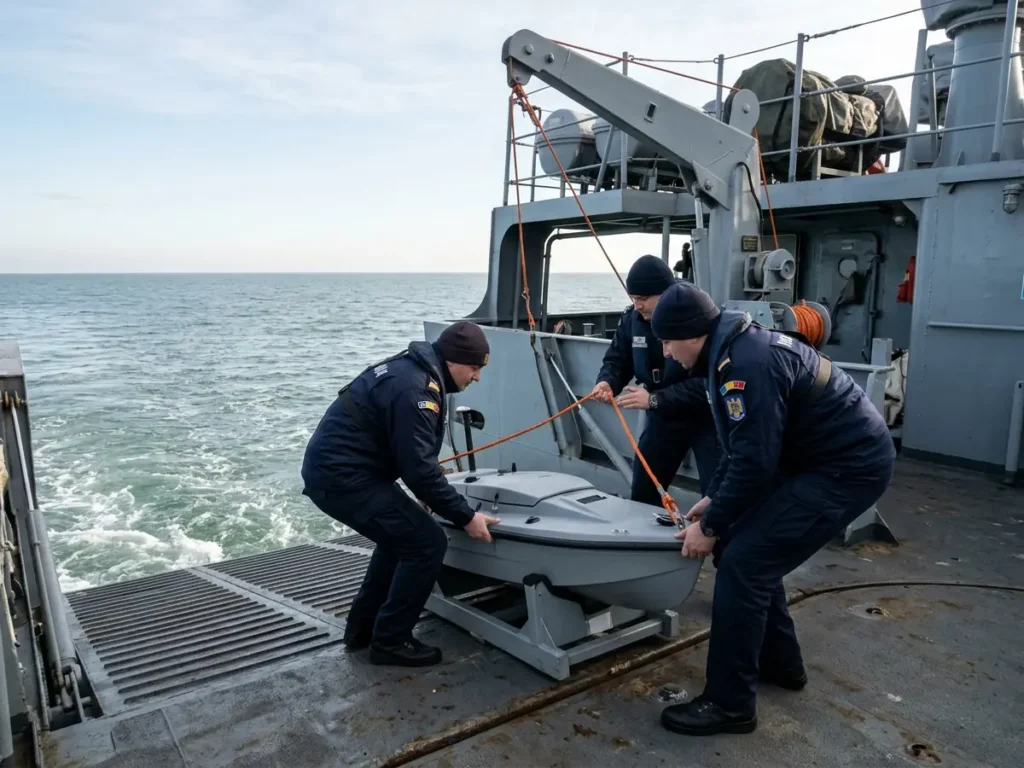
- From 21 October 2026, military ships have a structure of their own for drones. The list of combat groups on board gains the maritime unmanned systems combat group, which the regulation calls the MUS combat group, after Maritime Unmanned Systems. Its commander answers to the commander of the operations combat department, has 2 responsibilities and 9 specific duties, and where the post does not exist in the manning table the tasks pass to the commander of the anti-air and surface combat group.
- 72 points of amendment, 14 new articles, 4 repealed. The regulation also gains a new combat department, military hydrographic and oceanographic survey, with a whole section of responsibilities, plus 12 new points, 4 new paragraphs, 2 new sections and 4 new station bills for aerial drones and for unmanned naval systems. Annex no. 22 is repealed, and Annexes nos. 3, 4, 5, 11 and 15 are rewritten.
- The aviation threshold on board is weight, not the type of aircraft. The aviation combat department becomes operational when state aircraft weighing more than 15 kg are embarked, which means it does so even when those aircraft are only drones. For that case, however, the regulation has no organisation annex at all, and the department’s manning is still written around helicopter posts.
Published: Official Gazette of Romania (Monitorul Oficial), Part I, no. 880 of 21 October 2026, pages 2-16
Who it affects: the crews of the ships, submarines and boats of the Romanian Naval Forces, ship and ship-unit commanders, embarked aeronautical personnel and operators of aerial and naval drones, the doctors and psychologists of ship units, candidates for a naval military career
Takes effect: 21 October 2026, the date of publication, because Article II of the order provides only for publication in the Official Gazette of Romania and sets no other deadline
The Regulations on Service on Board Military Ships, the document that says who does what on a ship of the Romanian Naval Forces, have been rewritten in 72 points. Order no. M.202/2026, signed in Bucharest on 13 October 2026 by the Deputy Prime Minister, Minister of National Defence, Radu-Dinel Miruță, was published in the Official Gazette of Romania, Part I, no. 880 of 21 October 2026, an issue that contains no other act.
The change that shows at once is organisational: two structures that until now did not exist in the regulation appear on board ships. The first is the maritime unmanned systems combat group, added as point (h) to Article 23 and described in Article 1001, an entirely new article. The second is the military hydrographic and oceanographic survey combat department, added as point (g) to Article 18(1) and described in Articles 281 and 1241 to 1244. The superscript numbering is not a typesetting error: Article 281 is an article inserted after Article 28, not Article 281.
For anyone who does not work with this vocabulary, three notions make the text readable. A combat department is a slice of the crew, people plus equipment, gathered around one mission and led by a commander of its own: navigation, operations, aviation, damage control. A station bill is the pre-set assignment of the crew to posts for a given activity, from the manoeuvre of leaving harbour to firefighting. And a ship’s rank is the category it falls into by size, armament and importance, rank 1 being the highest: frigates and large ships, the only ones for which the new order introduces decision-support structures.
What it changes in practice
The order takes effect on 21 October 2026, that is, on the day of publication. Article II says only that the order is published in the Official Gazette of Romania, Part I, without setting an entry-into-force deadline of its own, and normative acts of central public administration bodies that do not set their own deadline enter into force on the date of publication. There is no transitional provision, so all 72 points apply at once, including those that require paperwork on board to be redone.
The first practical effect falls on rank 1 ships. Article 15(2) now says that the two components of a ship are structured into combat departments, combat groups or sections and battle stations, and that rank 1 ships also have decision-support structures. Article 282, new, lists the nine micro-structures that make up this support: chief medical officer, security office, personnel and mobilisation office, boatswain, fire protection, occupational health and safety together with environmental protection, technical supervision and metrology, physical training, crypto custodian and classified documents registry. Article 17 refers the ship’s organisational chart to Annex no. 3, which is rewritten by point 64.
The second effect concerns aviation activity on board. Article 27(1) establishes that the aviation combat department becomes operational when state aircraft weighing more than 15 kg and requiring specialised personnel for maintenance and operation are embarked. The threshold is measured in kilograms, so an aerial drone over 15 kg triggers the setting up of the department exactly as a helicopter does. Along the same line, Article 78 includes in the ship’s crew for a mission, besides the helicopter crew, the operators and remote pilots of unmanned aerial systems, the payload operators, the air traffic controllers, the meteorologist and the technical and engineering personnel.
The third effect touches the ship’s catalogue of station bills. Article 47 gains four new points, from (w) to (z): the bill for moving the aerial drone out of and into the hangar or the parking spot, the bill for preparing it for flight, the bill for preparing the launch and recovery of aerial drones, unmanned surface vessels and uncrewed underwater vehicles, and the bill for responding to a crash or a forced ditching. Point (e) of the same article is rewritten and becomes the bill for the alert states of the unmanned aerial system. Those alert states acquire an article of their own, 681, which ties them to the class and type of aircraft, to the number of operators and to their level of training, and gives them concrete shape through the take-off readiness standard.
The fourth effect is on internal duty service, the part of the regulation that concerns every serviceman, not only those in aviation. Internal duty service is from now on organised at the level of the military installation, Article 368(3), and covers three categories: command continuity duty, standing duty, and guard and response duty. Article 371 sets the length of guard duty and of watch duty at 24 hours, with the watch stood at post, as a rule, in 4-hour shifts. Two new posts appear, the sensors and armament guard officer and the duty diver or duty swimmer, plus the helicopter guard round.
What has changed compared with the previous situation
The underlying regulations were approved by Order of the Minister of National Defence no. M.24/2022, published in the Official Gazette of Romania, Part I, nos. 143 and 143 bis of 11 February 2022. Between that date and 21 October 2026, 1,713 days passed, and the present order is the broadest intervention in them so far: 14 new articles, 2 new sections, 12 new points, 4 new paragraphs, 4 articles repealed in full, 4 smaller units repealed and one annex taken out of the regulation.
Drones were, before, an absence. The old text had no combat group for unmanned systems, no alert states for them and no bills for launch, recovery or crash response. Now Article 180 defines special-purpose military boats as those operating on the surface or underwater, crewed or uncrewed, locally controlled, remotely controlled or autonomous. Article 1001 names the commander of the MUS combat group, places him directly under the commander of the operations combat department, sets out his cooperation with three other combat group commanders and gives him nine specific duties, from planning the use of sensors to checking the registration certificate.
Hydrographic and oceanographic survey work existed as an activity, but not as a combat department. Article 281 says the department becomes operational when survey teams are embarked, and Section 111, with Articles 1241 to 1244, gives its commander nine duties, among them validating survey plans and validating the resulting information, and splits the structure into the hydrographic survey group and the oceanographic survey group, each with seven duties of its own.
On the protection of people, the changes are concrete and numbered. Article 386(3) requires the ship’s commander, when the air temperature is 5 degrees Celsius below zero or lower, and also in rain, blizzard or snow, to provide special protective equipment and to cut the time spent on post by 1 to 2 hours. Paragraph (4) provides, at 35 degrees in the shade or more, for awnings and canopies and the same cut of 1 to 2 hours. Article 3871 places psychological support for internal duty personnel with the unit’s psychologist or with the psychologist assigned to it, and Article 3872 ties selection and medical assessment to the results of the periodic medical check. Article 5271 lists 11 situations in which embarked personnel wear special protective equipment, from missions at sea and the operation of equipment to training sessions, meetings, ceremonies and the receiving of visitors.
Preparation for duty is put on fixed intervals. Article 385 requires a centralised 3 to 4 hour training session at least once every 6 months, by type of duty, and one of 4 to 6 hours for newly appointed personnel or for those who have been away from the ship for more than 3 months. Personnel posted after graduating from a form of education, or those who have been away for more than 3 months, are appointed to internal duty only after at least 15 working days from arriving in the unit, while personnel transferred or seconded from other units start duty on the 11th working day. The selection is made once a year, in November, by a board chaired by the commander of the military installation or by the commander of the ship unit, made up of the head of the security office, the heads of the modules, the commanders of the combat departments, the doctor and the psychologist.
Three smaller changes are worth keeping in mind. Article 162 allows, with the approval of the Chief of the Naval Forces Staff, outings at sea or on the river with military ships for ministry personnel, for servicemen in the reserve or retired and for their families, on festive days or in exceptional situations. Article 1731 obliges the commander of the military installation in military harbours to organise patrols on the water, by day and by night. And Article 236 gains paragraph (21), which stations the force protection section in harbours or at unimproved berths, depending on the threat, to repel surprise attacks on the ship.
Finally, point 72 changes the vocabulary throughout the regulation: the abbreviations for the maritime and river combat groups become GL Mar. and GL Flv., guard duty and response duty merge into guard and response duty, electronic warfare becomes electromagnetic warfare, and military harbour now reads military installation, military harbour.
Advantages and disadvantages
What it improves
- Drones enter the organisation on board with a named commander, with explicit subordination and with 9 duties written down, no longer as an improvisation made up for each mission.
- Article 1001(2) provides the fallback: where the post of commander of the MUS combat group is not in the manning table, the tasks are taken over by the commander of the anti-air and surface combat group, so no one is left without command.
- The four new station bills cover the full cycle of the aerial drone: moving it out of the hangar, preparing it for flight, launch and recovery, and response to a crash or forced ditching.
- Hydrographic and oceanographic survey work now has formal validation of plans and of information, through Article 1241(2)(h) and (i).
- Nine posts on rank 1 ships come out of the informal zone and into the organisational chart, including the chief medical officer, fire protection and the classified documents registry.
- Protection in extreme temperatures acquires numerical thresholds, 5 degrees below zero and 35 degrees in the shade, and measures the ship’s commander is to order.
- The search for and rescue of a man overboard gains, in Article 272, four criteria the commander analyses before calling off the operation, plus the obligation to inform the rescue coordination centre.
- Psychological support and the medical assessment of internal duty personnel become articles of their own in the regulation, with a named holder of the task.
What remains a problem
- A ship that embarks only drones over 15 kg has an operational aviation combat department but no organisation annex at all: Annex no. 4 is for the case with a helicopter on board, Annex no. 5 for the case where the department is not set up.
- Article 209 mans the aviation combat department with a helicopter pilot, an air traffic controller, an embarked technical team and a meteorologist, with no operator or remote pilot post, even though Article 78 already recognises them in the crew for a mission.
- Article 116(3) and (4) answer the same question differently: who commands the aviation combat department of a ship with drones over 15 kg and no helicopter.
- Unmanned naval systems, surface and underwater, appear in a single station bill, the one on preparing launch and recovery, and are missing entirely from the alert states, because Article 681 speaks only of aerial systems.
- The nine insignia added to Annex no. 15 are defined only by colours and dimensions. The title of the annex speaks of armbands and badges, but the order does not say which insignia is worn as an armband and which is pinned on as a badge, nor on which part of the uniform.
- Cutting time on post by 1 to 2 hours in extreme weather comes with no rule on compensating the personnel, and on a 4-hour watch the maximum cut means doubling the number of shifts over 24 hours.
- There are no transitional provisions: organisational charts, station bill registers and internal documents must comply from 21 October 2026, with no adaptation period.
- The catalogue of station bills in Article 47 reaches point (z), so the list is alphabetically exhausted and any future bill will need a point with a superscript.
Practical advice
- On rank 1 ships, redo the organisational chart starting from Articles 15, 17 and 282 and from Annex no. 3 in its new form. The nine decision-support micro-structures must appear in the chart, with the relations between them.
- If the ship embarks drones weighing more than 15 kg and has no helicopter on board, establish in writing, through the chain of command, who the commander of the aviation combat department is. The two paragraphs of Article 116, (3) and (4), lead to different answers, and a decision taken on board without written cover stays with the commander.
- Add the four new bills from Article 47, points (w) to (z), to the ship’s station bill register before unmanned systems are first embarked, not afterwards.
- Check that the documents attesting qualifications are valid for all aeronautical personnel, and that the registration certificate is valid. These are express duties of the commander of the MUS combat group, Article 1001(4)(h) and (i).
- Schedule the centralised training session for standing duty at no more than 6 months. For ships aligning from the date of entry into force, the first deadline falls on 21 April 2027.
- Prepare the November 2026 selection with the board in the new composition set out in Article 382 and with a report drawn up by the operations and training module, the conclusions being entered in the unit’s daily order.
- Work out the personnel needed for the cold season well in advance. A 4-hour watch shortened by 2 hours requires 12 shifts over 24 hours instead of 6, and the annual selection takes place in the very month in which temperatures start to fall below zero.
- Update the abbreviations in every internal document that cites the regulation, in line with point 72, and check each occurrence of the phrase electronic warfare, including in the newly inserted texts.
Frequently asked questions
What is a combat department on board a military ship?
What does the MUS combat group do?
What does a ship’s rank mean and what changes at rank 1?
From what weight is the aviation combat department set up?
Who commands the aviation combat department if there are only drones on board?
What are the alert states of aerial drones?
What changes for guard duty and for watch duty?
Can servicemen’s families go to sea on a military ship?
What measures are compulsory in cold and in heat?
When does the order enter into force and where is the text to be found?
Errors and inconsistencies in the published text
- Art. 27(1)-(3), read together with Annexes nos. 4 and 5 and with Art. 209. Paragraph (1) makes the aviation combat department operational for any state aircraft over 15 kg, so also on a ship that embarks only aerial drones. Paragraph (2) refers the department’s organisation to Annex no. 4, but only when a helicopter is embarked, and the title of the annex, rewritten by point 65, says the same. Paragraph (3) refers to Annex no. 5 only for the case where the department is not set up. The ship with drones over 15 kg and no helicopter falls between the two hypotheses: the department is set up, so Annex no. 5 does not apply, but it has no helicopter, so Annex no. 4 does not either. Article 209 closes the circle, because it mans the aviation combat department with licensed aeronautical personnel in five positions, among them helicopter pilot, with no operator or remote pilot post. A whole category of ships is thus left with a compulsory combat department and no rule on its organisation or manning.
- Art. 116(3) against (4). The first of them provides that „the commander of the aviation combat department is one of the pilots in command from the crews of the embarked helicopter when state aircraft weighing more than 15 kg are on board the ship”, and its condition is tied to weight, a category that includes drones. Immediately after, the text provides that, when only unmanned aerial systems over 15 kg are embarked, the commander is appointed from among licensed, certified or qualified aeronautical personnel. The same set of facts, a ship with drones over 15 kg, receives two answers, and the one in paragraph (3) is impossible to carry out, because there is no helicopter crew from which to pick the commander. The condition „helicopter embarked” is present in paragraph (4) and absent from paragraph (3).
- Art. I point 17, Art. 1001(1)(c) and (4)(e), against Art. I point 72(e). Point 17 inserts a new article in which the commander of the MUS combat group cooperates with „the commander of the communications and electronic warfare combat group”, while point 72(e) of the same order replaces the phrase „electronic warfare” with „electromagnetic warfare” throughout the regulation. Both points enter into force on the same day, so the new text is born carrying a phrase that the same act removes. On top of that, within the same new article, the structure with which the cooperation takes place appears under two different names: „the communications and electronic warfare combat group” in paragraph (1)(c) and „the communications and information technology combat group” in paragraph (4)(e).
Editorial analysis
The order does the hard thing properly and leaves the easy thing undone. The hard part was to lift unmanned systems out of improvisation and give them a structure with a commander, a chain of command and duties, and Article 1001 does exactly that, across nine duties and with a fallback clause that moves the tasks to the commander of the anti-air and surface combat group where the post does not yet exist in the manning table. The easy part was to align with the new reality the three articles that describe the manning of the aviation combat department, 209, 210 and 211, and the two organisation annexes. There the text has stayed written for the helicopter: the minimum crew is pilot in command, co-pilot and flight engineer, the technical team has four classic aviation specialities, and the blade-folding and helicopter-handling section figures in Annex no. 4 with no counterpart for a drone. The result is a regulation that tells you the department must be set up but does not tell you with whom.
The second observation does not show when you read the act from end to end; it shows when you count. After being supplemented with points (w) to (z), Article 47 reaches 26 station bills, from (a) to (z), so the list is alphabetically exhausted at the very moment when equipment on board is diversifying fastest. Any future bill, say one for responding to the loss of an unmanned surface vessel, which is missing now, will enter the regulation as a point with a superscript, that is, in the same notation the text has already been forced to use for 14 articles and 2 sections. Of the four new bills, three concern aerial systems only, and naval systems appear just once, in the bill on preparing launch and recovery. A combat group christened „maritime unmanned systems” is thus left with no bills for the maritime part and no alert states, because Article 681 grants those expressly to organic aerial systems alone.
The third observation comes from combining two provisions that are not read together. Article 371 sets the watch at 24 hours, stood in 4-hour shifts, that is, 6 shifts a day at each post. Article 386 requires, at 5 degrees below zero, that time on post be cut by 1 to 2 hours, which turns those 6 shifts into 8 or even 12 and calls, at the peak, for twice the personnel available for watchkeeping, with no provision on compensation. The annual selection of personnel for internal duty takes place, under Article 382, in November, that is, in the month when the temperature threshold starts to be reached. A second calculation from the same area: a graduate posted to a unit waits at least 15 working days before being appointed to internal duty, while a serviceman transferred or seconded from another unit starts duty on the 11th working day, a week earlier, although neither of them has necessarily stood duty on board that ship.
Finally, Article 272 produces a result worth reading twice. Its last paragraph says that, in time of war, the provisions of paragraph (1) are not compulsory, that is, the commander’s obligation to take every measure for the search and rescue of a man overboard. Paragraphs (2) and (3), however, remain untouched, so the obligation to consult higher echelons and the rescue coordination centre before leaving the area and calling off the search for survivors applies in wartime too. The resulting order is the reverse of the intuitive one: the duty to stop searching by the rules outlives the duty to search.
What should be changed
- An organisation annex for an aviation combat department set up with unmanned systems only. The ship would know how many operators and remote pilots it embarks, what technical team and what deck section it needs, and the commander would no longer be applying by analogy an annex written for a helicopter.
- Adding the condition „helicopter embarked” to Art. 116(3). The commander of the aviation combat department would be appointed straight from the text, with no interpretation and no risk of a decision taken on board being challenged.
- Supplementing Art. 209 with the posts of operator or remote pilot and of payload operator. They are already recognised in Art. 78 as part of the ship’s crew for a mission, and including them would give manning tables an explicit basis for those posts.
- Extending Art. 681 to unmanned surface vessels and uncrewed underwater vehicles, or an express mention that it does not apply. It would be clear whether a naval drone can be held at alert and against what standard, and the MUS combat group would have rules for all its equipment, not just for the aerial part.
- Renumbering the station bills in Art. 47 with figures instead of letters. The list is exhausted at point (z), and numbering with figures would allow future bills to be added without superscripts, which make citation in documents on board harder.
- A rule on compensation for the shortening of time on post in extreme weather. The ship’s commander would no longer be put in the position of choosing between protecting the crew and covering the posts, and personnel planning for the cold season would rest on a calculation rather than on availability.
Original text of the legal act
The text below is reproduced in Romanian, the official form of publication.
The full text, as published in the Official Gazette of Romania
Official Gazette of Romania no. 880 of 21 October 2026, pages 2-16 16 pages PDF, 684 KB the act starts on page 2
Open the official PDFDownload the PDF
The viewer is not shown on small screens. Use the buttons above to open or download the file.
This article is for informational purposes only and does not constitute legal advice. For specific situations, consult a licensed attorney or tax advisor.