
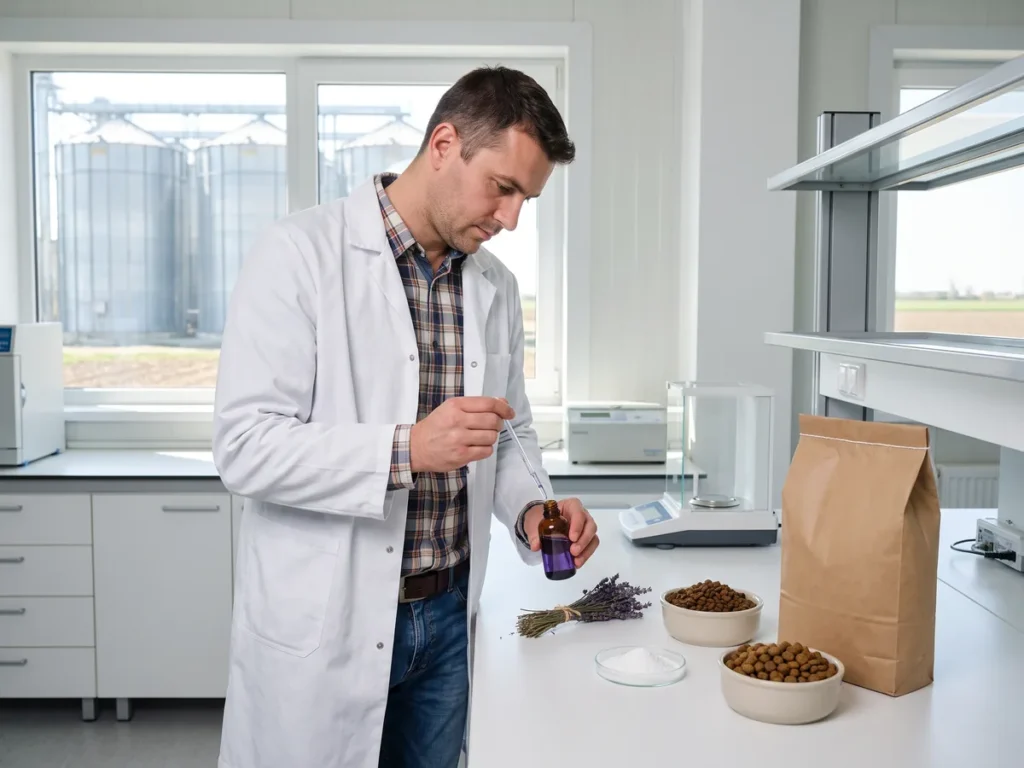
In brief
- Both regulations date from 25 September 2026, and from 15 October 2026 they take effect. Commission Implementing Regulation (EU) 2026/2120 and Commission Implementing Regulation (EU) 2026/2129 were adopted in Brussels on 24 September 2026 and published in the Official Journal of the European Union, L series, of 25 September 2026. Article 5 of the first and Article 4 of the second say the same thing: entry into force occurs „on the twentieth day following that of its publication”. Counting from 25 September 2026, the twentieth day is 15 October 2026.
- Lavender tincture from Lavandula angustifolia Mill. is authorised for all animal species, with a maximum dose for each species. The identification number is 2b257-t, the category is „sensory additives”, the functional group „flavouring compounds”, and the period of authorisation ends on 15 October 2036, that is exactly ten years. The ceilings run from 60 milligrams of additive per kilogram of complete feed, for chickens for fattening, up to 500 milligrams for ornamental fish, with 284 for dogs and 237 for cats.
- The tincture from the hybrid Lavandula angustifolia × L. latifolia is withdrawn from the market for all species, on three steps of date. Stocks of the additive may be sold and used until 15 October 2027, premixtures produced with it until 15 January 2028, and compound feed and feed materials made with the additive or with the premixture until 15 October 2028. Unlike the other timetable in the same act, these are closing dates, and the day on which the product was made does not change them.
- The reason for the withdrawal is not a risk that was found, but a dossier that was never filed. Recital (5) of Regulation 2026/2120 records that the applicant submitted no data for any tincture obtained from the hybrid, and recital (6) that it subsequently withdrew its application for that substance. The withdrawal is ordered on the basis of Article 10(5) of Regulation (EC) No 1831/2003.
- L-cysteine hydrochloride monohydrate stays in cat and dog food, but with a new mandatory statement on the label. Authorisation number 2b920 is renewed until 15 October 2036, Commission Implementing Regulation (EU) 2015/2306 is repealed, and the additive label must from now on bear „Maximum recommended content of active substance in complete feed with a moisture content of 12 %: 25 mg/kg”.
- Who it touches in Romania and who checks. Importers and distributors of feed additives, premixture plants, compound feed mills, farms that mix their own rations and pet food manufacturers. Enforcement falls to the National Sanitary Veterinary and Food Safety Authority (ANSVSA), a competence that follows from Government Decision no. 1.415/2009.
A feed additive in the „flavouring compounds” group neither feeds the animal nor cures it. It makes the ration acceptable in taste and smell, so that it is eaten in full and in the same way from one batch of raw material to the next. Lavender tincture belongs to this group, and recital (5) of Regulation 2026/2120 explains why it was no longer asked for proof of efficacy: the flowers of Lavandula angustifolia Mill. and the preparations obtained from them are recognised as flavourings for foodstuffs, and their function in animal feed is, in essence, the same.
The two regulations each close an old file in their own way. Until now, both lavender tinctures were on the market without a time limit, authorised under Council Directive 70/524/EEC and subsequently entered in the Register of Feed Additives as existing products, on the basis of Article 10(1)(b) of Regulation (EC) No 1831/2003. The re-evaluation required by Article 10(2) of that regulation caught both of them in the same application. From there the paths part: one comes out with a modern authorisation, with doses and conditions written down, the other comes out altogether.
Their parting comes from the dossier, not from a difference in risk. Lavandula angustifolia Mill. is the species itself. The other substance is obtained from the hybrid between it and Lavandula latifolia, that is, from a different plant, with a different composition of oils. For the first, the European Food Safety Authority gave an opinion on 25 June 2025 (EFSA Journal 2025;23(7), e9550), with maximum concentrations for each species. In the same opinion, the authority found that for no tincture obtained from the hybrid had the applicant submitted data. Without data there is no assessment, and without an assessment there is no authorisation. The applicant drew the conclusion itself and withdrew its application for the hybrid, which obliged the Commission to adopt a regulation withdrawing it from the market.
The second act is smaller, but it touches a shelf that many people look at: food for cats and dogs. L-cysteine hydrochloride monohydrate, a flavouring authorised in 2015 for ten years, gets its renewal. In exchange, a figure appears that until now existed nowhere in the authorisation.
On 16 October 2026 the veterinary authority opened the way for vaccines not authorised in the Union in epidemic situations.
What it changes in practice
From 15 October 2026, lavender tincture from Lavandula angustifolia Mill. may be used only under the conditions set out in the Annex to Regulation 2026/2120. The additive is identified by number 2b257-t, EC number 289-995-2, CAS number 90063-37-9 and number 257 of the Council of Europe nomenclature. It is a liquid tincture, obtained from dried flowers by extraction with a mixture of water and ethanol, pressing and filtration, and the specification fixes its dry matter range between 1.62 % and 1.76 % and ceilings for nine components, among them linalool at no more than 0.0170 %, camphor at no more than 0.0190 % and methyl eugenol at no more than 0.0008 %.
The use ceiling is expressed in milligrams of additive per kilogram of complete feed with a moisture content of 12 %, and the Annex gives it for each species or category:
- chickens for fattening and minor poultry for fattening: 60; turkeys for fattening: 81;
- all poultry reared for laying or breeding: 89; all poultry for laying and breeding: 89; ornamental birds: 89;
- piglets, suckling and weaned, of all Suidae species: 108; pigs for fattening, including those of minor species: 129; all Suidae species for reproduction: 157;
- calves for fattening, up to a maximum age of 6 months: 269; cattle for fattening and other ruminants for fattening, except sheep, goats and calves up to 6 months old: 237; sheep and goats: 237; equidae: 237; all other ruminants and other Camelidae: 154;
- Leporidae: 95; salmonids and minor finfish species: 270; ornamental fish: 500;
- dogs: 284; cats: 237;
- other species and categories: 60.
The last row matters more than it looks. Any species that does not appear on the list falls under „other species and categories”, that is, under the lowest ceiling in the whole table. And the calf for fattening changes its ceiling at 6 months: 269 until then, 237 afterwards, because it moves into the row for cattle for fattening.
Four conditions go with the authorisation, written under the heading „other provisions”. The additive is to be incorporated into feed only in the form of a premixture. The directions for use of the additive and of the premixtures must indicate the storage conditions and the stability to heat treatment. Simultaneous use of lavender tincture with other feed additives remains permitted, provided that the combined content of p-allylalkoxybenzenes, that is methyleugenol, estragole, elemicin, safrole, myristicin, dillapiole and apiole, remains below the content that would result from using, at the maximum or recommended dose, the authorised feed additive with the highest content of those substances for the species concerned. And, for people, feed business operators must establish operational procedures and organisational measures for the risks resulting from handling; where the risks cannot be eliminated in that way, the additive and the premixtures are to be used with personal skin, eye and breathing protective equipment. The substance was classified by the authority as a skin and eye irritant and a skin and respiratory sensitiser, with possible exposure to methyleugenol during handling.
One request was expressly refused. Recital (4) shows that the applicant also wanted authorisation for use in drinking water, but Regulation (EC) No 1831/2003 does not allow „flavouring compounds” to be authorised for drinking water. Lavender tincture in the water of the drinkers therefore remains not permitted.
For the substance that stays on the market, Article 3 of Regulation 2026/2120 gives a breathing space on three levels, all of them tied to the date of production and labelling. The additive and the premixtures produced and labelled before 15 April 2027, under the rules applicable before 15 October 2026, may be sold and used until existing stocks are exhausted. For compound feed and feed materials containing this additive, produced and labelled before 15 October 2027, selling and use run until stocks are exhausted if they are intended for food-producing animals. For non-food-producing animals, the production date moves up to 15 October 2028. Nowhere in Article 3 is there a final date of use: once the stock has been produced in time, it is used up until it runs out.
For the substance that leaves, Article 4 works the other way round. There the threshold is set on the last day on which the product may still circulate, whenever it was made. Existing stocks of the additive obtained from the hybrid may be placed on the market and used until 15 October 2027. Premixtures made with it, until 15 January 2028. Compound feed and feed materials made with the additive or with the premixture, until 15 October 2028. These are firm deadlines, with no „until stocks are exhausted”, and they draw no distinction between food-producing animals and the rest.
The second regulation renews the authorisation of L-cysteine hydrochloride monohydrate, number 2b920, for cats and dogs until 15 October 2036, and repeals Commission Implementing Regulation (EU) 2015/2306. The authority confirmed, in its opinion of 18 November 2025 (EFSA Journal 2025;23(12):e9783), that the substance remains safe for cats, dogs, users and the environment under the authorised conditions of use, classified it as an irritant to skin, eyes and mucous membranes, and stated that any exposure is considered a risk. Efficacy was no longer assessed, because the renewal application proposed no change to the conditions that would affect it. The new Annex sets no maximum content, nor a minimum one. In its place, point 3 of „other provisions” requires the additive label to state „Maximum recommended content of active substance in complete feed with a moisture content of 12 %: 25 mg/kg”, and point 4 adds an obligation for the premixture manufacturer: if the use level indicated on the premixture label would lead to that recommended content being exceeded, the label must also show the functional group, the identification number, the name and the added amount of active substance. There are two transitional measures: 15 April 2027 for the additive and premixtures, 15 October 2028 for compound feed and feed materials, in both cases as dates of production and labelling, with use until stocks are exhausted. On the same subject, Implementing Decision (EU) 2026/2119 and the other decisions postponing the expiry of approval for active substances used in biocidal products stop a similar timetable before it starts.
In Romania, both regulations apply directly, without any transposing act, because they are regulations. The obligation to comply needs no new national rule: Article 12(1) of Regulation (EC) No 1831/2003 places on anyone who uses or places on the market the substance, or a feed into which it has been introduced, the responsibility for ensuring compliance with the conditions and restrictions imposed. Official controls on feed, premixtures and feed additives fall within the competence of the National Sanitary Veterinary and Food Safety Authority, a competence that follows from Article 1(1) and Article 3(1)(A), point 15, of Government Decision no. 1.415/2009, published in the Official Gazette of Romania (Monitorul Oficial), Part I, no. 834 of 3 December 2009. A national act designating it with the formula „competent authority within the meaning of Regulation (EC) No 1831/2003” could not be identified, so the competence is read from the decision, not from an express designation. The amounts of the administrative fines applicable in this field cannot be confirmed in the version in force, so they are not given here.
What has changed compared with the previous situation
Before 15 October 2026, the two lavender tinctures sat on the market under the regime for existing products: authorised without a time limit under Directive 70/524/EEC, entered in the Register, used under the old labelling conditions for compound feed and feed materials. That the new regime is a different one is said by the act itself: recital (11) speaks of „the modifications of the conditions of the authorisation” and of „the new requirements resulting from the authorisation”, and recital (8) of „the setting of a maximum content for this feed additive in complete feed”, that is, of a figure that has to be fixed, not updated. From 15 October 2026, one of the two tinctures has ceilings per species, written conditions of use and an expiry date, 15 October 2036; the other has nothing left, only an exit timetable.
For L-cysteine hydrochloride monohydrate, the comparison with Commission Implementing Regulation (EU) 2015/2306, the act repealed, shows where control has in fact moved. The identification number stays 2b920, the species stay cats and dogs, the chemical formula stays C3H7NO2S·HClH2O, the CAS number stays 7048-04-6, the minimum purity stays 98.5 %, and the maximum content stays unset, exactly as in 2015. The changes are elsewhere. The first: the obligation to incorporate the additive in the form of a premixture did not exist in the 2015 authorisation and appears now. The second: the line with 25 mg/kg on the additive label is entirely new, and with it the obligation to give additional information on the premixture label when the use level would lead to it being exceeded. The third: the instruction from 2015 requiring supplementation to be made „in relation to the needs of cats and dogs for sulphur-containing amino acids and to the level of other sulphur-containing amino acids in the ration” has disappeared from the new Annex.
The fourth change concerns the protection of people and runs the other way from the rest. In 2015 the text was categorical: „during handling, users should wear breathing protection, safety glasses and gloves”. In 2026, personal protective equipment appears only as a fallback, after the operator has established operational procedures and organisational measures, and only if the risks cannot be eliminated by those. The new wording is the one in the Commission’s current template and shifts the emphasis from equipment to the organisation of work, but, on paper, the mask and the glasses are no longer imposed unconditionally for a substance of which the authority says, in the same act, that any exposure is considered a risk.
The methods of analysis have changed too. In 2015 the additive was quantified by titrimetry, according to the European Pharmacopoeia, and cyst(e)ine was determined in premixtures and in feed by ion exchange chromatography, under Regulation (EC) No 152/2009. The Annex from 2026 moves identification to the monograph in the Food Chemicals Codex, determination in the additive to ion exchange chromatography with optical detection, and determination in premixtures again to ion exchange, with a reference to Regulation (EC) No 152/2009. The method for determination in finished feed, present in 2015, no longer appears. That is consistent with the fact that there is no legal maximum content to check in the feed, but it means that the only point of control left is the label, not the product in the bag.
There is one more difference of calendar, invisible in the text of the new act. The authorisation granted by Regulation 2015/2306 had 31 December 2025 as the end of its period. The renewal enters into force on 15 October 2026, that is 288 days later. The gap is covered by Article 14(4) of Regulation (EC) No 1831/2003, which automatically extends the period of authorisation until the Commission decides, where that decision is not taken before expiry for reasons beyond the applicant’s control. The practical consequence is that the new ten-year period is counted from the entry into force of the renewal, not from the expiry of the old one, so the total cover reaches ten years and almost ten months.
Advantages and disadvantages
What it improves
- Lavender tincture from Lavandula angustifolia Mill. has, for the first time, written ceilings for each species, from 60 to 500 milligrams per kilogram of complete feed. Until now, a manufacturer who wanted to stay on the safe side had nowhere to take a figure from.
- The hybrid is not withdrawn overnight. The three steps, 15 October 2027, 15 January 2028 and 15 October 2028, follow the real production chain: additive, premixture, feed, so the stock is not thrown away.
- The dates are calendar dates and exact, with no deadline to calculate. There is no formula of the kind „within 18 months of”, which forces every operator to do the arithmetic alone and to get it wrong on their own account.
- The rule on the combined content of p-allylalkoxybenzenes closes a real loophole: without it, a manufacturer could comply with the ceiling for each flavouring additive taken separately and, by adding several together, end up well above the exposure the opinion considers acceptable.
- The line with 25 mg/kg on the label of the L-cysteine additive finally gives a verifiable figure where the authorisation from 2015 had none, and the information obligation on the premixture label makes it traceable one step further along the chain.
- Both authorisations end on the same day, 15 October 2036, which makes it simpler to plan renewal dossiers for anyone working with both substances.
What remains a problem
- The premixture step in the withdrawal timetable gets 92 days after the additive step, from 15 October 2027 to 15 January 2028, while from premixture to feed 274 days are given. Someone who legally buys the last case of additive on 14 October 2027 has three months to turn it into a premixture and sell it.
- Compound feed made with the tincture from the hybrid may circulate until 15 October 2028, that is 1,208 days after the opinion of 25 June 2025 in which it was recorded that no data had been submitted for this substance. The substance without a dossier has, in feed, a longer breathing space than its departure from the market would suggest.
- Article 3 fixes no final date of use. Pet food produced under the old rules on 14 October 2028 may be passed on indefinitely, with no obligation to comply with the new ceilings per species, as long as the stock lasts.
- For finished food for cats and dogs nothing changes in plain sight. The figure of 25 mg/kg is only recommended and appears solely on the additive label and, conditionally, on that of the premixture. The buyer in the shop has no way of learning it.
- The act does not give the identification number of the withdrawn additive. The hybrid is identified only by its botanical name, and whoever checks a stock or a recipe has to make the link with the entry in the Register himself.
- User protection for L-cysteine hydrochloride monohydrate weakens on paper. The mask, the glasses and the gloves, unconditionally mandatory in 2015, become a fallback in 2026, for a substance for which any exposure is considered a risk.
- In Romania there is no express designation of the competent authority within the meaning of Regulation (EC) No 1831/2003, and the applicable penalty regime cannot be confirmed in the version in force. The operator knows exactly what to do and by when, but does not know exactly what is at stake if he does not.
Practical advice
- Take stock now of everything that contains lavender tincture and separate the two substances clearly. The label and the technical sheet must say what the tincture was obtained from: Lavandula angustifolia Mill. or the hybrid Lavandula angustifolia × L. latifolia. If the sheet does not say so, ask the supplier in writing, because his answer decides whether the stock has ten years ahead of it or one.
- Put the six dates in the production calendar, separately for each substance: 15 April 2027, 15 October 2027 and 15 October 2028 for the tincture that stays, plus 15 October 2027, 15 January 2028 and 15 October 2028 for the one being withdrawn. The two calendars share dates but not meanings: in the first what counts is the day you produced, in the second the day you sell or use.
- If you make premixtures with the tincture from the hybrid, plan the last batch well ahead. Between the last day on which you may buy the additive and the last day on which you may sell the premixture there are 92 days, and a batch held up in quality control eats them quickly.
- Enter the ceilings per species in the formulation software as a calculation limit applied automatically, and add the age threshold for calves: 269 milligrams per kilogram up to 6 months, 237 afterwards. Check separately which recipes go to species that do not appear in the table, because those fall to 60, the lowest ceiling in the Annex.
- Check cumulative exposure to p-allylalkoxybenzenes, beyond the ceiling for the tincture. If the same recipe also takes in other flavourings containing methyleugenol, estragole, safrole or the other substances on the list, the calculation is made on their sum, and the document showing that calculation is what you will have to put on the table at an inspection.
- Do not dose lavender tincture into drinking water. Authorisation for water was requested and expressly refused, because Regulation (EC) No 1831/2003 does not allow flavouring compounds to be authorised for this use.
- Put the line with „25 mg/kg” on the label of the L-cysteine hydrochloride monohydrate additive by 15 April 2027 and check, for each premixture, whether the use level you indicate on the label exceeds that recommended content. If it does, the premixture label must also bear the functional group, number 2b920, the name and the added amount of active substance.
- Write the user protection procedures before 15 October 2026 and keep them dated. The obligation goes further than equipment: you must be able to show what operational procedures and what organisational measures you have established, and why personal equipment remained necessary or not.
Frequently asked questions
Can I go on using lavender tincture in feed after 15 October 2026?
How long can I still sell compound feed made with the tincture from the hybrid?
What do I do with the stock of additive from the hybrid that I have in the warehouse?
Do I have to change the labels right from 15 October 2026?
Does anything change for the cat and dog food in the shop?
Who checks in Romania and what happens if I do not keep to the dates?
Why was the tincture from the hybrid withdrawn, if it had been in use for decades?
Editorial analysis
The two regulations do a job that someone had to do: after 23 years, they close the re-evaluation of two substances inherited from the regime of Directive 70/524/EEC. The result is good in substance. Lavender tincture from Lavandula angustifolia Mill. leaves the grey zone in which it had been authorised „without a time limit” and enters a regime with ceilings for 20 categories of animals, with the premixture obligation, with a summation rule for p-allylalkoxybenzenes and with an expiry date. The tincture obtained from the hybrid leaves altogether, without the Union having had to invent a safety reason that did not exist: the reason is the true one, nobody paid for the dossier.
Where the acts fall short shows in the ratio between the deadlines the administration gives itself and those it imposes on the addressee. Article 9(1) of Regulation (EC) No 1831/2003 obliges the Commission to prepare the draft regulation „within three months of receiving the opinion of the authority”, with the possibility of an extension in particularly complex cases. The opinion on lavender is from 25 June 2025, and the regulation was adopted on 24 September 2026: 456 days, that is almost five times the reference period. For L-cysteine hydrochloride monohydrate, the opinion is from 18 November 2025 and the adoption from 24 September 2026: 310 days, of which 218 after the three months had run out. The operator is given, for the first step, 182 days, from 15 October 2026 to 15 April 2027. Neither of the two acts explains why it took so long, and the recitals do not mention the particular complexity that Article 9 would have required as justification.
The second observation is not visible by reading the act from start to finish, but by putting Article 4 next to recital (5). The authority recorded on 25 June 2025 that there are no data for the tincture from the hybrid. Compound feed made with it may circulate and may be used until 15 October 2028, that is 1,208 days, almost three years and four months, after that finding. The breathing space itself is defensible, recital (12) justifies it by the need for stocks to be used up in full. The problem is the scale of the steps in Article 4, which does not follow the real length of the chain. Between additive and premixture 92 days are given, between premixture and feed 274. A premixture manufacturer who legally buys additive on the last day permitted has three months for production, control, labelling and sale, while the feed manufacturer, who comes after him, has nine.
The third point concerns the renewal and what exactly was renewed. The comparison with Commission Implementing Regulation (EU) 2015/2306 shows that the dose has not changed, because there was no maximum content and there still is none; the species have not changed; the purity and the chemical identification have not changed. Three things have changed: the additive must from now on be incorporated through a premixture, a figure has to be written on its label, 25 milligrams per kilogram of complete feed, and personal protective equipment has moved from an unconditional obligation to a fallback. The first two shift the point of control from the product to the paper, which is consistent with the absence of a legal ceiling, but they leave the chain without any place where the figure could be checked by analysis: the new Annex does not even keep the method for determination in finished feed, which the Annex from 2015 had. The third change is the only one that weakens a requirement, and it does so for a substance of which the same act says that any exposure is considered a risk. The comparison also yields a figure that appears nowhere in the new act: the old authorisation expired on 31 December 2025, the renewal enters into force on 15 October 2026, and the 288 days between them are covered by the automatic extension in Article 14(4) of Regulation (EC) No 1831/2003. Because the new ten-year period runs from the entry into force, the holder ends up with ten years and almost ten months of cover for a ten-year renewal.
What should be changed
- The identification number of the withdrawn additive should be written in the act. Article 2 withdraws the tincture from the hybrid only by its botanical name, while the authorised substance receives number 2b257-t. An inspector checking a recipe or a batch would need the entry in the Register in order to make the identification without interpreting it himself, and the operator would have an objective criterion for classifying his stock.
- The premixture step in the withdrawal timetable should get the same breathing space as compound feed. With 92 days between the last day for selling the additive and the last day for selling the premixture, part of the additive bought legally cannot be turned to account. Aligned at six months, the two steps would follow the real production chain and would reduce the quantity of additive that ends up as waste precisely because it was bought in time.
- Article 3 should also have a final date of use, not only a date of production. As it is written, pet food produced under the old rules on 14 October 2028 may be used indefinitely, without complying with the ceilings per species that the authority’s opinion established. A closing date, even a distant one, would make the ceilings effectively applicable to all feed, not only to that produced after the transition.
- The maximum recommended content of 25 mg/kg should appear on the packaging of finished food for cats and dogs as well. As the regulation is written, the figure stops on the additive label and, conditionally, on that of the premixture. Carried over to the product on the shelf, it would let the veterinarian and the owner compare rations, and let the manufacturer who stays below the threshold show that as an argument.
- Determination of the active substance in finished feed should stay in the Annex, even without a legal ceiling. The Annex from 2015 had the method, the one from 2026 no longer does. Kept, it would give official laboratories a single reference when they check a complaint or a suspicion, instead of each choosing its own method.
- Going beyond the three-month deadline in Article 9(1) should be justified in the recitals. At 456 days from opinion to adoption, a single recital saying what exactly called for the extension would turn an opaque delay into a verifiable decision and would give operators a basis for asking, in their turn, for proportionate breathing space.
Original text of the legal act
The text below is reproduced in Romanian, the official form of publication.
The full text, as published in the Official Gazette of Romania
Official Journal of the European Union, L series, of 25 September 2026 5 pages PDF, 483 KB
Open the official PDFDownload the PDF
The viewer is not shown on small screens. Use the buttons above to open or download the file.
This article is for informational purposes only and does not constitute legal advice. For specific situations, consult a licensed attorney or tax advisor.