
In brief
- Three European Commission decisions keep wood treatment products, metalworking fluids and part of the disinfectant range on the market. Implementing Decisions (EU) 2026/2119, 2026/2124 and 2026/2131 were published in the Official Journal of the European Union, L series, of 25 September 2026, and under Article 2 of each of them they enter into force on the twentieth day following publication, that is on 15 October 2026.
- Each of the three decisions pushes back the date on which the approval of an active substance expires. K-HDO, used to preserve wood, moves from 31 December 2026 to 30 June 2029. IPBC, used to preserve working fluids, moves from 30 November 2026 to 31 May 2029. Hydrogen peroxide moves from 31 January 2027 to 31 July 2029.
- This is no registry formality. A biocidal product is authorised only if its active substances are approved for the relevant product-type, under Article 19(1), point (a), of Regulation (EU) No 528/2012. Once that condition is no longer met, the authority cancels or amends the authorisation, under Article 48(1), point (a), and stocks are run down within a grace period of no more than 180 plus 180 days, under Article 52. Without the postponement, the products would have left the market.
- One use is lost all the same. The approval of hydrogen peroxide covered product-types 1-6, but the renewal applications submitted on 29 July 2025 concern only types 1-5. For type 6, preservatives for products during storage, no application was submitted, so the approval expires on 31 January 2027, 108 days after 15 October 2026, and nothing extends it.
- In Romania, biocidal products are authorised by the National Commission for Biocidal Products, a specialist body attached to the Ministry of Health, set up by Government Decision no. 617/2014, Article 5(1). The three decisions ask nothing of the ordinary buyer: they apply directly, and their effect is that existing authorisations need not be touched.
Published: Official Journal of the European Union, L series, of 25 September 2026
In force from: 15 October 2026, the twentieth day following publication, under Article 2 of each of the three decisions
Applies from: directly, in all Member States, from 15 October 2026
A decision postponing an expiry date looks, at first glance, like a piece of administrative bookkeeping. It is not. Behind the three acts published in the Official Journal of the European Union, L series, of 25 September 2026 sit products that somebody buys and uses: the solution that treats construction timber so insects do not eat it, the additive that stops the coolant of a lathe from spoiling, the surface disinfectant and the one used to treat drinking water.
The legal mechanism is simple and brutal. An active substance is approved at Union level for certain product-types, for a set period. A biocidal product containing the substance is authorised, in a Member State, only if the substance is approved for the relevant product-type, under Article 19(1), point (a), of Regulation (EU) No 528/2012 concerning the making available on the market and use of biocidal products. If the approval of the substance expires, the condition in Article 19 is no longer met, and the competent authority cancels or amends the authorisation of the product, under Article 48(1), point (a). On top of that, Article 17(1) states that biocidal products are not to be made available on the market or used unless they are authorised. What is left after cancellation is only the grace period in Article 52: no more than 180 days for making available on the market and a further 180 days at most for the disposal and use of stocks.
The three decisions stop exactly this chain before it starts. All three rest on the same text, Article 14(5) of Regulation (EU) No 528/2012: where, for reasons beyond the applicant’s control, the approval is likely to expire before a decision has been taken on its renewal, the Commission postpones the expiry date for a period sufficient to allow the application to be examined. The postponement is not the same thing as a renewal: it is a pause. At the end of it the approval may or may not be renewed, and Article 14(6) provides that, if renewal is refused, Member States cancel the authorisations of the products of the relevant product-types.
On 16 October 2026 a correction swapped two analysis methods in the wastewater penalties annex.
On 16 October 2026 the Commission set the uniform emission conditions for poultry and pig farms.
Two more biocidal active substances have been renewed until 2041: hydrochloric acid in disinfectants and muscalure in fly traps.
What it changes in practice
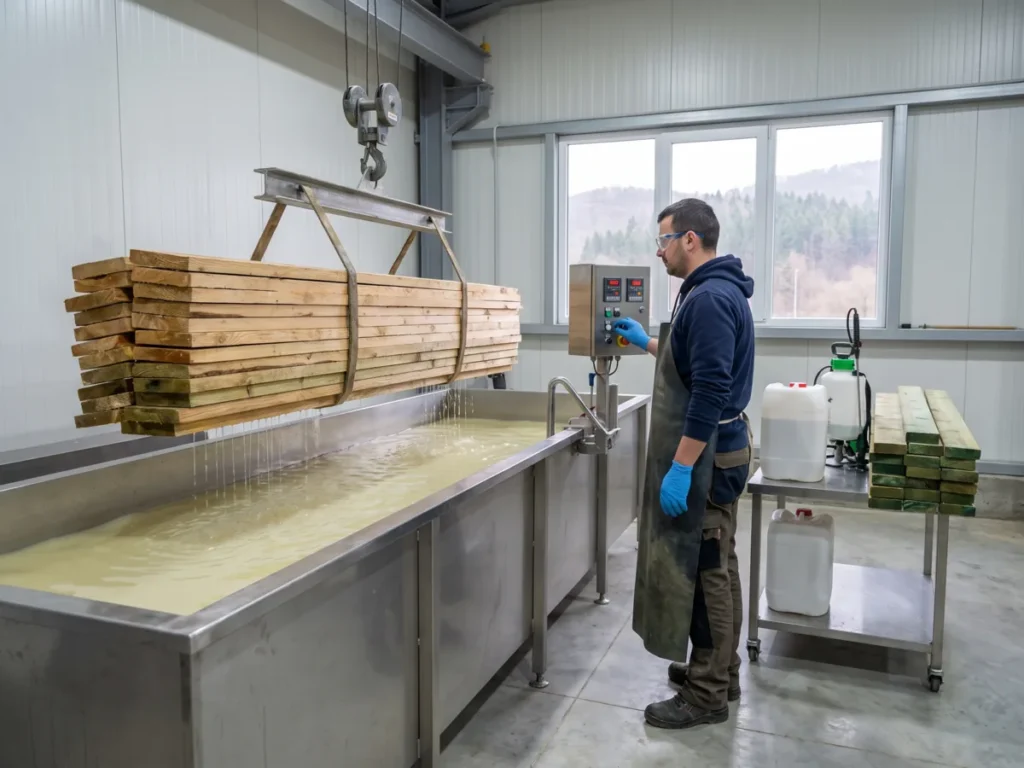
K-HDO, wood preservation, product-type 8. Annex V to Regulation (EU) No 528/2012 describes type 8 as wood preservatives: products used for the preservation of wood, from and including the saw-mill stage, or of wood products, by controlling wood-destroying or wood-disfiguring organisms, including insects, both preventively and curatively. Decision (EU) 2026/2119 moves the expiry date from 31 December 2026 to 30 June 2029, that is 912 days, the last day of the month 30 months out. The evaluating competent authority is Austria’s, which on 29 January 2026 informed the Commission that the evaluation is running late because of efficacy data and the examination of endocrine-disrupting properties, under recital (8). The assessment report is not expected before the fourth quarter of 2027.
IPBC, working fluids, product-type 13. Annex V calls type 13 working or cutting fluid preservatives and describes it as products to control microbial deterioration in fluids used for working or cutting metal, glass or other materials. Not metal alone, then: glass and the other materials count just the same. Decision (EU) 2026/2124 moves the date from 30 November 2026 to 31 May 2029, that is 913 days. The evaluating competent authority is Denmark’s, which on 10 March 2026 told the Commission that the application includes studies new by comparison with the original approval dossier and that the evaluation is delayed for reasons beyond the applicant’s control, under recital (6). The recommendation to the European Chemicals Agency is not expected before the end of 2027.
Hydrogen peroxide, product-types 1-5. Here there are five uses, and they cover the ground closest to everyday life. Under Annex V, type 1 is human hygiene, with products applied on the skin or the scalp in order to disinfect them. Type 2 is called „disinfectants and algaecides not intended for direct application to humans or animals” and covers the disinfection of surfaces, materials, equipment and furniture, but also swimming pools, aquariums, air conditioning systems, walls and floors in private, public and industrial spaces, air, water that is not for consumption, chemical toilets, waste water, hospital waste and soil. Type 3 is veterinary hygiene. Type 4 is the food and feed area, meaning the disinfection of equipment, containers, utensils, surfaces and pipework used in the production, transport, storage or consumption of food, including drinking water. Type 5 is the disinfection of drinking water itself, for people and for animals. Decision (EU) 2026/2131 moves the date from 31 January 2027 to 31 July 2029, that is 912 days. The evaluating competent authority is Finland’s, which on 16 March 2026 announced that the evaluation is running late because of data for determining the exact composition of the substance, on an analysis of five batches, under recital (6). The report is not expected before the first quarter of 2028.
What is not postponed. Implementing Regulation (EU) 2015/1730 approved hydrogen peroxide for product-types 1, 2, 3, 4, 5 and 6, with expiry on 31 January 2027. The applications submitted on 29 July 2025 concern only types 1-5, however, and recital (2) of Decision (EU) 2026/2131 says plainly that no application was submitted for type 6. Type 6 is, under Annex V, preservatives for products during storage: products used to keep manufactured goods other than food, feed, cosmetics, medicinal products and medical devices from microbial deterioration, so as to guarantee their shelf life, plus preservatives for rodenticide or insecticide baits. For this use, the approval of hydrogen peroxide expires on 31 January 2027, with no extension and no evaluation at all. The substance was not refused; renewal simply was not applied for on this use.
The conditions of use remain unchanged. All three decisions state, in their last recital, that after the postponement the substance remains approved „subject to” the requirements or conditions set out in the act that originally approved it: Annex I to Directive 98/8/EC for K-HDO, the Annex to Regulation (EU) 2015/1728 for IPBC, the Annex to Regulation (EU) 2015/1730 for hydrogen peroxide. The minimum degree of purity, the specific conditions for each product-type, the attention paid to the exposure of professional users, the personal protective equipment: none of it is touched. A single figure moves, the date.
What has changed compared with the previous situation
For K-HDO this is the third postponement. The substance was included in Annex I to Directive 98/8/EC and, on the basis of Article 86 of Regulation (EU) No 528/2012, was deemed to be approved until 30 June 2020. Implementing Decision (EU) 2019/1950 moved the date to 31 December 2022. Implementing Decision (EU) 2022/1488 moved it to 31 December 2026. It now reaches 30 June 2029. Counting from the date that would have been the first expiry, 30 June 2020, the approval will have been extended by exactly nine years, through three successive acts, without the renewal procedure ever being completed. On the same subject, Implementing Regulation (EU) 2026/2120, which withdraws from the market a lavender tincture used as a feed additive, shows what happens when the re-evaluation dossier is never filed.
The renewal application for K-HDO is already almost eight years old. It was submitted on 14 December 2018, so on 15 October 2026 it is 2,862 days old. If the renewal decision comes on the new expiry date itself, 3,851 days will have passed between submission and that point, more than ten and a half years. For comparison, the time limits set by the regulation for the same procedure are 365 days for a full evaluation, Article 8(1), which may be suspended by no more than 180 days, Article 8(2), and 270 days for the opinion of the European Chemicals Agency, Article 14(3). That is 815 days in all.
The Austrian authority’s estimate has slipped by two and a half years. On 11 April 2022, in recital (7) of Decision (EU) 2022/1488, the same authority estimated that it would submit the assessment report in the first quarter of 2025. In Decision (EU) 2026/2119 the estimate has become the fourth quarter of 2027 at the earliest. Between the end of the first quarter of 2025 and the start of the fourth quarter of 2027 there are 914 days. The reason given has stayed essentially the same, the properties that affect the endocrine system, a question open since 11 April 2022, which is 1,628 days before the three decisions were published.
For IPBC and for hydrogen peroxide this is the first postponement. Both substances were approved by regulations of 28 September 2015, for exactly ten years: IPBC from 1 December 2016 to 30 November 2026, hydrogen peroxide from 1 February 2017 to 31 January 2027. In both cases the renewal application arrived at the legal limit. Article 13(1) of Regulation (EU) No 528/2012 requires the application to be submitted at least 550 days before the approval expires. The application for IPBC, submitted on 28 May 2025, came 551 days before. The two applications for hydrogen peroxide, submitted on 29 July 2025, also came 551 days before. In both situations, one day of margin over the legal minimum.
The text of the annexes is not amended. None of the three decisions rewrites the annex of the approving act. Anyone opening the Annex to Regulation (EU) 2015/1730 still finds, in the column headed „Expiry date of the approval”, 31 January 2027, for all six product-types. The real date for types 1-5 can be established only by reading the postponing decision alongside the regulation. For K-HDO the chain runs to four acts: the directive from 1998, the decision from 2019, the one from 2022 and the one from 2026.
Advantages and disadvantages
What it improves
- Authorised products stay on the market and in use. The cancellation of authorisations under Article 48(1), point (a), is not triggered and the grace period under Article 52 is not consumed, for a delay that is not the holder’s doing.
- The legal basis is narrow and conditional: Article 14(5) applies only where the delay is beyond the applicant’s control. The postponement is not granted on request alone and cannot be used by a holder who has failed to submit the data.
- The disinfection of drinking water and disinfection in the food area, product-types 4 and 5, remain covered by an approved active substance. These are the uses where an interruption would have been felt soonest and furthest from industry.
- Each decision names the Member State whose authority is carrying out the evaluation and the concrete reason for the delay, with a date: Austria on 29 January 2026, Denmark on 10 March 2026, Finland on 16 March 2026. The delay therefore has an identifiable owner.
- The conditions for authorising products are left alone. An operator has nothing to redo in the dossier, the minimum purity does not change, nor do the measures protecting professional users.
- No new obligation falls on the buyer, the household user or the Romanian authorities. The decisions apply directly, and their effect is to preserve the existing situation.
What remains a problem
- K-HDO stays approved for another two years and eight months, while the open question is whether it has properties that affect the endocrine system. Under Article 5(1), point (d), of Regulation (EU) No 528/2012, such a substance is not to be approved, apart from the tightly drawn derogations in paragraph (2) of the same article. The postponement therefore keeps on the market a substance under examination for an exclusion criterion itself.
- Article 14(5) does not limit the number of postponements. In the case of K-HDO this is the third extension and nine cumulative years beyond the first expiry date, with no provision imposing an end point.
- The duration is identical in all three cases, 30 months, even though the dates announced for the reports differ by one or two quarters. The margin left after the earliest point each act allows is 638 days for K-HDO, 517 for IPBC and 577 for hydrogen peroxide. Of these, 270 days belong to the European Chemicals Agency, so the Commission is left with 368, 247 and 307 days. The tightest margin is IPBC’s.
- Between the time limit written in the regulation and the real one there is a difference of several times over. For K-HDO, from the decision on full evaluation of 6 May 2019 to the earliest point announced for the report there are 3,070 days, more than five times the legal window of 365 plus 180 days.
- Product-type 6 drops out of the approval without anyone having assessed the substance on the merits. The fact is recorded in a single sentence in recital (2) of Decision (EU) 2026/2131 and is not picked up anywhere else, neither in the title nor in an article, although it is the only real loss of use in the whole package.
- The true date cannot be read from a single act. The annexes of the approving regulations keep the old dates, so anyone checking the position of a substance has to remember which postponing decisions have been layered on top of them.
- The decisions do not say who the applicant is and do not say which products and which markets depend on each substance. A Romanian operator cannot learn from the act whether its product is among those covered; that is verified only against its own authorisation.
Practical advice
- Read the product-type off the product authorisation, not the trade name. What decides whether the product stays legal is the type number, from 1 to 22, and the active substance, not the label on the packaging.
- If you use or sell a product containing hydrogen peroxide authorised for product-type 6, that is a preservative for goods in storage, treat 31 January 2027 as a firm deadline. Reformulation, the switch to another active substance or running down the stock should be planned from 15 October 2026, not from December 2026.
- Do not take the expiry date from the annex of the approving regulation. For K-HDO, IPBC and hydrogen peroxide on types 1-5, the date in force is the one in the postponing decisions: 30 June 2029, 31 May 2029 and 31 July 2029.
- For the status of a biocidal product authorisation in Romania, contact the National Commission for Biocidal Products, the specialist body attached to the Ministry of Health that authorises products, handles mutual recognition and issues opinions on parallel trade, under Article 5(1) of Government Decision no. 617/2014. Its technical secretariat operates within the National Institute of Public Health.
- If your product contains K-HDO, prepare for the scenario in which the approval is not renewed. The open question there concerns an exclusion criterion, and Article 14(6) provides for the cancellation of product authorisations if renewal is refused, with the grace period under Article 52.
- Keep the limit of the grace period in mind, whatever the exit scenario: no more than 180 days for making available on the market and no more than a further 180 days for disposal and use. That ceiling is no guarantee of a year: it may be set shorter, and where the risk is unacceptable it may be absent altogether.
- On inspections, the authorities with powers are the public health directorates, the National Environmental Guard and the sanitary-veterinary and food safety directorates, under Article 4(1) of Government Decision no. 617/2014. Checks start from the authorisation and the label, so keep both up to date.
Frequently asked questions
What happens to a biocidal product if the approval of the active substance expires?
Does the hydrogen peroxide disinfectant I use stay legal?
Why are there three separate decisions and not a single act?
What does „product-type 8” or „product-type 13” mean?
Why is K-HDO being postponed for a third time?
Does a Romanian company have to do anything from 15 October 2026?
Does the postponement mean the substances will be renewed?
Editorial analysis
The three decisions are soundly built and solve a real problem: without them, legal products for which a renewal application was filed in time would have left the market because of the slowness of the administration, not of the holder. The choice of legal basis is right, the reasoning is concrete, and each act names the date and the authority that flagged the delay. The texts hide nothing and contain no contradictions. The problem is not in them, but in what becomes visible when they are set side by side.
The first observation comes out of the arithmetic. All three postponements run for exactly 30 months, to the last day of the month, 912, 913 and 912 days, even though the dates announced for the assessment reports differ: the fourth quarter of 2027 for K-HDO, the end of 2027 for IPBC, the first quarter of 2028 for hydrogen peroxide. The consequence is that the remaining margin is not the same: 638 days for K-HDO, 517 for IPBC, 577 for hydrogen peroxide. Subtracting the 270 days that Article 14(3) gives the European Chemicals Agency, the Commission is left with 368, 247 and 307 days respectively in which to decide. The 30-month figure looks chosen as a uniform threshold rather than calculated on each file. If one of the three reports is late, the first to need a fresh postponement will be IPBC, the one with the smallest margin, even though it is only at its first extension.
The second observation comes out of the comparison with the earlier acts. For K-HDO, the renewal application was filed on 14 December 2018 and the approval would have expired on 30 June 2020. Three decisions later, the date reaches 30 June 2029: exactly nine years of extension beyond the first expiry, for an application that on 15 October 2026 is 2,862 days old. The evaluating authority’s own estimate has slipped by 914 days, from the first quarter of 2025, written in recital (7) of Decision (EU) 2022/1488, to the fourth quarter of 2027. The underlying question has not moved: the properties that affect the endocrine system, open since 11 April 2022. Yet under Article 5(1), point (d), of Regulation (EU) No 528/2012, a substance considered to have such properties is not to be approved, apart from the derogations in paragraph (2). The postponement mechanism, designed to protect a diligent applicant, also has the side effect here of keeping on the market, for years on end, a substance under examination for an exclusion criterion itself.
The third observation is at the other end, and it is the one that touches an operator directly. Hydrogen peroxide was approved for six product-types, and the applications of 29 July 2025 cover five. Type 6 falls on 31 January 2027, which is 108 days after the entry into force of the decision that rescues the other five uses, and it falls with no assessment on the merits: no application was submitted, so there is no report, no opinion and no decision refusing renewal. The fact sits in a single subordinate clause of recital (2), and the title of the act does not let it show, because it lists only the types that were rescued. It is also worth noting how close to the limit the filing was done: Article 13(1) requires 550 days before expiry, and the applications for IPBC and for hydrogen peroxide both came 551 days before. One day of margin, in two independent files.
What should be changed
- An end point for successive postponements. No provision limits the number of extensions granted on the basis of Article 14(5). A cumulative cap, of say 48 months beyond the original expiry date, past which the file would enter the review procedure in Article 15, would prevent situations like that of K-HDO, where an approval stretches by nine years without a conclusion. The practical effect: the holder would know from the outset how long the uncertainty can last, and the evaluating authority would have a deadline with a consequence.
- The length of the postponement, calculated on each file. Instead of 30 months in all three cases, the period should start from the date announced for the report, plus the agency’s 270 days, plus a fixed interval for the Commission’s decision. In practice: the margins would no longer be 638, 517 and 577 days for the same problem, and files with a late announced report would not be given the shortest reserve.
- Product-types dropping out of the approval, stated in the act rather than inferred. Decision (EU) 2026/2131 should have an article, or at least a mention in the title, about product-type 6, with the date of 31 January 2027 and the ground that no application was submitted. The practical effect: a manufacturer checking only the title and Article 1 would not be left with the impression that the approval of hydrogen peroxide has been extended across the board.
- The annexes of the approving acts, amended along with the postponement. The Annex to Regulation (EU) 2015/1730 shows 31 January 2027 for all six types, although for five of them the real date is 31 July 2029. If the postponing decision amended the column headed „Expiry date of the approval” directly, the date in force would be readable from a single document. The consequence: it would shorten the chain of four acts now needed to check the position of K-HDO.
- The reason for the delay, broken down by stage. The decisions say the evaluation is late for reasons beyond the applicant’s control, but they do not show how much of the delay comes from the suspension for additional data provided for in Article 8(2) and how much from the authority’s lack of capacity. The practical effect: it would be possible to see which evaluating Member States are building up backlogs and to redistribute files, instead of an identical formula in every act.
- A public list of the real deadlines per substance. For a Romanian operator the practical question is a single one: until when is the substance in my product approved, for my product-type. A consolidated register, kept up to date with each postponing decision, would answer it instead of a reading of three or four acts. In practice: fewer authorisations overlooked and fewer stocks that slide into the grace period unnoticed.
Original text of the legal act
The text below is reproduced in Romanian, the official form of publication.
The full text, as published in the Official Gazette of Romania
Official Journal of the European Union, L series, of 25 September 2026 2 pages PDF, 449 KB
Open the official PDFDownload the PDF
The viewer is not shown on small screens. Use the buttons above to open or download the file.
This article is for informational purposes only and does not constitute legal advice. For specific situations, consult a licensed attorney or tax advisor.