
In brief
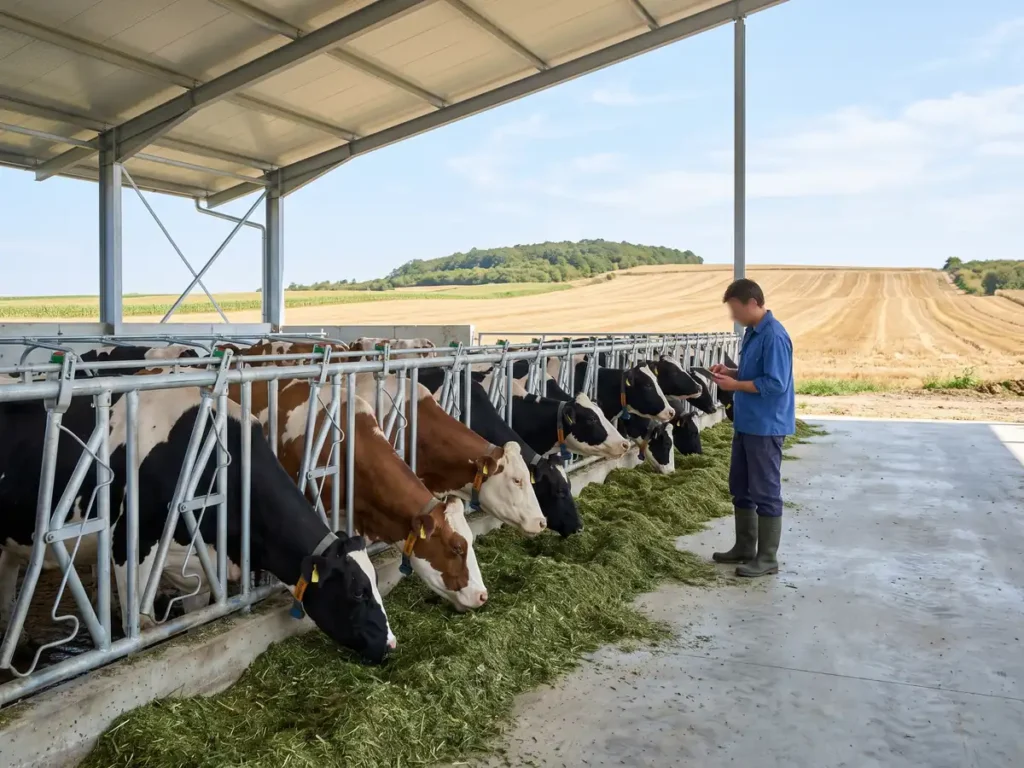
- Cattle and buffalo farmers receive 68 euro per head of animal, from a state aid scheme worth 54.4 million euro, that is 277.18 million lei.
- Entry condition: at least 10 head on 1 March 2026, or at least 5 head for farms in the mountain area, with animals aged at least 22 months on 28 February 2026.
- Applications go to APIA, the Agency for Payments and Intervention in Agriculture, within 20 working days, and on 5 October 2026 at least 75% of the herd applied for must still be in place.
Published: Official Gazette of Romania (Monitorul Oficial) no. 700 of 24 August 2026
In force from: 27 August 2026
A farmer with 40 cows can receive 2,720 euro, provided that at least 30 of them are still on the holding in October. Law no. 176/2026, published in Official Gazette of Romania no. 700 of 24 August 2026 and promulgated by Decree no. 729/2026, sets up a state aid scheme for farmers in the cattle sector, for the period 1 March to 31 December 2026. The stated purpose is to compensate in part for the losses caused by rising fertiliser and fuel costs, against the background of the crisis in the Middle East. On the same day Parliament also adopted a parallel scheme for the pig sector, through Law no. 175/2026, and both add to the instruments through which the state supports agricultural producers directly.
The European legal basis is section 2.1 of the Temporary Crisis Framework for State aid measures in the context of the crisis in the Middle East, European Commission Communication C/2026/2.593, published in the Official Journal of the European Union of 5 May 2026. The scheme is notified to the European Commission under Article 108(3) of the Treaty and applies on Romanian territory only after the Commission authorises it.
Implementation falls to the county and local centres of APIA. One provision worth remembering: the sums granted as state aid under this scheme cannot be garnished if enforcement proceedings have been opened against the beneficiary.
What it changes in practice
The first effect is the amount. The aid is 68 euro per head of cattle or buffalo, and the exchange rate used for the calculation is the one announced by the National Bank of Romania on 1 March 2026, that is 5.0953 lei to the euro. The maximum total value of the scheme is 54.4 million euro, the equivalent of 277,184,320 lei.
The second effect is the entry threshold. On 1 March 2026 the beneficiary must hold at least 10 head of cattle or buffalo in a holding with a code issued by ANSVSA, the National Sanitary Veterinary and Food Safety Authority, registered in the national database. For holdings in the administrative territorial units of the mountain area listed in the Strategic Plan for the Common Agricultural Policy 2023 to 2027, the threshold drops to 5 head.
The third effect concerns the age of the animals. Cattle and buffalo, male and female, are eligible if they were at least 22 months old on 28 February 2026. Younger animals do not count towards the payment, however many of them there are.
The fourth effect is the obligation to keep the herd, which is checked automatically. On 5 October 2026 the national system for the identification and registration of animals must show at least 75% of the herd applied for. If it does not, the support is not validated. Exceptions are made for beneficiaries in bankruptcy or liquidation, for cases of force majeure and for holdings under veterinary movement restrictions because of the diseases listed in Article 5(1)(a) of Regulation (EU) 2016/429.
The fifth effect is the individual ceiling. The total amount that can be granted to an undertaking active in primary agricultural production does not exceed the leu equivalent of 50,000 euro. Sums already received through other schemes financed from the state budget under the same section 2.1 of the European communication are deducted from that ceiling.
The sixth effect is the timetable. Applications and supporting documents go to APIA within 20 working days, starting the day after the law enters into force, and payment is made by 31 December 2026. The money comes from the reserve fund at the Government’s disposal, through a supplement to the budget of the Ministry of Agriculture and Rural Development, on the basis of a Government decision to be initiated within 10 working days of entry into force.
The same 20 working day window applies to the crops dried out by drought: maize and sunflower hit in 2025 bring up to 333 lei per hectare, cut proportionally below 90% damage.
What has changed compared with the previous situation
Until now there was no scheme dedicated to compensating fertiliser and fuel costs in the cattle sector for 2026. The law creates one, with its own budget and with application limited to 31 December 2026.
The second change is the recognition of the mountain area through a lower threshold. A farmer in the mountain area enters the scheme with 5 animals, compared with 10 in the rest of the country, which takes into account the smaller size of the farms there.
The third change concerns continuity of ownership. The law expressly accepts that the beneficiary at the time of the application may be someone other than the holder of the animals on 1 March 2026, if the change in the form of organisation or the striking off took place between 1 March 2026 and the date of the application. Animals that entered or left holdings belonging to the same beneficiary, or that were transferred temporarily to associations, cooperatives or producer groups for grazing, are also eligible.
The fourth change is the protection of the amount. The aid cannot be garnished in enforcement proceedings, which means that a farmer with debts actually receives the money instead of seeing it frozen in the account.
What does not change is the European condition. The scheme produces no effects until the European Commission authorises it, and the ceiling of 50,000 euro per beneficiary comes from the Commission communication, not from the Romanian law.
Advantages and disadvantages
What it improves
- It brings 68 euro per head of animal, an amount large enough to matter on a medium sized farm.
- It lowers the entry threshold to 5 head in the mountain area, where holdings are smaller.
- It shields the money from garnishment, so it reaches the farmer even if enforcement proceedings are pending.
- It accepts a change in the form of organisation between March and the date of the application, which does not penalise farmers who have reorganised.
- It expressly covers animals transferred temporarily for grazing to associations or cooperatives.
What remains a problem
- The scheme does not apply until the European Commission authorises it, and the law sets no deadline for that step.
- The filing window is only 20 working days, very short for farmers who have to gather documents from several institutions.
- The requirement to still hold 75% of the herd on 5 October 2026 penalises farmers who sell animals in the usual selling season.
- Farms with fewer than 10 head are left out of the scheme entirely, apart from those in the mountain area.
- Animals under 22 months on 28 February 2026 are not counted, so the young stock of farms that have just rebuilt their herds does not help.
- The ceiling of 50,000 euro is shared with other schemes under the same European section, so the real support can be far smaller than it looks.
Practical advice
- Check first in the national database how many animals were recorded on your holding on 1 March 2026 and how many of them had turned 22 months on 28 February 2026. Those are the two reference dates.
- Do not apply for more animals than you can document. The maximum claim is limited by the registered herd, and an inflated application is corrected at the check.
- Plan your sales around 5 October 2026. If you drop below 75% of the herd applied for, you lose the support in full, not in proportion.
- If you have several holdings in different counties, file a single application, at the APIA centre covering your registered office or your home address.
- Check whether your holding appears on the list of mountain areas in the Strategic Plan 2023 to 2027, published on the website of the Ministry of Agriculture. There the threshold is 5 head, not 10.
- Gather in good time a copy of your identity document, the registration certificate from the Trade Register and the certificate attesting the size of the herd. The window of 20 working days passes quickly.
- Work out how much you have already received through other schemes under section 2.1. Those sums are deducted from the ceiling of 50,000 euro.
Frequently asked questions
How much do I get per head of animal?
How many animals do I need in order to be eligible?
Which animals are taken into account?
What happens if I sell animals before October?
When are the applications filed?
Is there a ceiling per beneficiary?
Can the money be garnished if I have debts?
Errors and inconsistencies in the published text
- Article 4 para. (3): a ceiling that caps nothing. The text says that the beneficiary may apply for aid „pentru un număr maxim de animale mai mic sau cel puțin egal cu cel mai mic dintre efectivul de animale deținut la 1 martie 2026 și efectivul deținut la data depunerii cererii”, that is, for a maximum number of animals smaller than or at least equal to the lower of the herd held on 1 March 2026 and the herd held on the date of the application. Any number at all is either smaller than or at least equal to a given value, so the condition rules nothing out. The correct wording, which follows from the rest of the article, is „cel mult egal”, at most equal.
- The filing window closes before the scheme can produce any effect. Article 6 para. (3) sets 20 working days for filing, starting the day after entry into force, that is from 28 August 2026. Article 1 para. (6) provides, however, that the scheme applies „după autorizarea de către Comisia Europeană”, after authorisation by the European Commission, and Article 14 para. (1) that only „la data primirii deciziei Comisiei Europene … se stabilește eligibilitatea beneficiarului”, on the date the Commission decision is received is the eligibility of the beneficiary established. The law lays down no deadline for the notification or for obtaining the decision, so the farmer files a complete dossier for a scheme whose criteria may, under Article 14 para. (2), be „completa și/sau modifica în mod corespunzător”, supplemented and/or amended accordingly, after the dossier has already gone in.
- Buffalo disappear from three texts in which they ought to be. Article 3 grants the aid to farmers „care dețin bovine sau bubaline”, who hold cattle or buffalo, and Article 4 para. (1) letter c) ties the 75% condition to the „efectivul de bovine sau bubaline”, the herd of cattle or buffalo. By contrast, Article 2 letter d) defines the livestock farmer as someone who permanently holds only „bovine înscrise în BND”, cattle registered in the national database, Article 4 para. (1) letter b) point (i) likewise refers only to the situation in which „bovinele figurează în BND”, the cattle appear in the national database, and Article 7 para. (1), the provision that orders the automatic check, requires the system to be queried „cu privire la efectivul de bovine deținut de către beneficiar la data de 5 octombrie 2026”, as to the herd of cattle held by the beneficiary on 5 October 2026. The confusion starts in the definitions themselves: Article 2 letter c) describes buffalo as „animale din speciile bovine”, animals of the bovine species, although letter b) defines cattle as taurine animals and the rest of the law treats the two as separate categories.
- Article 4 para. (2) declares eligible animals that arrive on the holding after the payment has to be made. The paragraph covers animals which „în perioada 1 martie-31 decembrie 2026 au intrat, respectiv au ieșit” from holdings belonging to the same beneficiary, which entered or left them between 1 March and 31 December 2026. The herd is checked, however, on 5 October 2026, under Article 4 para. (1) letter c), and payment is made by 31 December 2026, under Article 6 para. (4). An animal that arrives on the holding in November or December can no longer affect either the check or the payment, even though the text declares it eligible.
- The address to which the law sends the farmer cannot be opened as printed. Article 4 para. (1) letter a) says that the list of administrative territorial units in the mountain area is published on the www.madr.ro website, then gives a link to a different domain, „https://pndr.ro/documente/ro/PNS-2023-2027lista-zonelor eligibile-pentru intervențiile-HNV-ANC-AEC.xlsx”. The address contains two spaces inside it and is missing a hyphen after „2023-2027”, so it does not work as it stands, and the site named in the text is not the site in the link. For a farmer with 5 to 9 head, that very file decides whether he is eligible or not.
- Article 1 para. (3): two European regulations cited in a form that does not exist. The provision invokes „Regulamentul (UE) 2013/1.408 al Comisiei din 18 decembrie 2013” and „Regulamentul (UE) 2014/717 al Comisiei din 27 iunie 2014”, that is, year/number numbering, which is used only for acts adopted from 2015 onwards. The correct names are Regulation (EU) No 1408/2013 and Regulation (EU) No 717/2014. In the same sentence, Regulation (EU) 2023/2831 is cited correctly, so the law uses two different conventions in a single statement.
Editorial analysis
The law solves a concrete problem and solves it simply: a flat sum per head of animal, an entry threshold, an automatic check against the database, payment by the end of the year. For a crisis scheme that architecture is exactly the right one, and details such as shielding the money from garnishment or accepting animals transferred temporarily for grazing show that the text was written by someone who knows what farms actually look like.
The weakness lies elsewhere, in the relationship between the money and the numbers. The maximum value of the scheme, 54.4 million euro, divided by the rate of 68 euro per head, gives exactly 800,000 head. The round figure shows that the budget was built from an estimate of the eligible herd, but the law does not say what that estimate is or where it comes from. And Article 8 para. (3) already provides for what happens if the applications exceed the ceiling: „valoarea ajutorului de stat se reduce proporțional pentru toți beneficiarii”, the value of the state aid is reduced proportionally for all beneficiaries. In other words, the 68 euro announced in Article 5 para. (2) is not a promise but a theoretical maximum, and the farmer learns what he actually receives only at the moment of payment. In a scheme that asks him to plan his sales through to October, that matters.
The second substantive problem is the threshold of 75% in Article 4 para. (1) letter c). It is a photograph taken on a single day, 5 October 2026, with no proportionality at all: a farmer holding 75% of the herd applied for receives everything, one holding 74% receives nothing, because Article 7 para. (2) states flatly that „sprijinul financiar nu se validează”, the financial support is not validated. The date falls in the middle of the selling season, and APIA queries the identification system in any event and knows the exact number of animals, so a proportional reduction would be just as easy to apply as an outright refusal. As it stands, the rule pushes the farmer to postpone sales he would have made anyway, which has nothing to do with the declared purpose of the scheme, compensating for fertiliser and fuel costs.
That leaves the question of timing. Every landmark in the law is fixed to the day: 28 February, 1 March, 5 October, 31 December. The only date missing is the one on which everything depends, the moment when the European Commission authorises the scheme. The law gives the farmer 20 working days in which to file and imposes on nobody any deadline for the step without which the money cannot be paid.
What should be changed
- Filing should run from publication of the Commission decision, not from the entry into force of the law. Or, if the present order is preferred, a reopening clause: if the Commission decision changes the criteria, a further 10 working days should be allowed for supplementing or withdrawing applications already filed.
- The threshold of 75% should be replaced by a proportional reduction. The aid should be paid for the herd actually found on 5 October 2026, rather than in full or not at all. The data already exist in the identification system, and the calculation is the same query that Article 7 para. (1) provides for in any event.
- The estimated number of eligible head should be published together with the decision allocating the funds. The Government decision provided for in Article 5 para. (3) is to be initiated within 10 working days of entry into force, that is, before the filing window closes. If it also carried the estimate of the herd, the farmer would know in advance whether the 68 euro holds or is diluted.
- The text of the automatic check should name buffalo as well. Article 7 para. (1) is the provision from which the computer query is written. As long as it says only „efectivul de bovine”, the herd of cattle, buffalo farmers risk being rejected by a filter written to the letter.
- The list of mountain areas should be an annex to the law, not a link. A file on a website that can be reorganised at any time decides eligibility for farms with 5 to 9 head. The list of administrative territorial units runs to a few pages and, as an annex, would have the same stability as the rest of the law.
- A deadline for the notification to the European Commission. Article 1 para. (5) lays down the obligation to notify, with no deadline attached. A deadline of 10 working days from entry into force, matching the one given to the Ministry of Agriculture for initiating the allocation decision, would tie together the two stages that today run in parallel without waiting for each other.
Original text of the legal act
The text below is reproduced in Romanian, the official form of publication.
The full text, as published in the Official Gazette of Romania
Official Gazette of Romania no. 700 of 24 August 2026 16 pages PDF, 114 KB the act starts on page 2
Open the official PDFDownload the PDF
The viewer is not shown on small screens. Use the buttons above to open or download the file.
This article is for informational purposes only and does not constitute legal advice. For specific situations, consult a licensed attorney or tax advisor.