
In brief
- The 15.8% duty on heavyweight thermal paper from South Korea stays in place. The European Commission has closed the review opened on 17 October 2025 and decided to keep the level imposed in 2020, without changing it. The duty is calculated on the net, free-at-Union-frontier price, before duty, and it is paid by the importer in the Union, not by the Korean producer.
- The product is not the paper in a till receipt roll, but the large rolls from which labels are cut. It covers thermal paper weighing more than 65 g/m², sold in jumbo rolls at least 20 cm wide, at least 50 kg in weight and 40 cm in diameter, under TARIC codes 4809 90 00 20, 4811 59 00 20 and 4811 90 00 20. It is used mainly for the self-adhesive labels on parcels and packaging, for tickets and for shelf labels.
- Korean imports are down to 2.5% of the Union market, and the duty raises around one million euro a year across all the Member States. At the same time, Union consumption fell by 22% between 2022 and the middle of 2025, and the unit cost of production of the European mills rose by 17%. The Commission acknowledges in the act that these two developments also caused injury, alongside the dumped imports.
Published: Official Journal of the European Union, L series, no. 2026/2311 of 20 October 2026; CELEX 32026R2311
Who it affects: importers and converters of thermal paper in Romania, labelling and courier companies, online retailers that buy shipping labels, European producers of thermal paper and the customs offices that classify goods under the three TARIC codes
Takes effect: 21 October 2026, the day following publication in the Official Journal of the European Union, under Article 2 of the regulation
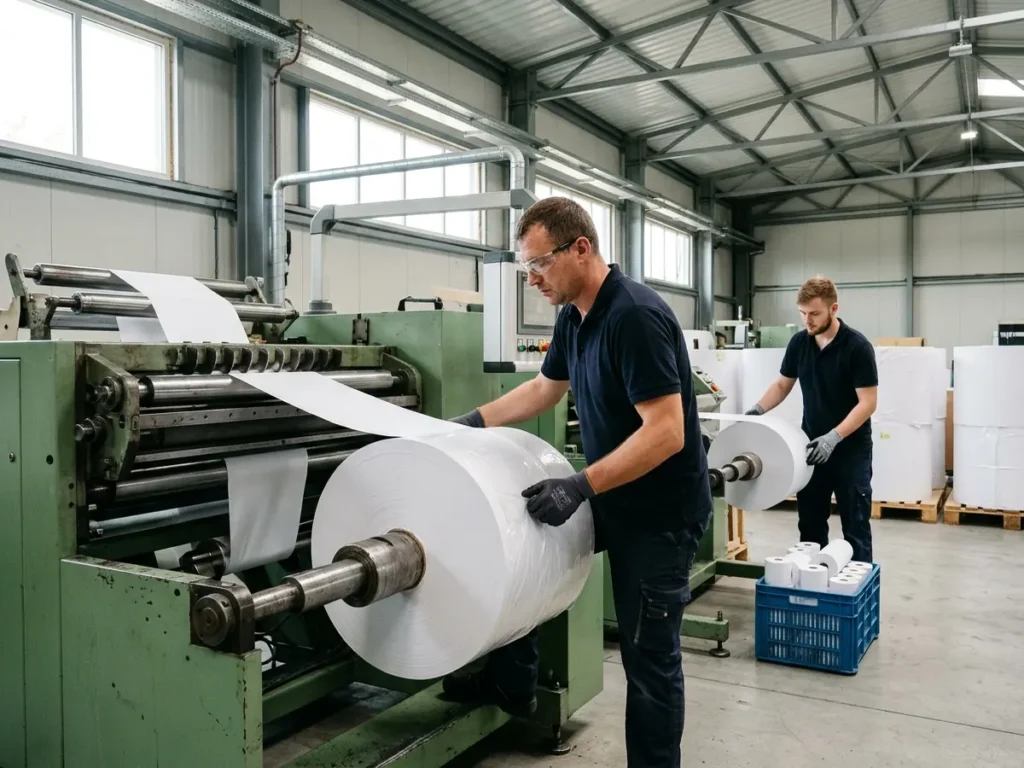
The label stuck on the parcel delivered to your door was almost certainly cut from a roll of thermal paper several tens of centimetres wide and weighing more than 50 kilograms. If that roll came from South Korea, it enters customs with a duty of 15.8% on top of its price. On 19 October 2026 the European Commission decided that the duty stays, and the decision takes effect from 21 October 2026.
The decision is set out in Commission Implementing Regulation (EU) 2026/2311, which closes a review started a year earlier, on 17 October 2025. An expiry review is the procedure for checking whether an anti-dumping duty still serves a purpose after five years in force. The Commission’s answer: it does, because dumping continued and because, without the duty, Korean paper would enter the Union market at prices 17.1% below those of the European mills.
An anti-dumping duty requires proof of an unfair price. Since 6 November 2026 the Union also has an instrument that does not: the bilateral safeguard for industrial imports from Mercosur, triggered by a rise in preferential imports that causes serious injury.
For a Romanian company that cuts jumbo rolls into label reels, the act changes nothing about what it has been paying. Its importance lies in what did not happen: the duty did not lapse, did not fall and did not rise. Anyone who built a cost price on the assumption that the measure would fall in the autumn of 2026 has to redo the arithmetic.
One detail worth stating at the outset, because it is often confused: the paper in a cash register roll does not come in here. That is lightweight thermal paper, covered by a separate measure, Commission Implementing Regulation (EU) 2023/1330. The present regulation concerns only paper above 65 g/m², the kind used for self-adhesive labels, tickets and packaging labels.
What it changes in practice
Article 1(2) sets the duty at 15.8% of the net, free-at-Union-frontier price, before duty. There are no company-specific rates, as happens in other anti-dumping files: a single level, for any supplier from South Korea. Paragraph (3) refers to the provisions in force concerning customs duties, so the duty is added to the ordinary customs duty and enters the taxable amount for import VAT.
The product scope is defined by three elements that must all be met. Weight: more than 65 g/m². Form: rolls at least 20 cm wide, weighing at least 50 kg including the paper, and 40 cm in diameter, which is what the industry calls a jumbo roll. Coating: a thermo-sensitive layer, a mixture of dye and developer that forms an image when heat is applied, on one or both sides. A base coat and a top coat may be present or absent, with no bearing on classification.
At customs, identification is made under CN codes ex 4809 90 00, ex 4811 59 00 and ex 4811 90 00, with TARIC codes 4809 90 00 20, 4811 59 00 20 and 4811 90 00 20. The prefix “ex” in the CN code means that not the whole heading falls under the duty, only the part described in Article 1, which is why the ten-digit TARIC code is the one that decides.
The regulation applies directly in every Member State, with no act of transposition into Romanian law. The Romanian Customs Authority needs no order of its own in order to collect the duty, and an importer has nowhere to look for a national implementing rule: the text of the regulation is the rule.
What it costs, in money: in the review investigation period, from 1 July 2024 to 30 June 2025, 3,258 tonnes of Korean thermal paper entered the Union at an average price of 2,036 euro per tonne. Simple multiplication of those two figures from the act shows that the 15.8% duty yields around one million euro a year, for all 27 Member States together. The sum is small for a market of 128,075 tonnes. The point of the measure is to hold the price steady, and that is achieved even with little money reaching the budget.
What has changed compared with the previous situation
On the figures, nothing. The 15.8% duty was imposed by Commission Implementing Regulation (EU) 2020/1524 of 19 October 2020 and stays at the same level. What has changed is the landscape it applies to, and the act describes it in detail.
Korean imports have thinned out. In the period of the original investigation, from 1 July 2018 to 30 June 2019, they accounted for 10% to 11% of the Union market, with a volume of 18,500 to 20,500 tonnes. By the end of the period considered they had fallen to 2.5% and 3,258 tonnes. The peak year of the period considered was 2023, with 7,740 tonnes and a share of 5.8%.
The market has shrunk as well. Union consumption fell from 165,045 tonnes in 2022 to 128,075 tonnes in the review investigation period, a drop of 22%. The Commission explains in recital 51 that the 2022 figure was inflated by demand left over from the pandemic years and by stockpiling after the start of Russia’s war of aggression against Ukraine; measured against 2023, consumption fell by only 2%.
The European industry has weakened. The product is made by nine Union producers, one of which became insolvent in 2024. Production fell by 31%, from 224,496 to 155,879 tonnes, and capacity utilisation dropped from 90% to 62%. The number of employees fell by 14%, from 1,047 to 900. Three mills were verified on the spot by Commission inspectors: Jujo Thermal Oy in Kauttua, Finland, Kanzan Spezialpapiere GmbH in Düren and Koehler Paper SE in Oberkirch, both in Germany.
The harshest change is in profitability. In 2022, sales of the product in the Union returned a profit of 6.9% of turnover. In the review investigation period they returned a loss of 3.6%. The average selling price rose by 1% over the whole period considered, from 2,069 to 2,099 euro per tonne, while the unit cost of production rose by 17%, from 1,950 to 2,281 euro per tonne. The European mills are therefore selling at roughly 182 euro per tonne below their own cost.
The position of the Korean producer has changed too. The only exporter in the file is Hansol Paper, and in the United States the anti-dumping duty applied to its products was recently reduced to 0%, according to recital 42. The American market has become more accessible to it than the European one, which the Commission acknowledges in recital 116, without abandoning its conclusion that the Union remains attractive because it is the largest single market for this product and pays better prices.
Finally, the level of dumping found has changed. In the review, the Commission compared a constructed normal value of 2,060 euro per tonne with an ex-works export price of 1,827.7 euro per tonne and found a margin of 11.4%, lower than the 15.8% duty that stays in force. The Commission notes that the real margin may be higher, because it worked on cautious assumptions favourable to the exporter, and that the purpose of an expiry review is not to calculate a new margin but to establish whether dumping is continuing.
Advantages and disadvantages
What it improves
- The level does not rise. The duty stays at 15.8%, exactly where it was, so the cost prices calculated over the past six years do not change.
- Without the duty, the pressure would be heavy. The Commission measured undercutting of 4% with the duty included in the price and of 17.1% without it. The second figure shows how much the duty is holding the European price in place.
- The total cost to importers is small. At 3,258 tonnes and 2,036 euro per tonne, the duty amounts to around one million euro a year across the whole Union, not a barrier that shuts off trade.
- Supply is not at risk. Union production capacity, 251,405 tonnes, covers almost twice its own consumption, and the mills are running at 62%, so paper is available without Korean imports.
- Nine mills and 900 jobs get another year of breathing space. They are in Germany, Finland and other Member States, and without the measure their financial situation would have deteriorated, says recital 123.
- It applies directly, with no new paperwork. No authorisation, no additional declaration and no entry in a register is needed; the duty is calculated at customs on the TARIC code.
- Lightweight thermal paper stays outside the measure. Cash register rolls are covered by a different regulation, so the measure does not touch the price of a till receipt.
What remains a problem
- The duty is paid by the European buyer. The 15.8% is settled at customs by the importer in the Union and goes into the cost of the label, not into the cost of the Korean producer.
- The act does not say until when it applies. Article 2 governs only entry into force. An importer cannot learn from this text the date on which the measure expires.
- The duty stays above the margin found now. The review found dumping of 11.4%, while the duty maintained is 15.8%. The regulation does not explain why the level does not follow the new figure.
- No user and no importer took part. Recitals 125 and 128 show that nobody on the buyers’ side came forward, so the effect of the duty on converters and on online retail was not measured but assumed on the basis of the 2020 investigation.
- The Romanian text of the diameter leaves room for dispute. Article 1 requires a width of “20 cm or more” and a weight of “50 kg or more”, but the Romanian version writes „un diametru de 40 cm”, without the word minimum that the English version carries.
- The main cause of the losses lies elsewhere. The Commission itself finds in recital 112 that the 22% fall in consumption and the 17% rise in costs caused material injury, alongside Korean imports holding a share of 2.5%.
- The non-Korean alternative is dearer. Serbia, the second supplier from outside the Union, delivered in the review investigation period at 3,534 euro per tonne, more than 70% above the Korean price.
Practical advice
- Check on the customs declaration whether the goods are classified under 4809 90 00 20, 4811 59 00 20 or 4811 90 00 20. Classification is settled on the ten-digit code; the eight-digit code on the invoice leaves the matter open.
- Ask your supplier, in writing, for the exact grammage and the dimensions of the rolls. A product at 65 g/m² or below falls outside the measure, and a difference of one gram changes the cost by 15.8%.
- Redo your cost price on the correct formula: the 15.8% applies to the free-at-frontier value, before duty. The invoice price of goods delivered to your warehouse is a different base and gives the wrong result.
- If you have multi-year supply contracts, read the clause on new taxes and duties. The duty is not new, so a clause covering “subsequent legislative changes” is not triggered by this regulation.
- Ask whether the paper you are buying is lightweight or heavyweight. The two are covered by different regulations, with different duty levels, and the confusion is paid for at a post-clearance control.
- Compare the Korean offer with the duty included against the European offer. The average selling price of Union producers in the review investigation period was 2,099 euro per tonne, and the Korean price plus the duty exceeds that figure.
- If the duty affects your business, register as an interested party at the next review, from the first day of the notice. In this file no importer and no user came forward, and the Commission decided on the producers’ data.
Frequently asked questions
Which product is taxed, exactly?
How much extra is paid at customs?
From what date does it apply?
Does the paper in cash register rolls fall under this duty?
Until when does the duty apply?
Can I still import from South Korea?
Who asked for the measure to be extended?
Why did nobody from South Korea put up a defence?
What would have happened if the measure had lapsed?
How much do Korean imports matter on the European market?
Errors and inconsistencies in the published text
- Article 1(1) and recital 23, the definition of the diameter, in the Romanian version of the regulation. The English version of the Official Journal of the European Union describes rolls of a width of 20 cm or more, weighing 50 kg or more (including paper) and with a diameter of 40 cm or more, the jumbo rolls of the trade. The Romanian version keeps the word minimum for the width and for the weight but drops it for the diameter, which reads there as a fixed value. A roll 48 cm in diameter therefore falls under the duty on the English text, while a literal reading of the Romanian text leaves it outside, and the difference between the two readings is the 15.8% duty. Each language version is official, so an importer or a customs officer working from the Romanian text is reading a narrower product scope than the one the Commission imposed.
- Recital 28, the volume of imports in the review investigation period. The text states that imports from the Republic of Korea “were 2,036 tonnes in the review investigation period”, whereas Table 2 gives 3,258 tonnes for the same period. The figure 2,036 is in fact the average import price per tonne from Table 3. The market share in the same recital, 2.5%, confirms the table: 3,258 out of 128,075 tonnes gives 2.54%, while 2,036 tonnes would give 1.59%. The error carries into the next sentence: the absolute decrease of “at least 16,464 tonnes” is obtained precisely from 18,500 minus 2,036, whereas on the correct figure the decrease is 15,242 tonnes.
- Recital 40, the ratio between Korean production and the Union market. The text states that Korean thermal paper production “already amounted to over 200 % the yearly heavyweight thermal paper consumption in the Union capacity in the review investigation period”. The denominator cannot be established, because it puts consumption and capacity in the same phrase, and the figure checks out against neither: Korean production of 240,000 tonnes in 2021 is 187% of Union consumption of 128,075 tonnes and 95% of Union capacity of 251,405 tonnes. The 200% threshold is reached only if the numerator is Korean capacity of 275,000 tonnes rather than production. Recital 115 states the same ratio correctly, with capacity “at least two times bigger than Union consumption”, so the act supports two different figures for the same element of the spare capacity analysis.
- Recital 14, the missing negative, in the Romanian version of the regulation. The English version reads “No exporting producers in the country concerned provided the requested information and agreed to be included in the sample”, where the negative governs both verbs, and recital 12 uses the same construction for importers. The Romanian version breaks the agreement between them, „nu a furnizat informațiile solicitate și au fost de acord să fie incluși în eșantion”, a singular negative followed by a plural affirmative, so the sentence states at once that nobody replied and that they agreed to be sampled. The last sentence of the same recital says the opposite, that no producer in the Republic of Korea cooperated with the investigation. Cooperation is the element on which the application of Article 18 of the basic Regulation and the whole construction of the normal value rest, so the defect in the Romanian text reaches the legal basis, not merely the wording.
Editorial analysis
The most interesting figure in the regulation is not the duty but the gap between the two undercutting margins. Recital 60 gives 4%, with the duty included in the import price, and recital 117 gives 17.1%, without it. The two do not contradict each other, they are the same calculation: take the 15.8% duty out of a price that undercuts by 4% and the result is undercutting of 17.1%, figure for figure. The regulation does not show the derivation, but it explains why the measure was maintained without debate. The duty does not correct a price difference, it is the price difference. Taken out of the equation, Korean paper would enter the European market a fifth below the price of the local mills.
The arithmetic of the injury, by contrast, does not close on imports. In the review investigation period the European mills sold at 2,099 euro per tonne with a unit cost of 2,281 euro, which is 182 euro of loss on every tonne. Multiplied by the 120,730 tonnes sold in the Union, that is a hole of roughly 22 million euro. The duty the regulation defends raises, at 3,258 tonnes and 2,036 euro per tonne, around one million euro a year. The ratio is one to twenty-two. The Commission openly acknowledges, in recital 112, that the 22% fall in consumption and the 17% rise in unit cost also caused material injury, yet it concludes that the causal link with Korean imports is not broken. On the figures, the European industry’s problem lies elsewhere: capacity of 251,405 tonnes for a home consumption of 128,075 tonnes, used at 62%, which is almost twice the market it serves.
The third thing that does not show when the act is read from start to finish is the calendar. ETPA lodged the review request on 16 July 2025, and the Commission opened the proceeding on 17 October 2025, ninety-three days later and four days before the 2020 measure could have lapsed. The investigation then ran for 369 days, from opening to the entry into force of the new regulation. The asymmetry is worth remembering for any company that wants to be heard in a file of this kind: the applicants had three months to prepare and a year of procedure, while importers and converters had the deadlines in the notice of initiation, which none of them used. Recitals 125 and 128 record, drily, that no importer and no user came forward. The cost of the duty along the converting chain was not measured in this file; it was carried over from the conclusions of the 2020 investigation.
What should be changed
- The Romanian version of the product definition should be corrected to read „un diametru de minimum 40 cm”, as the English version already does. One word closes an ambiguity that otherwise gets settled at a post-clearance control, with duty differences and penalties for importers acting in good faith.
- The date on which the measure expires should be written into Article 2. A three-year supply contract is negotiated differently when the year in which the duty may fall is known. In the published form, that information has to be looked for outside the act.
- The regulation should explain why the level stays at 15.8% when the margin found in the review is 11.4%. Without that explanation, an importer cannot judge whether it is worth asking for an interim review, and the gap of 4.4 percentage points is money in the price of a label.
- Recital 28 should be corrected to 3,258 tonnes, with the absolute decrease recalculated at 15,242 tonnes. Figures from a recital are quoted later in other files and in the trade press, and an error left in the text reproduces itself for years.
- The notice of initiation should be notified directly to national converters’ associations, not only to those known at Union level. Romania has no thermal paper producers, but it does have companies that cut and print labels, and they hear about the proceeding after it has closed.
- The Commission should estimate the effect of the duty on converters and on online retail even when they do not reply, using the customs data it holds. An imperfect figure on the cost of a label is more useful than a conclusion carried over from an investigation closed in 2020, under a different market structure.
Original text of the legal act
The text below is reproduced in Romanian, the official form of publication.
The full text, as published in the Official Gazette of Romania
Official Journal of the European Union, L series, no. 2026/2311 of 20 October 2026; CELEX 32026R2311 20 pages PDF, 790 KB
Open the official PDFDownload the PDF
The viewer is not shown on small screens. Use the buttons above to open or download the file.
This article is for informational purposes only and does not constitute legal advice. For specific situations, consult a licensed attorney or tax advisor.