
In brief
- The committees through which the applications of service members and their families pass, from accommodation and the housing allowance to the help given after a serious illness, are given a new membership, a new calendar and, for the first time, a quorum. A meeting of the central committee is valid if at least three quarters of the members take part, and it may also be held online or in hybrid form, on the order of the chair.
- The regulation now fixes when a meeting is valid, but it does not say how a decision is taken in it. No provision shows how the members’ positions are expressed and counted, and the only text that mentioned a vote at central committee level, half plus one, is precisely the one this order replaces. Members who cannot attend may send a legal representative with a mandate, yet the act does not say whether that representative counts towards the three quarters.
- The order was published and entered into force on 9 October 2026, with no transitional provision at all. The first meeting held under the new rules is the one at ministry level, in the last ten days of October 2026, that is within at most three weeks of publication, while the six-monthly cascade starts in the first ten days of November.
Published: Official Gazette of Romania (Monitorul Oficial), Part I, no. 848 of 9 October 2026
In force from: 9 October 2026
A service member who applies for service accommodation, who needs help after a serious illness or who is not paid a financial entitlement does not send the application to the minister. It goes to a committee for social affairs, an internal body that gathers the problems of the personnel, forwards them to the specialist structures and proposes solutions. This filter also catches the matters in which the law remains unclear, such as the housing allowance of a service member who buys a home together with somebody else, left in August without a uniform answer by the High Court of Cassation and Justice. On 9 October 2026, the Ministry of National Defence rewrote the rules under which these committees work.
Order of the Minister of National Defence no. M.194/2026 amends, in 16 points, the Regulation on the organisation and functioning of the committees for the social affairs of the personnel of the Ministry of National Defence, approved by Order no. M.87/2014. It changes the membership of the central committee, the list of structures that have a committee of their own, the calendar of meetings and the way reporting is done. It adds a competence filter at the secretariat, a quorum, audio or video recording of the meeting and the possibility of holding it online. The order comes two days after another act by the same minister, which cut the minimum time in post from 24 to 12 months.
„Social affairs” is not a vague formula. The regulation counts them, and this order has left the list untouched: pay, feeding, clothing, medical assistance, working and training conditions, accommodation, recreation and the recovery of working capacity, living conditions and respect for the entitlements arising from the service or employment relationship. Nine fields, which therefore take in rent, the garrison hostel, meals and the subsidised rest home stay. Separately from them, the regulation has a second, heavier category: support for army personnel and their families, for the wounded, for the disabled and for the survivors of those killed in military action, when a serious medical condition or another exceptional personal situation arises.
The route of an application runs in steps. In the unit, the problems are gathered by the officer responsible for social affairs, as a rule the deputy commander. The large structures have a committee of their own, and whatever cannot be resolved there goes up to the Central Committee for Social Affairs, the one at ministry level. The summary of the conclusions goes to the higher echelon within five working days of the meeting, and the minutes of the central committee’s meeting reach the minister within 15 working days. The two categories of problem run at different rhythms: the ordinary fields are examined every six months, the cases of serious illness and the exceptional personal situations every three months.
What it changes in practice
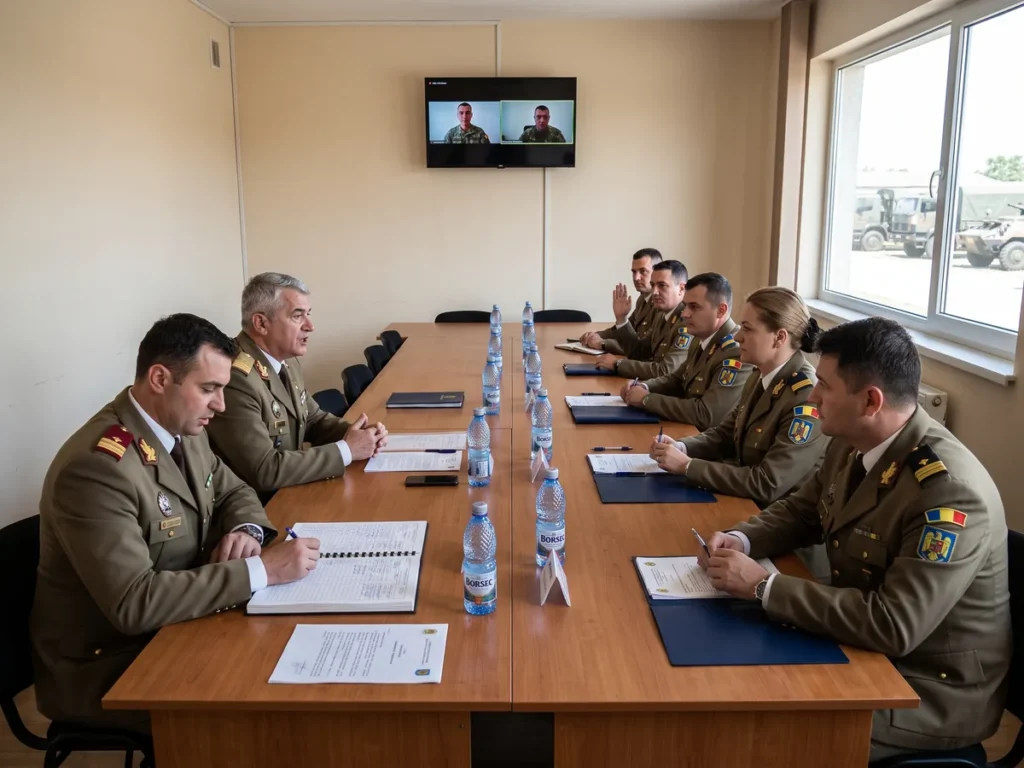
From now on, a meeting of the central committee has a participation threshold. The new paragraph (7) of Article 11 says that a meeting is validly constituted if at least three quarters of the members referred to in Article 5(1) take part in the activities themselves. Until this order the regulation had no quorum at all, so a meeting with five participants was as valid as one with 25. The threshold is hard to turn into a figure, though, because the number of members is not fixed either. The list contains 22 specified posts, to which are added the deputies of the chiefs of staff of the three services, land, air and naval, and a trade union representative present „where applicable”. That is between 25 and 26 people, or between 27 and 28 if the chair and the deputy chair are counted in as well. Three quarters of 25 is 18.75, of 26 is 19.5, of 27 is 20.25, and of 28 is exactly 21. Depending on the reading, the meeting goes ahead with 19, with 20 or with 21 people.
The meeting can move online. As a rule it is organised in person, but on the order of the chair of the central committee it may be held online or in hybrid form. In that case the secretariat issues „in good time” specific instructions on how it is to run, in compliance with the rules on classified information. The order sets no condition for going online, provides no notice period and does not say what that document of the secretariat may and may not contain.
Audio or video recording enters the regulation, but not for the person who submitted the problem. With the approval of the chair, the activity is recorded in audio or video form and stored on a medium matching the classification level of the information discussed. At the opening, the secretariat announces that the activity is of a military character and that the recording may be consulted by authorised persons, on a need-to-know basis, after which it is archived. The service member whose file is being discussed is not among those who can ask for the recording.
Anyone who cannot attend sends a representative. Full members who cannot take part may be replaced by their legal representatives, on the basis of a power of representation. The provision is new and explains itself: a committee of 25 people with a three-quarters threshold is easily blocked.
The secretariat can stop a referral before the meeting. The new point b1) of Article 6 gives the secretariat the task of checking, before drawing up the draft agenda, whether the matter falls within the competence of the central committee and within the field of social affairs. If it does not, then with the approval of the chair the referral is returned or sent on to the competent structure. For somebody who has addressed an application to the wrong place, that is good news: they no longer wait months for a meeting that could not have answered them anyway. The bad part is that the regulation provides no deadline for the check, no duty to tell the applicant that the referral has been moved and no way of challenging the decision.
Reporting moves onto a single form. Article 15 now refers to a model summary, set out in the new Annex no. 2 to the regulation. The model has two sections, one for the problems resolved within the structure itself and within its subordinate structures, the other for the problems falling within the competence of other structures of the ministry, and both are filled in across the nine fields, from pay to respect for the entitlements arising from the employment relationship. For each problem the form asks, in order, for the item number, the problem encountered, the structure where it arose, the measure taken, the proposals for resolving it, the reasoning behind them with reference to the legal framework, the way it was resolved and the structure that resolved it, plus observations. For the problems sent on to other structures the column for the way it was resolved is missing, logically, because that is not yet known. The summary is signed by the chair of the committee or by the officer responsible for social affairs, as the case may be, and the form is filled in at the appropriate classification level.
What has changed compared with the previous situation
The regulation has been amended between 2014 and now, so some renaming of structures may have happened along the way. The comparison below is with the form published in the Official Gazette of Romania no. 593 of 8 August 2014.
The membership of the central committee. The chair is still a state secretary, but the portfolio has narrowed: „relations with Parliament and the quality of life of the personnel”, without public information. The deputy chair is the deputy chief of the Defence Staff, the structure that in 2014 was called the General Staff. Among the members, the changes run in three directions:
- The posts of control and of money come in. The head of the General Legal Directorate, the head of the General Financial and Accounting Directorate, the head of the Directorate for the Prevention and Investigation of Corruption and Fraud, the head of the General Armaments Directorate and the head of the General Human Resources Management Directorate.
- The new commands come in. The deputy commanders of the Cyber Defence Command and of the Special Operations Forces Command, structures that did not exist when the regulation was made.
- Two posts go out. The commander of the Army Sports Club „Steaua”, who was a member by right in 2014, and the adviser to the chief of the General Staff for the affairs of warrant officers and non-commissioned officers, replaced by the command senior enlisted leader of the Defence Staff.
The number of posts named one by one rises from 17 to 22. Both forms add the deputies of the chiefs of staff of the services and the trade union representative, the difference being that the 2014 list also contained a plural, „the deputy heads of departments”, which the new form replaces with two named posts. A larger committee, with a quorum that in 2014 did not exist.
The structures with a committee of their own. The list is extended by three commands, the Cyber Defence Command, the Special Operations Forces Command and the Joint Forces Command, and it takes over the current names, Defence Staff instead of General Staff and General Armaments Directorate instead of Armaments Department.
At unit level, the circle widens. The officer responsible for social affairs was supported, until now, only by the heads of the structures with duties in the nine fields. Now he is also supported by the command senior enlisted leader and, for the civilian personnel, by the representative of the trade union structure. The same change appears at the committees of the large structures, where the place of the adviser for the affairs of warrant officers and non-commissioned officers is taken by the command warrant officer or senior enlisted leader.
The calendar of meetings, step by step. This is the change with the greatest practical effect, even though it looks like a shuffling of ten-day periods. For the six-monthly examination of the nine fields:
- Divisions and similar structures: previously the second ten days of May and November, now the first ten days of the same months.
- The staffs of the services and the commands: previously the second ten days of June and December, now the last ten days of May and November, that is a month earlier.
- The Defence Staff, the General Directorate for Defence Intelligence, the General Armaments Directorate, the Medical Directorate and the Estates and Infrastructure Directorate: the second ten days of June and December, an unchanged window.
- Ministry level: the last ten days of July and January, an unchanged window, though moved from point c) to point d) of the same paragraph.
Until now, the commands and the central structures met in the same window, the second ten days of June. A problem that the Joint Logistics Command could not resolve and that fell within the competence of the Estates and Infrastructure Directorate had no way of arriving in time, because both meetings fell on the same days. From now on, the commands meet roughly three weeks before the central structures, and the summary has its five working days in which to travel upwards. For the first time, the four steps follow one another in order: divisions, commands, central structures, ministry.
The same shift has been made for the quarterly examination of the cases of serious illness: the divisions move to the first ten days of February, May, August and November, the commands to the last ten days of the same months, the central structures stay in the second ten days of March, June, September and December, and the ministry in the last ten days of April, July, October and January.
A vote that disappears. The old Article 15(1) said that the models of the documents were to be drawn up by the secretariat and approved by a vote of half plus one of the total membership of the central committee. The text has been replaced in full: the model is no longer voted on, because it is now in Annex no. 2 to the regulation. The consequence is that the only mention of a vote at central committee level has left the regulation, and nothing has taken its place.
The relationship annex, remade. The old single annex becomes Annex no. 1 and is replaced. It shows, as a diagram, who approves, who collaborates and who cooperates with whom, from the minister and the central committee down to the officers responsible at unit level, passing through the specialist structures of the ministry and the non-governmental organisations with a social profile. The new version also includes the three commands that have been added and separates the committees of the central structures from those of the commands. Being a diagram, it is printed as an image, and the act itself states that it is reproduced in facsimile; it can be read in the official PDF edition attached below. A new article, Article 18, states expressly that both annexes form part of the regulation.
Advantages and disadvantages
What it improves
- A quorum appears where there was none. A measure concerning accommodation and financial help can no longer be adopted by a handful of people who happen to be present.
- The calendar becomes a real cascade. The commands meet before the central structures, not in the same ten-day period, so a problem that moves up has time to arrive before the next meeting.
- The online format acknowledges a reality: a committee of 25 people from structures spread across the whole country is hard to gather in person four times a year.
- Reporting is done on a single form, across the nine fields. Two units can no longer describe the same problem in two different ways, and comparison between structures becomes possible.
- The trade union representative of the civilian personnel reaches down to unit level, instead of sitting only on the central committee and on the large structures.
- The competence check carried out by the secretariat shortens the route of an application sent to the wrong place.
- Bringing in the heads of the legal, financial and integrity directorates puts at the table exactly the structures that can say on the spot whether a solution has a legal basis and money behind it.
What remains a problem
- The quorum cannot be calculated from the act: between 19 and 21 participants, depending on how the base is read, and with no rounding rule at all.
- There is no voting rule. The regulation says when a meeting is valid, not how a decision is taken in it, and at an online meeting that gap is felt all the more.
- It remains unclear whether a representative with a mandate counts towards the quorum, that is whether the solution devised for unblocking meetings really does unblock them.
- Going online depends solely on the order of the chair, with no criteria, no notice period and the rules of procedure left to an internal document that is not published.
- The recording is made „to ensure transparency”, yet it is accessible only to authorised persons. The person who raised the problem has no access to it and no right to a written answer either, because the regulation has never provided for such a duty.
- No transitional provision: nothing is said about the referrals already submitted, about how soon the committees are to be reconstituted in their new membership, or about when the three commands that are only now given a committee are to adopt rules of their own.
- The Joint Forces Command has a committee of its own and a slot in the calendar, but it has no member on the central committee, although the other four commands do.
Practical advice
- Submit your problem before the meeting window of your echelon, not during it. For divisions and similar structures the six-monthly meeting falls in the first ten days of May and November, so an application left until 5 November will most likely catch the May meeting.
- Write in your application which field the problem belongs to, using the terms of the regulation: pay, feeding, clothing, medical assistance, working and training conditions, accommodation, recreation and the recovery of working capacity, living conditions, or respect for the entitlements arising from the service or employment relationship. The summary is filled in under these nine headings, and a problem that fits none of them risks being returned for lack of competence.
- If the problem comes from a serious illness or from another exceptional personal situation, say so explicitly. Those cases are examined quarterly, not every six months, so you wait less.
- Ask for the registration number and keep it. The secretariat of the central committee can now return or redirect a referral, and the act does not oblige it to let you know.
- If you are civilian personnel, ask the trade union representative for support. From 9 October 2026 he also supports the officer responsible for social affairs down to unit level.
- Ask at which meeting the problem was examined and ask for the summary of the minutes. The regulation provides for it to be published in the Army Information Bulletin, with the protection of personal data respected.
- If the problem is beyond the power of the structure, keep an eye on the five working days. The summary and the proposals must be forwarded to the higher echelon within that period from the date of the meeting.
Frequently asked questions
What, in concrete terms, do the army’s committees for social affairs do?
When does the order enter into force?
How many members must be present for a meeting of the central committee to be valid?
How is the vote taken at the meeting?
Under what conditions can the meeting be held online?
Is the meeting recorded, and can I ask for the recording?
What happens to an application submitted before 9 October 2026?
What does the new Annex no. 2 contain?
Why can Annex no. 1 not be read in the reproduced text?
Errors and inconsistencies in the published text
- The basis for calculating the quorum cannot be established, so the threshold for a meeting lies between 19 and 21 people. Article 11(7) requires the participation of „cel puțin 3/4 dintre membrii prevăzuți la art. 5 alin. (1)”, at least three quarters of the members listed in the provision on the composition of the committee. Article 5(1) does not, however, give a number: it lists the chair under point a), the deputy chair under point b) and the members under point c), and the list under point c) contains 22 specified posts, a plural with no number, „locțiitorii șefilor statelor majore ale categoriilor de forțe ale armatei”, the deputies of the chiefs of staff of the services of the armed forces, and a trade union representative present only „după caz”, where applicable. A reader in good faith can reckon the base in four ways: only the members under point c), without the trade union representative, 25 people, three quarters of whom make 18.75; the same members with the trade union representative, 26, three quarters of whom make 19.5; everyone listed in paragraph (1), the chair and the deputy chair included, 27, three quarters of whom make 20.25; or 28, three quarters of whom make exactly 21. The threshold therefore swings between 19 and 21 participants, and in three of the four ways of counting the result is not even a whole number, while the regulation provides no rounding rule whatsoever. The legal conclusion differs on whether a meeting with 20 participants is validly constituted or not, that is on whether the measures adopted in it stand. The fix: paragraph (7) ought to refer expressly to Article 5(1)(c), to say whether the trade union representative is part of the base and to provide for rounding up to the next whole number, or, more simply, the total number of members ought to be written in a paragraph of its own.
- It does not follow whether a legal representative with a mandate counts towards the three quarters. Article 5(3), introduced by this same order, says that where the full members under paragraph (1), point c), cannot take part, „reprezentanții legali ai acestora vor participa la aceasta în baza unui mandat de reprezentare”, their legal representatives are to take part on the basis of a power of representation. Paragraph (7) of Article 11 requires, however, the participation of three quarters „dintre membrii prevăzuți la art. 5 alin. (1)”, of the members listed in the provision on the composition, and a mandated representative is not a member listed there. The first reading, the literal one: the representatives do not count, so a meeting with 15 full members and 6 representatives is not validly constituted, and paragraph (3) is left without practical effect, because it unblocks nothing. The second reading, the functional one: the representative takes part in place of the full member and covers his seat, since otherwise there would have been no point in introducing the power of representation. Two opposite conclusions about the validity of the same meeting. The fix: a single text, either in Article 5(3) or in Article 11(7), saying whether participation through a legal representative is counted towards the quorum and, if so, how many members may be replaced in this way at one meeting.
- Which structures must be present cannot be established, and one reading makes the condition impossible. The same paragraph (7) requires that, among the three quarters, there take part „obligatoriu reprezentanții structurilor ale căror probleme înscrise pe ordinea de zi sunt din sfera domeniilor de responsabilitate ale acestora”, compulsorily the representatives of the structures whose fields of responsibility cover the problems entered on the agenda. The wording can be read in two ways. Either these are the specialist structures answerable for the field of the problem, the Estates and Infrastructure Directorate for a housing problem, for instance, and the condition can be met, because all those directorates have a member on the committee. Or they are the structures the problem came from, and then the condition becomes impossible for some referrals: Article 4(1), point b), gives a committee of its own to the Joint Forces Command and to the divisions, and Article 11(1), point b), fixes meetings for them, yet neither the Joint Forces Command nor the divisions have any member under Article 5(1)(c), where only the deputy commanders of the Joint Logistics Command, of the Communications and Information Technology Command, of the Cyber Defence Command and of the Special Operations Forces Command appear. A problem sent up by the Joint Forces Command could never be validly examined, because nobody on the committee represents it. The fix: the text of paragraph (7) ought to say plainly that the specialist structures answerable for the field are meant, and the deputy commander of the Joint Forces Command ought to be added to Article 5(1)(c), alongside the other four commands.
Editorial analysis
The order settles two things that the 2014 regulation had left open, and it settles them well. The first is the cascade of meetings. In the old form, the commands and the central structures met in the same ten-day period of June, which made it impossible for a problem that a command could not resolve to reach the competent directorate before that directorate’s own meeting. Moving the commands to the last ten days of May gives the five working days under Article 12 a real purpose: the summary goes off and has somewhere to arrive. The second is the single reporting form. A free-form summary allowed the same problem to be described in two different ways at two units, whereas a model with nine fixed headings makes it comparable and, by implication, countable.
Where the order shows that it was thought through only halfway is precisely its newest part, paragraph (7) of Article 11. A quorum is a good idea in a regulation that had none, but the quorum is only one of the three pieces that make a deliberation open to challenge or not. The second piece is the way of voting, and it is missing entirely. Nowhere is it said by what majority a measure is adopted, whether the vote is open or secret and whether the positions are recorded. Until this order there was a single mention of a vote at central committee level in the regulation, half plus one of the total membership, in Article 15(1), for the approval of the models of the documents. Point 13 of the order replaces precisely that text. The reason is logical, the model is now in an annex and no longer needs a vote, but the side effect went unnoticed: the regulation has been left with no reference at all to a vote of the central committee, and nothing has taken its place.
The third piece is the record, and it exists only by half. Paragraph (8) says that the activity „is recorded”, but only „with the approval of the chair of the Central Committee”, so the recording is optional. Paragraph (9) nevertheless obliges the secretariat to announce, at the opening of every meeting, that the activity „will be recorded”. The second text takes as certain what the first leaves to the discretion of the chair, and an announcement made at a meeting the chair has decided not to record is quite simply untrue.
These three gaps matter all the more now that the meeting can be held online. In a room, participation and agreement are visible, and a challenge breaks against the way the meeting actually went. In a hybrid meeting, with 20 people out of 26 and some of them on a video link, the question „who agreed” no longer has an answer in the regulation. Nor does the act fix the way it is to run: going online happens „on the order of the chair”, with no condition at all, and the rules are given through „specific instructions” that the secretariat issues „in good time”. This is sub-delegation without limits, to an internal document that is not published, at exactly the point where it is decided whether the deliberation was valid. A measure concerning service accommodation or help for a family can be challenged administratively or before the administrative courts, and the first line of defence of a dissatisfied applicant is the procedure itself.
The absence of transitional provisions shows up most clearly on the calendar. The order enters into force on 9 October 2026, and the first meeting that falls under the new rules is the one at ministry level, in the last ten days of October, that is in 12 to 22 days. It has to be held with a quorum of three quarters of a committee whose membership changed on the day of publication and whose exact number does not follow from the act, by structures that have been given no deadline for appointing their members or their legal representatives. Likewise, three commands are only now given a committee of their own, while Article 15(2), unamended, requires them to have rules of their own approved „at the first meeting after the entry into force of this regulation”, a wording written in 2014 for other structures. A four-line article in the order, with deadlines for reconstitution and with the fate of the referrals under way, would have closed all these questions.
There remains, finally, the thing the order did not touch although it was the closest to the reader. The new point b1) of Article 6 gives the secretariat the power to return or to redirect a referral before it reaches the agenda, with the approval of the chair. The power is useful, filtering shortens the route of applications sent to the wrong place. But it carries no deadline, no duty to give reasons and no duty to tell the applicant what has happened to his problem. And that comes on top of an older gap: neither before nor after this order does the regulation oblige the committee to tell the person who raised the problem what was decided. The personnel are informed, under Article 17, through the summary of the minutes published in the Army Information Bulletin and through the military press. That is also why the word „transparency” in paragraph (8) sounds odd: the recording is made for transparency, yet it can be consulted only by authorised persons, on a need-to-know basis. Transparency inside, not towards the person who asked for help.
What should be changed
- The number of members of the central committee, written as a figure. A paragraph showing how many members the Central Committee is made up of makes the quorum calculable in a single reading and takes out of the argument the plural „the deputy heads of the staffs” and the trade union representative present „where applicable”.
- A voting rule for the central committee. The majority by which measures are adopted, the way the vote is cast and the duty to record the result in the minutes. Without them, the new quorum protects the form of the meeting, not the validity of the decision taken in it.
- The rules of the online meeting, in the regulation, not in instructions. How attendance is checked, how the vote is cast at a distance, how participation is recorded and how far in advance the format is announced. Going online may well remain a matter for the order of the chair, but the conduct of the meeting ought not to be left to an internal document that is not published.
- Recording made compulsory, or the announcement made conditional. Either every meeting is recorded, or the announcement under paragraph (9) is made only where the chair has approved the recording. As the two paragraphs are written now, they cannot both be complied with.
- Transitional provisions. A deadline for reconstituting the committees in their new membership, a deadline for the own rules of the three newly added commands and a rule for the referrals already submitted.
- The Joint Forces Command, at the table. The deputy commander ought to be added among the members of the central committee, as for the other four commands that have a committee of their own.
- A written answer for the person who raised the problem. A period within which the applicant is informed about the solution given or about the redirection of the referral, with reasons. It is the only change on this list that the service member or his family would feel directly.
Original text of the legal act
The text below is reproduced in Romanian, the official form of publication.
The full text, as published in the Official Gazette of Romania
Official Gazette of Romania no. 848 of 9 October 2026, pages 2-6 16 pages PDF, 121 KB the act starts on page 2
Open the official PDFDownload the PDF
The viewer is not shown on small screens. Use the buttons above to open or download the file.
This article is for informational purposes only and does not constitute legal advice. For specific situations, consult a licensed attorney or tax advisor.