
In brief
- The Romanian government has declared the gasification of central and north-eastern Botoșani county a project of national importance, covering three transmission pipelines: Coșula-Săveni-Darabani, Stăuceni-Ștefănești and Dorohoi-Darabani, together with their electricity supply, cathodic protection and optical fibre.
- The label brings no money, but a special legal regime. Under Law No. 185/2016, projects of national importance in the natural gas field benefit from accelerated permitting procedures and from instruments for securing the land along the pipeline route.
- The Ministry of Energy is designated as the competent authority responsible for facilitating and coordinating the authorisation procedure. In practice, it becomes the single desk holding together the approvals from all other institutions.
Published: Official Gazette of Romania (Monitorul Oficial) No. 636 of 31 July 2026
In force from: 31 July 2026
Botoșani is one of the Romanian counties with the poorest natural gas coverage, and the government has decided to treat bringing pipelines there as a matter of state urgency rather than an ordinary investment. Through Decision No. 573/2026, the development of the national transmission system supplying localities in the centre and north-east of the county was declared a project of national importance in the natural gas field. It is the second major energy policy decision published the same day, alongside the deadline set for renewable self-consumption investments, a sign that the state is working on two fronts at once: extending the classic network and local energy production.
The decision has only two articles and contains no figures. It does not say what it costs, who builds it, where the money comes from or when it finishes. It does exactly two things: it puts the legal label on the project and names the institution responsible for permitting.
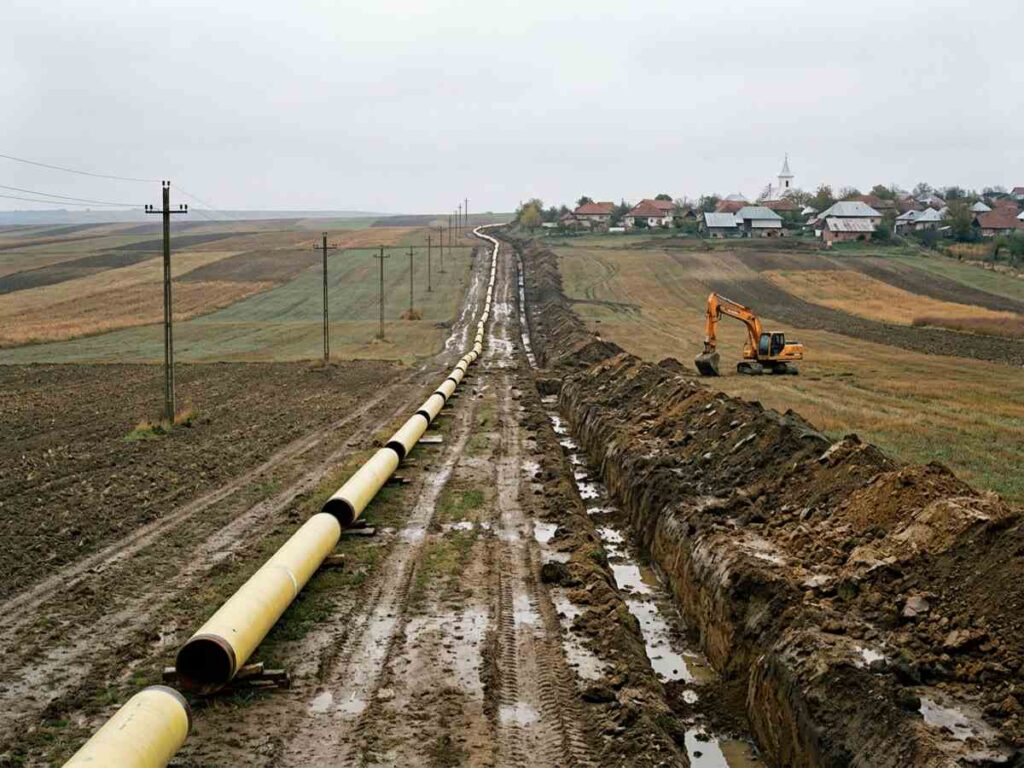
The project covers three transmission pipelines which together trace a route across the northern part of the county: Coșula-Săveni-Darabani, Stăuceni-Ștefănești and Dorohoi-Darabani. The title expressly includes the ancillary works as well: the electricity supply for the stations, cathodic protection, meaning the system that prevents corrosion of the buried steel pipeline, and the optical fibre used for remote control and monitoring. Including them in the same act is not a bureaucratic detail: it means these components also benefit from the special regime, not just the pipe itself.
The legal basis is Article 2 paragraph (1) letters b) and m) of Law No. 185/2016 on certain measures necessary for implementing projects of national importance in the natural gas field. The decision was adopted on 30 July 2026 and signed by Prime Minister Ilie-Gavril Bolojan, countersigned by the interim deputy prime minister, the Ministry of Energy, the General Secretariat of the Government, the Ministry of Agriculture and Rural Development and the Ministry of Environment, Waters and Forests.
What it changes in practice
The first effect is procedural and it is the most important one. A project of national importance in the gas field falls under Law No. 185/2016, which was designed precisely to shorten the road from paper to pipeline in the ground. Its typical instruments are shorter deadlines for approvals, centralised coordination of the authorisation procedure, and mechanisms for obtaining the right to use the land crossed, including private property, against compensation.
The second effect is institutional. The Ministry of Energy becomes the competent authority responsible for facilitating and coordinating authorisation. Its role is not to issue every approval but to track them all: environment, water, heritage, agriculture, forestry, local administration. In a county where the route crosses numerous communes, this coordination is the difference between a file that moves and one stuck between institutions.
The third effect concerns landowners along the route. Anyone with land in the path of Coșula-Săveni-Darabani, Stăuceni-Ștefănești or Dorohoi-Darabani should expect requests for access for field surveys, then procedures establishing easement rights or expropriation for public utility, depending on the solution chosen. The decision does not itself open those procedures, but it makes triggering them possible and likely.
The fourth effect is longer term and concerns residents. The pipelines in this project are transmission pipelines, not distribution networks. They bring gas close to localities, to regulating and metering stations. Actually connecting houses requires an additional step, the distribution network in each commune, with an operator, a separate investment and its own approvals. Between the trunk pipeline and the kitchen tap there remains a distinct stage.
What has changed compared with the previous situation
Until 31 July 2026 the three pipelines were an investment project like any other, subject to the ordinary permitting regime. From publication onwards they enter the category of projects for which the law allows preferential procedural treatment.
Nothing has changed in the technical content of the project. Routes, diameters, capacities and construction solutions are not set by this decision but by the technical documentation that follows. Likewise, nothing has changed regarding financing: the act allocates no funds and mentions no source, neither the state budget, nor European funds, nor the transmission operator’s own resources.
What has changed is accountability. Previously a project of this kind could sit in the gap between institutions, with no clear holder of the coordinating role. Now there is an institution named in the Official Gazette of Romania, which makes public tracking of progress simpler: the question “where did it get stuck” now has a precise addressee.
Advantages and disadvantages
What it improves
- It procedurally unblocks an investment in one of the least gasified areas of the country, where heating is predominantly by wood and bottled gas.
- It names a single institution responsible for coordinating authorisation, reducing the risk of the file circulating between ministries without an owner.
- It places the ancillary works under the same regime, electricity supply, cathodic protection and optical fibre, so the project does not stall over an auxiliary component left in the ordinary procedure.
- It treats the three pipelines as one whole rather than separate projects, which helps route coherence and avoids permitting them in the wrong order.
- It creates a clear legal basis for the next steps, including the land procedures, instead of case-by-case negotiations without a framework.
What remains a problem
- It allocates not a single leu and indicates no source of financing. The national importance label is no guarantee that the project actually gets built.
- It sets no deadline. There is no cut-off date for permitting, for the start of works or for commissioning, so there is no benchmark against which progress could be measured.
- An accelerated regime inevitably means shorter deadlines for consultation and for challenges. Landowners and communities along the route have less time to react than under the ordinary procedure.
- Transmission pipelines do not bring gas into homes by themselves. Without local distribution networks, built separately, the benefit for residents remains theoretical.
- The investment locks the county into a fossil fuel for decades, partly at odds with the decarbonisation direction the state pursues through other energy programmes.
Practical advice
- If you own farmland around Coșula, Săveni, Darabani, Stăuceni, Ștefănești or Dorohoi: check your title deeds and land registry entry in good time. Land with an unclear legal status complicates and delays compensation, however fast the project moves.
- If you are asked for access to your land for surveys: request written identification of the project and the legal basis for the request. Field surveys are a normal stage, but access is documented, and any crop damage is assessed on site.
- If you are a mayor or commune secretary general along the route: prepare the urban planning documents and the register of publicly owned land. The coordination at the Ministry of Energy will request data from local administration, and delays here show up directly in the overall timetable.
- If you are waiting to have your house connected to gas: do not confuse the transmission pipeline with the distribution network. Ask at the town hall whether a distribution project exists for your locality and at what stage it is, because that is what decides whether you end up with gas at home.
- If you want to follow progress: the addressee for questions is the Ministry of Energy, designated by Article 2. A public information request to it is the natural way to find out the state of authorisation.
- If you are a local construction firm or supplier: watch the announcements of the national transmission system operator, not the Official Gazette of Romania. Procurement procedures for execution are published in the public procurement system, not in the designating act.
Frequently asked questions
What does “project of national importance in the natural gas field” mean?
Which pipelines does the project include?
What is cathodic protection?
Who pays for the works?
When will localities in Botoșani have gas?
What happens to the land along the route?
What is the Ministry of Energy’s role?
From when does the decision apply?
Who signed the decision?
Original text of the legal act
The text below is reproduced in Romanian, the official form of publication.
The full text, as published in the Official Gazette of Romania
Official Gazette of Romania no. 636 of 31 July 2026 8 pages PDF, 75 KB
Open the official PDFDownload the PDF
The viewer is not shown on small screens. Use the buttons above to open or download the file.
This article is for informational purposes only and does not constitute legal advice. For specific situations, consult a licensed attorney or tax advisor.