
In brief
- 58 projects financed from European funds and left unfinished can be handed over in two stages: first the works that make the building usable, then, separately, the works that remain. The list is annexed to the order and covers 22 hospital projects, 18 natural gas distribution networks in communes and small towns, 13 investments by regional water and sewerage operators, 4 flood defence works and one photovoltaic panel project at a water operator. Each project is identified by its code in the IT system for the management of European funds, known as the SMIS code, and not by the name of the beneficiary.
- The mechanism had been in the law since 16 July 2026, but it could not be used for European projects until 16 October 2026. Law no. 141/2026 provides, in art. 18 para. (1), that in the absence of a technical instruction from the ministry responsible its provisions do not apply to investments financed from European funds. That instruction is precisely what the order of 14 October 2026 approves, signed on the 90th day of the deadline the law had given the ministries.
- The remaining works have to be finished within no more than 120 days of the signing of the acceptance report, they cannot exceed 5% of the value, and until they are handed over the building cannot be registered in the land register. For the beneficiaries on the list, however, the deadline that decides the fate of the money is a different one: 31 December 2026, the date by which Government Emergency Ordinance no. 36/2023 requires these projects to be completed, failing which the financing contracts are terminated and the European amounts are repaid with interest and penalties.
Published: Official Gazette of Romania (Monitorul Oficial), Part I, no. 866 of 16 October 2026, pages 3-7
In force from: 16 October 2026, the date of publication, since the order does not provide for a different date
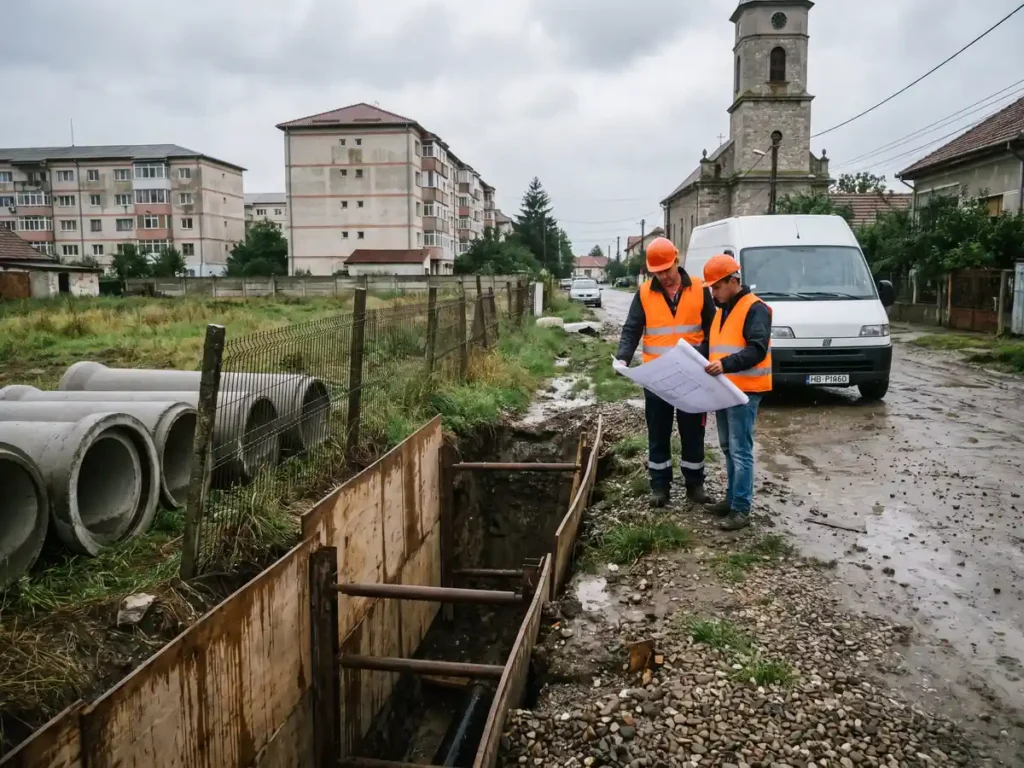
In a hospital in Bucharest the fire detection systems and the oxygen pipework have been installed, but the permanent electricity connection is not ready. In a commune in Harghita county the gas network has been laid, yet a few service connections are missing. In Mehedinți county the wastewater treatment plant is running, but part of the perimeter fence is unfinished. In all three cases the general rule on the handover of construction works says the same thing: unless every work is finished, nothing is signed. And without an acceptance report there is no settlement, no commissioning and no closure of the project.
For 58 investments of this kind, the deadlock opened on 16 October 2026. The Official Gazette of Romania, Part I, no. 866 of that day, pages 3-7, published Order of the Minister of Investments and European Projects no. 1.581/2026, which approves a technical instruction and, in its annex, the list by name of the projects it applies to. All of them are projects financed under the Large Infrastructure Operational Programme 2014-2020, the programme through which Romania spent European money on transport, water, the environment, energy and, through the funds added during the pandemic, on hospitals. All of them have been declared non-functional, which means they were not finished on time.
The order itself has two articles and says almost nothing. The weight lies in the annex and in the fact that the order was the condition for a law adopted in July to be usable for European money. Law no. 141/2026 on the application of measures to accelerate the implementation of public investment in the field of construction, published in the Official Gazette of Romania, Part I, no. 575 of 13 July 2026 and in force from 16 July 2026, introduced a new mechanism: the handover committee may accept the works carried out and suspend the handover only for the works that do not affect the use of the building. But art. 18 para. (1) of the law adds a condition: „In the absence of the technical instructions, the provisions of this law are not applicable to the investment objectives financed under art. 2 para. (1) letter a) and letters c) to e)”. Letter a) of art. 2 para. (1) means European funds. Until 16 October 2026 the mechanism could not be used on any of the 58 projects.
Under the same art. 18 para. (1), the ministry had „no more than 90 days from the date of entry into force” of the law in which to issue the instruction. The order was signed on 14 October 2026, exactly 90 days after 16 July, and published two days later.
What it changes in practice
After 16 October 2026, the practical questions of a beneficiary on the list have the following answers.
Who falls under this order. Only the projects named in the annex to the technical instruction, identified by the operation code in the SMIS system, and only those which include construction works subject to handover. Art. 1 para. (1) of the instruction ties the list to the final implementation report for the programme, submitted to the European Commission, and states that it also applies to „the subsequent updates to the list communicated to the European Commission”. The list is therefore not closed: a project added later to the report submitted to the Commission falls under the instruction automatically, without a new order.
Who does not. National transport infrastructure projects, that is road, rail, air, waterway and metro. The instruction excludes them in art. 1 para. (2), by reference to art. 16 of Law no. 141/2026, which states that „the provisions of art. 1-15 do not apply” to that infrastructure. In the annex, the exclusion is described as priorities 1 and 2 of the programme. For motorways, railways and the metro, the regime under Government Decision no. 845/2018 remains in place, the one that art. 18 para. (4) of the law required the Ministry of Transport and Infrastructure to update.
What can actually be done. The works of a project are split into two categories, defined in art. 3 of the law. Essential works are those which ensure the fundamental quality requirements, comply with the building permit and allow the building to be used in accordance with its approved purpose. Ancillary works are those which affect neither the quality, nor the functionality, nor the use of the building, and can be finished after the handover. The split is made before the handover is convened, through a technical classification note drawn up by the beneficiary together with the lead designer, the specialist designers, the certified design verifiers, the contractor and the site supervisor.
What limit applies to the part left unfinished. No more than 5%. Art. 4 para. (3) letter d) of the law requires the technical note to set out separately, in physical and in value terms, the unfinished ancillary works, „without exceeding 5% of the value of the contract”, while art. 8 para. (2) letter d) repeats the condition at the handover stage, worded this time as „5% of the value of the investment”. Above that ceiling the mechanism cannot be used.
How much time is available for the rest. No more than 120 days from the signing of the acceptance report, under art. 8 para. (3), a deadline which „cannot be extended”, except for delays caused by utility operators or by other causes beyond the control of the beneficiary and the contractor. Art. 11 para. (5) repeats the ceiling, calculated from the date of the handover of the essential works.
What can be settled immediately. That depends on how much has been carried out. Art. 9 para. (1) of the law provides that, if the essential works allow the building to be used and the conditions of safety, fire safety and health are met, the handover produces effects as regards commissioning, payment and settlement of the works handed over, the start of the guarantee period and the regularisation of charges. If those conditions are not met, paras. (2) and (4) allow a handover „solely for the purpose of certifying and settling the works carried out”, while para. (3) is explicit: until the complementary acceptance report, the building cannot be commissioned, cannot be used in accordance with its approved purpose, and no documents attesting its lawful use may be issued.
What stays blocked in either variant. The land register. Art. 11 para. (6) of the law prohibits the issuing of certificates attesting the erection of buildings and their registration in the land register where the mechanism has been used „before the completion of all authorised execution works, both essential and ancillary”. Likewise, the certificate concerning the contributions owed to the State Inspectorate for Constructions is issued, under art. 7 para. (6) letter b), only after all the works have been finished.
Who signs. The handover committee for the essential works, with the composition set out in art. 7 para. (7): a chair appointed by the investor, a representative of the authority which issued the building permit, between one and three specialists appointed by the investor and not involved in the design or the execution, a representative of the inspectorate for emergency situations for the categories of construction covered by Law no. 307/2006, a representative of the county directorate for culture in the case of historical monuments and, for buildings of exceptional or particular importance financed from public funds, a representative of the principal authorising officer. Decisions are taken by a majority of the members. The contractor and the designer have to attend, but as guests, without the right to vote.
Where the State Inspectorate for Constructions comes in. Not at the first handover. Art. 7 para. (6) letter a) provides that the inspectorate’s representatives attend „solely the handover organised after all the works have been fully finished”, that is, when the suspension is lifted. The instruction confirms this in art. 3 para. (2): the complementary acceptance report is drawn up with the participation of the inspectorate and supplements the initial report, „without a new report on the handover of the completed works being drawn up”.
Which form is used. The model approved by Order of the Minister of Development, Public Works and Administration no. 930/2026, published in the Official Gazette of Romania, Part I, no. 683 of 18 August 2026. The instruction refers to it in art. 3 para. (1).
What new obligation arises for the beneficiary. A single one, in art. 4 of the instruction: beneficiaries send the managing authority of the programme, „within 5 working days of the date of signing”, both the acceptance report for the essential works and the complementary acceptance report, so that the completion of the projects can be monitored. The instruction provides no penalty for exceeding that deadline.
What happens if the 120 days are exceeded. Art. 8 para. (5) of the law refers to art. 15, which treats the failure to finish the ancillary works on time as an administrative offence, penalised by a fine of 0.5% to 2% of the value of the unfinished ancillary works, established by the control staff of the State Inspectorate for Constructions. Classifying works as ancillary above the 5% ceiling is penalised more heavily, with a fine of 1% to 5% of the value of the unlawfully classified works, up to a maximum of 500,000 lei. Half of the fine may be paid within 15 days of the notification of the report.
Who pays for the works that remain. Not the European funds. Government Emergency Ordinance no. 36/2023 provides, in art. 15 para. (2), that payments made after 31 December 2023 on non-functional projects are ineligible expenditure both in the 2014-2020 programmes and in the 2021-2027 ones, and are borne by the beneficiaries „from their own budget or from other lawfully constituted sources of financing, in compliance with the State aid rules”. Art. 14 qualifies this: for national public infrastructure owned by the State, the expenditure is borne by the State budget, within the limits of the approved amounts; for local infrastructure, by local budgets, with the possibility of transfers from the State budget.
What has changed compared with the previous situation
Until 16 October 2026, a beneficiary on the list had a choice between two options, both bad. Either it waited for absolutely all the works to be finished, including those that depended on an electricity operator, and missed the completion deadline. Or it signed a handover with objections, under the general regime of Government Decision no. 273/1994, which gave it neither certainty of settlement nor a firm timetable for the rest. The mechanism in Law no. 141/2026 had existed on paper since 16 July 2026, but for European funds it was inert, because of the condition in art. 18 para. (1).
From 16 October 2026, the mechanism is available for the 58 projects named. Three concrete things change.
First, settlement no longer depends on the last work. The handover of the essential works produces, under the conditions of art. 9 para. (1) of the law, payment and settlement effects for what has been carried out. In the minimal variant under para. (2), the handover serves at least to certify the physical and financial stage reached and to allow settlement, even if the objective cannot be used yet.
Second, a firm timetable appears, with a penalty. The 120 days in art. 8 para. (3) did not exist under the general regime for handovers with objections, where remedial deadlines were set case by case. They are now capped and, if they are exceeded, the State Inspectorate for Constructions can impose a fine.
Third, the performance guarantee is released in instalments. Art. 14 para. (2) of the law allows the guarantee to be released progressively, in proportion to the value of the works handed over, but para. (3) makes it mandatory to keep a retention amount until the handover of the ancillary works and until the final financial and tax regularisation. The size of that retention is set neither in the law nor in the instruction.
What does not change: the classification of the projects as non-functional, the deadline by which they have to become functional and the financial consequence if they do not. These remain the ones in Government Emergency Ordinance no. 36/2023, art. 11 para. (1) of which defines a non-functional project through four cumulative conditions: it was not physically completed or fully implemented by 31 December 2023 or does not contribute to the objectives of the relevant priorities, the expenditure incurred after that date is borne from its own budget, the project does not belong to the category of phased projects, and its total budget exceeds one million euro.
Advantages and disadvantages
What it improves
- It unblocks settlement for works already carried out and verified, instead of tying it to the last electricity connection or the last finishing work.
- It puts a measurable deadline and a penalty on the part that remains, in place of remedial work with deadlines negotiated case by case.
- It allows the building to be commissioned, if the essential works make it safely usable, so a wastewater treatment plant or a hospital ward can start operating sooner.
- It takes the State Inspectorate for Constructions out of the first handover and brings it to the final one, which shortens the convening of the first committee.
- It identifies each project by the SMIS code, not by the name of the beneficiary, so an operator that changes its name or a newly elected mayor does not take the project off the list.
- The list stays open: the updates communicated to the European Commission fall under the instruction automatically, without a new order and without a new wait.
What remains a problem
- It came 92 days after the law entered into force and 76 days before 31 December 2026, the deadline by which the same projects have to be completed, under art. 13 para. (1) of Government Emergency Ordinance no. 36/2023.
- The 120 days for the ancillary works exceed by 44 days the interval left until 31 December 2026, even if the handover had been signed on the day the order was published.
- The 5% ceiling is measured in the law against two different bases, the value of the contract in art. 4 para. (3) letter d) and the value of the investment in art. 8 para. (2) letter d), and in a project with several works contracts the two amounts do not coincide.
- Until the ancillary works are handed over, no certificates attesting the erection of the building can be issued and no registration in the land register is possible, so public assets cannot be recorded, however advanced the objective may be.
- The instruction settles none of the five matters that art. 18 para. (2) of the law required it to establish: it refers all five back to articles of the same law.
- The obligation to send the documents to the managing authority within 5 working days carries no penalty, so the monitoring the order invokes rests on good will.
- The text says nothing about the handovers completed between 16 July and 16 October 2026, the period in which the law did not apply to these projects.
Practical advice
- Check first whether the project is in the annex, by the SMIS code and not by the name of the beneficiary. The list contains 58 distinct codes, and the same company sometimes appears with its name spelled in different ways. If the project has no code in the annex, the instruction does not apply to it and the handover stays under the general regime.
- Calculate the 5% ceiling in both variants, against the value of the contract and against the value of the investment, and use the smaller amount. The law imposes the condition in both wordings, and the fine of 1% to 5% of the value of the unlawfully classified works applies precisely for breaching this ceiling.
- Draw up the technical classification note before the committee is convened, not during the meeting. Art. 4 para. (1) of the law requires the classification to be made before the convening, and the note has to be signed by the lead designer, the specialist designers, the certified verifiers, the contractor and the site supervisor.
- Write deadlines you can meet into the technical note, not optimistic ones. The 120 days can be extended only for delays by utility operators or for causes beyond the control of the beneficiary and the contractor, and exceeding them is an administrative offence.
- If you are waiting for a permanent electricity connection, start gathering the evidence of your efforts now. Art. 10 para. (2) of the law requires that the lack of connection not be attributable to the beneficiary or the contractor and that the beneficiary prove the steps taken, while para. (4) requires the stage reached to be recorded separately in the handover documentation.
- For buildings with a fire safety permit, do not count on a handover with the right of use before the fire protection systems are ready. Art. 10 para. (3) allows it only if all the fire safety measures and systems are in place and operational.
- Do not confuse settlement with commissioning. If the essential works do not allow the building to be used, the handover serves only for certification and settlement, and commissioning stays blocked until the complementary acceptance report.
- Send both reports to the managing authority within 5 working days of signing and keep proof of transmission. Even without a penalty of its own, this is the only record on which the monitoring of the project’s completion rests.
- Budget for the regularisation differences. Art. 13 para. (3) of the law makes them payable within 30 days of the approval of the complementary acceptance report, and exceeding that deadline attracts interest and penalties.
- Keep the European funding calendar in parallel, not just the handover one. The deadline in art. 13 para. (1) of Government Emergency Ordinance no. 36/2023 is 31 December 2026, and failing to meet it leads, under para. (5), to the termination of the financing contract and to the repayment of the European amounts together with the co-financing from the State budget.
Frequently asked questions
What does it mean that a project has been „declared non-functional”?
How many projects are on the list and what kind of investments are they?
Which beneficiaries have the most projects?
What is the difference between essential works and ancillary works?
Can the building be used immediately after the first handover?
Can the building be registered in the land register after the handover of the essential works?
Who pays for the works that remain to be done?
If the project is not ready by 31 December 2026, what follows?
Why did the order appear only in October 2026?
Does the order also apply to motorways, railways or the metro?
Errors and inconsistencies in the published text
- The technical instruction, art. 1 para. (3), makes mandatory a regime that the law leaves optional. The text of the instruction says that for projects under execution or in handover procedures on the date the law entered into force „se aplică regimul tranzitoriu prevăzut la art. 18 alin. (3) din lege”, that is, the transitional regime provided for in that paragraph of the law applies. Art. 18 para. (3) of Law no. 141/2026, however, says that for those investments „se poate aplica un regim tranzitoriu de implementare”, a transitional implementation regime may apply, and art. 2 para. (3) of the same law reinforces the optional character: „Aplicarea mecanismului prevăzut de prezenta lege nu este obligatorie”, the application of the mechanism provided for by this law is not mandatory, and the mechanism „are caracter excepțional”, is exceptional in nature. A beneficiary acting in good faith reaches two opposite conclusions: either the phased adaptation of the documentation and of the handover procedures is imposed on it automatically, or it can ask for that adaptation if it suits it. Nor does the instruction designate who decides on the application, the beneficiary, the managing authority or the handover committee.
- The same provision fixes the transitional regime at a date on which the rule did not apply to the projects concerned. Art. 1 para. (3) of the instruction refers to the situation of the project „la data intrării în vigoare a legii”, on the date the law entered into force, that is on 16 July 2026. But art. 18 para. (1) of the law provides that, in the absence of the technical instructions, its provisions are not applicable to investments financed under art. 2 para. (1) letter a), that is from European funds, and the instruction entered into force on 16 October 2026. For a project in the annex which was in a handover procedure on 16 July 2026 and completed it under the general regime before 16 October 2026, the text makes it impossible to establish whether it falls under the transitional regime, and therefore whether the documentation and the handover procedure have to be redone or adapted. No provision of the order deals with the 92 days between the two dates.
Editorial analysis
The order solves a real problem, and it solves it late. The problem: 58 public investments, from hospital wards in Bucharest to gas networks in communes in Harghita and Bihor, were a few steps from the finish and could not be handed over, because the general rule on the handover of construction works requires everything to be ready. The solution, the mechanism of suspending the handover for ancillary works, had existed in Law no. 141/2026 since 16 July 2026. But for European money the law had made a condition of itself, in art. 18 para. (1): without the ministry’s technical instruction, it does not apply. The ministry had 90 days and used all 90, signing the order on 14 October 2026. The part worth remembering is not the delay itself, but who paid for it: the law provides no consequence for a ministry that fails to issue the instruction on time, yet it provides, as the direct effect of that absence, that the law does not apply to the beneficiaries. The administrative deadline carries no penalty, and its cost is borne by the party that did not control it.
Set beside the other deadlines, the calendar looks worse than it does at first reading. The instruction was published on 16 October 2026. Art. 13 para. (1) of Government Emergency Ordinance no. 36/2023 requires these projects to become functional by 31 December 2026, that is 76 days later, failing which the financing contracts are terminated and the European money is repaid with interest. But the mechanism the instruction unblocks grants up to 120 days for the ancillary works from the signing of the acceptance report, under art. 8 para. (3) of the law. Even in the ideal case, a beneficiary that signed the handover on the very day the order was published, the 120 days end on 13 February 2027, 44 days after the national deadline and two days before 15 February 2027, the date by which the European Commission requires, through the programme closure guidelines, that non-functioning operations be completed, failing which the amounts are repaid to the budget of the Union. For any handover signed later than 16 October 2026, the 120-day window runs past the European deadline as well. The mechanism works in legal terms only because ancillary works are defined, by art. 3 letter b) of the law, as works that do not affect functionality: a project can be „functional” on 31 December 2026 with works still not handed over. How long that building stays on paper is another discussion, because art. 11 para. (6) prohibits registration in the land register until the last work is done.
The second observation concerns what the instruction actually contains. Art. 18 para. (2) of the law required it to establish at least five things: the procedure for classifying the works, the minimum content of the technical note, the composition and the tasks of the handover committees, the procedure for suspending and resuming the handover, and the manner of technical, financial and tax recording. Art. 2 of the instruction restates exactly these five letters, in the same order and almost in the same words, and completes each of them with a reference to articles of the same law: art. 3-6, art. 4 para. (3), art. 7 paras. (6) to (11) and art. 12 para. (2), art. 8-12, art. 11 para. (4) and arts. 13 and 14. All the references check out and are correct, but the result is a table of contents, not a rule. On the five points the law had given it to settle, the instruction adds nothing. The only rules of its own in the whole text are two: art. 3 para. (2), which states that the complementary acceptance report supplements the initial handover without a new report being drawn up, and art. 4, the 5 working days in which the beneficiary sends the documents to the managing authority. The proportion speaks for itself: 5 working days for the beneficiary, 90 days for the ministry, and a penalty only on the first deadline, in fact not even there, because the instruction provides none.
The third observation comes out of the combination of two provisions that the instruction invokes in the same article. The 5% ceiling, the condition that decides whether the mechanism can be used, is measured in the law against two different bases: art. 4 para. (3) letter d) says „5% of the value of the contract”, art. 8 para. (2) letter d) says „5% of the value of the investment”. In a water and sewerage project with several works contracts, the two amounts do not coincide. Further on, art. 15 para. (3) letter a) defines the administrative offence by exclusive reference to art. 4 para. (3) letter d), that is to the value of the contract. A classification that respects 5% of the value of the contract but exceeds 5% of the value of the investment breaches a handover condition that carries no penalty of its own and complies, at the same time, with the only provision that is penalised. The instruction takes over both references, in art. 2 letters b) and d), without showing which base applies.
About the list, one thing is worth saying that does not show up when reading the table. Eight of the 58 entries, from 1 to 8, begin with „Fazarea proiectului”, the phasing of the project: they are the second phase of water and sewerage investments started in the 2007-2013 programming period, in Mehedinți, Vaslui, Prahova, Botoșani, Tulcea, Caraș-Severin, Teleorman and Brașov. They were moved into a new financial framework so that they would have time to be finished, and they were not finished then either. And 10 of the 58 projects have a ministry as beneficiary, four of them flood defence works at the Ministry of Environment, Waters and Forests. For those, art. 14 para. (3) of Government Emergency Ordinance no. 36/2023 sends the completion to the State budget, which means the State pays from its own budget to finish investments that it did not itself carry through with European money. For the 18 gas networks in communes, art. 14 para. (2) sends the bill to local budgets, the thinnest on the whole list.
What should be changed
- The instruction should state, in art. 1 para. (3), that the transitional regime applies at the request of the beneficiary, and should show who approves that request. Practical effect: the divergence from art. 18 para. (3) and from art. 2 para. (3) of the law disappears, and a beneficiary that has already completed the handover under the general regime no longer risks being obliged to redo it.
- A new paragraph should settle the 92 days between 16 July and 16 October 2026. In practice, the projects that went through a handover in the period when the law did not apply to them would learn whether they remain validly handed over or not, without waiting for an interpretation from the managing authority, project by project.
- The 5% ceiling should be unified against a single base, preferably the value of the investment, through an amendment to art. 4 para. (3) letter d) of the law. In practice, the technical classification note could be drawn up without a double calculation, and the fine of 1% to 5% of the value of the unlawfully classified works would apply on a criterion that no longer depends on how the investment was divided into contracts.
- The instruction should provide a consequence for failing to meet the 5 working days in art. 4, if only the suspension of settlement until the documents are sent. Practical effect: the monitoring of the completion of the projects, the declared purpose of the obligation, would rest on a mechanism and not on the good will of 41 beneficiaries.
- The managing authority should publish the list of the 58 projects with the physical stage reached and the amount remaining for each, updated monthly until 31 December 2026. That way, the inhabitants of the communes and the patients of the hospitals on the list could see whether the investment in their locality is being finished or is heading for repayment, and the local councils that will pay from their own budget would know how much before they vote the 2027 budget.
- The retention amount from the performance guarantee, required as mandatory by art. 14 para. (3) of the law without any figure attached, should be set in the instruction. Practical effect: the beneficiary and the contractor would not negotiate from scratch at every handover, and the progressive release of the guarantee would become predictable for both parties.
Original text of the legal act
The text below is reproduced in Romanian, the official form of publication.
The full text, as published in the Official Gazette of Romania
Official Gazette of Romania no. 866 of 16 October 2026, pages 3-7 16 pages PDF, 122 KB the act starts on page 3
Open the official PDFDownload the PDF
The viewer is not shown on small screens. Use the buttons above to open or download the file.
This article is for informational purposes only and does not constitute legal advice. For specific situations, consult a licensed attorney or tax advisor.