
In brief
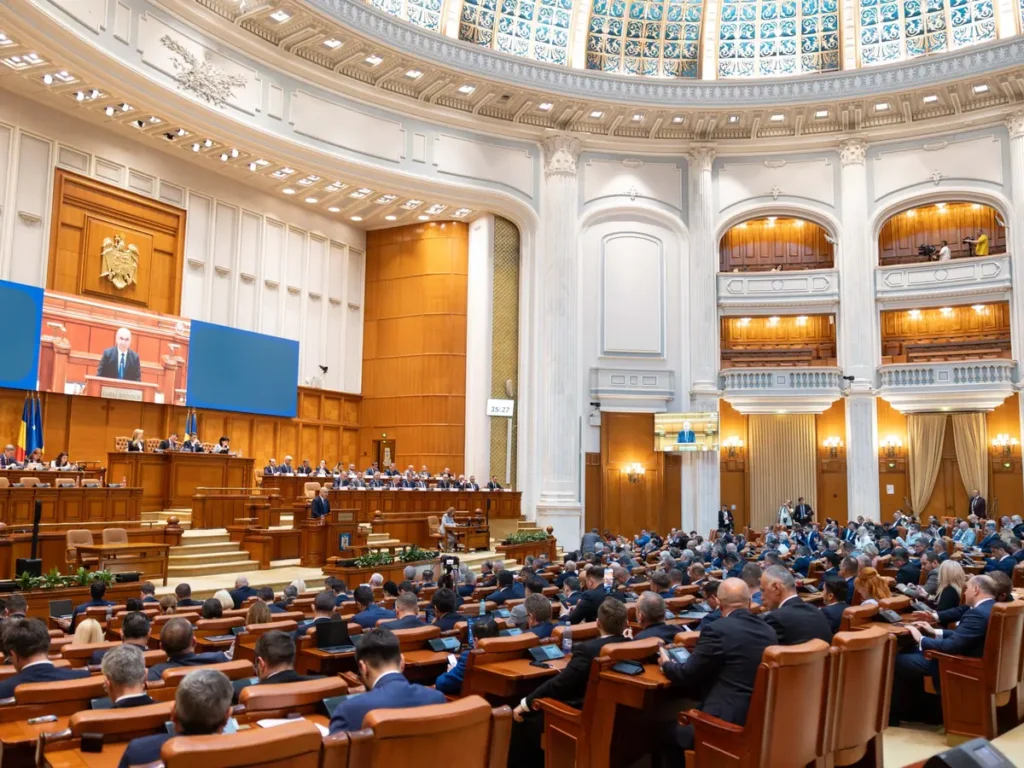
- The law on the operational and financial closure of the PNRR is placed on the Senate’s agenda, adopted by the Senate and entered on the agenda of the Chamber of Deputies, all on 26 August 2026.
- In the Chamber, the bill is entered „debated subject to the filing of the report” of the Budget Committee, that is, scheduled before the report exists. The Chamber is the decision-making Chamber, so its vote closes the passage through Parliament.
- The Chamber’s work programme for that day is rewritten, with a second plenary sitting from 18:00 and a second final vote.
Published: Official Gazette of Romania (Monitorul Oficial) no. 709 and no. 710 of 26 August 2026
In force from: 26 August 2026
A legislative proposal crossed an entire Parliament in a single day, and the two decisions that made it possible were published on the very day of the sittings. Decision no. 17/2026 of the President of the Senate, published in Official Gazette of Romania no. 709, and Decision no. 14/2026 of the President of the Chamber of Deputies, published in Official Gazette of Romania no. 710, both of 26 August 2026, supplement the agenda of the extraordinary session with the bill on the operational and financial closure of the National Recovery and Resilience Plan. This is the second round of supplements in the same session, after the six items added a day earlier.
The extraordinary session had been convened by Decision no. 15/2026 of the President of the Senate, for the period 24 to 26 August 2026, and by Decision no. 11/2026 of the President of the Chamber of Deputies, both published in Official Gazette of Romania no. 697 of 21 August 2026. 26 August was therefore the last day of the session. The two decisions now amend the annexes to those acts, and the phrase „as subsequently supplemented” shows that they are not the first to do so.
The legal basis is Article 66(2) and (3) of the Constitution, together with Article 84 of the Rules of Procedure of the Senate in the Senate and Article 84 paragraphs (8) and (10) of the Rules of Procedure of the Chamber of Deputies in the Chamber. The decisions are signed by the President of the Senate, Mircea Abrudean, and by the President of the Chamber of Deputies, Sorin-Mihai Grindeanu.
The two chambers convened again on 28 August 2026, for the year’s second ordinary session: Decisions no. 18 and no. 15/2026 both set Tuesday, 1 September, 16:00.
What it changes in practice
The first effect is in the Senate. Two new items are inserted after item 11 of the draft agenda: at 12, the legislative proposal on the operational and financial closure of the National Recovery and Resilience Plan, registered under number B473/2026, and at 13, the legislative proposal repealing certain provisions of Government Emergency Ordinance no. 57/2019 on the Administrative Code, under number B179/2026.
The second effect is in the Chamber of Deputies. Item 3^5 is inserted after item 3^4 of the draft agenda: the bill on the operational and financial closure of the National Recovery and Resilience Plan, under number PL-x 539/2026.
The third effect is the most important one, and it can be read from the record of the new item in the Chamber. It says „adopted by the Senate, 26.08.2026”. The same day on which the proposal was placed on the Senate’s agenda is also the day on which the Senate adopted it and the Chamber scheduled it.
The fourth effect is the procedural regime. The bill is an ordinary law, it is debated under the urgent procedure, the report falls to the Budget Committee, and the Chamber of Deputies is the decision-making Chamber. The vote of the Chamber closes the passage through Parliament.
The fifth effect is the condition written into the agenda itself: „Debated subject to the filing of the report”. The item stays on the agenda only if the report of the Budget Committee arrives in time.
The sixth effect is the rewriting of the Chamber’s work programme for Wednesday, 26 August 2026: committees between 8:30 and 10:00, plenary from 10:00 until the agenda is exhausted, with a final vote at the close of the debates, committees between 13:00 and 18:00, the Standing Bureau and the Committee of Parliamentary Group Leaders online from 17:30, then a second plenary sitting from 18:00, again until the agenda is exhausted and again with a final vote.
The seventh effect concerns the second file opened in the Senate. The repeal of certain provisions of the Administrative Code stays in the Senate as an agenda item, with no mention of any adoption, so its passage is only beginning.
What has changed compared with the previous situation
The first change is the number of items. The Senate’s agenda had 11 items and now reaches 13. In the Chamber, item 3 of the agenda receives its fifth indexed addition, 3^5.
The second change is the timetable of the Chamber. The programme for 26 August laid down by Decision no. 11/2026 is replaced in full, and the day gains a second plenary sitting, in the evening, with a final vote of its own.
The third change is where the bill stands in Parliament. In the morning it was a legislative proposal in the Senate, under number B473/2026. By the evening it had become a bill adopted by the Senate and registered with the Chamber of Deputies under number PL-x 539/2026.
What does not change is the length of the extraordinary session. The two decisions supplement the agenda and the work programme, they do not extend the session and they do not alter the convening acts as regards the period.
Nor does the role of the committees change. The report remains the responsibility of the Budget Committee of the Chamber, and the urgent procedure shortens the deadlines, it does not remove the stage.
Advantages and disadvantages
What it improves
- Every change to the agenda appears in the Official Gazette of Romania, so the passage of the bill can be reconstructed act by act.
- The record of the item in the Chamber states everything that matters procedurally: the type of law, the committee seised, the procedure, the decision-making Chamber and the condition for debate.
- The file numbers are published, B473/2026 in the Senate and PL-x 539/2026 in the Chamber, so the bill can be followed in both chambers.
- The condition „subject to the filing of the report” prevents a debate without a committee report.
- The rewritten work programme is broken down by the hour, so the public can know when the vote takes place.
- The supplement in the Senate is limited to two named files, it is not an open-ended authorisation.
What remains a problem
- A bill scheduled for a final vote before the committee report exists leaves very little reading time to anyone outside the committee.
- The decisions are published on the day of the sittings, so the public learns of the change to the agenda while it is happening.
- Passing through the Senate and being scheduled in the Chamber on the same day compresses the stage of public debate to the utmost.
- Indexed items of the 3^5 kind make the agenda of the Chamber hard to follow from outside.
- Neither decision says what the bill contains, so readers have to look for the text elsewhere.
- The second plenary sitting, from 18:00, with a final vote of its own, moves important decisions to an hour of reduced public visibility.
Practical advice
- If you are following the PNRR closure law, you need two file numbers: B473/2026 in the Senate and PL-x 539/2026 in the Chamber of Deputies. It is the same bill.
- If you are interested in the second file added in the Senate, the repeal of certain provisions of the Administrative Code, its number is B179/2026.
- The Chamber of Deputies is the decision-making Chamber for the PNRR bill, so its vote closes the passage through Parliament. Do not expect a second reading in the Senate.
- Bear in mind what „debated subject to the filing of the report” means: if the report of the Budget Committee is not filed, the item may drop off the agenda of that sitting.
- If you are reconstructing the course of the extraordinary session, the convening acts are Senate Decision no. 15/2026 and Chamber of Deputies Decision no. 11/2026, both in Official Gazette of Romania no. 697 of 21 August 2026.
- For the text of the bill itself, the decisions are of no help. They only amend the agenda, they do not publish the bill.
- These decisions create no obligations for individuals or for companies.
Frequently asked questions
What was added to the agenda?
Is it the same bill in both chambers?
How long did the passage through the Senate take?
What does „decision-making Chamber” mean?
What is the urgent procedure?
What does „debated subject to the filing of the report” mean?
Why was the work programme of the Chamber changed?
Who signs these decisions?
Editorial analysis
Two decisions of a few lines each tell, together, the densest procedural story of the day. On 26 August 2026, a legislative proposal on the operational and financial closure of the National Recovery and Resilience Plan was placed on the agenda of the Senate, adopted by the Senate and entered on the agenda of the Chamber of Deputies as a bill already adopted. The date of adoption by the Senate does not appear in the decision of the Senate but in the record of the item in the decision of the Chamber, which notes it because it has to justify why a file numbered B473/2026 became PL-x 539/2026.
The haste has two explanations, one European and one domestic. The first: the deadline by which the milestones and targets under the Recovery and Resilience Facility have to be met is 31 August 2026, and a state that wants to settle the operational and financial side of implementation cannot do so after that date. The second: the extraordinary session had been convened for 24 to 26 August, so 26 August was the last day on which Parliament could still vote on anything without a fresh convening. Seen that way, the speed is not a whim. What remains open to question is the method: if the European deadline has been known since the regulation was adopted, the moment at which the bill reaches Parliament, five days before expiry and on the last day of the session, was not inevitable.
The part that should give pause is the note „debated subject to the filing of the report”. The wording is correct under the rules of procedure and works, in theory, as a brake: no report, no debate. In practice, it confirms that the item was scheduled for a final vote at a sitting for which the report of the Budget Committee did not yet exist. A deputy who is not a member of the Budget Committee, a journalist or an organisation with an interest in PNRR money has no way of reading a report that is filed on the same day as the vote.
The third observation concerns publication. Both decisions are dated 26 August and appeared in the Official Gazette of Romania on 26 August as well, that is, on the day of the very sittings they organise. This is not a breach, because the rules of procedure allow the agenda to be supplemented in the course of the session, but it means that the Official Gazette of Romania records rather than announces. For an agenda, the difference between recording and announcing is precisely the difference between being able and not being able to prepare.
What should be changed
- A minimum gap between the publication of a supplement to the agenda and the sitting at which the item is debated. Even 24 hours would turn the decision from a record into an announcement.
- Filing the committee report before the final vote is scheduled, not at the same sitting. The reservation written into the agenda shows that the rules of procedure accept the situation, which is precisely the problem.
- Publishing, together with the decision, a reference to the text of the bill. A file number and a link would spare readers a search through two parliamentary websites.
- Dropping indexed items on the agenda in favour of renumbering. A list in which the fifth addition bears the number 3^5 is hard to read from outside the institution.
Original text of the legal act
The text below is reproduced in Romanian, the official form of publication.
The full text, as published in the Official Gazette of Romania
Official Gazette of Romania no. 709 and no. 710 of 26 August 2026 8 pages PDF, 83 KB
Open the official PDFDownload the PDF
The other editions cited: nr. 710/2026
The viewer is not shown on small screens. Use the buttons above to open or download the file.
This article is for informational purposes only and does not constitute legal advice. For specific situations, consult a licensed attorney or tax advisor.