
In brief
- The Constitutional Court has dismissed as inadmissible, unanimously, the plea by which a former minister argued that the Senate could no longer be seised a second time for the same acts. Decision no. 336 of 16 April 2026 appeared in the Official Gazette of Romania (Monitorul Oficial), Part I, no. 823 of 28 September 2026. The text challenged, Article 12 of Law no. 115/1999 on ministerial responsibility, stays exactly as it was.
- The dismissal says nothing about the substance of the criticism. Article 12 takes up word for word the first sentence of Article 109(2) of the Constitution, so it cannot breach it. The Court found that the author’s grievance concerns the way the text was used in his own case, and that interpreting and applying the law in a particular case is a matter for the courts of law.
- Those concerned are the members and former members of the Government under criminal investigation for acts committed in the exercise of their office, together with the prosecutors and the judges who work on such cases. For everybody else nothing changes from 28 September 2026. The substantive question, whether the right to request criminal prosecution is used up by the first decision of the authority seised, is left without an answer binding on everyone.
Published: Official Gazette of Romania, Part I, no. 823 of 28 September 2026, pages 2-3
Delivered: 16 April 2026, unanimously
Final and generally binding: 28 September 2026, the date of publication
The Constitutional Court has dismissed as inadmissible the plea challenging Article 12 of Law no. 115/1999 on ministerial responsibility, that is the text laying down who has the right to request the criminal prosecution of a minister for what he did in office. Decision no. 336 of 16 April 2026, published on 28 September 2026, leaves the text unchanged and does not answer the question put by the author of the plea. The reason is the one the Court also used in the case about the definition of a serious offence in the witness protection law: the criticism was aimed at the way the text had been applied, not at the text itself, and that is a matter for the courts.
Article 12 fits into one sentence: „Numai Camera Deputaților, Senatul și Președintele României au dreptul să ceară urmărirea penală a membrilor Guvernului pentru faptele săvârșite în exercițiul funcției lor.” Only the Chamber of Deputies, the Senate and the President of Romania have the right to request the criminal prosecution of members of the Government for acts committed in the exercise of their office. The law was republished in the Official Gazette of Romania, Part I, no. 200 of 23 March 2007, and this article has kept the same form ever since. The sentence is a copy of the first sentence of Article 109(2) of the Constitution, taken over by the legislator of 1999 without any change. It is precisely this detail that decides the fate of the plea, and the Court says so at paragraph 15 of the decision.
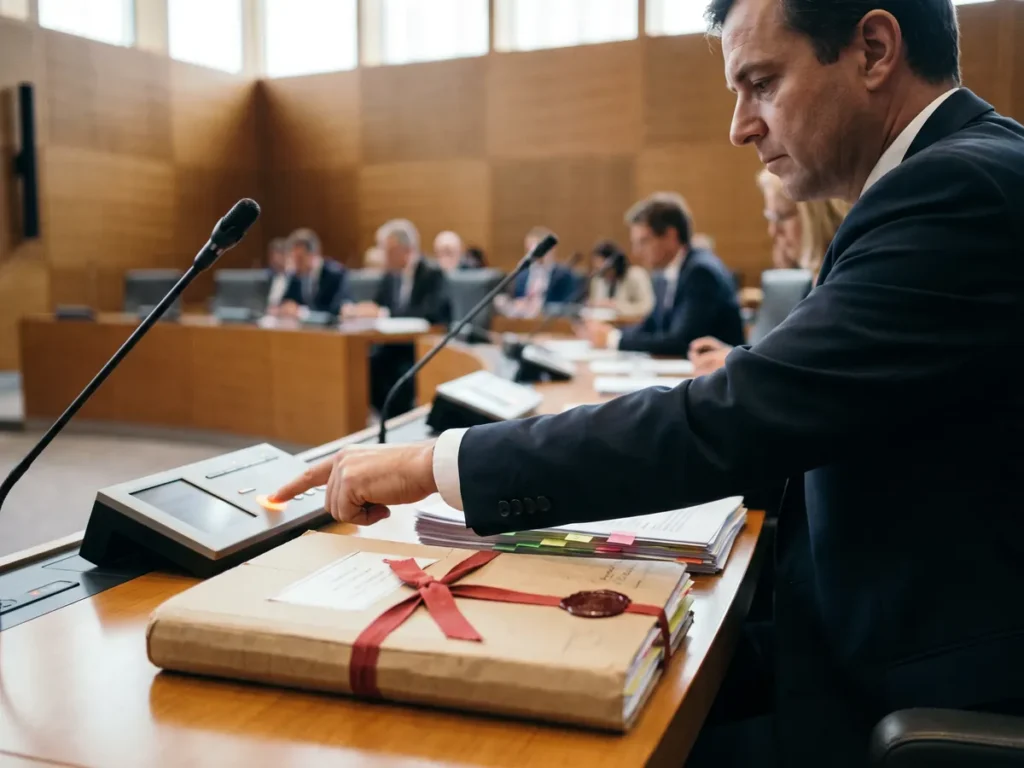
What happens in practice when a former minister comes under criminal investigation for acts committed in office. The prosecutor cannot start the prosecution on his own, as he would in an ordinary case. He needs a request coming from one of the three authorities listed in the text: the Chamber of Deputies, the Senate or the President of Romania. The competent Chamber is the one the person belongs to, if he is a member of Parliament, and the President steps in for former members of the Government who no longer hold a parliamentary mandate. The authority seised votes, and it may request the prosecution or refuse. Without that favourable vote the prosecutor has no way of going further, and the case stops before it starts.
In the case from which the plea came, the National Anticorruption Directorate, a unit of the Prosecutor’s Office attached to the High Court of Cassation and Justice, seised the Senate twice: the first time on 4 July 2019, the second on 8 April 2021. The person concerned, Florian Dorel Bodog, had been Minister of Health between January 2017 and February 2018 and was a senator in the 2016-2020 and 2020-2024 legislatures. According to the decision, the author of the plea argued that the facts set out in the two referrals are identical. On the date the Court was seised, the criminal case was in the preliminary chamber procedure, the stage in which the judge checks the lawfulness of the committal for trial and of the evidence, without ruling on guilt.
The criticism of unconstitutionality had a simple construction. The author was not asking for Article 12 to disappear, but for it to be declared unconstitutional in so far as it is read in any way other than one: the right to request criminal prosecution is exhausted on the date on which the competent authority adopts its first decision, whether by that decision it requests the prosecution or refuses to. The argument rested on Decision of the Constitutional Court no. 270 of 10 March 2008 and on Decision no. 93 of 16 June 1999, according to which the request for criminal prosecution is a constitutional procedural guarantee, meant to protect the mandate of the members of the Government. If the request could be taken up again whenever the political majority in Parliament changes, the author’s reasoning says, the guarantee would be emptied of content and the very risk the Constitution seeks to prevent would appear.
The High Court of Cassation and Justice, Criminal Division, sent the plea on with a favourable assessment: paragraph 9 of the decision states that the court considered that there may be aspects of unconstitutionality making an examination on the merits necessary. The presidents of the two Chambers of Parliament, the Government and the Ombudsman sent no view at all. The representative of the Public Ministry asked for the plea to be dismissed as inadmissible.
The Court followed the prosecutor’s line. Paragraph 17 finds that the author’s submissions are not aimed at the text of the law, which is identical in content to the constitutional rule, but at the way the judicial bodies interpret and apply it in the particular case. Paragraph 18 adds the basis: Article 2(3) of Law no. 47/1992 on the organisation and functioning of the Constitutional Court lays down that the constitutional court rules only on the constitutionality of the acts with which it has been seised, and not on the way the law is applied in a given case. The conclusion, at paragraph 19, is that the plea is inadmissible.
What it changes in practice
The first effect is the one that is missing. The text of Article 12 of Law no. 115/1999 stays in force, untouched, in the form it has had since 2007. No authority loses or gains any power, and the procedure by which the criminal prosecution of a member of the Government is requested goes on working in the same way.
The second effect concerns the case from which everything started. The preliminary chamber judge at the High Court remains the only person who can say whether the second referral of the Senate was valid or not and what consequences it has for the acts of prosecution. The Constitutional Court gave him no benchmark, because it did not enter the discussion. It is also worth remembering that raising the plea did not block the trial: since 2010, when Law no. 177/2010 removed the automatic suspension from Article 29 of Law no. 47/1992, the case goes on while the Court deliberates.
The third effect is one of practical precedent. A criticism formulated in the same way, however solidly argued, will receive the same answer. Anyone who nevertheless wants an answer from the Court on this question has to challenge something other than Article 12, for example a rule of criminal procedure governing the effect of the request, or seek a ruling from the High Court through the mechanisms for unifying case law.
The fourth effect is one of transparency. Until 28 September 2026, the Court’s position on this text was not public. It now exists, dated and reasoned, and anyone can read at paragraphs 15, 17 and 18 the reasoning on which any future dismissal of a similar criticism will rest.
What has changed compared with the previous situation
In positive law nothing has changed. Law no. 115/1999 has the same content as on 27 September 2026, and Article 12 has the same form as at the republication of 23 March 2007. A decision of inadmissibility amends nothing, repeals nothing and suspends nothing.
What has changed is what we know about the limits of constitutional review on this text. Before the decision, the fact that Article 12 reproduces the first sentence of Article 109(2) of the Constitution was an observation anyone could make by putting the two texts side by side. It is now the argument the Court used expressly to show that the text cannot be measured against the rule it copies.
The position of the substantive question has moved as well. Until now it could be kept waiting, in the hope that constitutional litigation would settle it. After 28 September 2026 it is clear that the answer does not come from there. Whether the right of the authority seised is used up by the first decision or can be exercised again for the same acts remains a question of interpretation, which each panel can resolve in its own way until a solution unifying case law appears or the legislator intervenes.
Advantages and disadvantages
What it improves
- The boundary between jurisdictions is drawn clearly and with an example that is easy to check: a law repeating the Constitution cannot be measured against the Constitution. Anyone who reads paragraph 15 understands why in ten lines.
- The solution was given unanimously, with no separate opinion and no concurring opinion. No signal is left that inside the Court there might be another reading of its jurisdiction.
- The criminal trial was not stopped. The plea has not suspended the proceedings since 2010, so the nearly four and a half years of waiting at the Court were not, formally, taken out of the life of the case.
- The decision makes available to the public the full text of Article 12 and the confirmation that it is identical to the first sentence of Article 109(2) of the Constitution. These are two things a reader without a subscription to a legal database found hard to obtain.
- The reasoning refers to a verifiable precedent, Decision no. 276 of 10 May 2016, published in the Official Gazette of Romania, Part I, no. 572 of 28 July 2016, so the criterion applied is not invented for this case.
What remains a problem
- The question that matters to the public receives no answer. Whether the Senate, the Chamber of Deputies or the President can go back on a decision refusing criminal prosecution is left to the judgement of each court.
- The Court does not say who ought to answer in its place. The reasoning stops at „ține de atribuțiile instanțelor judecătorești”, that it is for the courts of law, without pointing to any mechanism for unifying case law on a question that does not arise often but arises with much at stake.
- The court that referred the matter to the Court is left without help. At paragraph 9 the High Court had said that there may be aspects calling for an examination on the merits, and the answer it received does not deal with them.
- Between the referral order, of 23 November 2021, and the delivery, on 16 April 2026, 1,605 days passed. A ground of inadmissibility visible from the very formulation of the criticism does not need four and a half years.
- From the delivery to publication another 165 days passed, and the decision produces effects only from publication. The precedent cited in its own reasoning, Decision no. 276/2016, had reached the Official Gazette of Romania in 79 days.
Practical advice
- Do not read „inadmissible” as a verdict on constitutionality. The Court did not say that Article 12 is all right after weighing the arguments, but that the arguments were not about the text. These are two different things, and the second leaves the text exposed to a better-aimed criticism.
- If you are interested in the criminal case from which the plea came, follow the rulings of the preliminary chamber judge at the High Court. That is where the effect of the second referral of the Senate is decided, not at the Constitutional Court.
- When you build a plea of unconstitutionality, check first whether the text challenged does not reproduce a constitutional rule. If it does, the criticism has to be aimed at something else, otherwise it stops at admissibility.
- Remember that the date that counts for a decision of the Constitutional Court is the date of publication in the Official Gazette of Romania, not the date of the hearing. Here, 28 September 2026, not 16 April 2026.
- For the up-to-date form of Article 12, use the legislative portal of the Ministry of Justice. The text has been unchanged since the republication of 23 March 2007, but checking costs a minute and spares you from citing an old version.
- Do not confuse the request for criminal prosecution with a decision on guilt. The vote of a Chamber or the act of the President only opens or closes the possibility of an investigation, and guilt is established by the court, at the end of the trial.
Frequently asked questions
What does Article 12 of Law no. 115/1999 actually say?
What does it mean that the plea was dismissed as inadmissible?
How does it differ from a dismissal on the merits?
Has anything changed in the pending criminal case?
Can Article 12 be challenged again before the Constitutional Court?
Can the Senate be seised twice for the same acts?
From when does the decision produce effects?
Editorial analysis
The solution is correct and could have been written on one page. A sub-constitutional text that takes over the constitutional rule word for word cannot be set against it, and criticisms concerning the way the authorities use it in a particular case do not fall within the jurisdiction of the constitutional court. The problem is not the reasoning, but the time it took to deliver it and what it leaves unresolved behind.
The first thing that is not visible from reading the decision end to end comes from two dates placed side by side. The order by which the High Court referred the matter to the Constitutional Court is of 23 November 2021, and the delivery took place on 16 April 2026: 1,605 days, that is four years and almost five months. Another 165 days followed until publication, so from the referral to the moment the decision began to produce effects 1,770 days passed. The harshest comparison comes from its own reasoning: the precedent invoked at paragraph 17, Decision no. 276 of 10 May 2016, reached the Official Gazette of Romania on 28 July 2016, 79 days after the hearing. The same institution, the same kind of act, less than half the delay.
The second observation comes from combining paragraph 9 with paragraph 17. The High Court said that there may be aspects of unconstitutionality making an examination on the merits of the referral request necessary, and the Constitutional Court answered that the problem falls to the courts of law. Each institution points to the other, and between them a question with a direct effect on a criminal case is left standing: can the authority that once refused the criminal prosecution of a minister go back on that decision years later. The reasoning does not even indicate the direction in which the answer should be sought, although the mechanisms for unifying case law exist and are likewise at the High Court.
The third observation has to do with the calendar outside the Court. The two referrals of the Senate are 644 days apart, 4 July 2019 and 8 April 2021, and from the first of them to the publication of the decision 2,643 days passed, more than seven years. Both referrals came after the end of the ministerial mandate, in February 2018. The practical result is that a procedural guarantee designed to protect the exercise of a government mandate ended up being discussed more than eight years after that mandate had ended, and the discussion is not over even now. It is also worth saying that the list at the head of the decision contains seven judges, although the Court has nine members under Article 142(2) of the Constitution; the unanimity referred to in paragraph 20 is therefore the unanimity of the panel that judged the case.
What should be changed
- A legal time limit for publishing the decisions. Law no. 47/1992 does not provide how long after delivery the decision reaches the Official Gazette of Romania. A time limit of 30 days would cut the 165 days here to a fifth, and the effects of a decision, which in any case arise only from publication, would no longer depend on the pace at which the reasons are drafted.
- An admissibility filter working at the start of the case. The ground for the dismissal could be read from the very formulation of the criticism, as early as the referral order. A short procedure, settled within a few months, would spare the referring court a wait of four and a half years for an answer that does not touch the merits.
- A duty to indicate the competent authority when the Court declares that it lacks jurisdiction. A final paragraph saying that the question can be resolved through an appeal in the interests of the law or through a preliminary ruling on a point of law would turn a sterile answer into a useful benchmark for the court that sent the case.
- Supplementing Article 12 of Law no. 115/1999 with the rule the text sidesteps. A sentence saying whether the right to request criminal prosecution is used up by the first decision of the authority seised, and on what conditions that decision could be revisited, would close the question where it belongs, in the law, not in the deliberations of each panel.
- Publishing the reason why a judge is absent from the panel. When a decision is taken by seven judges out of nine, the reader ought to learn from the act why, not count the names at the head of it.
Original text of the legal act
The text below is reproduced in Romanian, the official form of publication.
The full text, as published in the Official Gazette of Romania
Official Gazette of Romania no. 823 of 28 September 2026, pages 2-3 16 pages PDF, 159 KB the act starts on page 2
Open the official PDFDownload the PDF
The viewer is not shown on small screens. Use the buttons above to open or download the file.
This article is for informational purposes only and does not constitute legal advice. For specific situations, consult a licensed attorney or tax advisor.