
In brief
- The State is taking 2,729 square metres of private land north of Ploiești in order to rebuild a junction on DN 1. There are 22 entries, all within the commune of Păulești, Prahova County, all arable land outside the built-up area, and the total estimated compensation is 40,106.62 lei. The procedure starts on 23 September 2026, the date the decision is published.
- The compensation is worked out at a single rate per square metre. At each of the 22 entries, the ratio between the sum awarded and the area taken comes to between 14.69 and 14.71 lei per square metre. The largest sum is 8,142.12 lei, the smallest 176.36 lei, and the biggest beneficiary is the commune of Păulești itself, with 8,567.74 lei for two plots in its private domain.
- Whoever receives the notification has 20 days to react, while the State has up to 90 days to pay. The owner has to come forward with the documents within 20 calendar days of notification and to file the claim for payment within 10 days of the list being posted at the town hall. The compensation money reaches the account of the National Company for Road Infrastructure Administration within at most 30 days of the approval of the request to open appropriations, a date that cannot be read from the decision.
Published: Official Gazette of Romania (Monitorul Oficial), Part I, no. 806 of 23 September 2026
In force from: 23 September 2026, the date of publication, because the act does not set a later date
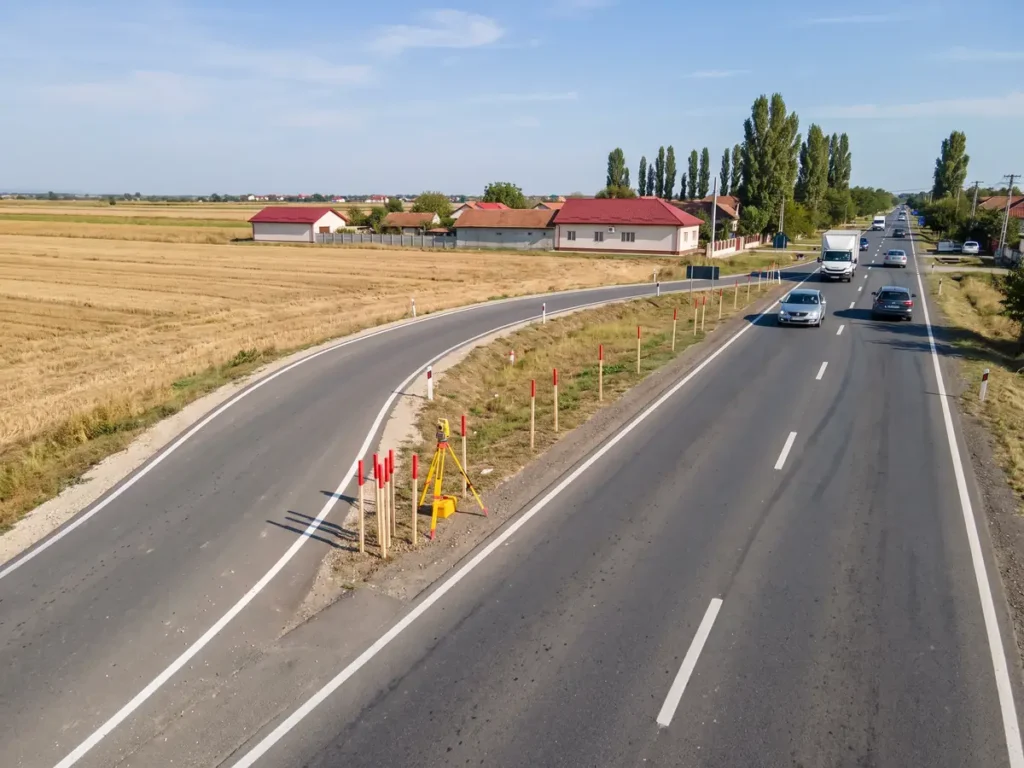
Government Decision no. 746/2026, published on 23 September 2026, starts the expropriation procedure for a small and very concrete piece of work: the rebuilding of the junction between DN 1, at kilometre 66+500, and the slip road linking the European route to DN 1B, at the northern exit of Ploiești, within the communes of Păulești and Blejoi. It is the second expropriation published on two consecutive days. The day before, for the conservation works at Lacul Roșu the State had taken 3,214 square metres of forest, with 48,357.96 lei in compensation. Here the area is smaller, and so is the sum: 2,729 square metres and 40,106.62 lei.
The act has six articles and three annexes. Article 1 approves the site of the works, in line with the final version of the feasibility study, and the plan itself is Annex no. 1, reproduced in facsimile in the Official Gazette of Romania. Article 2 starts the expropriation and approves the two lists: Annex no. 2, with the privately owned properties, their owners and the individual sums, and Annex no. 3, with the properties in the public domain of the State lying in the same corridor. Article 3 allocates the money from the state budget, through the budget of the Ministry of Transport and Infrastructure, under the state budget law for 2026 no. 43/2026. The expropriating authority is the Romanian State, represented by that ministry, through the National Company for Road Infrastructure Administration, known as CNAIR, the company that runs the national roads.
The legal basis is Article 108 of the Constitution and Article 5(1) and (11) of Law no. 255/2010 on expropriation for a cause of public utility, published in Official Gazette of Romania no. 853 of 20 December 2010. Being a government decision, it enters into force on the very date of publication, under Article 12(3) of Law no. 24/2000 on legislative drafting rules, republished, because no later date appears in its text.
What it changes in practice
The first effect is that 22 plots enter a procedure the owner cannot leave. Law no. 255/2010 asks for nobody’s consent: the government decision approves the list, the expropriating authority notifies, and ownership passes through the expropriation decision. Article 9(2) of the law states expressly that the decision is an enforceable title for handing over the property and that a challenge does not suspend the transfer. What can be challenged is only the amount.
The second effect is the calendar that starts on 23 September 2026. After publication, the expropriating authority posts the list of properties and the plan of the corridor at the town halls of Păulești and Blejoi and on its own website, then sends the notifications by post. From the date of notification, the owner has 20 calendar days to appear at the offices of the expropriating authority with the documents proving their title, under Article 8(2) of the law. The same notification also sets the deadline for vacating the property, which cannot be shorter than 30 working days. Within 5 working days of the expiry of those periods, the expropriating authority issues the expropriation decision, and within another 5 days it appoints the commission that verifies the ownership right.
The third effect is felt by whoever wants the money. The claim for payment is filed within 10 days of the decision being brought to public notice, by posting at the offices of the local council, under Article 19(2). Those who do not file the claim do not lose the sum: Article 19(5) requires the expropriating authority to deposit the money into an account in the name of the expropriated party, but it is released only once the right is proved. Actual payment is made within at most 90 days of the issuing of the decision setting the amount of the compensation, under Article 21.
The fourth effect is budgetary and has a chain of deadlines of its own. Under Article 3(2) of the decision, the sums are transferred into a treasury account opened in the name of CNAIR within at most 30 days of the approval of the request to open appropriations. That approval is given by the Ministry of Finance, at the request of the expropriating authority, within 30 days of the publication of the decision, under Article 4(8) of the implementing rules approved by Government Decision no. 53/2011. Put end to end, the two periods push the ceiling to 23 October 2026 for the opening of the appropriation and to 22 November 2026 for the transfer of the money.
The fifth effect does not concern private owners. Annex no. 3 brings into the corridor 25 entries of land in the public domain of the State, administered by the Ministry of Transport and Infrastructure and held under concession by CNAIR, with 1,450 square metres subject to transfer. Nothing is paid here, because the State does not compensate itself. Two of those entries, both at Blejoi and both with road as their land use category, account for 974 square metres, that is two thirds of the public area of the corridor.
What has changed compared with the previous situation
Until 23 September 2026, the works existed only on paper. Their technical and economic indicators had been approved by Order no. 148/2025 of the minister of transport and infrastructure, invoked in the preamble of the decision, and the feasibility study had reached its final version. What was missing was the piece without which nothing can be built on someone else’s land: the act by which the Government approves the site and starts the expropriation. Decision no. 746/2026 is that piece.
For the 18 distinct holders in Annex no. 2, the change is that their land became, overnight, land inside an expropriation corridor. The effect shows at once in planning terms: Article 5(1) of Law no. 255/2010 requires the local authorities to include the coordinates of the corridor in the general urban plans, and the site is marked out on the ground by setting boundary markers at all the points that define it. A plot inside a corridor can no longer be sold or built on like any other.
The meaning of „my land” changes too. At 20 of the 22 entries only a strip is taken: out of the 107,940 square metres that the total areas recorded in the annex add up to, 2,729 are expropriated, that is 2.53 per cent. The largest plot, 26,200 square metres belonging to the company Oro Invest, loses 554 square metres. There is, however, one entry taken in full, number 11, where the commune of Păulești loses its entire plot of 227 square metres, and one where almost a third is taken, entry 22, also belonging to the commune, with 356 square metres out of 1,103.
Nothing changes at Blejoi as far as private property goes. Although Article 2(1) speaks of the private properties within both communes, Annex no. 2 contains no entry at Blejoi. There the corridor touches only land belonging to the State, already administered by the ministry.
Advantages and disadvantages
What it improves
- The list is complete and gives names. All 22 entries have an identified holder, a field block, a parcel, a land book number and a sum of their own. There is no entry with an unknown owner, which shortens the procedure and reduces the risk of the money being stuck on deposit.
- The areas are small and predictable. At 20 of the 22 entries less than 10 per cent of the plot is taken, and the rest of the land stays in agricultural use, with access to the road the works are rebuilding.
- The corridor rests in good part on land the State already owns. Of the 4,179 square metres of the corridor, 1,450 are publicly owned, so 35 per cent of the works call for no expropriation at all.
- The money is allocated at the same time as the procedure starts, not afterwards. Article 3 sets the sum, the budget chapter and the expenditure heading, and payment does not depend on a future budget revision.
- The individual sums can be checked one by one. The annex gives both the expropriated area and the value, so any owner can redo the calculation and compare it with their neighbours.
- Anyone dissatisfied has the route to court open. Article 22 of Law no. 255/2010 gives them the general limitation period running from the communication of the decision setting the compensation, and the court appoints a panel of three experts, one of them proposed by the expropriated parties.
What remains a problem
- The compensation is a rate, not a valuation. Dividing the sum by the area at each entry gives values between 14.69 and 14.71 lei per square metre, the differences coming only from rounding. Land fronting DN 1 and land behind it receive the same price.
- No sum takes account of what is left. When a strip is taken out of a plot, the rest may become hard to use or to sell, and the annex contains no entry for damage to the remaining land.
- The deadlines hurry the owner and bind the expropriating authority to nothing precise. The owner has 20 calendar days to gather the documents and 10 days to file the claim for payment, while payment may be made within 90 days, and the transfer of the money runs from an internal act, the approval of the request to open appropriations, whose date appears nowhere in the decision.
- The text does not say where the junction actually is. Kilometre 66+500 of DN 1 and the slip road towards DN 1B are technical references, and an owner in Păulești has no way of learning from the act whether the works run through their yard or across the end of their field block, unless they go to the town hall to see the posted plan.
- The total in Article 3 does not match the total in the annex. The act states 40.2 thousand lei, while Annex no. 2 adds up to 40,106.62 lei, a difference of 93.38 lei more than what is actually owed.
- The value of the works does not appear in the decision. The technical and economic indicators were approved by a ministerial order invoked in the preamble but not reproduced, so the reader cannot set the 40,106.62 lei of compensation beside the cost of the investment.
Practical advice
- Check the list by land book number, not by name. Annex no. 2 identifies each entry by field block, parcel and land book number, and the name in the act is the one in the cadastral records, which may be that of a deceased predecessor or of a former owner.
- Go to the town hall in Păulești or Blejoi to see the plan of the corridor. Article 5 of the decision requires the expropriating authority to post it at the offices of the local councils and on its own website, and the plan is the only place that shows exactly where the line runs.
- Do not miss the 20 calendar days from notification. They run from the receipt of the letter, not from the publication of the decision, and appearing at the offices of the expropriating authority with your title documents is the step at which the sum can be discussed before it is formally set.
- Prepare the succession documents in good time. If the land is inherited and the succession procedure has not been opened, the compensation is deposited on account of the estate and released only against the certificate of inheritance, which can add months.
- Work out the price per square metre yourself and compare it with actual sales in the area. Divide the sum in the annex by the expropriated area. If the result is far from what changes hands in Păulești, you have a documented argument for the discussion with the commission and, if need be, for the court.
- Claim the compensation even if you do not agree with it. Article 19(11) of Law no. 255/2010 allows the sum set by the expropriating authority to be released and, if the court later awards more, the difference to be paid. Refusing to collect does not count as a challenge.
- If the land is mortgaged or under seizure, tell the creditor in good time. Article 9(31) and (32) provides for a notification 30 days before the decision, and the absence of a reply within 15 days means the procedure goes ahead without the security being taken into account.
- Check whether the rest of the plot still has access to a road after the works. Damage to the remaining area does not appear in the annex, and it can be argued only before the commission or the court, with a valuation of your own.
Frequently asked questions
Where exactly are the works?
How much is taken and how much is paid?
Where does the figure of 14.70 lei per square metre come from?
Can I refuse the expropriation?
Can I challenge the amount, and within what time?
When does the money arrive?
My land is at Blejoi. Am I affected?
What happens to the part of my land that is left?
Why is a mere junction „works of national interest”?
Errors and inconsistencies in the published text
- Article 2(1) and Article 3(1), read against Article 2(2) and Annex no. 2. Article 2(1) starts the expropriation of „tuturor imobilelor proprietate privată”, all privately owned properties, within the localities of Păulești and Blejoi. Article 2(2), however, approves the list of those same properties, „potrivit alin. (1)”, in accordance with paragraph (1), only for the locality of Păulești, and Annex no. 2 contains no entry at Blejoi. In Article 3(1) the two delimitations appear in the same sentence, one after the other: the sums are allocated for the properties „aflate pe raza localităților Păulești și Blejoi din județul Prahova, situate pe amplasamentul prevăzut la art. 1, aflate pe raza localității Păulești”, located within the localities of Păulești and Blejoi in Prahova County, on the site provided for in Article 1, located within the locality of Păulești. An owner of private land at Blejoi touched by the corridor cannot establish from the act whether the procedure concerns them. If it does, the act starts it without entering their property on the list and without allocating any sum to it, although Article 5(1) of Law no. 255/2010 requires the decision to approve the list of owners and the individual sums. If it does not, then Article 2(1) and the first half of Article 3(1) describe a scope wider than the one the act actually regulates. Page 4 of Official Gazette of Romania no. 806/2026.
Editorial analysis
The first observation comes out of 22 divisions. Divide the compensation by the expropriated area and every entry in Annex no. 2 gives a result between 14.6891 and 14.7086 lei per square metre, with the total at 14.6965. A range of two hundredths, across 22 plots that differ from one another more than a hundredfold in size, from 227 to 26,200 square metres, and that share neither the same position relative to the road nor the same neighbours. What the act calls „sume individuale aferente despăgubirilor”, individual sums of compensation, is in fact a unit price multiplied by an area. The method is lawful, because Article 5(1) of Law no. 255/2010 refers to the valuations of the chambers of notaries public, which work by land use category and by zone, not by plot. It remains, however, a starting estimate rather than fair compensation, and the only place where the difference between two pieces of arable land can be demonstrated is the court provided for in Article 22.
The second observation concerns how the money is shared out. The biggest beneficiary of the 40,106.62 lei is the commune of Păulești, with 8,567.74 lei for the two entries in its private domain, that is 21.4 per cent of the total. It thus comes ahead of the company Oro Invest, which takes 8,142.12 lei for the largest expropriated strip, 554 square metres. The three companies on the list receive 12,918.62 lei between them, that is 32.2 per cent, while the individuals, who are the great majority of the holders, receive 18,620.26 lei, less than half the sum. The state budget therefore pays a fifth of the compensation to another public authority, for land that leaves the private domain of the commune and enters the public domain of the State.
The third observation measures the deadlines that the act and the law impose on the two sides. The owner has 20 calendar days from notification to come forward with the documents and 10 days from the posting to file the claim for payment, plus another 15 days to complete the file if asked. These are short periods, and they call for papers from the cadastre office, from a notary and sometimes for a succession. On the other side, the expropriating authority has 5 working days for the decision, 5 days to appoint the commission and up to 90 days to pay, while Article 3(2) of the decision ties the transfer of the money to „data aprobării cererii de deschidere de credite”, the date on which the request to open appropriations is approved, an internal administrative act whose date does not appear in the Official Gazette of Romania and which the owner has no way of learning. The 30 days in the implementing rules run from publication, so the theoretical ceiling is 22 November 2026, but it is reached only by combining two acts, not by reading the decision. For the person waiting for the money, the only deadline visible in the published act is anchored in a document nobody outside the administration sees.
The fourth observation concerns the form of the act. Article 4(1) and (2)(a) of the implementing rules approved by Government Decision no. 53/2011 provide that the technical and economic indicators of the works are approved by the very decision that starts the expropriation. Decision no. 746/2026 confines itself to invoking in its preamble Order no. 148/2025 of the minister of transport and infrastructure, without approving its indicators and without reproducing anything from it. The practical consequence is that the value of the investment appears nowhere in the published act. The reader learns that the State is paying 40,106.62 lei for land, but cannot compare the sum with the cost of the works for which the land is being taken, nor check whether the expropriation is of the right size for the approved project. For works covering 4,179 square metres, that is 0.42 hectares including the State’s share, the ratio between effort and result is precisely the useful information.
What should be changed
- The territorial delimitation should be written once and written the same way throughout the act. If there is no private property in the corridor at Blejoi, Article 2(1) and Article 3(1) should say „Păulești”, as Article 2(2) does. If there is, those properties have to be entered in Annex no. 2 with sums of their own. Putting it right would spare every owner in Blejoi a trip to the town hall to find out whether they are affected.
- The sum in Article 3 should be written in lei, not in rounded thousands of lei. „40.2 thousand lei” differs from the annex total, 40,106.62 lei, by 93.38 lei. The difference leaves nobody short of money, since the allocation is larger than the debt, but a decision that approves individual sums to two decimal places has no reason to round its own total.
- The act should also give a reference the owner recognises. A mention of the villages crossed, of the communal roads touched or at least a pointer to the exact address on the website of the expropriating authority where the plan can be found would make Article 5 something more than an obligation to post a notice. Kilometre 66+500 means nothing to the person whose field block lies there.
- The transfer deadline should be tied to publication, not to an internal act. The formula „30 days from the approval of the request to open appropriations” recurs in expropriation decisions and moves the starting point into an unpublished document. A deadline written as „within at most 60 days of the publication of this decision” would say the same thing, would preserve the administration’s margin and would give the owner a date they can check for themselves.
- The value of the investment should appear in the act. Either by approving the technical and economic indicators in this very decision, as the implementing rules require, or by stating the total value approved by the order that is invoked. Without it, the expropriation is published without the benchmark that shows whether the works are worth the land taken.
- The annex should say what happens to the remaining area. At 20 of the 22 entries a strip is taken out of a larger plot, and at entry 22 almost a third. A column with the remaining area and a note on access to a road would show from the outset where a partial expropriation leaves land that is hard to use, instead of pushing the discussion into the challenge stage.
Original text of the legal act
The text below is reproduced in Romanian, the official form of publication.
The full text, as published in the Official Gazette of Romania
Official Gazette of Romania no. 806 of 23 September 2026 16 pages PDF, 467 KB the act starts on page 4
Open the official PDFDownload the PDF
The viewer is not shown on small screens. Use the buttons above to open or download the file.
This article is for informational purposes only and does not constitute legal advice. For specific situations, consult a licensed attorney or tax advisor.