
In brief
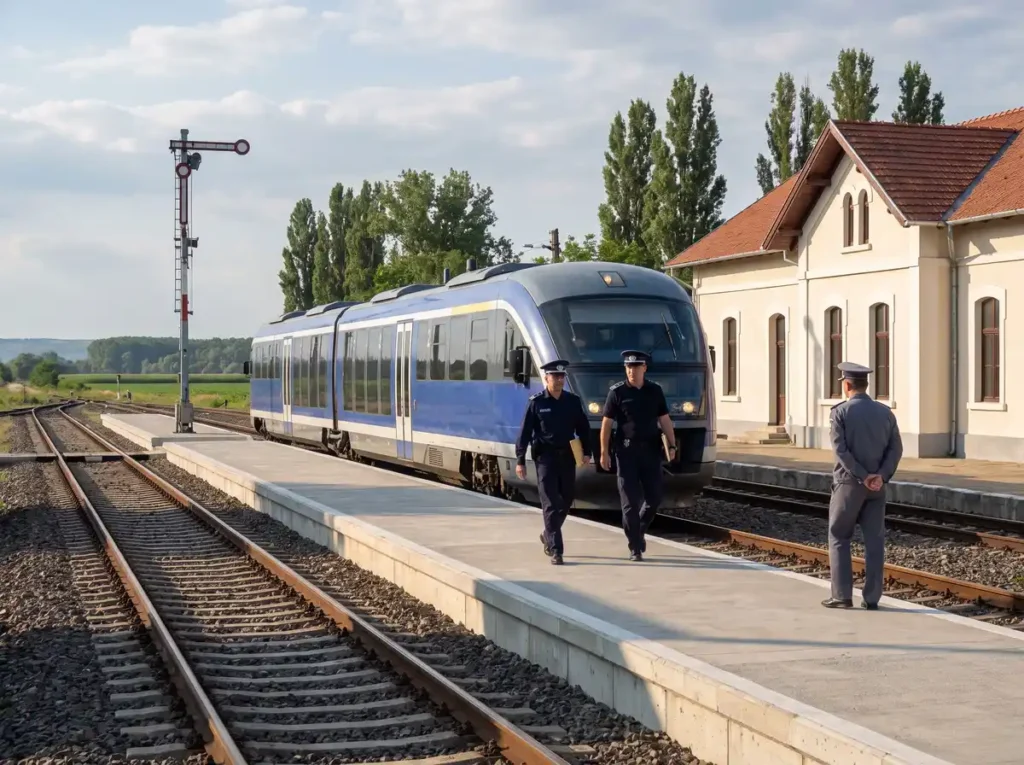
- At Fălciu, in Vaslui county, border checks on trains running to and from the Republic of Moldova will be carried out in a single location, on Romanian territory, by border guards and customs officers from both states, one team after the other.
- Moldovan border police officers, customs officers and sanitary veterinary inspectors will work at Fălciu station, applying the law of the Republic of Moldova, as if they were on their own territory.
- The agreement applies for 12 months from the date on which the coordinated control becomes operational and can be extended for further periods of 12 months, after a joint assessment of the results.
Published: Official Gazette of Romania (Monitorul Oficial) no. 573 of 13 July 2026
In force from: 16 July 2026
A train crossing the Prut at Fălciu stops twice today, once in each country, for checks that are performed all over again. Law no. 134/2026, published in Official Gazette of Romania no. 573 of 13 July 2026, ratifies the agreement under which the two states carry out the checks in a single location, at Fălciu station. The time saved comes from a change of procedure, not of infrastructure, which matters in a network where 1,688 kilometres of railway line are subject to speed restrictions.
The agreement was signed in Bucharest on 1 October 2025 and starts from a simple principle: coordinated control means that the two teams carry out their checks one after the other, at the same point, first the staff of the state of exit, then that of the state of entry. The train stops once, not twice.
The unusual part, the one that called for a treaty and a ratification law, is that Moldovan staff will exercise their powers on Romanian territory. And what they do there, the agreement says, is deemed to have been done on the territory of the Republic of Moldova.
The agreement actually entered into force on 21 July 2026, and MAE Order no. 1.944/2026 announced it only 50 days later.
What it changes in practice
Checks are carried out during a single stop, at Fălciu station, in both directions. This is the central mechanism of the agreement. Moldovan staff work within the limits of the duty location for the coordinated control, established by a joint set of rules.
An „operating territory” is created on Romanian soil. It covers the duty location for the coordinated control, the service rooms used by Moldovan staff and other facilities laid down in the joint rules, plus the stretch of railway between the border and the place where the checks are carried out.
Acts contrary to Moldovan law committed there are deemed to have been committed in Moldova. The agreement expressly states that the duties performed by Moldovan staff within the operating territory are deemed to have been performed on the territory of the Republic of Moldova, in the locality closest to the crossing point.
The right to free movement remains untouched. Moldovan staff cannot prevent entry into Romania of persons enjoying the right of free movement under European Union law, listed in the annex to the agreement, nor of persons covered by the United Kingdom Withdrawal Agreement.
An asylum application goes to the Romanian authority. A third-country national who applies for international protection on Romanian territory is guaranteed access to the competent Romanian authority and to the procedures set out in the European asylum acquis.
Nobody is left stranded in the station. Moldovan staff cannot refuse to take back into Moldova persons who have been refused entry into Romania, nor to take back goods that have not been cleared. Symmetrically, the Romanian side cannot refuse to take back persons whom Moldovan staff have not allowed to cross.
The authorities involved are named. On the Romanian side: the Ministry of Internal Affairs through the Romanian Border Police, the Ministry of Finance through the Romanian Customs Authority, and the National Sanitary Veterinary and Food Safety Authority.
The same institutions share the posts at a new road crossing on the border with Ukraine: Sighetu Marmației II comes with 14 lanes and 172 posts.
An entire chapter is devoted to personal data. Chapter VI, Articles 23 to 34, governs the transfer, purpose, storage, rectification and erasure of data, together with the obligation on each party to designate public supervisory authorities. Decisions based solely on automated processing, including profiling, are dealt with separately.
Classified information stays outside the exchange. Article 22 states explicitly that, in applying the agreement, the parties do not exchange classified information.
What has changed compared with the previous situation
Until now, Fălciu-Cantemir was covered by the general regime laid down in the Romanian-Moldovan agreement on border crossing points, signed in Bucharest on 13 November 2009: each state carries out its checks on its own territory. For a train, that means two stops, two teams, two procedures, in two different stations.
The new agreement does not abolish that rule, it creates an exception for a single railway crossing point. What changes in practice is the place: both sets of checks are carried out at Fălciu, one after the other, during the same stop. It is the Moldovan staff who move, not the train.
The second change is a legal one, and it is the reason a treaty was needed: the fiction of territoriality. Without the article stating that the powers of the Moldovan staff are deemed to be exercised on the territory of the Republic of Moldova, a Moldovan customs officer seizing goods at Fălciu station would be acting with no legal basis.
The third novelty is the duration. The agreement is not concluded for an indefinite period, but for 12 months from the date on which the coordinated control becomes operational, with extensions of 12 months each decided by mutual agreement, on the basis of a joint assessment of how the system has performed, carried out no more than 30 days before expiry. In practice, it is a trial mechanism.
A reserve clause is added in favour of the Moldovan side: in exceptional situations, it may temporarily move the checks back onto the territory of the Republic of Moldova, giving the Romanian side at least 24 hours’ notice through diplomatic channels.
Advantages and disadvantages
What it improves
- A single stop instead of two significantly shortens the time it takes to cross the border for both passenger and freight trains.
- The agreement expressly requires joint measures to cut waiting times, not merely formal coordination.
- The safeguards for the right of free movement and for access to the asylum procedure are written into the text, not left to practice.
- The reciprocal obligation to take people back removes the risk that someone ends up stuck between the two sets of checks.
- Personal data protection takes up an entire chapter, with designated supervisory authorities and separate treatment for automated decisions.
- The 12-month term with a joint assessment before each extension turns the agreement into a mechanism that can be checked, rather than a permanent commitment.
What remains a problem
- The set of rules that actually defines the duty location, the service rooms and the facilities is drawn up by the heads of the local units and is not published in the Official Gazette of Romania, even though the extent of the operating territory depends on it.
- The clause allowing the Moldovan side to move the checks back temporarily onto its own territory carries no time limit written into the agreement, only the obligation to give 24 hours’ notice.
- The agreement can be suspended unilaterally, in whole or in part, on grounds of national security, public order or public health, and in situations calling for immediate measures the suspension takes effect on the very date of notification.
- The 12-month term runs from a date that the parties communicate later, through diplomatic channels, so the public has no way of learning it from the text until the arrangement actually starts to apply.
- Either party can denounce the agreement at any time, with effect after 30 days, which leaves rail traffic dependent on a unilateral decision.
Practical advice
- Do not assume the change applies from the moment the law was published. The law entered into force on 16 July 2026, but the agreement itself enters into force on the last diplomatic notification, and the 12 months run from the date on which the coordinated control actually becomes operational.
- If you travel on this route, follow the announcements of the Romanian Border Police concerning the date from which checks will be carried out during a single stop at Fălciu.
- Bear in mind that at Fălciu station you will be checked by two teams in turn, first by that of the state you are leaving, then by that of the state you are entering.
- If you are a national of a European Union state, of the European Economic Area or of Switzerland, or a family member of one, your right to enter Romania cannot be blocked by Moldovan staff. The full list is in the annex to the agreement.
- If you apply for international protection, the application is addressed to the competent Romanian authority, which must guarantee you access to the procedure.
- For goods transport, check whether the cargo falls under sanitary veterinary control: the National Sanitary Veterinary and Food Safety Authority also takes part on the Romanian side.
- If you want to know what happens to your data, Chapter VI of the agreement sets out the purpose, storage, rectification and erasure of that data, and each party is required to designate a supervisory authority.
Frequently asked questions
What does coordinated control mean?
Will Moldovan customs officers work in Romania?
Which law applies there?
Can a Moldovan border guard stop me from entering Romania?
How long is the agreement valid for?
Can the agreement be stopped?
Is classified information exchanged?
What happens to my personal data?
Editorial analysis
The agreement solves a small and very concrete problem, and that is its main quality. One stop instead of two, at a railway crossing point used by both freight and passengers, is the kind of gain that is felt immediately, with no investment and no European projects. The legal construction, the fiction of territoriality under which what the Moldovan customs officer does at Fălciu counts as done in Moldova, is the classic solution and it is correctly applied.
The care taken over the substantive safeguards is also worth noting. The express ban on Moldovan staff blocking the entry of someone who enjoys free movement, the guaranteed access to the asylum procedure before the Romanian authority and the mutual obligation to take people back cover precisely those situations in which checks on foreign soil could give rise to abuse. The data protection chapter, with its twelve articles, is unusually developed for a technical border agreement.
Where the text stays thin is on transparency and on stability. The exact extent of the operating territory, meaning the piece of Romania in which Moldovan law applies, is set out in rules drawn up by the heads of the local units, which are published nowhere. And the 12-month architecture, with immediate unilateral suspension and denunciation on 30 days’ notice, suits a pilot phase, but it turns a public transport service into a permanently provisional arrangement.
What should be changed
- Publication of the operating rules. The document that delimits the operating territory should be published, at least on the websites of the Border Police and of the Customs Authority. Anyone crossing the border has the right to know exactly where another state’s law applies.
- A time limit on moving the checks back. The clause allowing the Moldovan side to move the checks back onto its own territory carries a notice period, but no maximum duration. A written cap would stop the exception from turning into the rule.
- Public announcement of the date on which the arrangement starts. The 12 months run from a date the parties notify to each other through diplomatic channels. An obligation to announce it publicly would make the timetable verifiable for hauliers and passengers.
- A public report at each extension assessment. The joint assessment of results is already in the text, ahead of every extension. Publishing the conclusions would show whether the mechanism really does cut waiting times, the only reason it was created.
- Extension of the model, if the results bear it out. The same construction could be applied at other railway crossing points towards the Republic of Moldova, and a framework agreement would avoid negotiating from scratch for every station.
Original text of the legal act
The text below is reproduced in Romanian, the official form of publication.
The full text, as published in the Official Gazette of Romania
Official Gazette of Romania no. 573 of 13 July 2026 16 pages PDF, 114 KB the act starts on page 2
Open the official PDFDownload the PDF
The viewer is not shown on small screens. Use the buttons above to open or download the file.
This article is for informational purposes only and does not constitute legal advice. For specific situations, consult a licensed attorney or tax advisor.