
In brief
- The state is once again checking the quality of the petrol and diesel sold in Romania, but from now on against the 2025 edition of the reference standards: SR EN 228:2025 for unleaded petrol and SR EN 590:2025 for diesel, in place of the 2017 editions.
- The change concerns section A of annex no. 1 to Order no. 569/2019 of the Minister of Energy, that is, precisely the part describing the sampling carried out by the Ministry of Energy through third-party inspection bodies, at filling stations and other points of sale.
- The order does not itself alter any quality parameter and does not rewrite the permitted limits. All it changes is the edition of the standard against which the checks are made, and the content of those standards is published by the Romanian Standards Association, ASRO, not in the Official Gazette of Romania (Monitorul Oficial).
Published: Official Gazette of Romania no. 633 of 31 July 2026
In force from: 31 July 2026
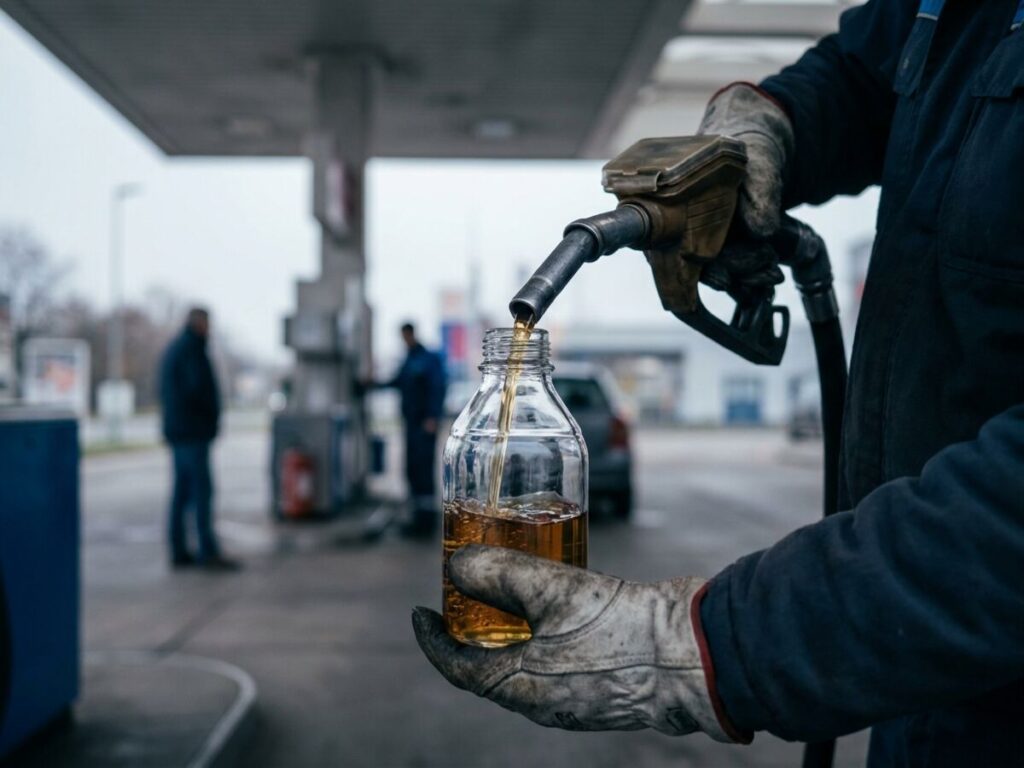
The petrol and diesel samples that the state collects from filling stations will from now on be analysed against the 2025 standards, not the 2017 ones. The Ministry of Energy has signed Order no. 770/2026, published in Official Gazette of Romania no. 633 of 31 July 2026, which replaces, within the national fuel quality monitoring system, the references to SR EN 228+A1:2017 and SR EN 590+A1:2017 with references to SR EN 228:2025 and SR EN 590:2025. This is the state’s second intervention in the fuel market in a short space of time, after the measures that brought fuel prices under legal control, with a capped markup and a reduced excise duty on diesel, except that this time the object is not the price but the quality of the product in the tank.
The sampling-based system for monitoring the quality of petrol and diesel has existed since 2019 and is the mechanism through which Romania meets a long-standing European obligation. Directive 98/70/EC of the European Parliament and of the Council, of 13 October 1998, requires every member state to check periodically, by taking samples, whether the petrol and diesel placed on the market meet the quality specifications, and to report the results each year. Order no. 569/2019 of the Minister of Energy, published in Official Gazette of Romania no. 720 of 2 September 2019, turned that obligation into a concrete procedure, with roles, a timetable and laboratory methods.
Within the architecture of that system, the European standards are not a decorative technical detail. They define the very object of the control: what counts as compliant unleaded petrol, what counts as compliant diesel, which grades are sampled (E10 with a minimum octane rating of 95 and 98, and B7 for diesel) and how the year is divided into a summer period, a winter period and transition periods, because the volatility requirements for petrol and the cold-weather requirements for diesel differ from one season to another. All of this is set out in SR EN 228 and SR EN 590, and the order of 31 July shifts the reference from the old edition to the new one.
The reason the ministry gives in the preamble is straightforward: standards SR EN 228+A1:2017 and SR EN 590+A1:2017 have been revised and replaced by the 2025 editions, and the national legal framework had to be brought into line with the technical standards currently in force. The decision rests on statement of need no. 151,940 of 14 May 2026, drawn up by the specialist directorate within the Ministry of Energy. The order was signed on 24 July 2026 by the interim Minister of Energy, Ilie-Gavril Bolojan.
What it changes in practice
The first effect falls on the laboratories and the inspection bodies working for the Ministry of Energy. The test reports issued for samples taken at filling stations must from now on cite the test methods and limit values in the 2025 editions of the two standards. A report that continued to quote the 2017 edition would be pointing to a document withdrawn by the national standardisation body.
The second effect concerns the sampling calendar. The summer, winter and transition periods used in the annual sampling programme are those defined in the standards, and from 31 July 2026 the benchmark is the 2025 edition. In practice, the sampling campaigns for the cold season ahead will be planned according to the new reference.
The third effect is indirect, but the most important one for the market. Fuel distributors, importers and producers now know that the sample taken at their station will be compared against the specification in the 2025 edition. Anyone who had already aligned their internal procedures and supply contracts with the new edition needs to do nothing. Anyone still working to the 2017 edition has a gap to close, because the state’s checks will no longer wait for them.
The fourth effect concerns reporting to the European institutions. The data collected through this system feeds the annual report that Romania submits on fuel quality. With the reference updated, the reported results rest on the same technical basis used by the other member states, which likewise apply the editions of EN 228 and EN 590 currently in force.
For the ordinary driver, the direct effect on the day of publication is nil. Neither prices, nor the grades at the pump, nor the driver’s own obligations change. The only thing that changes is the ruler the state uses to measure what is being sold.
What has changed compared with the previous situation
Until 31 July 2026, section A of annex no. 1 to Order no. 569/2019 referred to standards SR EN 228+A1:2017, Automotive fuels. Unleaded petrol. Requirements and test methods, and SR EN 590+A1:2017, Automotive fuels. Diesel. Requirements and test methods. These were the 2017 editions, amendment A1 included, in force at the time the monitoring system was built.
Order no. 770/2026 performs two replacements, worded identically. The first: wherever the reference to SR EN 228+A1:2017 appears in section A, it is from now on read as a reference to SR EN 228:2025. The second: wherever the reference to SR EN 590+A1:2017 appears, it is read as a reference to SR EN 590:2025. The titles of the standards stay the same, only the edition changes.
It is worth spelling out what has not changed. The order does not touch the structure of the monitoring system, does not alter the number of samples, does not change who carries out the sampling and does not rewrite the counter-sample procedure. Nor does it touch section B of the annex, the one on sampling in operators’ own laboratories and on the transmission of sales data. The intervention sits strictly at the level of the bibliographic reference, yet its legal effect is real, because the reference determines which technical document applies.
Just as important: the order says nothing about what has actually been modified inside the standards. The differences between the 2017 edition and the 2025 edition of the two standards are not published in the Official Gazette of Romania. Romanian standards are drawn up and sold by the Romanian Standards Association, and their text has to be bought from ASRO. Anyone who needs the exact list of modified parameters has to compare the two editions at source.
Advantages and disadvantages
What it improves
- It removes a genuine inconsistency: until now, a legal act in force referred to a withdrawn edition of a standard, while the laboratories were in fact working with the current document.
- It aligns state control with the technical level at which the industry and the other member states already operate, which makes the data reported at European level comparable.
- It reduces the risk of challenge. An operator penalised for non-compliance could argue that the reference in the order was out of date; that argument now falls away.
- It is a clean, two-line amendment, with no new administrative costs and no additional reporting obligations for companies.
What remains a problem
- The order says nothing about what has actually changed in the standards. A distributor can only find out the differences by buying both editions from ASRO, which is a real cost for small companies.
- There is no transition period. The reference changes on the date of publication, and anyone whose internal procedures were calibrated to the 2017 edition has to update them with no grace period.
- The amendment touches only section A. A reader of the order cannot tell, without opening the full annex, whether the rest of the document still contains references to the old editions.
- The monitoring results do not reach the general public in a form that is easy to consult, so consumers cannot see the effect of this control on the station where they fill up.
Practical advice
- If you run a filling station or a fuel depot: check which edition of the standards is cited in your internal fuel acceptance procedures and in your contracts with suppliers. Any reference to SR EN 228+A1:2017 or SR EN 590+A1:2017 has to be replaced.
- If you work in a testing laboratory: confirm that your scope of accreditation and your test report templates cite the 2025 editions. A sample taken after 31 July 2026 is assessed against the new edition.
- If you import or produce fuels: ask your suppliers for quality certificates issued on the basis of the editions in force. A certificate quoting the 2017 edition no longer covers your risk in a sampling check.
- If you need the text of the standards: it is not available in the Official Gazette of Romania. It has to be ordered from the Romanian Standards Association, the national standardisation body and the only lawful distributor of SR EN standards.
- If you are a driver and suspect that a fuel is substandard: the complaint goes to the National Authority for Consumer Protection, ANPC, which holds the enforcement powers in dealings with the end consumer. The system set up by this order is a mechanism for statistical monitoring of the market, not a procedure for settling individual complaints.
- If you follow this field professionally: remember that a standard cited in a legal act applies in the edition to which the act refers. When the standard is revised, the legal effect arrives only once the order itself is amended, exactly as has happened here.
Frequently asked questions
What does Energy Order no. 770/2026 actually do?
Does the quality of the petrol and diesel at the pump change?
What are SR EN 228 and SR EN 590?
Who takes the fuel samples?
From when do the new references apply?
Why was this order needed if the standards had changed anyway?
Where can I read the text of the standards?
Does the order also change economic operators’ obligations regarding their own laboratories?
How does the order relate to European legislation?
Original text of the legal act
The text below is reproduced in Romanian, the official form of publication.
The full text, as published in the Official Gazette of Romania
Official Gazette of Romania no. 633 of 31 July 2026 16 pages PDF, 338 KB the act starts on page 7
Open the official PDFDownload the PDF
The viewer is not shown on small screens. Use the buttons above to open or download the file.
This article is for informational purposes only and does not constitute legal advice. For specific situations, consult a licensed attorney or tax advisor.