
In brief
- The rules arrive 3,101 days past the deadline set by the law. Law no. 27/2018 required the Government to approve the implementing methodology within 60 days of the law entering into force, that is by 18 April 2018. The decision was adopted on 9 October 2026 and published on 14 October 2026, after an interval more than 52 times longer than the deadline the law had set.
- The mining authority draws up the lists, the Ministry of Economy provides the money. The regulatory authority for mining and petroleum draws up the lists of geological objectives to be investigated, the areas and formations where prospecting and exploration work is to be carried out, after consulting the Ministry of Environment, Waters and Forests, the Ministry of Economy and the Ministry of Energy, and sends them by 1 September each year. The Ministry of Economy, Digitalisation, Entrepreneurship and Tourism is the principal authorising officer, so it releases the money and signs the contracts.
- A company paid from the budget does not keep the geological data. On acceptance, the reports and studies are handed over by protocol to the mining authority and enter the National Geological Fund, while those concerning groundwater also go to the Ministry of Environment. A contractor financed from the state budget has no right to use the data obtained, and the state then turns that data to account through public offers for exploration, open to anyone.
- Contracts are awarded through a design contest, for a maximum of 3 years. Selection is made in a design contest, the procurement procedure in which a panel picks the winning proposal, by a panel of no more than 7 people appointed by order of the Minister of Economy, and payment comes within 30 days of the settlement statements being approved. Only bidders that are legal persons certified by the mining authority for the type of work put out to contest are eligible.
Published: Official Gazette of Romania, Part I, no. 860 of 14 October 2026, pages 2-4
In force from: 14 October 2026, the date of publication, because the decision does not itself set a later date, and a government decision takes effect on publication unless it provides otherwise
Since 14 October 2026, Romania has the rules by which it investigates its own subsoil. Government Decision no. 812/2026, published in the Official Gazette of Romania, Part I, no. 860 of 14 October 2026, approves the Implementing Rules for Law no. 27/2018, the law that set up the National Geological Programme. Without these rules the programme existed on paper, but it had no procedure for choosing the objectives, allocating the money and contracting the work. This is the second case in 2026 in which a methodology in the resources field reaches the Official Gazette of Romania (Monitorul Oficial) long after the deadline the law had given it: in September, the methodology for the exploration permit for the wind perimeters in the Black Sea appeared 428 days past the deadline, and here the delay is more than seven times greater.
The arithmetic is simple and comes out of the text of the law. Law no. 27/2018 was published in Official Gazette of Romania no. 49 of 18 January 2018 and, under Article 7, entered into force 30 days after publication, that is on 17 February 2018. Article 4 paragraph (3) of the same law, invoked as the legal basis in the preamble of the present decision, provided that the implementing methodology is approved by government decision „within 60 days of the date this law enters into force”. The deadline expired on 18 April 2018. From that day to the publication of the rules, 3,101 days passed. From the moment the clock started, 17 February 2018, 3,161 days passed, for an obligation that had to be discharged in 60. Between the adoption of the decision in the government meeting of 9 October 2026 and its publication, 5 days passed.
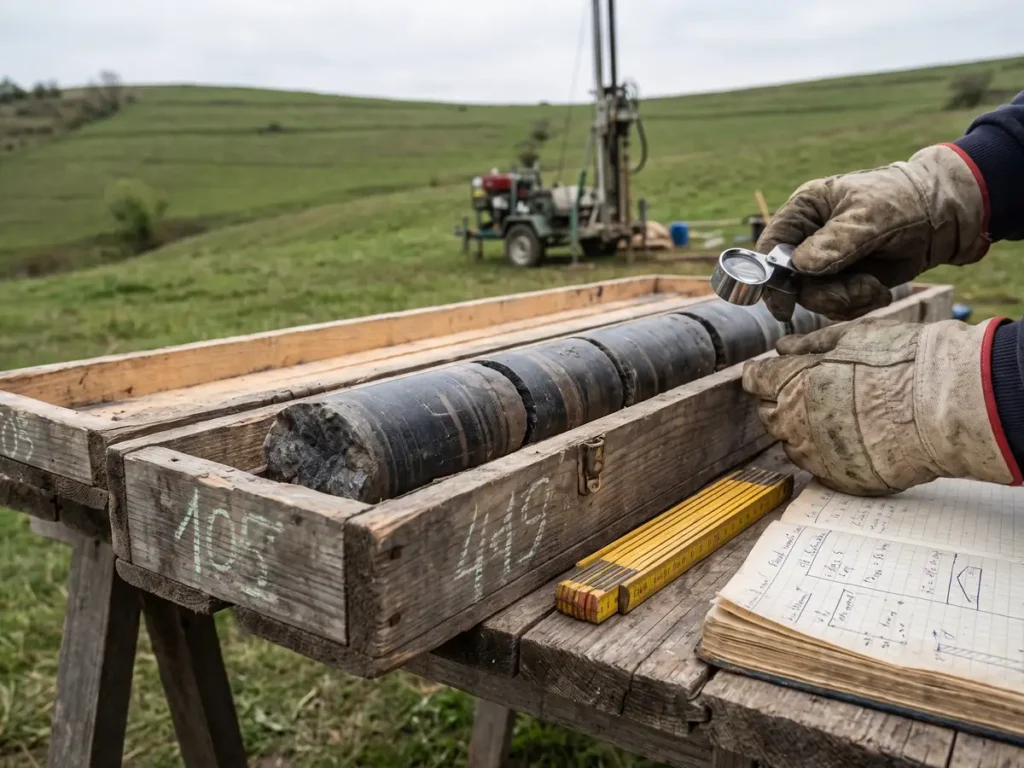
For the reader who does not follow the field, the National Geological Programme means public money spent on prospecting and exploration, that is on the field and desk work through which the country finds out where its mineral resources are and what they are worth, from ores and critical raw materials to drinking and industrial groundwater. The result is not an open mine but geological information: maps, syntheses, reports, data that the state gathers in a fund of its own and can later put on the table, at auction, for anyone willing to explore with their own money.
What it changes in practice
The first effect is a clear chain of competences, something that was missing until now. The National Authority for the Regulation of Mining, Petroleum and the Geological Storage of Carbon Dioxide (A.N.R.M.P.S.G.), the authority that issues permits and licences in mining, petroleum and carbon dioxide storage, draws up the lists of geological objectives proposed for prospecting and exploration work. It does not draw them up on its own: Article 1 paragraph (1) requires it to consult beforehand the Ministry of Environment, Waters and Forests for its field of competence, the Ministry of Economy, Digitalisation, Entrepreneurship and Tourism for non-energy mineral resources and the Ministry of Energy for energy resources. The lists leave by 1 September each year for the Ministry of Economy, which is the principal authorising officer for the programme’s funds, so that it can estimate the budget needed. The ministry then proposes the research topics, and has to base them on the objectives received from the mining authority, set in their regional context.
The second effect is an immediate deadline. For the current year, Article 1 paragraph (3) short-circuits the annual calendar: the lists are communicated within 30 days of the rules entering into force, that is by 13 November 2026. It is the only firm date the act produces in 2026 and the only sign that the programme is genuinely starting, instead of remaining a set of rules.
The third effect concerns those who carry out the work. Topics that involve prospecting within a geological objective are performed on the basis of a prospecting permit issued by the mining authority, while topics that involve only studies, syntheses, geothematic maps of national interest, forecast maps for resource potential, including critical raw materials, or national geological reports on areas already prospected require no permit. The maximum duration of a topic cannot exceed the statutory duration of the prospecting permit, which under Mining Law no. 85/2003 is at most 3 years, with no right of extension. A topic is developed in no more than 3 stages, each of at most one year, and the contract is concluded for a maximum of 3 years. The three ceilings overlap, so a contract signed on 14 October 2026 cannot run beyond 14 October 2029.
The fourth effect is financial and calendar-bound. Each year, within 30 days of the state budget being approved, the Ministry of Economy examines in its technical and economic council the budget allocated to the proposed objectives, before it opens the procurement procedure. The opinion of that council and of the specialist directorate is the basis for distributing the funds across each objective or topic, and the financing then enters the ministry’s annual public procurement plan. Implementation runs through a competitive procedure, under Law no. 98/2016 on public procurement and its implementing rules in Government Decision no. 395/2016, and the concrete form is the design contest.
The fifth effect matters most to companies and is set out in Article 11. On acceptance at the completion of the works, performed by a joint panel appointed through a joint order of the Minister of Economy and the president of the mining authority, the reports and studies are handed over by protocol to the mining authority and become part of the National Geological Fund, while those concerning groundwater also go to the Ministry of Environment. A contractor that has worked on state budget money has no right to use the data obtained and does not benefit from the facilities that the implementing rules of the Mining Law ordinarily grant to the holder of data, should it take part in a later exploration round organised in the same perimeter. In short, whoever prospects with public money gains no information advantage over the competitors who will bid later for the exploration of the same perimeter.
What has changed compared with the previous situation
Until 13 October 2026, Law no. 27/2018 was in force, approved the National Geological Programme and provided that the funds come from the state budget through the budget of the ministry concerned, within the limits of the appropriations approved each year. It also provided that the ministry distributes the funds across each geological objective „in accordance with the methodology implementing this law”. That methodology did not exist. The practical result was a law with an objective, with an authorising officer and with an article that pointed to a document which did not exist, and therefore without the mechanism by which money reaches the work.
Since 14 October 2026 the mechanism exists, and five things that were previously written nowhere become rules. It is known who proposes the objectives and who has to be consulted beforehand. There is an annual deadline, 1 September, by which the list goes to the ministry. Contracts are awarded through a design contest, not by direct negotiation, and a panel of no more than seven people, a chair and at most 6 members with expertise in mineral resources, legal and economic sciences, votes on the winning proposal, the chair voting only in the event of a tie, to break it. Payment opens on a closed list of documents: a payment request, a geological research report, a post-completion cost statement with supporting documents and a record of acceptance of the payment documents. And it is known who ends up with the data, which was previously the most expensive question for a company thinking of entering the programme.
One detail of quality also changes, which the Official Gazette of Romania carries in Article 10 paragraph (2): petrographic, mineralogical, palaeontological, geochemical and chemical analyses are carried out only in testing laboratories accredited by the national accreditation body or by accreditation bodies that are signatories to recognised international agreements. For contractors, this moves part of the cost from estimate to certainty: the laboratory can no longer be just any laboratory.
Advantages and disadvantages
What it improves
- It unblocks a law that sat for eight and a half years with no mechanism of implementation, so it makes the first spending under the National Geological Programme possible.
- It sets a verifiable and near deadline, 13 November 2026, for the first lists of geological objectives, instead of pushing everything into the annual calendar.
- It requires three ministries to be consulted before the list leaves, which reduces the risk that groundwater and energy objectives are proposed without the authority answerable for them.
- It imposes a competitive procedure under the public procurement law and a design contest rather than negotiation, and the casting vote of the panel chair works only in the event of a tie.
- It closes the loophole through which a company could have prospected on public money and then bid with an information advantage in the same perimeter, because the data enters the National Geological Fund.
- It puts reporting in plain sight: the ministry draws up annual reports with indicators and results and publishes them on its own website.
What remains a problem
- The delay of 3,101 days past the deadline cannot be recovered: geological objectives identified as priorities in 2018 will be financed at the prices and against the raw material needs of 2026 and after.
- For payment, the state gives itself 30 days from the approval of the settlement statements, but sets itself no deadline for that approval and none for acceptance, which depends on a joint order of two institutions.
- Article 4 paragraph (1) requires every winner to hold a prospecting permit, even though Article 2 paragraph (2) provides that topics for studies and maps need no permit, and Article 6 requires only certification.
- Article 5 paragraph (4) ties the technical designs for the works and for environmental restoration to the desk topics, not to those with field work, where the environment is actually affected.
- The rules do not require the winner’s prospecting permit to remain valid throughout the contract, even though the permit is granted for at most 3 years with no extension, while the contract may run for 3 years as well.
- The local authorities on whose territory the work is carried out appear nowhere in the rules, neither for consultation nor for information, even though prospecting work is carried out on land in their administrative units.
Practical advice
- If you want to carry out work under the programme, check the certification first. Article 6 requires bidders to be legal persons certified by the mining authority for exactly the type of work put out to contest. Certification for one type of work does not cover another, and its absence takes you out of the running before your proposal is assessed.
- For prospecting topics, calculate the remaining life of the permit, not just the length of the contract. The permit is granted for at most 3 years, with no extension, and the rules allow a contract of up to 3 years. If your permit is halfway through, a bid for the maximum duration has nothing behind it, and the rules do not sort the situation out.
- If the objective touches groundwater, prepare the environmental and water management documents from the start. Article 5 paragraph (2) provides that prospecting and the recording of drinking and industrial groundwater resources are carried out on the basis of documents issued by the authorities subordinated to or coordinated by the Ministry of Environment, which supervises compliance with the rules throughout the work.
- Do not build a business plan on the data you are going to produce. If you work on state budget funds, Article 11 paragraph (3) denies you the right to use the data obtained, and Article 13 paragraph (2) says plainly that it will be turned to account through public offers for exploration, open to your competitors as well.
- If you hold a mining or petroleum licence, follow the lists, not just the rounds. The list of geological objectives leaves by 1 September each year, and for 2026 by 13 November. What goes on the list today becomes, after acceptance, material in the National Geological Fund for tomorrow’s public exploration offer.
- If you are a mayor’s office or a county council, ask to be informed in writing. The rules give you no role, but the work is carried out on land in your administrative unit, and the permits and approvals under Article 5 paragraph (2) remain mandatory. The environmental and water documents are the lever through which you find out what is happening on your own territory.
Frequently asked questions
From when does Government Decision no. 812/2026 apply?
How long did it take for these rules to appear?
Who decides which geological objectives are investigated?
Who pays and how are the companies chosen?
What happens to the geological data obtained with public money?
How long can a research topic and a contract last?
How soon is the work paid for?
Do the mayor’s offices on whose territory the work is carried out have any role?
Errors and inconsistencies in the published text
- Annex, Article 4 paragraph (1), set against Article 2 paragraph (2) and Article 6. Article 4 paragraph (1) defines the contracting party as „câștigătorii concursurilor de soluții organizate pentru realizarea obiectivelor geologice din etapa respectivă, titulari ai permiselor de prospecțiune”, the winners of the design contests organised for the geological objectives of the stage in question, holders of prospecting permits, and so requires every winner to hold a prospecting permit. But Article 2 paragraph (2) provides that topics for studies, syntheses, geothematic maps, forecast maps and geological reports „nu necesită emiterea unui permis de prospecțiune”, do not require a prospecting permit to be issued, while Article 6 declares eligible, for these topics, bidders that are legal persons certified by the Authority, without requiring a permit. A company that wins a mapping or synthesis topic cannot find out from the act whether it needs a permit that the act itself says is not issued for its topic. The condition sits in the article that produces the contract and is missing from the one that establishes eligibility, and the consequence is that it cannot be determined who signs.
- Annex, Article 5 paragraph (4), read against Article 5 paragraphs (2) and (3). The paragraph requires bidders to submit a programme of works with physical and financial volumes, „iar pentru temele prevăzute la alin. (3) ofertele depuse vor cuprinde inclusiv proiectele tehnice pentru lucrări și pentru refacerea mediului”, and for the topics referred to there the bids submitted are to include the technical designs for the works and for environmental restoration. The topics under paragraph (3) are, however, the desk ones, specific studies, syntheses, geothematic and forecast maps, geological reports on pre-existing information, for which no work is carried out in the field and the environment is not affected. Physical works and environmental restoration appear under paragraph (2), the topics for prospecting a well defined perimeter, where that paragraph does not require those designs. A bidder cannot establish whether it has to submit a technical design for environmental restoration for a map, or whether it may bid for field work without such a design. The reference to the paragraph decides the content of the bid, so it changes the outcome.
- Annex, Article 11 paragraph (3), set against Article 11 paragraph (2) and Article 13 paragraph (2). The text states that the holder of a contract financed from the state budget „nu va avea niciun drept de utilizare a datelor obținute”, will have no right to use the data obtained, and will not benefit from two provisions of the implementing rules of the Mining Law, „în situația în care va participa la o rundă de explorare ulterioară organizată de A.N.R.M.P.S.G. în același perimetru”, where it takes part in a later exploration round organised by A.N.R.M.P.S.G. in the same perimeter. The final condition can be read either as covering both prohibitions or as covering only the second. On the first reading, the company may use its data freely as long as it does not bid in the same perimeter. On the second, it may never use it. The difference decides whether a company can commercially reuse geological information produced with public money, and Article 11 paragraph (2) and Article 13 paragraph (2), which move the data into the National Geological Fund and earmark it for public offers, support the stricter reading without imposing it.
Editorial analysis
The figure that says most about this act is not in it: it is the ratio between the deadline the law gave the administration and the time the administration used. Law no. 27/2018 asked for the methodology in 60 days. From the start of that deadline, 3,161 days passed, more than 52 times longer. Throughout that interval the National Geological Programme had a principal authorising officer, an objective approved by law and an article, Article 4 paragraph (2), which sent the distribution of funds to a methodology that did not exist. Now, in the same act, it is plain that the deadlines the administration sets for itself are still there, but the most important ones are missing. For payment, Article 12 paragraph (3) sets 30 days, yet they run from the approval of the settlement statements, and the approval has no deadline. Acceptance depends on a joint panel appointed through a joint order of the Minister of Economy and the president of the mining authority, and that order has no deadline either. So the only firm deadline for money runs from a moment the act does not frame at all, while the contractor has fixed deadlines for delivery and reporting in the contract.
The second observation comes from putting the calendar in the rules next to the reality of the budget year, and it is not visible if you read the act straight through. The cycle as designed has four steps: the lists leave by 1 September, the ministry estimates the following year’s budget, within 30 days of the state budget being approved the technical and economic council examines the allocation, and then procurement opens. The rules entered into force on 14 October 2026, with the 1 September 2026 deadline already behind them. The exception in Article 1 paragraph (3) saves the current year with a 30-day deadline, that is until 13 November 2026, but the first 1 September deadline that can be met is 1 September 2027, 322 days after publication. In other words, the first complete annual cycle, from list to contract, can only run for the 2028 budget, while 2026 and 2027 operate under a transitional regime. An act that was eight and a half years late adds two more budget years of running in, through its own calendar.
The third observation concerns duration and is a trap for bidders. The rules set three ceilings of 3 years that look identical but do not start at the same moment. The prospecting permit, under Article 14 paragraph (2) of Mining Law no. 85/2003, is granted for at most 3 years, with no right of extension, and its clock starts when the permit is issued. A topic may have 3 stages of one year each, and the contract, under Article 8 paragraph (2), may run up to 3 years, but their clock starts when the contract is signed. Since Article 4 paragraph (1) requires the signatory to be a permit holder already, the permit is always older than the contract. A company that enters the contest with a permit issued a year earlier has, in fact, two years of cover for a three-year contract, and nowhere does the act require the remaining validity of the permit to cover the contracted duration. On top of that, the Mining Law obliges the holder to file the final report within 60 days of the permit expiring, so the report to the Authority may fall due before the work contracted with the ministry is finished. Nothing in the rules links the two deadlines.
On the substance, the act is better than one could expect after a delay like this. It chooses the design contest instead of direct award, it requires accredited laboratories for petrographic, mineralogical, palaeontological, geochemical and chemical analyses, it obliges the ministry to publish an annual report with indicators and results, and it correctly settles the question that most discourages honest private investment: whoever prospects on public money is left with no information advantage over those who will bid after them. Its shortcomings are ones of connection, not of design. Three cross-references to paragraphs and a calendar aligned with the budget year would make the difference between an act that works from the first year and one that will be corrected through practice.
What should be changed
- Correcting the cross-reference in Article 5 paragraph (4) from paragraph (3) to paragraph (2). Practical effect: the technical designs for the works and for environmental restoration would be required where digging happens and the land is affected, and bidders for maps and syntheses would no longer submit documents that cannot be drawn up for a desk topic.
- Removing the requirement to hold a permit from Article 4 paragraph (1) for the topics that need none. Practical effect: companies certified for studies, syntheses and maps could contract without the risk of their bid being challenged over the absence of a permit that is not issued for their topic, and assessment panels would no longer have to choose between two articles.
- A deadline for approving the settlement statements and one for issuing the joint acceptance order. Practical effect: the 30 days for payment under Article 12 paragraph (3) would become calculable from a predictable date, and the contractor could estimate the working capital needed over a contract of up to 3 years.
- A condition that the remaining validity of the prospecting permit cover the duration of the contract. Practical effect: no topic would be contracted for a period longer than the permit, and the 60-day final report required by the Mining Law would no longer fall in the middle of performance.
- Clarifying Article 11 paragraph (3) by splitting it into two paragraphs. Practical effect: it would be clear separately what the contractor cannot do in general with data produced from public money and what it cannot do if it enters a later round in the same perimeter, and companies could properly assess whether taking part is worth it.
- Mandatory information of the local authorities on whose territory the work is carried out, when the list is approved. Practical effect: mayor’s offices and county councils would learn about prospecting work at the planning stage, not when the crews turn up in the field, and the environmental and water permits would be ready without holding up the one-year stage of the topic.
Original text of the legal act
The text below is reproduced in Romanian, the official form of publication.
The full text, as published in the Official Gazette of Romania
Official Gazette of Romania no. 860 of 14 October 2026, pages 2-4 16 pages PDF, 100 KB the act starts on page 2
Open the official PDFDownload the PDF
The viewer is not shown on small screens. Use the buttons above to open or download the file.
This article is for informational purposes only and does not constitute legal advice. For specific situations, consult a licensed attorney or tax advisor.