
In brief
- Any hydrogen refuelling station, production capacity or storage capacity now needs a risk analysis drawn up before the urban planning certificate or the building permit.
- The analysis marks out a risk influence zone, drawn on the cadastral base map, inside which housing, schools, hospitals and the other uses that gather large numbers of people can be restricted or banned.
- The town hall does not review the calculations: it only checks that the report exists and that it follows the methodology. If the report says the proposed use is incompatible, the permit cannot be issued.
Published: Official Gazette of Romania (Monitorul Oficial) no. 711 of 26 August 2026
In force from: 26 August 2026
A hydrogen station can no longer go up wherever it fits: the State first asks for a risk calculation that says how far it has to stay from blocks of flats, schools and hospitals. The joint order of the minister of development, public works and administration and of the acting minister of energy, no. 938/944/2026, published in Official Gazette of Romania no. 711 of 26 August 2026, approves the technical instruction for risk assessment in the urban planning and construction authorisation procedures for hydrogen infrastructure. It comes one day after the new Code of spatial planning, urbanism and construction entered into force.
The instruction stems from a milestone in the National Recovery and Resilience Plan, component C.6 Energy, reform R4, milestone 126, and from the National Hydrogen Strategy 2025-2030 with a perspective to 2050, approved by Government Decision no. 855/2025.
It applies to new projects, to extensions and to technological upgrades for hydrogen refuelling stations, including multi-fuel stations, and to production and storage capacities. It does not apply to the transport of hydrogen by road, by rail or by water, nor to the natural gas distribution networks into which hydrogen is injected as a blend, within the limits approved by ANRE.
On 28 August 2026 the framework was completed from the demand side: Law no. 181/2026 sets binding renewable hydrogen quotas, and on the same day ANRE approves the hydrogen code.
What it changes in practice
The first effect is that the risk analysis becomes a mandatory supporting document. It is drawn up either before the urban planning documentation is approved, where the site requires it, or before the building permit is issued, where the land already carries compatible urban planning rules.
The second effect is that the urban planning certificate becomes the place where the obligation is communicated. It has to state the need for the analysis, the ban on siting capacities closer than the safety distances resulting from the analysis, and the duty to observe the technical prescriptions of the State Inspectorate for the Control of Boilers, Pressure Vessels and Lifting Equipment (ISCIR).
The third effect is the list of additional approvals. Besides the usual ones, the urban planning certificate calls for at least the explosion and fire risk assessment analysis, the ISCIR approval or technical agreement for pressure equipment, and the approvals of the utility operators in the area.
The fourth effect is classification on three levels. Depending on the results of the analysis, the infrastructure is classified as low, medium or high risk, on the basis of a quantitative risk assessment (QRA) or, for installations of reduced complexity, through an equivalent method recognised at European level.
The fifth effect is the risk influence zone. It is established through the risk contours resulting from the analysis, it is shown on the site plan and on the cadastral base map, and it becomes a supporting element for the urban planning documentation and for the technical documentation.
The sixth effect reaches the neighbouring properties. For land situated wholly or partly within the influence zone, the urban planning documentation has to analyse functional compatibility, while the measures limiting vulnerable land uses, the setbacks and the conditions for occupying the land are set following the conclusions of the analysis.
The seventh effect fixes the role of the town hall. The authority checks only that the report exists, the identification of the site and of the installation, the delimitation of the protection zone and the conclusions. It does not review the technical solutions. If the report calls for additional measures, they become mandatory conditions in the permit; if it establishes incompatibility, the permit is not issued.
The eighth effect is the list of technical measures that are mandatory in the design: automatic detection of hydrogen leaks coupled with automatic shutdown of the flow, electrical and mechanical equipment certified as explosion-proof, and natural or forced ventilation to prevent accumulation in enclosed or semi-enclosed spaces.
The ninth effect concerns multi-fuel stations. Local individual risk is calculated by adding up the contributions of all the fuel systems on the site, with domino effects treated expressly in both directions, and fitting a hydrogen system to an existing petrol station counts as an extension and calls for the cumulative risk to be reassessed.
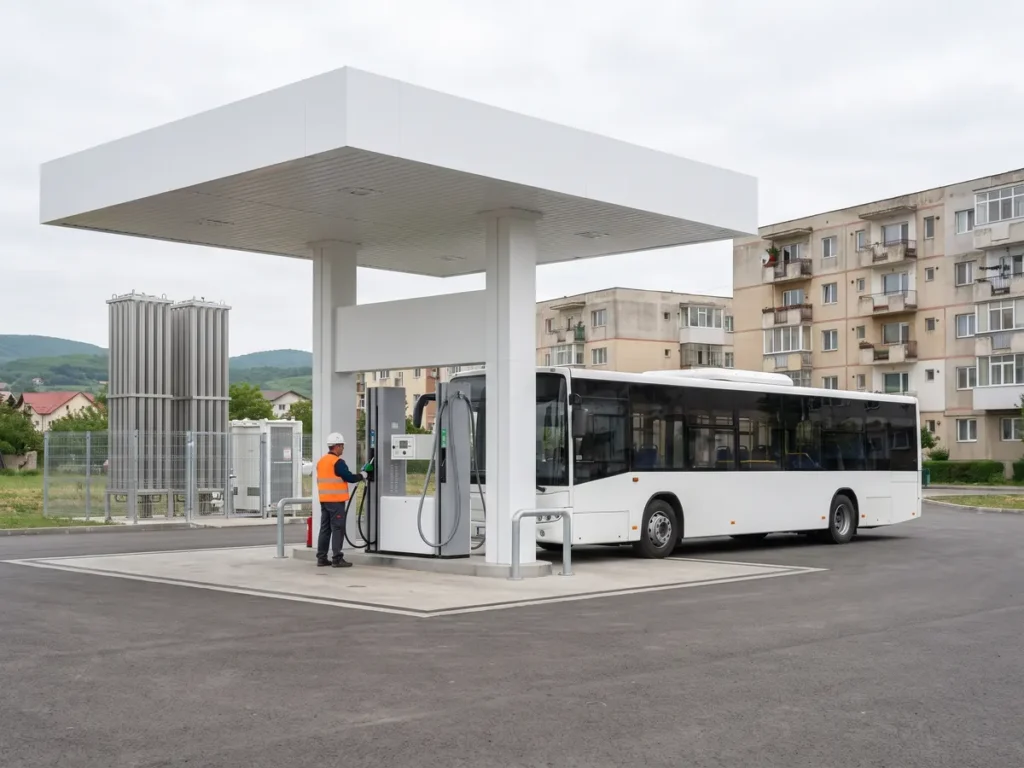
The tenth effect supports public transport. Stations for buses may be sited within existing depots, bus garages or coach stations, they are treated as public utility objectives of local interest, and the projects integrated into sustainable urban mobility plans receive priority when urban planning certificates and approvals are issued.
What has changed compared with the previous situation
The first change is that hydrogen gets an urban planning procedure of its own. Until now, siting a station was judged under the general rules on construction, fire safety and pressure equipment, without a dedicated risk assessment step at the urban planning stage.
The second change is that the risk analysis is no longer redone. The one drawn up for an approved urban planning documentation is taken over as a mandatory supporting element for the technical design and for the building permit, without reassessment.
The third change is that reducing the ISCIR safety distances becomes possible, but under strict conditions. It is allowed only if the ISCIR technical prescriptions permit such a justification, if the quantitative analysis shows that individual and societal risk stays within acceptable limits, and if the solution is validated through an independent technical expert report or through the check of an ISCIR-authorised specialist who did not work on the initial documentation.
The fourth change protects the existing networks. The influence zone generated by a new hydrogen installation cannot impose retroactive restrictions on the operation, maintenance, extension or connection of the natural gas and electricity networks licensed by ANRE that legally existed on the site on the date of the analysis.
The fifth change is for the installations already in operation. They do not have to draw up the analysis immediately, but on the occasion of the first extension, technological upgrade or modification subject to authorisation.
The sixth change concerns the files in progress. Documentation filed before the entry into force is settled under the rules valid on the filing date, and the urban planning certificates already issued keep their validity.
What does not change is the Seveso regime. For sites holding at least 5 tonnes of hydrogen, the lower-tier threshold, and 50 tonnes, the upper tier, the obligations under Law no. 59/2016, which transposes the Seveso directive, apply in full, and the documentation drawn up there is enough for urban planning purposes, without a second analysis for the same scenarios.
Advantages and disadvantages
What it improves
- The investor learns from the urban planning certificate, at the very first step, what studies have to be carried out and what distances cannot be breached.
- The analysis done once, at the urban planning stage, is not redone at the permit stage, which shortens the procedure and cuts the cost.
- The town hall cannot ask for a second risk analysis for scenarios already assessed in the Seveso safety report.
- The role of the authority is clearly delimited: it checks that the report exists and that the methodology was followed, it does not redo the calculations, so the decision does not depend on local expertise.
- Existing installations are not obliged to draw up the analysis immediately, but only at the first modification subject to authorisation.
- Stations for buses can be sited in the existing depots and receive priority in the approval process, which helps decarbonise public transport.
What remains a problem
- The instruction contains no numerical value for acceptable risk, although the issuing of the permit depends on it.
- The scope in relation to Seveso sites is described differently in two places of the same act.
- The cost of a quantitative risk assessment, with dispersion modelling and frequency-number of fatalities curves, is not bearable for a small investor.
- There is no register of competent specialists, and their definition is descriptive rather than based on certification.
- The standards invoked, the ISO 19880 series and the EIGA guides, have to be bought, so a mandatory rule points to texts that are not publicly accessible.
- Neighbours have no role in the procedure, although the risk influence zone can limit their right to build on their own land.
Practical advice
- If you are planning a hydrogen station or a production or storage capacity, ask for the urban planning certificate before commissioning the design. That is where the mandatory studies and the minimum distances appear.
- Contract the risk analysis before the urban planning documentation, not after. If it is done at the urban planning stage, it no longer has to be redone at the permit stage.
- Check whether the team carrying out the analysis has experience with safety reports or with consequence assessment studies for installations handling dangerous substances. The instruction asks for exactly this profile.
- If you want to reduce the safety distances, prepare the independent technical expert report from the start. The specialist who drew up the initial documentation cannot validate their own solution.
- If you are adding hydrogen to an existing petrol station, treat the project as an extension: the cumulative risk has to be reassessed for all the fuels on the site.
- If the site holds at least 5 tonnes of hydrogen, you come under Law no. 59/2016. Use the safety report already drawn up; the authority cannot ask for a separate analysis for the same scenarios.
- If you own land next to a hydrogen installation, ask the town hall for the plan showing the risk influence zone. It is drawn on the cadastral base map and it can limit what you build.
- If you are a town hall and the project is part of a sustainable urban mobility plan, the instruction requires you to give it priority for the urban planning certificate and the approvals.
- Keep proof of the filing date for the files in progress. Those filed before 26 August are judged under the old rules.
Frequently asked questions
Who has to carry out the risk analysis?
When is it carried out?
What is the risk influence zone?
What can the town hall do with the report?
Does it apply to installations that are already running?
What happens to the files filed earlier?
Does it apply to the gas networks into which hydrogen is injected?
What technical measures are mandatory in the design?
Can the safety distances be reduced?
Errors and inconsistencies in the published text
- Annex, Article 2(3) against Article 15: it cannot be established whether the instruction applies to Seveso sites. Article 2(3) says that its provisions „nu se aplică amplasamentelor care intră sub incidența Legii nr. 59/2016 […], cu excepția situațiilor prevăzute la art. 15 alin. (3)”, do not apply to sites falling under Law no. 59/2016, except for the situations provided for in Article 15(3). Article 15(3), however, describes no exceptional situation; it states the opposite rule: „Prezenta instrucțiune tehnică se aplică în mod complementar față de prevederile Legii nr. 59/2016”, this technical instruction applies as a complement to the provisions of Law no. 59/2016. And Article 15(4) regulates in detail how the Seveso documentation is used for urban planning purposes, so it assumes that the instruction does apply. An investor with a site holding more than 5 tonnes of hydrogen cannot establish from the text whether the obligations in Articles 4 to 14 apply to them or not.
- Annex, Article 12 read together with Article 3(j): the acceptable risk level is defined nowhere, although it decides the permit. Article 12(1) points to „criterii cantitative privind riscul individual și riscul societal”, quantitative criteria on individual risk and societal risk, but the instruction contains no value. Article 3(j) defines the acceptable risk level as „nivelul de risc individual și societal considerat admisibil potrivit prezentei instrucțiuni tehnice”, the level of individual and societal risk considered admissible under this technical instruction, that is, by reference to itself. Article 12(2) says that, until national criteria are set, the assessment is made on „criterii orientative”, indicative criteria, while paragraph (3) declares the use of the same criteria mandatory, without listing them. At the same time, Article 12(4)(a) allows siting to be refused for „risc neacceptabil”, unacceptable risk. The threshold at which a permit is refused cannot be found in the act.
Editorial analysis
The instruction solves a problem that was going to appear anyway. Hydrogen is climbing the investment agenda, and town halls had no instrument through which to judge whether a refuelling station can stand 40 or 400 metres from a block of flats. The text brings three useful things: the risk analysis becomes an urban planning document, not only a matter of industrial safety; the influence zone is drawn on the cadastral base map, so it becomes visible and enforceable against third parties; and the role of the town hall is limited to a formal check, which prevents both abuse and the paralysis of an administration that has no process engineers.
The serious problem is that the act does not say what the threshold is. It asks for a quantitative analysis, defines three risk categories and authorises refusal for „risc neacceptabil”, unacceptable risk, but publishes no limit value. Article 17(5) acknowledges the gap and leaves the two ministries to approve national sets of limit values later, by joint order. Until then, the same installation may receive a permit in one county and a refusal in another, depending on which European guide the author of the analysis picked, while Article 12(3) prohibits ad-hoc methodologies without saying which ones are allowed.
The second observation concerns access to the rules. The instruction points, as a matter of obligation, to the ISO 19880 series, to ISO 19881, to EN ISO 15916 and to the guides of the European Industrial Gases Association. All of them have to be bought, and some cost several hundred euros each. A mandatory rule whose application presupposes the purchase of a set of private standards raises an access cost that appears nowhere in the impact calculations.
The third concerns the neighbours. The risk influence zone limits what can be built on the surrounding land, sometimes on properties that have nothing to do with the investment. The instruction treats them purely as an object of the analysis, not as a party to the procedure: it provides neither for notifying the owners inside the delimited zone, nor for any way in which they might challenge the resulting contour.
What should be changed
- Publication of the national limit values for individual and societal risk, through the joint order announced in Article 17(5). Without them, the refusal for „risc neacceptabil”, unacceptable risk, under Article 12(4)(a) cannot be reasoned in a verifiable way, and practice will differ from one county to another.
- Clarification of the relationship with Law no. 59/2016, in a single article. It would remove the contradiction between Article 2(3) and Article 15 and would state plainly what obligations a site holding more than 5 tonnes of hydrogen has.
- A simplified procedure for the installations of reduced complexity, with classification criteria written into the act. The instruction uses the notion in Article 3(r) and in Article 7(2), but defines it by reference to „limitele stabilite de reglementările tehnice aplicabile”, the limits set by the applicable technical regulations, so a small investor cannot know in advance whether they escape the full quantitative analysis.
- Notification of the owners inside the risk influence zone and a way of challenging the contour. The zone limits the right to build on the neighbouring land, and in its current form it is established without those owners finding out.
- A free methodological guide, published by the two ministries, translating the requirements of the paid standards. It would make the rule applicable without the prior purchase of a set of private standards and it would make the reports uniform.
- A public register of competent specialists, with criteria for entry. Article 3(n) describes them through experience, not through certification, which leaves both the authority and the investor without a verifiable criterion.
Original text of the legal act
The text below is reproduced in Romanian, the official form of publication.
The full text, as published in the Official Gazette of Romania
Official Gazette of Romania no. 711 of 26 August 2026 16 pages PDF, 126 KB the act starts on page 8
Open the official PDFDownload the PDF
The viewer is not shown on small screens. Use the buttons above to open or download the file.
This article is for informational purposes only and does not constitute legal advice. For specific situations, consult a licensed attorney or tax advisor.