
In brief
- Prime Minister’s Decision no. 498/2026 sets up, from 25 November 2026, an advisory committee tasked with finding ways to keep electricity and natural gas prices affordable in the 2026-2027 winter.
- On the committee’s agenda: electricity and gas supply, support for large industrial consumers, energy vouchers for vulnerable consumers, incentives for industrial self-consumption and caps on prices or on excessive profit margins.
- The decision does not yet introduce any measure: the committee analyses and proposes, and vouchers or caps can only come through later acts.
Who is affected: household consumers, especially vulnerable ones, large industrial consumers, energy producers, suppliers and distributors, plus the 11 institutions and companies that make up the committee.
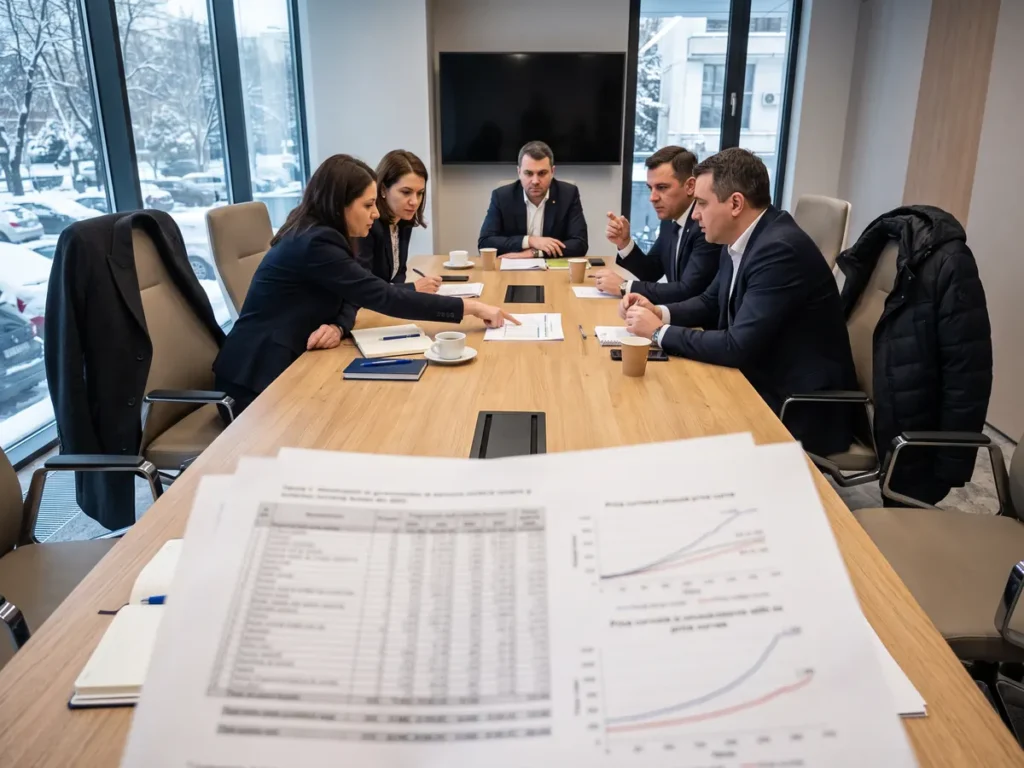
The 2026-2027 winter begins with the energy system under strain: the Cernavodă nuclear plant could not be restarted in November, and the state of energy alert has been extended. Against this background, Prime Minister Luca-Alexandru Niculescu signed Decision no. 498/2026 on 25 November 2026, published the same day in Official Gazette of Romania (Monitorul Oficial) no. 979, establishing the Interinstitutional Committee for identifying solutions on the affordability of electricity and natural gas prices during the 2026-2027 cold season.
The committee is an advisory body without legal personality, coordinated by the head of the Prime Minister’s Chancellery. Its role is to gather data from institutions and companies, analyse it and put proposals to the Prime Minister. The decision sets no amount, no voucher and no price cap.
What it changes in practice
The committee has five duties, listed in Article 3:
- analysing technical data in order to monitor and coordinate, as a priority, electricity and natural gas supply in the 2026-2027 winter;
- assessing the energy needs of large industrial consumers and identifying support measures, including by updating the state aid schemes that apply to them;
- proposing financial support measures for vulnerable consumers, including mechanisms for granting energy vouchers;
- mechanisms that encourage industrial companies to build their own energy generation and storage capacity, for more self-consumption and less pressure on the national energy system;
- analysing how prices are formed and the measures for capping prices or excessive profit margins, as appropriate.
The committee is made up of 11 institutions and companies (Annex 1): the Prime Minister’s Chancellery, the Ministry of Finance, the Ministry of Economy, Digitalisation, Entrepreneurship and Tourism, the Ministry of Energy, the Ministry of Environment, Waters and Forests, the Ministry of Labour, Family, Youth and Social Solidarity, the General Secretariat of the Government, ANRE, Transelectrica, OPCOM and the Romanian Commodities Exchange. Each sends one senior official and one technical expert, in a “1 + 1” format.
The associations listed in Annex 2 attend the meetings as permanent guests, represented by their heads: energy producers (HENRO, PATRES, RWEA, PSR), suppliers (AFEER), utility companies (ACUE), the Employers’ Federation of Energy, large industrial consumers (ABIEC, UniRomSider, the Association of Furniture Manufacturers of Romania), prosumers, as well as CNR-CME, the Smart Energy Association and Energy Policy Group. The list has 15 entries, but the Employers’ Federation of Energy appears twice, at entries 7 and 13, so there are 14 distinct organisations. Other public or private entities may be called in on specific issues as guests (Article 4).
The Ministry of Energy provides the technical secretariat: it convenes meetings, draws up the minutes, compiles proposals and tracks the deadlines of the measures agreed. The committee meets twice a month, or whenever needed, in person, online or in hybrid form, approves its rules of procedure at its first meeting and reports periodically to the Prime Minister.
What has changed compared with the previous situation
The decision creates a new coordination structure and does not amend or repeal any other act. For consumers, electricity and gas bills are still calculated under the rules in force on 25 November 2026, and existing support schemes, such as the compensation deducted from the bill and then recovered by suppliers from the state through the settlement procedure approved by Joint Order no. 1.205/1.449/2026, are not affected by this decision.
What changes is the forum where winter measures are discussed: ministries, the regulator, market operators and industry representatives now sit at the same table, under the direct coordination of the Prime Minister’s Chancellery, with a mandate limited to the 2026-2027 cold season.
Advantages and disadvantages
What it improves
- It brings the institutions that decide (Finance, Energy, Labour, ANRE) to the same table as those that see market data in real time (Transelectrica, OPCOM, the Romanian Commodities Exchange).
- It explicitly names energy vouchers for vulnerable consumers and caps on excessive profit margins among the options to be examined.
- It gives industry a direct channel: large consumers, producers and suppliers are permanent guests, and other entities can be called in at any time.
- Meetings twice a month and the online format allow quick responses in the middle of winter.
What remains a problem
- The decision sets no deadline at all: not for the first meeting, not for the first report, not for concrete proposals, even though the mandate covers a single winter.
- The committee cannot decide anything on its own; any voucher or cap requires a separate act, with its own timetable.
- The natural gas transmission system operator is missing from the membership, although gas supply is the first duty listed.
- Household consumers have no representative among the permanent guests, although support for vulnerable consumers is one of the five topics.
Practical advice
- If you are a household consumer, you do not need to file any application or form now: the decision grants no vouchers and does not change the price on your bill. Keep an eye on the acts that will follow the committee’s proposals.
- If you already receive compensation on your bill, it stays under the current rules; check the amount deducted on your bill and the supplier applying it.
- Industrial companies seeking support or state aid for the winter can send their data through the associations invited as permanent guests, ABIEC, UniRomSider or the Association of Furniture Manufacturers, or can ask to be invited to meetings under Article 4.
- Companies planning their own energy generation or storage capacity have reason to follow the committee’s proposals: encouraging industrial self-consumption is one of its five duties.
- Suppliers and wholesale market participants should prepare for requests for data on price formation: the analysis of profit margins is on the committee’s agenda.
Frequently asked questions
Will I receive energy vouchers in the 2026-2027 winter?
Will electricity and gas prices be capped?
Who chairs the committee?
How often does the committee meet?
How long will the committee operate?
Editorial analysis
The decision addresses a real problem: winter energy measures involve at least four ministries, the regulator and three grid and market operators, and there was no common forum for coordination. The membership, however, does not fully match the list of duties. Article 3(a) puts natural gas supply first, “as a priority”, yet Annex 1 leaves out Transgaz, the operator of the gas transmission network. On the electricity side, the transmission operator, Transelectrica, is a member. For gas, the committee has only the market operators, OPCOM and the Romanian Commodities Exchange, which see trading on the market; physical flows and storage stocks are outside their view.
The second point concerns timing. Five days earlier, Prime Minister’s Decision no. 480/2026 set up another advisory committee, for the reorganisation of public administration, and gave it fixed deadlines, up to 1 March 2027. Decision no. 498/2026 has none: none for the first meeting, none for the rules of procedure to be approved at that meeting, none for the first report. Reports are submitted “periodically”, with no frequency set. For a body whose mandate is a single winter, every week without a meeting is a week lost from the season it was created for.
Counting the participants also shows an imbalance of representation. The 11 member entities, in the “1 + 1” format, mean 22 seats. Of the 14 organisations invited as permanent guests, seven represent the supply side (producers, suppliers, utility companies, the energy employers’ federation), three large industrial consumers, one prosumers and three are expert organisations. None represents households, although Article 3(c) deals precisely with vulnerable consumers. In addition, Article 1(4) provides for representation “at the level of senior official”, yet three members, Transelectrica, OPCOM and the Romanian Commodities Exchange, are commercial companies with no such officials. For them, the decision does not say who takes part.
What should be changed
- Deadlines for the first meeting and the first report. A meeting within 7 days at most and a first set of proposals by mid-December 2026 would allow measures to be adopted while there is still winter left.
- Transgaz as a member, with the gas storage operators as permanent guests. The committee would have direct data on gas flows and stocks, precisely for the duty the decision declares a priority.
- Clarifying how companies are represented. For Transelectrica, OPCOM and the Romanian Commodities Exchange, Article 1(4) should name the chief executive or a member of the management board, so that it is clear who has a mandate to speak on their behalf.
- Correcting Annex 2. The Employers’ Federation of Energy appears twice; if another organisation was meant to be listed at one of those entries, a rectification would bring it back to the table.
- A representative of household consumers. The National Authority for Consumer Protection or a consumer association, as a permanent guest, would bring the other side of the bill into the discussion.
- Publishing the reports to the Prime Minister. Suppliers, companies and households would know in advance which measures are being prepared and could plan before they are adopted.
Original text of the legal act
The text below is reproduced in Romanian, the official form of publication.
The full text, as published in the Official Gazette of Romania
Official Gazette of Romania no. 979 of 25 November 2026, pages 13-14 16 pages PDF, 393 KB the act starts on page 13
Open the official PDFDownload the PDF
The viewer is not shown on small screens. Use the buttons above to open or download the file.
This article is for informational purposes only and does not constitute legal advice. For specific situations, consult a licensed attorney or tax advisor.