
In brief
- The fine for discharging wastewater without authorisation stays exactly as it was: 35,000-40,000 lei for companies and 10,000-15,000 lei for individuals. The Constitutional Court dismissed as inadmissible the objection by which a company from Lugoj challenged Article 87(4) and Article 88(1)(b) of Water Law no. 107/1996, and the decision is final and generally binding from 28 October 2026, the date it was published.
- „Inadmissible” does not mean „constitutional”. The Court did not review the provisions against the Constitution. It found that the company’s argument concerns the way the law is interpreted and applied, and that, under Article 2(3) of Law no. 47/1992, is a matter for the courts, not for the Constitutional Court. For the operator that was fined, the practical conclusion is that the argument moves to the Lugoj District Court.
- The company’s argument was not rejected on the substance, it was sent to the court on the merits. The company claimed that, following Directive 2004/35/EC, the Water Law ceases to apply in favour of the „polluter pays” principle, and that the pollution ought to be connected with the operator’s activity. The Court’s answer, in paragraphs 15 and 16, is that national courts are bound to apply European Union law and to set aside conflicting domestic rules, in line with Article 148 of the Constitution.
- The offence is complete through the absence of the permit, not through proven damage. Article 87(4) penalises „the discharge or injection of wastewater, as well as the release of residues and any other materials into water resources, without complying with the provisions of the water management permit or authorisation”. The offence consists in failing to observe the regulatory act, while liability for environmental damage, the kind based on the „polluter pays” principle, sits elsewhere: in Government Emergency Ordinance no. 68/2007.
- The case waited 1,886 days for an answer that does not answer the question. The Lugoj District Court referred the matter to the Court by the interlocutory judgment of 7 December 2020, delivery came on 5 February 2026, and publication on 28 October 2026, 265 days after delivery. The drafting limit in Article 60(1) of Law no. 47/1992 is 30 days at most.
Published: Official Gazette of Romania, Part I, no. 899 of 28 October 2026, pages 5-6
Delivered: 5 February 2026, by unanimous vote, in a panel of nine judges
Final and generally binding: 28 October 2026, the date of publication
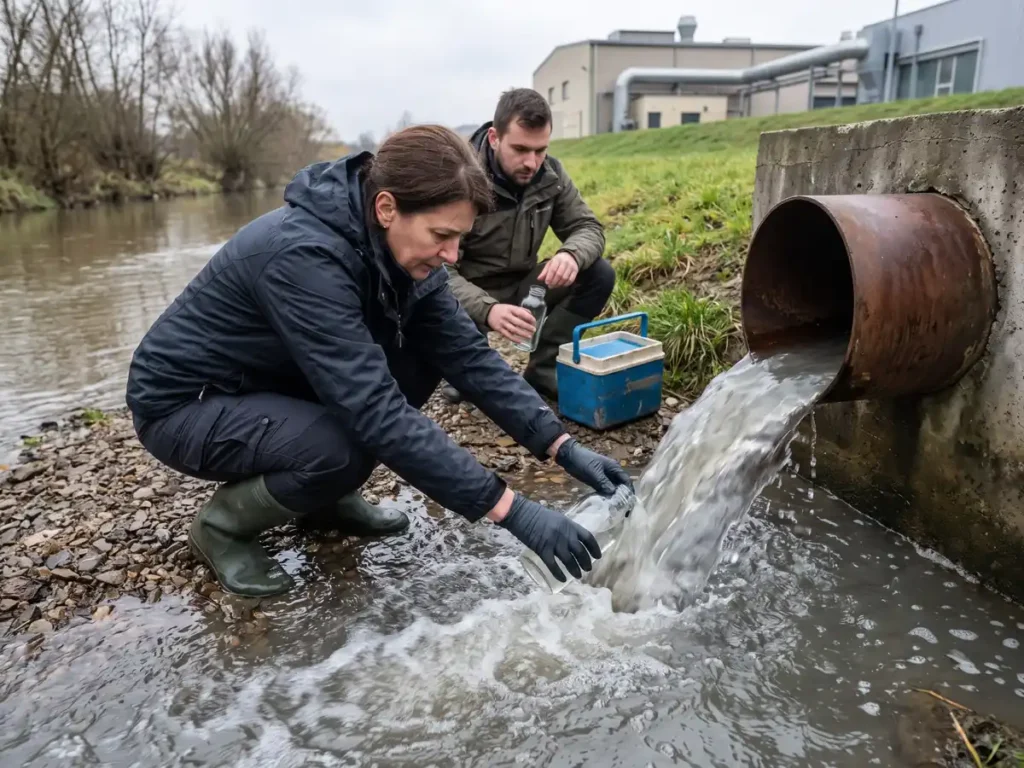
If your company has been served with an offence report for discharging wastewater into a river without a water management authorisation, the fine remains between 35,000 and 40,000 lei, and the „polluter pays” defence is made before the district court, not before the Constitutional Court. The Court dismissed as inadmissible the objection raised by Meridian 22 S.A. of Lugoj in Case no. 2.762/252/2020 before the Lugoj District Court, and Decision no. 99 of 5 February 2026 was published on 28 October 2026. The figures that actually decide how much an operator pays are still in the Water Law and in the related acts, and they do move: the penalties for exceeding wastewater limits, for instance, were restored by corrigendum to 3.56 lei per kilogram of COD-Cr instead of 1.28. The administrative fine in Article 88, by contrast, has not moved at all.
The starting point is ordinary and repeats itself across the country. The Banat Water Basin Administration drew up offence reports in the company’s name, the company challenged them before the Lugoj District Court and, in the course of that challenge, raised the objection of unconstitutionality. Its case, set out by the Court in paragraph 12, was that, following the entry into force of Directive 2004/35/EC of the European Parliament and of the Council of 21 April 2004 on environmental liability with regard to the prevention and remedying of environmental damage, Law no. 107/1996 no longer applies, but rather the principle that the polluter pays, and that the pollution ought to be connected with the operator’s activity.
The Court’s answer does not touch the constitutionality of the provisions. In paragraph 13, it notes that environmental liability based on the „polluter pays” principle has a framework of its own, Government Emergency Ordinance no. 68/2007 on environmental liability with regard to the prevention and remedying of environmental damage, published in the Official Gazette of Romania, Part I, no. 446 of 29 June 2007, the act by which the very directive invoked was transposed. The principle is also stated in Article 3(e) of Government Emergency Ordinance no. 195/2005 on environmental protection, as a principle governing the whole field. Then, in paragraph 14, the Court draws its conclusion: the complaints „concern matters relating to the interpretation and application of the law, which fall within the competence of the courts”, and the objection is dismissed as inadmissible.
The distinction on which the ruling rests is one of subject matter, not one of hierarchy of norms. Article 87(4) of the Water Law describes conduct that is complete through the absence of a regulatory act: wastewater is discharged or injected, residues and any other materials are released into water resources, without compliance with the water management permit or authorisation. No one is required to prove damage, an exceeded concentration or a dead fish; what is checked is whether the act exists and whether it was observed. Environmental liability under Government Emergency Ordinance no. 68/2007, by contrast, starts from damage caused to the environment and looks for the operator that caused it. The two regimes can run in parallel on the same installation, because they penalise different things, and a company whose authorisation is in order yet still causes damage answers on the second basis, not on the first.
One detail in the act is worth noting, because it shows how close the case came to a harsher outcome. The Public Prosecutor’s Office also sought dismissal as inadmissible, but on a different ground: the company „does not show in concrete terms what the unconstitutionality of the contested rules consists in”, that is, the objection was unsupported by reasons, within the meaning of Article 10(2) of Law no. 47/1992, which requires referrals to be made in writing and with reasons. The Lugoj District Court, for its part, had given a third characterisation: the objection was unfounded, and therefore admissible and reviewable on the substance. Three actors, three legal characterisations, the same practical outcome for the company. The decision is silent on the ground raised by the prosecutor, however, which is not a procedural detail: an objection dismissed because it lacks reasons can be reformulated, whereas one dismissed because it raises a question of applying the law does not become admissible however well it is drafted.
What it changes in practice
The first effect is in Case no. 2.762/252/2020 before the Lugoj District Court, which resumes on the conduct described in the offence reports. The constitutional argument was closed on 28 October 2026, though not against the company: the Court said that it belongs to the court on the merits. Paragraphs 15 and 16 of the decision are, in practice, instructions for the judge in Lugoj. The first holds that binding European Union rules, including directives transposed into national legislation, take precedence over conflicting domestic laws, and that national courts are bound to apply European Union law and to set aside divergent domestic rules. The second refers to Article 148 of the Constitution, which enshrines that precedence.
The second effect is on every economic operator that uses, abstracts or discharges water: factories, farms, fish farms, water and sewerage operators. For them nothing changes in money terms. Article 88(1) of the Water Law has three tiers, and letter (b), the one applied to the conduct in Article 87(1)-(4), provides for 35,000-40,000 lei for legal persons and 10,000-15,000 lei for individuals. Above it, letter (a) rises to 75,000-80,000 lei for companies, and below it letter (c) drops to 25,000-30,000 lei. Across the whole paragraph, the smallest fine is 6,500 lei, for an individual under letter (c), and the largest 80,000 lei, for a company under letter (a). The ratio between the two extremes is 12.3 times.
The third effect is on the water management authorities, the ones that draw up the offence reports. The decision indirectly confirms their practice: they do not have to demonstrate damage in order to impose a penalty for a discharge without authorisation, because the conduct described by the law contains no element of damage. The defence that shifts the argument onto the „polluter pays” principle does not defeat the offence report, but neither does it disappear: it is heard, only before the court, on the basis of Article 148 of the Constitution and of the transposed directive.
One effect that is rarely discussed emerges if you set the figures side by side. From 7 December 2020, the date of the interlocutory judgment by which the Lugoj District Court referred the matter to the Court, 1,886 days passed until delivery, and 2,151 until publication, that is, 5 years and 10 months. Throughout that time the offence reports remained in dispute, and the operator was left with an unresolved fine. The answer received after almost six years is that the court on the merits had to settle the question anyway, so it was a detour, not a wrong road.
What has changed compared with the previous situation
Nothing has changed in the penalty regime, and that is precisely the news for an economic operator. The amounts in Article 88(1)(b) have been the same since 19 February 2010, the date on which Government Emergency Ordinance no. 3/2010 amended the paragraph. From then until 28 October 2026, 6,095 days passed, that is, 16 years and 8 months, and the minimum fine for a company has stayed at 35,000 lei in nominal terms. The form in force at the time of the 2020 conduct does not differ from today’s, as checked against the consolidated versions of 29 May 2020 and 16 July 2020: there is no difference in amount between what was applied to the company and what would be applied now. Article 88(2) nevertheless provides that „the amounts of the fines shall be updated by Government decision”, and no such update appears to have been applied to these sums.
What has changed is the status of the complaint. Until 28 October 2026, an operator that had been fined could hope that the Water Law would fall, in part, before the European argument, and could ask the court to make a referral. It now has a published answer: that road leads nowhere, because this is not a question of constitutionality. The road that remains is shorter, not longer, because it is travelled before a single court.
What did not happen has also changed. The provisions were not declared unconstitutional, and Article 29(3) of Law no. 47/1992 bars a fresh objection only in respect of provisions found unconstitutional by an earlier decision. The two provisions therefore remain open to challenge, if anyone finds a genuine constitutional complaint and supports it with reasons. What has been exhausted is this company’s argument, not the article of the law.
Advantages and disadvantages
What it improves
- It clarifies, for any operator that has been fined, where the European Union law argument goes: to the court hearing the challenge, not to the Constitutional Court. It saves a referral and the months of waiting that come with it.
- Paragraphs 15 and 16 are not a rejection but a written and published confirmation that national courts must apply European Union law and set aside conflicting domestic rules. The operator leaves the Court with a reference it can cite before the district court.
- It draws a clear line between two regimes that are often confused: the administrative offence of discharging without authorisation, under the Water Law, and liability for environmental damage, under Government Emergency Ordinance no. 68/2007. The distinction is useful to the authorities and to companies alike.
- It does not touch the amounts, so it creates no uncertainty for offence reports drawn up between 2010 and 2026. Anyone with a pending case knows that the sum in the report remains the sum in the report.
- The ruling was taken by unanimous vote, in a panel of nine judges, with no dissenting opinion published alongside the decision. It leaves no room for doubt about how solid it is.
What remains a problem
- The 265 days between delivery and publication are measured against a drafting limit of 30 days at most, written in Article 60(1) of Law no. 47/1992. The overrun is 235 days, that is, 8.8 times the limit, for a decision running to 17 paragraphs.
- The 1,886 days spent at the Court ended with a finding that the question had belonged to the court on the merits from the outset. An admissibility filter applied earlier would have shortened the road by years, not by months.
- The ground raised by the Public Prosecutor’s Office, the lack of reasons under Article 10(2) of Law no. 47/1992, is left unanswered in the decision. For the author of the objection the difference matters: one ground can be repaired by redrafting, the other cannot.
- The fines have stood still for 6,095 days, even though Article 88(2) provides for them to be updated by Government decision. The nominal threshold stays the same, while its real weight for a company is no longer what it was in 2010.
- The margin left to the enforcement officer is uneven for no visible reason: 5,000 lei between minimum and maximum in five of the six bands, but only 500 lei for individuals under letter (c). Under letter (b), that same 5,000 lei amounts to 14.3% of the minimum for a company and 50% for an individual.
Practical advice
- Check first whether you hold a valid water management permit or authorisation and whether the discharge complies with what it says. The conduct in Article 87(4) is complete through the absence of the act or the failure to observe it, not through damage, so a defence based on „we did not pollute” does not touch the conduct held against you.
- If you raise the European Union law defence, write it into the challenge against the offence report, not into an application to refer the matter to the Constitutional Court. Decision no. 99/2026 says expressly that this falls within the competence of the courts, and paragraphs 15 and 16 give you the reference you can cite.
- Keep the two bases apart in your defence. A discharge without authorisation is argued under Water Law no. 107/1996; damage caused to the environment is argued under Government Emergency Ordinance no. 68/2007. Mixed together, they cancel each other out before the judge.
- Read the letter of Article 88(1) that was applied to you, not just the sum. Letter (b) covers the conduct in Article 87(1)-(4), (7), (10), (24)-(27), (29), (31), (32), (39)-(41), (43)-(51) and (55), and conduct classified under the wrong point moves you into a different fine band.
- If you still want to challenge the provisions before the Court, state in concrete terms what the unconstitutionality consists in and against which article of the Constitution. Article 10(2) of Law no. 47/1992 requires referrals in writing and with reasons, and a formal list of constitutional articles is exactly what the Public Prosecutor’s Office relied on as an argument in this case.
- Do not count on the fines being updated either in your favour or against you. The amounts have been unchanged since 19 February 2010, and the updating mechanism by Government decision in Article 88(2) has not been used on these sums.
Frequently asked questions
Does the decision mean that Article 87(4) and Article 88(1)(b) are constitutional?
How much is the fine for discharging wastewater without authorisation?
Can I still invoke the „polluter pays” principle in my defence?
If I did not actually pollute, does the offence fall away?
Can the same objection ever be raised again on these provisions?
Why did publication take so long?
What happens now with the case before the Lugoj District Court?
Editorial analysis
As a legal text the act is clean and short: 17 paragraphs, of which the examination proper takes up five, from 12 to 16, and the answer is complete in a single sentence, in paragraph 14. It contains no internal contradictions, the references check out one by one, and the inadmissibility ruling is reasoned on settled case law, with Decision no. 357 of 22 March 2011 as an example. The operative part was adopted by unanimous vote, in a panel of nine judges, that is, the full bench provided for by Article 142(2) of the Constitution, three judges above the two-thirds quorum in Article 51(1) of Law no. 47/1992. The problem with the act is not its text, it is the time it consumed in getting there.
The figure that does not show up if you read the decision from start to finish is the ratio between two waits. The case sat at the Court for 1,886 days, from the referring judgment of 7 December 2020 until delivery, and another 265 until publication, 2,151 days in all, that is, 5 years and 10 months. The only time limit the law sets anywhere along that route is the drafting limit: 30 days at most. The overrun is 235 days, 8.8 times the limit, on a decision that examines the constitutionality of no provision at all and whose reasoning fits into five paragraphs. An admissibility filter applied when the case arrived would have produced the same result in 2021, when the offence reports were still fresh.
The second observation comes from putting Article 87 together with Article 88, not from reading each one separately. The first has 66 points, and the second allocates them, through paragraph (1), across three fine bands. Five of the six resulting ranges are exactly the same width, 5,000 lei, which shows a deliberate choice by the legislature: the same margin of appreciation for the enforcement officer, whatever the gravity. The exception is the lowest band, for individuals under letter (c), which has only 500 lei between minimum and maximum. No provision explains why the margin drops tenfold there. And that same 5,000 lei under letter (b) amounts to 14.3% of the minimum for a company and 50% for an individual, so the margin for individualising the penalty bears very differently on the two categories, for the same conduct.
The third observation is procedural and has practical consequences. Three different characterisations were advanced in the same case: the Lugoj District Court said the objection was unfounded, the Public Prosecutor’s Office sought inadmissibility for lack of reasons, under Article 10(2) of Law no. 47/1992, and the Court held it inadmissible on a different ground, namely that what is at issue is the application of the law. The Court said nothing about the prosecutor’s ground. For the author of the objection the difference is not academic: an objection without reasons can be reformulated and filed again, whereas one that concerns the application of the law does not become admissible even if it is drafted impeccably. The decision leaves it unclear which of the two gates has closed.
What should be changed
- The Court should state which ground of inadmissibility it relies on, where two have been raised in the case. The author would learn whether it can come back with a redrafted objection or whether the road is closed for good, and the courts would know what to answer to a fresh application for a referral on the same provisions.
- The Government should use the mechanism in Article 88(2), or Parliament should remove it from the law. An updating clause left unused for 6,095 days protects no one: it lets the thresholds erode in nominal terms and creates the impression that the sum is provisional, when in fact it has been fixed since 19 February 2010.
- The margin under letter (c) for individuals should be aligned with the 5,000 lei used across the other five bands. The enforcement officer would have the same room for individualising the penalty in every case, and a tenfold difference between margins, with no explanation in the text, would disappear.
- The Court’s decisions should carry, next to the date of delivery, the date on which drafting was completed. The 265 days would become verifiable piece by piece, and the 30-day limit in Article 60(1) could be tracked by anyone, instead of remaining a benchmark with no public measurement.
- The Water Law should state expressly that administrative liability under Article 87 and environmental liability under Government Emergency Ordinance no. 68/2007 apply independently of each other. The confusion the company from Lugoj fell into is predictable and expensive: a single cross-reference in the law would cut whole cases short, including at the Court.
- The water management authorities should publish annually the number of offence reports drawn up under each point of Article 87 and the amounts imposed. Today there is no way of finding out whether the band under letter (b) is used at the bottom or at the top, and therefore no way of knowing whether the 5,000 lei margin has any real effect.
Original text of the legal act
The text below is reproduced in Romanian, the official form of publication.
The full text, as published in the Official Gazette of Romania
Official Gazette of Romania no. 899 of 28 October 2026, pages 5-6 16 pages PDF, 112 KB the act starts on page 5
Open the official PDFDownload the PDF
The viewer is not shown on small screens. Use the buttons above to open or download the file.
This article is for informational purposes only and does not constitute legal advice. For specific situations, consult a licensed attorney or tax advisor.