
In brief
- Telerehabilitation enters the law as a telemedicine service: medical rehabilitation can be delivered remotely, by digital means, from the consultation and the functional assessment through to the therapeutic intervention, patient education and monitoring.
- It can be provided by rehabilitation physicians, but also by cardiologists, neurologists, neurosurgeons and orthopaedic surgeons, the latter only within the first 3 months after the acute event or the operation, plus doctors of other clinical specialties and authorised providers of services ancillary to the medical act.
- The law came into force on 16 July 2026, but it does not yet apply in practice: the implementing rules are to be drawn up by the Ministry of Health within 30 days and approved by Government decision.
Published: Official Gazette of Romania (Monitorul Oficial) no. 574 of 13 July 2026
In force from: 16 July 2026
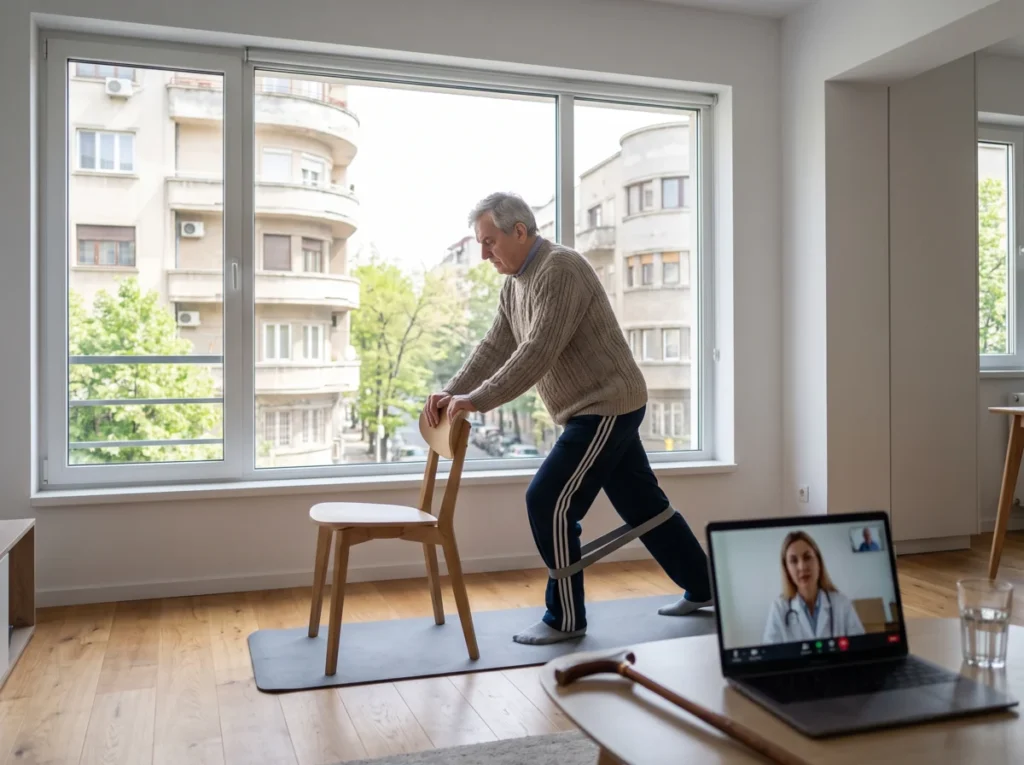
A patient who has had knee surgery, or who has been discharged after a heart attack, will be able to do the rehabilitation sessions from home, in front of a screen, with the doctor watching and correcting from a distance. Law no. 138/2026, published in Official Gazette of Romania no. 574 of 13 July 2026, adds telerehabilitation to the list of telemedicine services in Law no. 95/2006. It is the second move of 2026 that brings cardiac rehabilitation to the attention of the legislator, after leadless pacemakers were added to the list of reimbursed medical supplies.
The law is short, two articles, but it does two distinct things. First it adds a new letter, letter g), to the list of telemedicine services in Article 30^1(6) of Law no. 95/2006. Then it introduces a new article, Article 30^13, which says who may provide telerehabilitation and what it consists of.
Until now medical rehabilitation was, by definition, a hands-on activity: the patient came to the surgery or to the treatment facility. The new text acknowledges that part of it, the functional assessment, the guidance of the exercise, patient education and monitoring, can also be done through a screen.
What it changes in practice
Telerehabilitation becomes a legal category, not a tolerated practice. The text defines it as the remote delivery of physical and rehabilitation medicine services and of services ancillary to the medical act, by digital means, for the consultation, the functional assessment, the specialist therapeutic intervention, patient education and patient monitoring. That is five distinct components, not merely a teleconsultation.
The list of providers is exhaustive and follows a clear pattern. With no time restriction at all, it can be done by doctors with the specialty of rehabilitation, physical medicine and balneology, and of physical and rehabilitation medicine. Subject to a time restriction, it can be done by cardiologists, for patients in the acute phase of cardiovascular recovery, within the first 3 months after an acute cardiovascular event or a cardiac procedure; by neurologists and neurosurgeons, for the acute and the subacute phase, within the first 3 months; and by orthopaedic and trauma surgeons, likewise within the first 3 months after the orthopaedic operation or after a major musculoskeletal injury.
The professions around the medical act also come into play. Authorised providers of services ancillary to the medical act, the category that covers physiotherapists, kinesiotherapists, clinical psychologists and speech therapists, may provide telerehabilitation within the limits of the professional competences laid down by law. For them the law adds one further condition: the services are delivered in strict accordance with the prescription and the recommendations of the attending physician.
Letter e) opens a wide door. Besides the four named specialties, the text also allows telerehabilitation by doctors of other clinical specialties, within the limits of the professional competences laid down by law, without imposing any time limit on them.
Nothing can happen, though, until the implementing rules are issued. Article II requires the Ministry of Health to draw them up within 30 days of the law entering into force, and their approval comes by Government decision. They will set the technical conditions, the paperwork and, most important of all for the patient, whether and how the service is reimbursed. The college moved faster on its own rules: in September 2026 it replaced the whole recertification methodology, with 150 hours of supervised practice instead of 420.
What has changed compared with the previous situation
Telemedicine entered Law no. 95/2006 during the pandemic and stayed there, with a list of services that covered teleconsultation, tele-expertise, telemonitoring and the other classic forms. Medical rehabilitation was not among them. The practical consequence was that a kinesiotherapist guiding a patient through a video call was not, formally, performing a recognised medical act, and the practice had no way of billing it as a telemedicine service.
From 16 July 2026 the list has one letter more and an article of its own that develops it. The difference is not one of technology but of legal classification: the same Zoom call, or the same medical platform, now amounts to a telemedicine service, with the regime that follows from that.
The second change is that the law maps out, for the first time, a remote recovery pathway for the acute phase. The three months after a heart attack, a stroke or an orthopaedic operation were exactly the period in which the patient found it hardest to travel to hospital. The text assigns them explicitly to the cardiologist, the neurologist and the orthopaedic surgeon, not only to the rehabilitation physician.
The third change concerns the ancillary professions. The physiotherapist and the kinesiotherapist gain a legal basis for working at a distance, but under a condition that doctors do not have: the prescription and the recommendations of the attending physician. That is a hierarchy written into the law, not merely a practice of the clinic.
Advantages and disadvantages
What it improves
- The patient in the acute phase, the one who finds travelling hardest, is given a lawful way of continuing recovery without having to reach the hospital.
- The definition covers the whole chain, from the consultation and the functional assessment through to monitoring, so it is not confined to a video conversation.
- Physiotherapists and the other providers of ancillary services are given an explicit legal basis for working at a distance.
- For areas with no rehabilitation practice within a reasonable distance, telerehabilitation may be the only realistic form of access.
- The 30-day deadline for the implementing rules is short, which shows an intention to apply the law quickly.
What remains a problem
- The law says nothing about reimbursement. Without an amendment to the framework contract and to its implementing rules, the service stays available only for a fee.
- The 3-month restriction applies to the named specialties, but letter e) allows telerehabilitation by any doctor of another clinical specialty, with no time limit whatsoever. The asymmetry has no visible justification in the text.
- There is not a single technical requirement in the law: nothing on the platform, nothing on the security of medical data, nothing on recording the session. It is all left to the implementing rules.
- The law does not say how it is to be established whether a patient is suitable for remote recovery, even though functional assessment through a screen has obvious limits.
- The 30-day deadline covers the drawing up of the rules by the ministry, not their approval by Government decision, for which there is no deadline at all.
Practical advice
- Do not start from the assumption that the service is free. The law recognises it as a form of telemedicine, but reimbursement depends on the framework contract and on its implementing rules, which have not been amended yet.
- If you are within the first 3 months after a heart attack, a cardiac procedure, a neurological event or an orthopaedic operation, ask your attending physician whether they can enrol you in a telerehabilitation programme. The law gives them that possibility expressly.
- After those 3 months, turn to a doctor with the specialty of rehabilitation, physical medicine and balneology, or of physical and rehabilitation medicine. For them the law sets no time limit at all.
- If the sessions are led by a physiotherapist or a kinesiotherapist, ask for a written prescription and written recommendations from the attending physician. The law expressly makes the ancillary service conditional on them.
- Check that the provider of ancillary services is authorised. The text requires authorisation, not merely professional competence.
- Watch for the implementing rules, approved by Government decision. That is where the technical conditions, the paperwork and, possibly, the reimbursement rules will be.
- Keep evidence of the sessions, whoever leads them. In a remote form of care, documentation is the only proof that the service was actually delivered.
Frequently asked questions
What exactly is telerehabilitation?
Who may provide it?
Is it reimbursed under health insurance?
Why is there a 3-month limit?
Can a kinesiotherapist work with me alone, online?
From when does it apply in practice?
Which platform has to be used?
Editorial analysis
The law corrects a real inconsistency. Since 2020 the state has accepted that medicine can also be practised through a screen, yet it left out precisely the field in which distance hurts most: rehabilitation, which means repeated sessions, week after week, for a patient who can barely move. Adding a single letter to an existing list, plus an article ten lines long, solves the problem, formally at least.
The choice to name cardiology, neurology, neurosurgery and orthopaedics explicitly, with the 3-month window, is well judged: that is where functional recovery is decided, and the doctor who operated or treated the acute event holds the freshest clinical picture. The five-part definition, from the consultation through to monitoring, likewise shows that the text was written by someone who knows what a rehabilitation programme involves, not just a consultation.
The weakness is that the law stops just short of the part that decides whether the service will exist at all: the money. Nothing in the text touches reimbursement, and without an intervention in the framework contract telerehabilitation will remain a private option paid out of pocket, that is to say out of reach for exactly the rural patient for whom distance was the problem. In the same way, a service built entirely on digital means is introduced without a single data security requirement, even though the sessions involve video of the patient inside their own home.
What should be changed
- An express provision on reimbursement. An article requiring telerehabilitation to be included in the framework contract at its first amendment would turn a recognised right into a service that is genuinely accessible, instead of leaving it to a future negotiation.
- A deadline for approving the rules as well, not only for drawing them up. As it is written, the ministry has 30 days to write the text and the Government has unlimited time to approve it. A matching deadline would close the gap.
- Clarification of the relationship between letter e) and the 3-month restriction. If the limit has a clinical rationale, it should apply to doctors of other clinical specialties too; if it has none, it should be removed from the four named specialties. As things stand, the same session is permitted or prohibited according to the specialty on the stamp of the doctor, not according to the condition of the patient.
- Minimum requirements on security and on recording the session. A compliant platform, informed consent for transmitting the image and an entry in the file of the patient would protect patient and provider alike, in a field where proving that the service was delivered is difficult.
- A criterion for deciding whether a patient is eligible for the remote form. An initial face-to-face assessment, at least for the first session, would prevent the situation in which a patient at risk of falling is given exercises guided through a screen, without anyone having seen their home.
Original text of the legal act
The text below is reproduced in Romanian, the official form of publication.
The full text, as published in the Official Gazette of Romania
Official Gazette of Romania no. 574 of 13 July 2026 16 pages PDF, 101 KB the act starts on page 14
Open the official PDFDownload the PDF
The viewer is not shown on small screens. Use the buttons above to open or download the file.
This article is for informational purposes only and does not constitute legal advice. For specific situations, consult a licensed attorney or tax advisor.