
In brief
- Phosphine, the gas used to treat cereals and the other stored products, remains approved in the European Union for a further 15 years, from 1 October 2026 until 30 September 2041. The European Commission adopted Implementing Regulation (EU) 2026/1968 on 7 September 2026 and published it the next day in the Official Journal of the European Union. The regulation enters into force on 28 September 2026, the twentieth day following publication, and applies from 1 October 2026. Those 15 years are exactly the maximum duration that Article 14(2) of Regulation (EC) No 1107/2009 allows for a renewal.
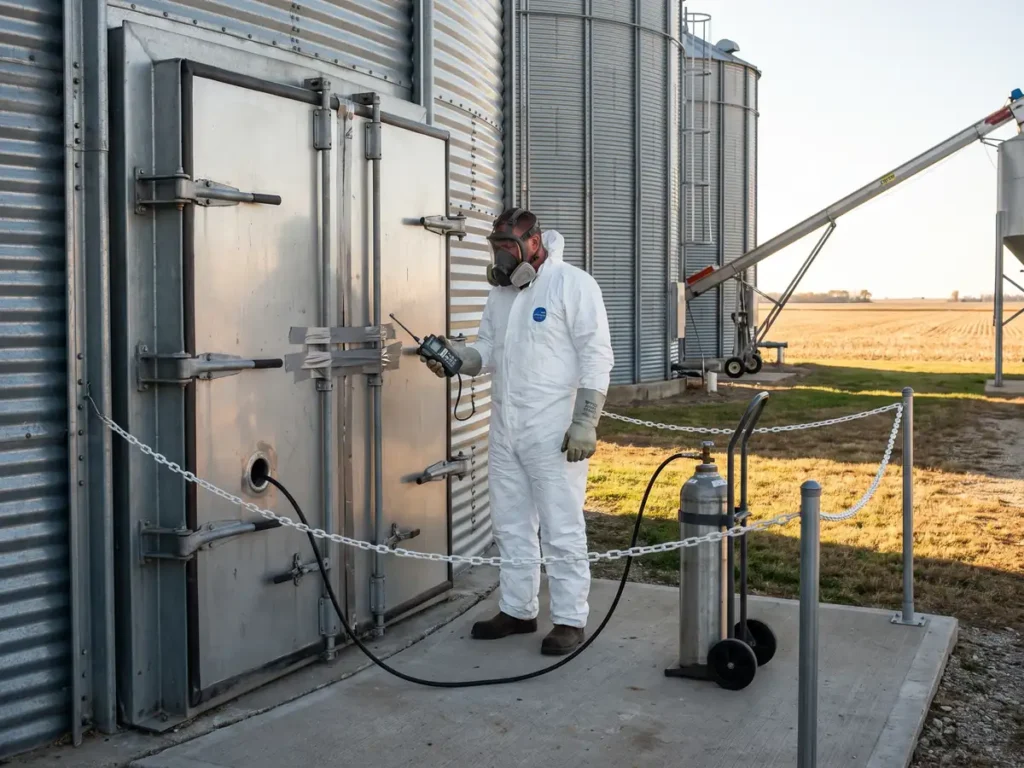
- The extension comes as a package with eight mandatory conditions, far stricter than those of 2012. The treatment is carried out only by authorised staff, holding a certificate of competence and a fumigation licence, only in gas-tight chambers or rooms whose tightness is tested, and the gas is supplied from outside, so that the operator does not come near the substance. Around the treated space a safety zone is established from which everyone is evacuated, and at its boundary certified devices measure that 0.01 parts per million of phosphine in the air is not exceeded. At the end, the remaining gas is pumped through a filter that captures it, instead of being vented into the atmosphere.
- In Romania those concerned are the silos, the grain stores, the companies providing fumigation services and, through them, the farmers who leave their harvest in storage. A European regulation applies directly, with no Romanian transposing law, but the national authorisations of the products do not change by themselves: their holders have three months in which to submit the documentation, that is, until 1 January 2027, and Member States have at most 12 months in which to decide, that is, until 1 October 2027. Beware of the readiest confusion: the act concerns phosphine supplied as a gas, not aluminium phosphide tablets, which are a separate active substance with their own approval.
Published: Official Journal of the European Union, L series, 2026/1968 of 8 September 2026, pages 1-7
In force from: 28 September 2026, the twentieth day following the date of publication in the Official Journal of the European Union, under Article 3 of the regulation; it applies from 1 October 2026
On 7 September 2026 the European Commission decided that phosphine may go on being used as a plant protection product and published the decision the next day, in the Official Journal of the European Union. A regulation of this kind applies directly in all Member States, with no Romanian law between it and the addressee, just like the three decisions by which one maize and two genetically modified soybeans were admitted into animal feed. The difference is that here it is not a particular product that is authorised but the substance in it, and on that decision hang all the national authorisations of the products containing it.
Phosphine is a colourless, highly toxic gas with the chemical formula PH3. In agriculture it is used for fumigation, that is, for treating by gassing the spaces where stored products are kept: cereals, seeds, pulses. The gas penetrates between the grains and kills the insects inside the bulk, which no surface treatment can do. Since 2012 the substance was approved in the Union under the name phosphane. The applicant sought the renewal under the name phosphine, and the regulation says expressly, in recital (3), that it is the same substance and has the same CAS number. The row in the European list now bears both names, „Phosphine/Phosphane”, with CAS number 7803-51-2 and CIPAC number 127.
What exactly was approved. Annex I to the regulation sets the identity data of the substance: purity 970 g/kg, IUPAC name phosphine, date of approval 1 October 2026, expiration of approval 30 September 2041. The dossier was assessed by Spain, as rapporteur Member State, together with Germany, as co-rapporteur Member State, and the European Food Safety Authority communicated its conclusion to the Commission on 10 December 2024.
That conclusion contained an alarm signal. The Authority identified a critical area of concern for the potential genotoxicity of phosphine, more precisely for clastogenicity, that is, for the capacity of the substance to break the chromosomes of exposed cells. The Commission writes in recital (8) that the concern does not prevent the renewal, „because the implementation of risk mitigation measures eliminates the exposure of humans, animals and the environment to phosphine”. In other words, the approval rests on the idea that nobody and nothing comes into contact with the gas, and the conditions in the annex are precisely the mechanism by which that is achieved.
The eight conditions. Annex I says that, when granting authorisations for products containing phosphine, Member States shall impose the following conditions and restrictions:
First, the application is carried out only by authorised and well-trained staff holding the certificate of competence and the corresponding fumigation licences, in accordance with national legislation. Second, the application is carried out only in gas-tight chambers, the tightness of the chamber or room is tested, and the fumigation starts by supplying the gas from outside. Third, a safety zone is established from which all persons are evacuated, and certified detection devices are used to ensure that at the boundary of the zone a concentration of 0.01 parts per million of PH3 in the air is not exceeded, for the protection of bystanders and residents. Fourth, entry into the treated spaces is prohibited, and in an emergency the operators and workers who enter must wear personal protective equipment, for example a self-contained breathing apparatus, known by the acronym SCBA.
The fifth condition changes practice the most: after fumigation, the remaining gas is pumped through a special filtration technology suitable for capturing phosphine, so that nothing is emitted into the environment. Sixth, the fumigation is regarded as finished only when the level of phosphine in the air of the treated chamber falls below the limit of detection, that is, below those same 0.01 parts per million. Seventh, the goods present in the space during the treatment are removed after ventilation and only if the phosphine residues in them are at or below the limit of quantification. The limit of quantification, written LOQ in the text, is the lowest value that the method of analysis can measure reliably. Eighth, treated containers are not transported before the fumigation has been completed.
A debt left unpaid. Besides the conditions, the annex requires the applicant to submit confirmatory information on the genotoxicity of phosphine. There is a choice of two routes. Either it demonstrates, on the basis of existing studies or of the scientific literature, that in vivo genotoxicity testing is not appropriate, because severe symptoms or the death of the laboratory animal would prevent a clear reading of the result and because positive results appear only close to high toxicity concentrations. Or, if it cannot demonstrate that, it carries out a new in vivo micronucleus test by inhalation, after a short-term exposure, in accordance with Test Guideline 474 of the Organisation for Economic Co-operation and Development. The deadline is 28 September 2028.
What the act changes in the European list. Annex II to the regulation replaces row 28 of Part B of the Annex to Implementing Regulation (EU) No 540/2011, that is, the row that kept the record of phosphane. The new text is identical, word for word, with the one in Annex I, and simply moves it into the official list of active substances approved in the Union. From 1 October 2026, anyone opening that list finds at position 28 the double name, the purity of 970 g/kg, the two dates and all eight conditions.
What it changes in practice
The first effect is one of continuity. If the approval had not been renewed, phosphine-based products would have had to be withdrawn from the market, and the stores would have been left with fewer tools against the insects inside the grain. The regulation closes the subject for 15 years, until 30 September 2041, and gives the sector a horizon that few authorisations have.
The second effect is felt by the operators. The conditions in the annex are obligations, not recommendations, and the Member State has to write them into the authorisation of each product. Anyone who today treats in a temporarily sealed warehouse and vents at the end straight into the atmosphere has two things to install that nobody asked for before: a system for capturing the remaining gas and a procedure for testing the tightness of the space. To these are added the certified detection devices for the boundary of the safety zone and the checking of residues in the goods before they are taken out.
The third effect concerns the national authorisations, and here the regulation is silent, because the mechanism lies elsewhere. Article 43(2) of Regulation (EC) No 1107/2009 gives the holder of the authorisation three months from the renewal of the approval in which to submit a copy of the authorisation, the new information required by the change in requirements and proof that the product meets the conditions in the renewal regulation. Paragraph (5) of the same article gives the Member State at most 12 months in which to decide on the renewal of the authorisation. Related to 1 October 2026, the two deadlines fall on 1 January 2027 and on 1 October 2027. In Romania, the decision belongs to the National Commission for the Authorisation of Plant Protection Products, the body provided for by Government Decision no. 1.559/2004 on the procedure for authorising plant protection products with a view to placing them on the market and using them on Romanian territory.
The fourth effect is one of delimitation, and it deserves to be said plainly, because in the stores in Romania the word „phosphine” covers, in everyday speech, two different things. This act concerns the active substance phosphine, that is, the gas as such. Aluminium phosphide and magnesium phosphide, that is, the tablets and sachets that release the gas on contact with moisture, are separate active substances, entered in Part A of the Annex to Implementing Regulation (EU) No 540/2011, with their own approvals and deadlines. The conditions in the present regulation, above all the one requiring the gas to be supplied from outside the space, do not apply to them.
The fifth effect is borne by those living nearby. The threshold of 0.01 parts per million at the boundary of the safety zone is written for bystanders and for residents, that is, for the people who live next to the store and who have nothing to do with the treatment. Until now the European text spoke of their protection in general terms. From 1 October 2026 there is a figure that an inspection authority can measure.
What has changed compared with the previous situation
The regime replaced comes from Commission Implementing Regulation (EU) No 1043/2012 of 8 November 2012, which had approved the substance under the name phosphane from 1 April 2013 until 31 March 2023, that is, for 10 years. The new approval lasts 15 years, 50% longer, and is the longest that European legislation allows.
Between the two regimes lay almost four years of postponements. The application for renewal was submitted on time, and Spain sent the draft renewal assessment report on 23 December 2021, 15 months before expiry. The approval was nonetheless extended three times: by Implementing Regulation (EU) 2023/114 of 16 January 2023, until 31 March 2024, by Implementing Regulation (EU) 2024/324 of 19 January 2024, until 15 March 2026, and by Implementing Regulation (EU) 2025/2316 of 17 November 2025, until 15 March 2027. That last extension now remains largely unused: the new approval starts on 1 October 2026, 165 days before the date on which the old one would have expired.
The purity required has changed too. In 2012 the substance had to have at least 994 g/kg, and the published table specified that the relevant impurity arsane must not exceed 0.023 g/kg in the technical material. The 2026 table requires 970 g/kg and no longer names any impurity. The footnote refers the identity and specification details to the renewal assessment report, which is not published in the Official Journal of the European Union.
The greatest change, however, is in the nature of the conditions. The 2012 text required Member States to pay „particular attention” to the protection of operators, workers and persons around the treated buildings, during the treatment and the airing, and then listed risk mitigation measures introduced by the formula „such as”, that is, by way of example: permanent monitoring with automatic devices, protective equipment, a zone around the treated spaces in which the presence of persons is refused, „where appropriate”. The 2026 text no longer gives examples of anything. It says „the following conditions and restrictions shall be imposed” and lists eight, each with its own verb in the indicative.
In the language of the store, the difference reads like this: until now the treatment could be carried out in a building that was aired at the end, and the safety measures were left to the judgment of the national authority. From 1 October 2026 the treatment is carried out in a space whose tightness is tested, the gas comes in from outside, and at the end it passes through a filter instead of going into the air. The restriction of 2012 under which authorisations are limited to professional users has disappeared from the new row, but nothing has been lost: the requirement that takes its place is heavier, because it calls for a certificate of competence and a fumigation licence, over and above the mere status of professional. For Romania, the framework for the training and certification of professional users is the one in Government Emergency Ordinance no. 34/2012 establishing the institutional framework for action with a view to the sustainable use of pesticides on Romanian territory.
Something that in 2012 did not exist at all has appeared, on the other hand: the obligation to bring confirmatory information on genotoxicity, with a deadline of 28 September 2028. And something that existed in 2012 has disappeared: an article dedicated to the national authorisations. The 2012 regulation had an Article 2 with exact dates, 31 March 2013 for the re-evaluation of the products, 30 September 2013 and 30 September 2014 for amending or withdrawing the authorisations. The 2026 act has three articles and says nothing about them.
Advantages and disadvantages
What it improves
- The sector keeps the fumigant that reaches inside the bulk of the grain, where surface treatments have no effect, and keeps it with a horizon of 15 years, until 30 September 2041.
- The protection of the people around gains a verifiable figure. The 0.01 parts per million at the boundary of the safety zone can be measured with a device, unlike the „particular attention” required by the 2012 text.
- Capturing the remaining gas by filtration instead of venting it into the atmosphere takes phosphine out of the air around the stores. It is the only one of the eight conditions that produces an environmental gain, not merely one of occupational safety.
- The rule that the goods leave the space only after ventilation and only if the residues are at or below the limit of quantification protects the final buyer of the cereals, not only the operator.
- The two annexes are identical word for word, so there is no risk that the European list of approved substances says something different from the regulation that amends it.
What remains a problem
- The investment falls entirely on the operator, with no transitional period written into the act. The filtration installation, the tightness testing and the certified detection devices cost money, and the regulation applies from 1 October 2026.
- The threshold that decides when the goods may leave the treated space has no figure. The limit of quantification depends on the method of analysis, and the method sits in the renewal assessment report, not in the published text.
- The safety zone has no dimension. The act says what must not be exceeded at its boundary, but does not say where the boundary lies, so the extent of the zone is left for each national authority to establish.
- The critical area of concern for genotoxicity remains open, and the approval was granted for the maximum duration anyway. The confirmatory information comes in 2028, with 13 years of approval left after it.
- The published table no longer names any impurity, although the 2012 version set a ceiling for arsane. The reader of the Official Journal of the European Union can no longer learn from it what the substance is allowed to contain besides phosphine.
- The deadlines for the national authorisations are not in the act. Anyone who wants to know by when their authorisation will be rewritten has to open Article 43 of Regulation (EC) No 1107/2009, which in 2012 was not necessary.
Practical advice
- First check what substance you actually use. If the treatment is carried out with tablets or sachets that release the gas inside the bulk of the goods, the active substance is aluminium phosphide or magnesium phosphide, and this regulation does not concern it. If the gas comes in cylinders, you are in its field.
- If you are a warehouse keeper, ask the fumigation provider, in writing, how it meets the two new conditions: how it tests the tightness of the space and through what it filters the gas remaining at the end. The answer says more about its preparedness than any price quotation.
- Follow the authorisation number of the product, not the trade name. By 1 October 2027 the national authorisations will be rewritten on the new conditions, and a product may stay on the market with limits of use other than today’s.
- If you hold an authorisation, remember 1 January 2027. Article 43(2) of Regulation (EC) No 1107/2009 gives you three months from 1 October 2026 in which to submit the documentation, and the deadline runs whether or not anyone tells you.
- If you live next to a store where fumigation is carried out, the figure that concerns you is 0.01 parts per million at the boundary of the safety zone. It is measured with certified devices, and the results of the measurement are an inspection document.
- Do not confuse the two dates of the act. The act enters into force on 28 September 2026 but applies from 1 October 2026, and the renewed approval likewise starts on 1 October. Until then the 2012 regime stays standing.
Frequently asked questions
Can phosphine still be used after 1 October 2026?
Why does the name „phosphane” also appear in the act?
Does this regulation also apply to aluminium phosphide tablets?
Does a Romanian law have to be adopted for the new rules to apply?
Who is allowed to carry out the treatment?
What happens if the information on genotoxicity does not arrive by 28 September 2028?
Why were three extensions needed before the renewal?
Editorial analysis
The act solves a real problem and solves it coherently. The European Food Safety Authority flagged a critical area of concern, and the Commission did not ignore it: it built around it eight conditions that try to take exposure to zero, from the tightness of the space to the filtration of the remaining gas. The logic is clear, and the two annexes are identical word for word, which in an act amending a list is not to be taken for granted.
The first observation comes from the arithmetic of the dates, not from reading the text. The entry into force falls on 28 September 2026, and the deadline for the confirmatory information is 28 September 2028, that is, exactly two years, to the day. The act nowhere writes „two years”; it gives only a date, and the match is visible only if one calculates. The problem is what follows it: the approval still has 13 years to run from that deadline, until 30 September 2041. If the answer to the genotoxicity question is late or turns out badly, the act provides for nothing. The duration granted is, moreover, the legal maximum: Article 14(2) of Regulation (EC) No 1107/2009 allows up to 15 years, and here exactly 15 were given, that is, 5,479 days, for a substance with a scientific concern left open. The 2012 approval, granted with no critical concern, had been for 10 years.
The second observation comes from the ratio between the deadlines the act distributes. The shortest goes to the holder of the national authorisation, three months, until 1 January 2027. The Member State has 12 months, until 1 October 2027. The applicant who left the scientific question behind has two years, until 28 September 2028. The order is exactly the reverse of the order of responsibility: the one who has to clear up the substantive problem gets the most time, and the one who merely files some documents gets the least. On top of that, the first two deadlines are not written in the act but have to be inferred from Article 43 of Regulation (EC) No 1107/2009. The 2012 regulation had a whole article, the second, which wrote them all down in black and white, with calendar dates.
The third observation is visible only by placing the two tables side by side. The minimum purity falls from 994 g/kg to 970 g/kg. In absolute figures, the margin of tolerated impurities rises from 6 g/kg to 30 g/kg, that is, fivefold. And the explicit ceiling for arsane, 0.023 g/kg, the only impurity named in 2012, no longer appears in the published text. The footnote refers to the renewal assessment report, a document that is not published in the Official Journal of the European Union. We do not claim that the limit has disappeared from the legal regime of the substance, because the report may contain it. We claim that it has disappeared from the only text a warehouse keeper, an occupational physician or an inspector can read, and that, in a substance whose typical contaminant is a compound of arsenic, is not a detail of drafting technique.
The fourth observation concerns the pace of the procedure. Spain sent the draft renewal assessment report on 23 December 2021. The Authority communicated its conclusion on 10 December 2024, after 1,083 days, almost three years. The Commission took the report to the Standing Committee on 10 December 2025, that is, exactly 365 days after the conclusion, to the day, and the draft regulation on 5 May 2026. From the draft report to adoption 1,719 days passed, four years and eight months, a period in which the approval had to be extended three times. It was not the procedure in Brussels that was slow: 636 days passed between the Authority’s conclusion and the signature, and the longest part sat in the scientific assessment.
What should be changed
- A figure for the limit of quantification, in the text. The moment when the treated cereals may leave the space depends today on a threshold that is written nowhere in the Official Journal of the European Union. A value expressed in milligrams per kilogram, or at least an express reference to the applicable method of analysis, would make the condition verifiable by anyone, not only by those with access to the renewal report.
- A rule for sizing the safety zone. The act says what must not be exceeded at the boundary of the zone, but does not say where the boundary is. A minimum distance, or a formula linked to the volume treated and to the quantity of gas used, would prevent the situation in which the same operation is carried out lawfully at 5 metres from a fence in one State and at 50 in another.
- A consequence attached to the deadline of 28 September 2028. If the confirmatory information does not arrive in time or does not clear up the concern, the approval ought to enter review automatically, not run on until 2041. The same clause would turn the deadline from an indicative date into an obligation with something at stake.
- The impurity ceiling, back in the table. The 2012 row named arsane and set it a limit. The 2026 one names nothing. Reintroducing a line half a row long would give the reader back the information needed to understand what is being breathed, at zero drafting cost.
- A transitional article, as in 2012. The two deadlines that concern the Romanian market directly, 1 January 2027 and 1 October 2027, are obtained today by calculation, from Article 43 of another regulation. Written into the act, with a calendar date, they would spare every authorisation holder and every national authority the same operation carried out 27 times.
- A duration proportionate to the uncertainty that remains. Fifteen years is the legal maximum and is granted, as a rule, to clean dossiers. For a substance with a critical area of concern still open, an approval of 7 or 10 years would have left room for a re-evaluation once the scientific answer arrives, without endangering the supply of the stores.
Original text of the legal act
The text below is reproduced in Romanian, the official form of publication.
EMITENT: Comisia Europeană Publicat în: Jurnalul Oficial al Uniunii Europene, seria L, 2026/1968 din 8 septembrie 2026, paginile 1-7 COMISIA EUROPEANĂ, având în vedere Tratatul privind funcționarea Uniunii Europene, având în vedere Regulamentul (CE) nr. 1107/2009 al Parlamentului European și al Consiliului din 21 octombrie 2009 privind introducerea pe piață a produselor fitosanitare și de abrogare a Directivelor 79/117/CEE și 91/414/CEE ale Consiliului (1), în special articolul 20 alineatul (1), întrucât: (1) Regulamentul de punere în aplicare (UE) nr. 1043/2012 al Comisiei (2) a aprobat substanța activă fosfan și a inclus-o în lista din partea B din anexa la Regulamentul de punere în aplicare (UE) nr. 540/2011 al Comisiei (3). (2) Aprobarea substanței active fosfan în condițiile menționate în partea B din anexa la Regulamentul de punere în aplicare (UE) nr. 540/2011 expiră la 15 martie 2027. (3) O cerere de reînnoire a aprobării substanței active fosfan, sub denumirea de fosfină, care este aceeași substanță și are același număr CAS ca fosfanul, a fost transmisă Spaniei, statul membru raportor, și Germaniei, statul membru coraportor, în conformitate cu articolul 1 din Regulamentul de punere în aplicare (UE) nr. 844/2012 al Comisiei (4), în termenul prevăzut la articolul respectiv. (4) Solicitantul a transmis dosarul suplimentar necesar statului membru raportor, statului membru coraportor, Comisiei și Autorității Europene pentru Siguranța Alimentară (denumită în continuare „autoritatea”), în conformitate cu articolul 6 din Regulamentul de punere în aplicare (UE) nr. 844/2012. Statul membru raportor a constatat că cererea era admisibilă. (5) Statul membru raportor, în colaborare cu statul membru coraportor, a pregătit un proiect de raport de evaluare a reînnoirii aprobării, pe care l-a transmis, la data de 23 decembrie 2021, autorității și Comisiei. În proiectul respectiv de raport de evaluare a reînnoirii aprobării, statul membru raportor a propus reînnoirea aprobării substanței fosfină. (6) Autoritatea a pus dosarul rezumativ suplimentar la dispoziția publicului. În plus, autoritatea a transmis solicitantului și statelor membre proiectul de raport de evaluare a reînnoirii aprobării în scopul formulării de observații și a lansat o consultare publică pe marginea lui. Autoritatea a transmis Comisiei observațiile primite. (7) La 10 decembrie 2024, autoritatea a comunicat Comisiei concluzia sa (5) cu privire la posibilitatea ca substanța fosfină să îndeplinească criteriile de aprobare prevăzute la articolul 4 din Regulamentul (CE) nr. 1107/2009. (8) Autoritatea a identificat un domeniu critic de îngrijorare pentru genotoxicitatea (clastogenicitatea) potențială a fosfinei. Totuși, această preocupare nu împiedică reînnoirea aprobării, deoarece punerea în aplicare a măsurilor de reducere a riscurilor elimină expunerea oamenilor, a animalelor și a mediului la fosfină. (9) La 10 decembrie 2025 și, respectiv, la 5 mai 2026, Comisia a prezentat Comitetului permanent pentru plante, animale, produse alimentare și hrană pentru animale un raport privind reînnoirea aprobării și, respectiv, un proiect al prezentului regulament. (10) Comisia a invitat solicitantul să își transmită observațiile cu privire la concluzia autorității și, în conformitate cu articolul 14 alineatul (1) al treilea paragraf din Regulamentul de punere în aplicare (UE) nr. 844/2012, cu privire la raportul privind reînnoirea aprobării. Solicitantul a transmis observațiile sale, care au fost examinate temeinic și luate în considerare. (11) În cazul uneia sau al mai multor utilizări reprezentative ale cel puțin unui produs de protecție a plantelor care conține substanța activă fosfină, s-a stabilit că sunt îndeplinite criteriile de aprobare prevăzute la articolul 4 din Regulamentul (CE) nr. 1107/2009, sub rezerva respectării condițiilor și a restricțiilor de utilizare specificate în anexa I la prezentul regulament. (12) În consecință, este adecvat să se reînnoiască aprobarea substanței fosfină. (13) Cu toate acestea, în conformitate cu articolul 14 alineatul (1) coroborat cu articolul 6 din Regulamentul (CE) nr. 1107/2009 și având în vedere cunoștințele științifice și tehnice actuale și rezultatul evaluării riscurilor, este necesar să se prevadă anumite condiții pentru eliminarea oricărei expuneri a oamenilor, a animalelor și a mediului la fosfină. Fosfina, care se aplică prin fumigație, trebuie utilizată numai în camerele sau încăperile etanșe la gaze, în care se verifică etanșeitatea la gaze și se furnizează fosfină din exterior, evitându-se astfel contactul operatorilor cu substanța activă. După fumigație, fosfina rămasă trebuie eliminată cu ajutorul unei tehnologii de filtrare adecvate, pentru a se asigura că nicio cantitate de fosfină nu este eliberată în mediu. Produsele pe care se aplică fosfină trebuie îndepărtate din camerele sau încăperile etanșe la gaze numai după ventilare și numai în cazul în care concentrațiile de reziduuri de fosfină sunt la sau sub limita de cuantificare (LOQ). (14) În plus, este necesar să se solicite informații de confirmare privind potențialul de genotoxicitate al fosfinei pentru a spori încrederea în decizia conform căreia este puțin probabil ca fosfina să conducă la efecte genotoxice în condiții de utilizare relevante. (15) Este necesar ca Regulamentul de punere în aplicare (UE) nr. 540/2011 să fie modificat în consecință. (16) Regulamentul de punere în aplicare (UE) 2025/2316 al Comisiei (6) a prelungit perioada de aprobare a fosfinei până la 15 martie 2027, pentru a se permite ca procesul de reînnoire a aprobării să fie finalizat înainte de expirarea perioadei de aprobare a substanței active respective. Cu toate acestea, având în vedere faptul că s-a luat o decizie cu privire la reînnoirea aprobării fosfinei înainte de această dată de expirare amânată, prezentul regulament trebuie să se aplice înainte de respectiva dată. (17) Măsurile prevăzute în prezentul regulament sunt conforme cu avizul Comitetului permanent pentru plante, animale, produse alimentare și hrană pentru animale, ADOPTĂ PREZENTUL REGULAMENT: Articolul 1 Reînnoirea aprobării substanței active Aprobarea substanței active fosfină, cu specificațiile din anexa I la prezentul regulament, se reînnoiește sub rezerva îndeplinirii condițiilor prevăzute în anexa respectivă. Articolul 2 Modificări ale Regulamentului de punere în aplicare (UE) nr. 540/2011 Anexa la Regulamentul de punere în aplicare (UE) nr. 540/2011 se modifică în conformitate cu anexa II la prezentul regulament. Articolul 3 Intrarea în vigoare și data aplicării Prezentul regulament intră în vigoare în a douăzecea zi de la data publicării în Jurnalul Oficial al Uniunii Europene. Se aplică de la 1 octombrie 2026. Prezentul regulament este obligatoriu în toate elementele sale și se aplică direct în toate statele membre. Adoptat la Bruxelles, 7 septembrie 2026. Pentru Comisie Președinta Ursula VON DER LEYEN (1) JO L 309, 24.11.2009, p. 1, ELI: http://data.europa.eu/eli/reg/2009/1107/oj. (2) Regulamentul de punere în aplicare (UE) nr. 1043/2012 al Comisiei din 8 noiembrie 2012 de autorizare a substanței active fosfan, în conformitate cu Regulamentul (CE) nr. 1107/2009 al Parlamentului European și al Consiliului privind introducerea pe piață a produselor fitosanitare și de modificare a anexei la Regulamentul de punere în aplicare (UE) nr. 540/2011 al Comisiei (JO L 310, 9.11.2012, p. 24, ELI: http://data.europa.eu/eli/reg_impl/2012/1043/oj). (3) Regulamentul de punere în aplicare (UE) nr. 540/2011 al Comisiei din 25 mai 2011 de punere în aplicare a Regulamentului (CE) nr. 1107/2009 al Parlamentului European și al Consiliului în ceea ce privește lista substanțelor active aprobate (JO L 153, 11.6.2011, p. 1, ELI: http://data.europa.eu/eli/reg_impl/2011/540/oj). (4) Regulamentul de punere în aplicare (UE) nr. 844/2012 al Comisiei din 18 septembrie 2012 de stabilire a dispozițiilor necesare pentru punerea în aplicare a procedurii de reînnoire pentru substanțele active, prevăzută în Regulamentul (CE) nr. 1107/2009 al Parlamentului European și al Consiliului privind introducerea pe piață a produselor fitosanitare (JO L 252, 19.9.2012, p. 26, ELI: http://data.europa.eu/eli/reg_impl/2012/844/oj), care continuă să se aplice procedurii de reînnoire a aprobării acestei substanțe active în temeiul articolului 17 din Regulamentul de punere în aplicare (UE) 2020/1740 al Comisiei din 20 noiembrie 2020 de stabilire a dispozițiilor necesare pentru punerea în aplicare a procedurii de reînnoire pentru substanțele active, astfel cum se prevede în Regulamentul (CE) nr. 1107/2009 al Parlamentului European și al Consiliului, și de abrogare a Regulamentului de punere în aplicare (UE) nr. 844/2012 al Comisiei (JO L 392, 23.11.2020, p. 20, ELI: http://data.europa.eu/eli/reg_impl/2020/1740/oj). (5) EFSA (Autoritatea Europeană pentru Siguranța Alimentară), „Peer review of the pesticide risk assessment of the active substance phosphine” (Revizuire inter pares a evaluării riscului utilizării ca pesticid a substanței active fosfină), în EFSA Journal 2025, articolul 23 alineatul (1): e9177, https://doi.org/10.2903/j.efsa.2025.9177. (6) Regulamentul de punere în aplicare (UE) 2025/2316 al Comisiei din 17 noiembrie 2025 de modificare a Regulamentului de punere în aplicare (UE) nr. 540/2011 în ceea ce privește prelungirea perioadelor de aprobare a substanțelor active silicat de aluminiu, difenoconazol, diflufenican, fosfonat de disodiu, extract din arbore de ceai, flurocloridonă, acid indolil butiric, maltodextrină, fosfan, uleiuri vegetale/ulei de cuișoare, uleiuri vegetale/ulei de mentă verde, fosfonați de potasiu și triclopir (JO L, 2025/2316, 18.11.2025, ELI: http://data.europa.eu/eli/reg_impl/2025/2316/oj). ANEXA I ANEXA II În partea B din anexa la Regulamentul de punere în aplicare (UE) nr. 540/2011, rândul 28 privind fosfanul se înlocuiește cu următorul text:Show the full legal textHide the full legal text
Regulamentul de punere în aplicare (UE) 2026/1968 al Comisiei din 7 septembrie 2026 de reînnoire a aprobării substanței active fosfină în conformitate cu Regulamentul (CE) nr. 1107/2009 al Parlamentului European și al Consiliului și de modificare a Regulamentului de punere în aplicare (UE) nr. 540/2011 al Comisiei
Denumire comună, numere de identificare
Denumire IUPAC
Puritate (1)
Data aprobării
Expirarea aprobării
Dispoziții specifice
Fosfină/Fosfan (nu a fost alocată o denumire comună ISO)
Nr. CAS: 7803-51-2
Nr. CIPAC: 127Fosfină
970 g/kg
1 octombrie 2026
30 septembrie 2041
În vederea punerii în aplicare a principiilor uniforme prevăzute la articolul 29 alineatul (6) din Regulamentul (CE) nr. 1107/2009, se ține seama de concluziile raportului privind reînnoirea aprobării fosfinei, în special de apendicele I și II la acesta.
Atunci când acordă autorizații pentru produse de protecție a plantelor care conțin fosfină, statele membre acordă o atenție deosebită eliminării oricărei expuneri a oamenilor, a animalelor și a mediului la fosfină. În acest scop, la autorizarea produselor de protecție a plantelor, se impun următoarele condiții și restricții:
— aplicarea produselor se efectuează numai de către personal autorizat bine pregătit, care deține certificatul de competență și licențele de fumigație corespunzătoare, în conformitate cu legislația națională respectivă;
— aplicarea produselor se efectuează numai în camere etanșe la gaze și se testează etanșeitatea la gaze a camerei sau a încăperii, iar fumigația este inițiată prin furnizarea de fosfină din exterior în cameră sau încăpere;
— trebuie să se stabilească o zonă de siguranță din care să fie evacuate toate persoanele și trebuie să se monitorizeze, cu ajutorul unor dispozitive de detectare certificate adecvate, că nu este depășită o concentrație de 0,01 ppm pentru PH3 în aer la limita zonei, pentru a se asigura protecția trecătorilor și a rezidenților;
— intrarea în camerele sau încăperile tratate este interzisă. Cu toate acestea, în caz de urgență, operatorii și lucrătorii care intră în camerele tratate trebuie să poarte echipamente individuale de protecție, de exemplu aparate de respirație autonome (SCBA);
— trebuie să se asigure că, în urma fumigației, fosfina rămasă este pompată printr-o tehnologie specială de filtrare adecvată pentru captarea fosfinei, pentru a se asigura că nu se emite fosfină în mediu;
— fumigația este considerată completă numai atunci când nivelul de fosfină din aerul din camera sau camera tratată este sub limita de detecție (0,01 ppm de PH3);
— produsele prezente în cameră sau încăpere în timpul tratamentului se îndepărtează după ventilație numai în cazul în care concentrațiile de reziduuri de fosfină din aceste produse sunt la nivelul LOQ sau sub acest nivel;
— containerele tratate nu se transportă înainte de finalizarea fumigației.
Solicitantul prezintă Comisiei, statelor membre și autorității următoarele informații de confirmare cu privire la genotoxicitatea potențială a fosfinei:
1. fie informații care confirmă, pe baza studiilor existente sau a literaturii științifice, că testarea genotoxicității fosfinei in vivo nu este adecvată deoarece: (a) simptomele clinice severe observate sau mortalitatea rezultată din expunerea la fosfină ar trebui să împiedice o interpretare clară a rezultatelor în ceea ce privește în mod specific genotoxicitatea și (b) rezultatele pozitive privind genotoxicitatea sunt observate doar în apropierea concentrațiilor mari de toxicitate, pe baza analizei doză-răspuns sau a modului de acțiune;
(a) simptomele clinice severe observate sau mortalitatea rezultată din expunerea la fosfină ar trebui să împiedice o interpretare clară a rezultatelor în ceea ce privește în mod specific genotoxicitatea și
(b) rezultatele pozitive privind genotoxicitatea sunt observate doar în apropierea concentrațiilor mari de toxicitate, pe baza analizei doză-răspuns sau a modului de acțiune;
2. fie, în cazul în care informațiile de la punctul 1 nu pot fi furnizate, un nou test in vivo de micronucleu prin inhalare în urma expunerii pe termen scurt în conformitate cu Orientările OCDE privind testarea din 474.
Solicitantul transmite Comisiei, statelor membre și autorității informațiile de confirmare solicitate până la 28 septembrie 2028.
(1) Detalii suplimentare privind identitatea și specificațiile substanței active sunt puse la dispoziție în raportul privind reînnoirea aprobării.
Nr.
Denumire comună, numere de identificare
Denumire IUPAC
Puritate (1)
Data aprobării
Expirarea aprobării
Dispoziții specifice
„28
Fosfină/Fosfan (nu a fost alocată o denumire comună ISO)
Nr. CAS: 7803-51-2
Nr. CIPAC: 127Fosfină
970 g/kg
1 octombrie 2026
30 septembrie 2041
În vederea punerii în aplicare a principiilor uniforme prevăzute la articolul 29 alineatul (6) din Regulamentul (CE) nr. 1107/2009, se ține seama de concluziile raportului privind reînnoirea aprobării fosfinei, în special de apendicele I și II la acesta.
Atunci când acordă autorizații pentru produse de protecție a plantelor care conțin fosfină, statele membre acordă o atenție deosebită eliminării oricărei expuneri a oamenilor, a animalelor și a mediului la fosfină. În acest scop, la autorizarea produselor de protecție a plantelor, se impun următoarele condiții și restricții:
— aplicarea produselor se efectuează numai de către personal autorizat bine pregătit, care deține certificatul de competență și licențele de fumigație corespunzătoare, în conformitate cu legislația națională respectivă;
— aplicarea produselor se efectuează numai în camere etanșe la gaze și se testează etanșeitatea la gaze a camerei sau a încăperii, iar fumigația este inițiată prin furnizarea de fosfină din exterior în cameră sau încăpere;
— trebuie să se stabilească o zonă de siguranță din care să fie evacuate toate persoanele și trebuie să se monitorizeze, cu ajutorul unor dispozitive de detectare certificate adecvate, că nu este depășită o concentrație de 0,01 ppm pentru PH3 în aer la limita zonei, pentru a se asigura protecția trecătorilor și a rezidenților;
— intrarea în camerele sau încăperile tratate este interzisă. Cu toate acestea, în caz de urgență, operatorii și lucrătorii care intră în camerele tratate trebuie să poarte echipamente individuale de protecție, de exemplu aparate de respirație autonome (SCBA);
— trebuie să se asigure că, în urma fumigației, fosfina rămasă este pompată printr-o tehnologie specială de filtrare adecvată pentru captarea fosfinei, pentru a se asigura că nu se emite fosfină în mediu;
— fumigația este considerată completă numai atunci când nivelul de fosfină din aerul din camera sau camera tratată este sub limita de detecție (0,01 ppm de PH3);
— produsele prezente în cameră sau încăpere în timpul tratamentului se îndepărtează după ventilație numai în cazul în care concentrațiile de reziduuri de fosfină din aceste produse sunt la nivelul LOQ sau sub acest nivel;
— containerele tratate nu se transportă înainte de finalizarea fumigației.
Solicitantul prezintă Comisiei, statelor membre și autorității următoarele informații de confirmare cu privire la genotoxicitatea potențială a fosfinei:
1. fie informații care confirmă, pe baza studiilor existente sau a literaturii științifice, că testarea genotoxicității fosfinei in vivo nu este adecvată deoarece: (a) simptomele clinice severe observate sau mortalitatea rezultată din expunerea la fosfină ar trebui să împiedice o interpretare clară a rezultatelor în ceea ce privește în mod specific genotoxicitatea și (b) rezultatele pozitive privind genotoxicitatea sunt observate doar în apropierea concentrațiilor mari de toxicitate, pe baza analizei doză-răspuns sau a modului de acțiune;
(a) simptomele clinice severe observate sau mortalitatea rezultată din expunerea la fosfină ar trebui să împiedice o interpretare clară a rezultatelor în ceea ce privește în mod specific genotoxicitatea și
(b) rezultatele pozitive privind genotoxicitatea sunt observate doar în apropierea concentrațiilor mari de toxicitate, pe baza analizei doză-răspuns sau a modului de acțiune;
2. fie, în cazul în care informațiile de la punctul 1 nu pot fi furnizate, un nou test in vivo de micronucleu prin inhalare în urma expunerii pe termen scurt în conformitate cu Orientările OCDE privind testarea din 474.
Solicitantul transmite Comisiei, statelor membre și autorității informațiile de confirmare solicitate până la 28 septembrie 2028.”
(1) Detalii suplimentare privind identitatea și specificațiile substanței active sunt puse la dispoziție în raportul privind reînnoirea aprobării.
This article is for informational purposes only and does not constitute legal advice. For specific situations, consult a licensed attorney or tax advisor.