
In brief
- The dryers that take the water out of compressed air may go on being sold with fluorinated greenhouse gases, four years past the date on which they were due to leave the market. The European Commission has authorised an exemption from the prohibition that applies from 1 January 2027, and the exemption runs from 1 January 2027 to 31 December 2030, that is 1,461 days, exactly the maximum ceiling European law allows.
- Those concerned are the manufacturers, importers and distributors who place such dryers on the Romanian market, but also the factories that assemble the equipment themselves for their own needs. Regulation (EU) 2024/573 counts as „placing on the market” even the use of equipment manufactured for own use, so a plant that builds its own installation does not escape the rule. The end users are the workshops and factories where compressed air drives tools, presses, packaging lines or paint systems.
- The exemption comes with a single condition: the label. The equipment has to be labelled under Article 12(2) of Regulation (EU) 2024/573, with the end date of the exemption, 31 December 2030, and with a reference saying that it may be used only for the purpose for which the exemption was granted. Without that label, the equipment is unlawfully placed on the market and can no longer be used, resold or exported.
Published: Official Journal of the European Union, L series, 2026/1975 of 9 September 2026
In force from: 29 September 2026, the twentieth day following publication, under the first paragraph of Article 2; it applies from 1 January 2027 to 31 December 2030
From 1 January 2027 the European Union takes off the market a whole category of cooling equipment that runs on fluorinated greenhouse gases, and among it would have been the dryers that take the water out of compressed air, the part without which few industrial halls can work. On 8 September 2026 the European Commission decided that for this type of equipment the prohibition is postponed by four years. The act appeared in the Official Journal of the European Union on 9 September 2026 and entered into force on 29 September 2026, 94 days before the deadline it corrects, a short gap that industry has met before in European technical legislation, as it did when the Euro 7 test for brake dust was changed 67 days before its first application.
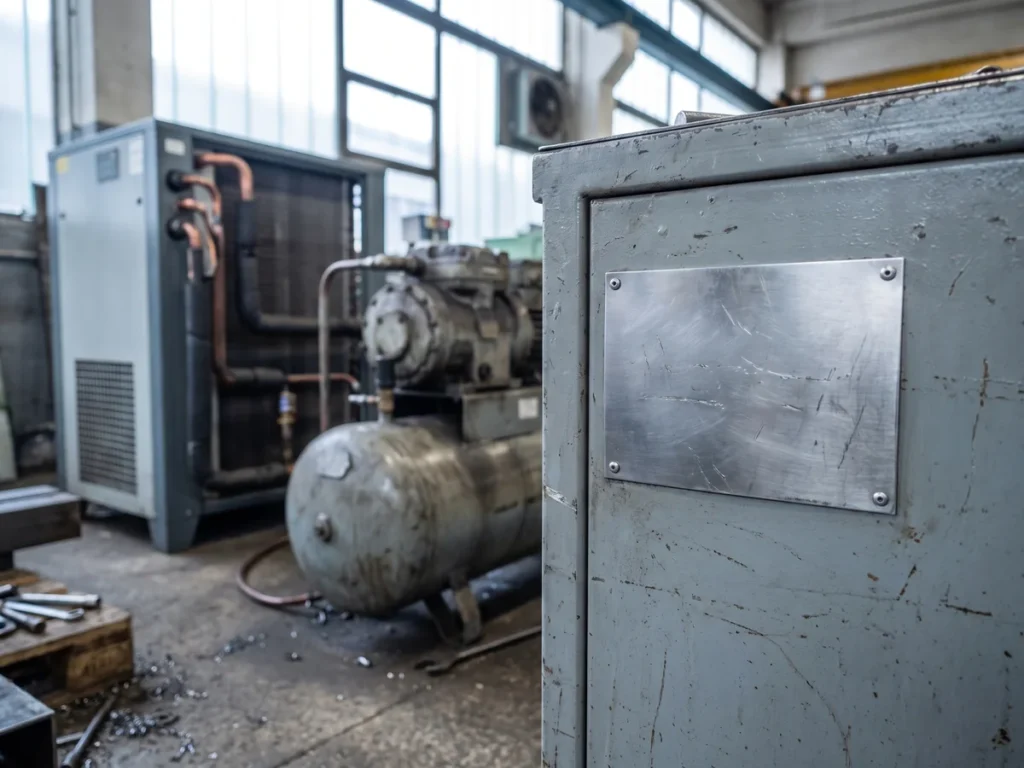
Compressed air leaves the compressor hot and loaded with water vapour. If the water stays there it condenses in the pipes, rusts the installation, ruins pneumatic tools and spoils the product, from paint shops to food packaging. The usual solution is a refrigeration dryer, which cools the air close to freezing point, lets the water condense, removes it and sends the air on dry. In the language of the act these are compressed air refrigerated dryers, which the act abbreviates as CARDs, and the regulation describes them as essential components of compressed air installations widely used across all industrial sectors.
The trouble is that the cooling is done with a refrigerant, and Regulation (EU) 2024/573 on fluorinated greenhouse gases, the act that replaced the old Regulation (EU) No 517/2014, bans those gases step by step according to how much they warm the atmosphere. The measure is called global warming potential, abbreviated GWP, and it shows how many times more one kilogram of the gas warms than one kilogram of carbon dioxide, counted over a hundred years. Annex IV to the regulation contains a calendar of prohibitions by type of equipment, and three of the entries in that calendar fell squarely on dryers: point 7(b), point 8(b) and point 8(d), all with the date 1 January 2027 and all for gases with a GWP of 150 or more.
The request did not come from Romania. In February 2026 the German authorities asked the Commission for the exemption, arguing that refrigerants with a GWP below 150 are not yet mature enough for all industrial applications, that moving to them calls for new safety concepts and a redesign that reduces the refrigerant charge, and that without an exemption manufacturers and users would bear disproportionate costs and risks, including premature replacement. The Commission assessed the request and considered both conditions in Article 11(5) of Regulation (EU) 2024/573 to be met: suitable alternatives are not technically feasible for all applications, and the absence of an exemption would lead to disproportionate costs.
What it changes in practice
In concrete terms, between 1 January 2027 and 31 December 2030 three categories of dryer may still be sold throughout the Union, and therefore in Romania too: stationary chillers with a rated capacity of up to and including 12 kW used for drying compressed air, stationary self-contained air-conditioning equipment of up to and including 12 kW for the same use, and equipment of more than 12 kW that does not exceed 50 kW. In all three cases the gas may have a GWP of 150 or more, and the exemption itself adds no upper ceiling.
The only condition is the label. Article 1 of the regulation ties the authorisation to the labelling laid down in Article 12(2) of Regulation (EU) 2024/573, and the text of that article requires the label to show the end date of the exemption and to include a reference saying that the equipment may be used only for the purpose for which the exemption was granted. On a dryer sold in Romania that means two pieces of information written on the machine: that the exemption expires on 31 December 2030, and that the machine is meant for drying compressed air, not for any other use. The label has to be drawn up in the official languages of the State where the sale takes place, so in Romanian, and its format is now set by Implementing Regulation (EU) 2024/2174, which repealed Implementing Regulation (EU) 2015/2068 and applies from 1 January 2025.
The consequence of a missing label is not a fine for a formality. An unlabelled machine falls outside the exemption, so it comes under the prohibition of 1 January 2027, and the third subparagraph of Article 11(1) of Regulation (EU) 2024/573 says what happens to products unlawfully placed on the market after the date of the prohibition: they are not to be used, supplied on, made available to anyone else in the Union for payment or free of charge, or exported. All that remains is storage and transport for disposal, after the gas has been recovered. Goods that have become unusable, not an irregularity to be put right later on.
In Romania, the control of placing on the market falls to the National Environmental Guard, and at the border to the Romanian Customs Authority, under Article 3 of Law no. 120/2024 on establishing the institutional framework and certain measures for implementing the management of fluorinated greenhouse gases, published in Official Gazette of Romania (Monitorul Oficial), Part I, no. 414 of 7 May 2024 and in force since 6 June 2024. The same law provides for administrative fines of 15,000 to 30,000 lei for individuals and of 50,000 to 100,000 lei for legal persons, while placing equipment on the market in breach of the prohibitions is a criminal offence, punishable by imprisonment from 6 months to 3 years or by a fine.
What has changed compared with the previous situation
Until now, the calendar in Annex IV was firm for dryers: from 1 January 2027 only the versions with gases below the GWP 150 threshold, or those required by safety requirements at the site of operation, could be sold. From 29 September 2026 there is a third way, valid for four years, for equipment intended for drying compressed air.
The exemption is not the first of its kind. It is the sixth authorisation the Commission has granted under Article 11(5) since the framework regulation entered into force, on 11 March 2024, and it joins a narrow and highly technical series: laboratory equipment and test chambers, by Regulation (EU) 2024/2729, cryogenic freezers, blood transport boxes and plasma freezers, by Regulations (EU) 2024/3120 and 2024/3122, professional kitchen appliances, by Regulation (EU) 2025/33, and the chillers used in semiconductor manufacturing, by Regulation (EU) 2026/286, adopted 210 days earlier.
The comparison with the precedents says something about how seriously the case was treated. Article 11(5) allows an exemption of no more than four years. The dryers got exactly four years, 1,461 days. The chillers for semiconductors got three years, 1,096 days, and the kitchen appliances only 546 days, that is a year and a half. The only exemption as long as this one was the one for laboratory equipment. This is, in other words, one of the two cases in which the Commission has used the whole ceiling.
The novelty compared with the earlier series is technical as well. The exemptions of 2024 and 2025 concerned point 4 of Annex IV, that is self-contained refrigeration equipment. This is the first one to touch point 8, self-contained air-conditioning equipment, and the first to raise the threshold as far as 50 kW. Until now the closest was the exemption for semiconductors, which covered point 7(b) and point 7(d), and so chillers of more than 12 kW as well.
Advantages and disadvantages
What it improves
- It avoids a real break in supply. Without the exemption, from 1 January 2027 a factory in Romania needing a replacement dryer would have found on the market only models that, according to the German request, do not yet cover the whole range of industrial applications.
- It removes the pressure of premature replacement. The regulation says explicitly that without the exemption operators and manufacturers would have faced disproportionate costs and interim solutions that would have undermined long-term investment.
- It applies directly, with no national intermediary. No company in Romania has to apply for anything, register anywhere or wait for a domestic implementing act in order to benefit from the exemption.
- The term is clear and has an end date written on the machine. The label required by Article 12(2) turns 31 December 2030 into a piece of information the buyer sees as well, not only the lawyer.
What remains a problem
- The exemption has no GWP ceiling. For self-contained air-conditioning equipment between 12 and 50 kW, the only relevant prohibition was the very one suspended, so in 2027 a dryer with a refrigerant far above the 150 threshold can lawfully be sold, while for chillers all that remains is the old limit of 2,500 for hydrofluorocarbons, in force since 2020.
- Dryers built on a chiller of more than 12 kW get nothing. Point 7(d) of Annex IV, which catches them from 1 January 2027, does not appear in the exemption, even though the Commission had covered it seven months earlier for semiconductors.
- The act does not say how the classification is to be made. The same 30 kW machine falls under the exemption if it counts as self-contained air-conditioning equipment and stays prohibited if it counts as a chiller, and the technical criterion appears nowhere in the text.
- On 1 January 2031 there is no gradual transition at all. The prohibition comes back at once, and the act provides neither for a review nor for interim reporting on how the alternatives are maturing.
- The Romanian penalty framework rests on a repealed regulation. Law no. 120/2024 builds all its references on Regulation (EU) No 517/2014, which was no longer in force on the date the law was adopted.
Practical advice
- If you are planning a new dryer for 2027 or later, ask your supplier in writing under which entry of Annex IV to Regulation (EU) 2024/573 the machine falls: point 7(b), point 8(b) or point 8(d). The answer decides whether the exemption applies or not.
- Check the label before acceptance, not after. It has to be on the machine, in Romanian, and it has to contain the end date of the exemption, 31 December 2030, plus the statement that the equipment is to be used only for drying compressed air. Without that label, the machine cannot lawfully be put into service after 1 January 2027.
- Keep the invoice, the declaration of conformity and a photograph of the label for the whole life of the machine. The burden of proving that the goods were lawfully placed on the market is yours, and the officers of the National Environmental Guard ask for it at an inspection.
- If you build your own compressed air installation, treat it as a placing on the market. The definition in the regulation also covers the use of equipment manufactured for own use, so the labelling duty remains yours.
- Put 31 December 2030 in the investment plan now, not in 2030. After that date new purchases stop, not the running of machines already bought, but a whole fleet of dryers cannot be replaced in a single winter.
- If you need a dryer built on a chiller of more than 12 kW, ask your supplier for a compliant solution from 2027, because the exemption does not cover you. The alternatives are either an architecture that falls under point 8, or a refrigerant below the GWP 150 threshold.
Frequently asked questions
Do I have to do anything in order to benefit from the exemption?
Does the dryer I already own become illegal on 1 January 2031?
Why are there three thresholds, 12 kW, 50 kW and GWP 150?
Can the exemption be extended after 2030?
What happens if I sell a dryer without the required label?
Does this regulation have anything to do with Official Gazette of Romania?
Editorial analysis
The act is short, cleanly drafted and it solves a real problem. It is worth reading together with Annex IV to the parent regulation, though, because that is where the two things the text of the exemption does not say come to light. The first: the exemption has no GWP ceiling. Article 1 authorises the placing on the market of equipment with gases of 150 or more, with no upper limit at all, whereas the suspended provisions themselves, at point 8(b) and point 8(d), lay down a limit of 750 for the safety case. For self-contained air-conditioning equipment between 12 and 50 kW that means that, for four years, a dryer with a very warming refrigerant is just as lawful as one that is nearly compliant. For chillers the situation is better, but not because the act provided anything: point 7(a) has prohibited hydrofluorocarbons with a GWP of 2,500 or more since 1 January 2020, it was not touched by the exemption, and it holds a ceiling on its own.
The second thing is a gap in coverage that shows up only by comparison. The exemption catches chillers only up to 12 kW, that is point 7(b) alone. A dryer built on a larger chiller falls under point 7(d), which also enters into force on 1 January 2027 and which does not appear in the act. Seven months earlier, on 10 February 2026, for the chillers used in semiconductor manufacturing, the Commission had expressly covered point 7(d) as well. The difference comes from the German request, which, according to recital (3), concerned chillers of up to and including 12 kW. The practical result is nonetheless an odd border: the same dryer, at 30 kW, is exempt if it is classified as self-contained air-conditioning equipment and is not exempt if it is classified as a chiller. The act offers no classification criterion, and the definition in the regulation, under which a chiller is a single system whose primary function is to cool a heat transfer fluid such as water, glycol or brine, does not sit cleanly over a machine whose job is to cool the air itself.
The Romanian part of the story is more tangled than the European part. The domestic framework is Law no. 120/2024, in force since 6 June 2024, which designates the Ministry of Environment, Waters and Forests as the competent authority, the National Environmental Guard as the authority controlling placing on the market, and the Romanian Customs Authority at the border. The trouble is that the law builds all its references on Regulation (EU) No 517/2014, which had already been repealed on 11 March 2024, 50 days before Parliament adopted the law. The references are saved by Article 37(5) of Regulation (EU) 2024/573 and by the correlation table in Annex X, where the old Annex III becomes the new Annex IV, but the rescue happens in two European steps, not in the Romanian text. For administrative offences the thing works. For the criminal offence in Article 8(c) of Law no. 120/2024, which punishes with imprisonment from 6 months to 3 years the placing on the market of equipment listed in Annex III to Regulation (EU) No 517/2014, a criminal rule defined by reference to a repealed annex and reconstituted through a European table of concordance is a fragile basis. The same is visible with the labels: Article 4 of the law refers to Implementing Regulation (EU) 2015/2068, itself repealed, while the format in force is the one in Implementing Regulation (EU) 2024/2174, applicable from 1 January 2025. Since the label is exactly the condition on which the exemption hangs, the gap is not academic.
There is also an observation about timing. The German request was lodged in February 2026, the Commission adopted the act on 8 September 2026, and it entered into force on 29 September 2026, 94 days before the deadline it postpones. A manufacturer planning a production line for 2027 had been working, until September, on the assumption that the prohibition would bite. The time for reacting that the European administration gave itself, almost seven months from the request, is more than twice as long as the time it leaves industry in which to reorganise.
What should be changed
- A GWP ceiling written into the exemption. An upper limit, of 750 for instance, would align the exemption with what the suspended provisions themselves lay down for safety cases and would prevent dryers with refrigerants far above what the general rule tolerates from being sold for four years.
- A technical criterion for classifying a machine as a chiller or as self-contained air-conditioning equipment. Without it, the same 30 kW machine gets two opposite legal treatments, and the choice is left to the supplier. One paragraph in Article 1 would close the discussion for everyone who buys.
- Covering point 7(d), or explaining why it is left out. If dryers built on large chillers really do not need the exemption, the recitals ought to say so, because the semiconductor precedent shows that the entry can be covered when it is asked for.
- A mid-term review clause. An assessment on 31 December 2028 of how the alternatives are maturing would give both the Commission and manufacturers something to lean on before the abrupt drop of 1 January 2031, instead of leaving everything to a possible fresh request in the final year.
- Updating Law no. 120/2024. The references to Regulation (EU) No 517/2014 and to Implementing Regulation (EU) 2015/2068 ought to be replaced with Regulation (EU) 2024/573 and Implementing Regulation (EU) 2024/2174, and the text of the offences rewritten directly on Annex IV, so that it does not depend on a correlation table.
- Aligning the fines with the European threshold. Article 31 of Regulation (EU) 2024/573 requires the maximum administrative penalty for unlawful placing on the market to be at least five times the market value of the equipment. The fixed ceiling of 100,000 lei in Law no. 120/2024 does not follow the value of the goods and does not produce the required effect on expensive industrial equipment.
Original text of the legal act
The text below is reproduced in Romanian, the official form of publication.
The full text, as published in the Official Gazette of Romania
Official Journal of the European Union, L series, 2026/1975 of 9 September 2026 2 pages PDF, 451 KB
Open the official PDFDownload the PDF
The viewer is not shown on small screens. Use the buttons above to open or download the file.
This article is for informational purposes only and does not constitute legal advice. For specific situations, consult a licensed attorney or tax advisor.