
In brief
- Chlorpyrifos, the insecticide taken out of European agriculture in 2020, becomes from 30 September 2026 a persistent organic pollutant, that is a substance whose manufacturing, placing on the market and use are banned throughout the Union. Commission Delegated Regulation (EU) 2026/1423 adds it to Part A of Annex I to Regulation (EU) 2019/1021 and sets a limit value of 0.01 mg/kg for cases where the substance occurs as an unintentional trace contaminant. The act appeared in the Official Journal of the European Union on 10 September 2026 and applies only from 30 September, on the twentieth day following publication.
- Who is concerned. Any manufacturer, importer, distributor or professional user in Romania who makes, brings into the Union, sells or uses substances, mixtures or articles in which chlorpyrifos may end up, including as an impurity left over from older processes: chemical manufacturers, importers of articles made of plastic, textiles, leather or treated wood, the testing laboratories that carry out the determinations, and holders of old insecticide stocks. The regulation applies directly, with no transposing law, and the penalties for breach are national, because Article 14 of Regulation (EU) 2019/1021 leaves them to each Member State.
- The figures and the deadlines that matter. The limit of 0.01 mg/kg means one gram of chlorpyrifos in a hundred tonnes of material and is, from 30 September 2026, the strictest contamination limit value in the whole of Annex I: 2.5 times lower than the two values of 0.025 mg/kg for the perfluorinated compounds and a thousand times lower than the 10 mg/kg for the brominated diphenyl ethers. Articles produced up to and including 30 September 2026 escape the ban for a further six months, that is until 30 March 2027, and those already in use escape it permanently. Between the adoption of the act, on 30 June 2026, and its application, 92 days passed, 72 of them before publication.
Published: Official Journal of the European Union, L series, 2026/1423 of 10 September 2026
In force from: 30 September 2026, the twentieth day following publication, under Article 2
A European regulation published on 10 September and one that applies from 10 September are two different things, and chlorpyrifos shows why the distinction matters: the ban on it has been written in the Official Journal of the European Union for three weeks, yet it starts to produce effects only on 30 September 2026. Commission Delegated Regulation (EU) 2026/1423 has no more than two articles and an annex one line long, but that line moves a substance out of a regime of sectoral prohibition into one of general prohibition, with a contamination tolerance lowered to the level at which laboratories can still measure it.
Chlorpyrifos is an organophosphate insecticide used for decades in agriculture, from cereal and vegetable crops to orchards and citrus groves. In the Union it has not been usable as an active substance in plant protection products since 2020, following Commission Implementing Regulation (EU) 2020/18 of 10 January 2020, which refused to renew its approval, nor in biocidal products, under Regulation (EU) No 528/2012. Between the decision not to renew its approval and the entry into force of the general ban, 2,455 days passed, that is six years and eight months.
What changes now is the legal status of the substance, not its use as a pesticide, which was closed off in any event. The 2020 prohibitions concerned a particular use, authorised through a particular procedure. The list in Annex I to Regulation (EU) 2019/1021 on persistent organic pollutants does not concern a use but the substance itself: Article 3(1) prohibits the manufacturing, placing on the market and use of the substances on that list, whether on their own, in mixtures or in articles. The difference is clearest with a container of toys, of textiles or of rubber parts imported from outside the Union: until 29 September 2026, the presence of a trace of chlorpyrifos in them was not in itself a breach of the rules on persistent organic pollutants, because the substance was not on the list. From 30 September it is, if it exceeds 0.01 mg/kg.
The road to this point begins outside the Union. The Conference of the Parties to the Stockholm Convention on Persistent Organic Pollutants, meeting for the twelfth time from 28 April to 9 May 2025, decided to include chlorpyrifos in Annex A to the Convention, the list of substances that each Party must prohibit or eliminate. The Union supported the inclusion, through Council Decision (EU) 2025/868 of 23 April 2025, which set its negotiating position. From the decision of the Conference to actual application in the Union, 509 days passed.
The Conference included the substance with specific exemptions, that is it left the Parties the possibility of requesting that certain uses continue. The Union did not make use of them. Recital 5 of the regulation says plainly why: because chlorpyrifos is not approved in the Union as an active substance in plant protection products or in biocidal products, the substance should be listed in Annex I without specific exemptions. Europe thus enters the Convention on a stricter footing than the Convention itself would have allowed.
This is also where the gap between the dates that gives this article its headline is explained. The Commission adopted the act on 30 June 2026, but could not publish it then. A delegated regulation adopted on the basis of Article 15(1) of Regulation (EU) 2019/1021 passes through the filter of Article 18(6) of the same regulation: it enters into force only if neither the European Parliament nor the Council raises objections within two months of notification, a period extended by a further two months at the request of either of them. The 72 days between adoption and publication are, in practice, the window of control of those two institutions plus the days up to printing. On top of that comes the act’s own period, the twenty days in Article 2, which push application to 30 September 2026.
The one-line annex says, in its entirety, only this: in Part A of Annex I to Regulation (EU) 2019/1021 an entry for chlorpyrifos is added, with CAS number 2921-88-2 and EC number 220-864-4, and in the column reserved for specific exemptions and other specifications it is stated that, for the purposes of that entry, Article 4(1)(b) applies to concentrations of chlorpyrifos equal to or below 0.01 mg/kg, that is 0.000001% by weight, where they are present in substances, mixtures or articles. The percentage equivalence checks out: 0.01 milligram per kilogram is one part in a hundred million, that is one millionth of one per cent.
The reference to Article 4(1)(b) is the part a hurried reader understands exactly the wrong way round. That text takes out of the prohibition in Article 3 a substance present as an unintentional trace contaminant, but only „as specified in the relevant entries in Annex I or II”. Without a value written into the entry, the exemption has nothing to apply to, and the prohibition would operate at any concentration, including one that no laboratory can confirm. The threshold of 0.01 mg/kg therefore does not weaken the prohibition: it makes it workable. Recital 6 says so in as many words, speaking of reinforcing the application and enforcement of Article 3(1).
What it changes in practice
The first effect is the prohibition itself, and it is a general one. From 30 September 2026, the manufacturing, placing on the market and use of chlorpyrifos are banned in the Union, with no specific exemption: there is no permitted use, no run-off period, no authorised quantity. The regulation is directly applicable, so the prohibition waits for no Romanian law.
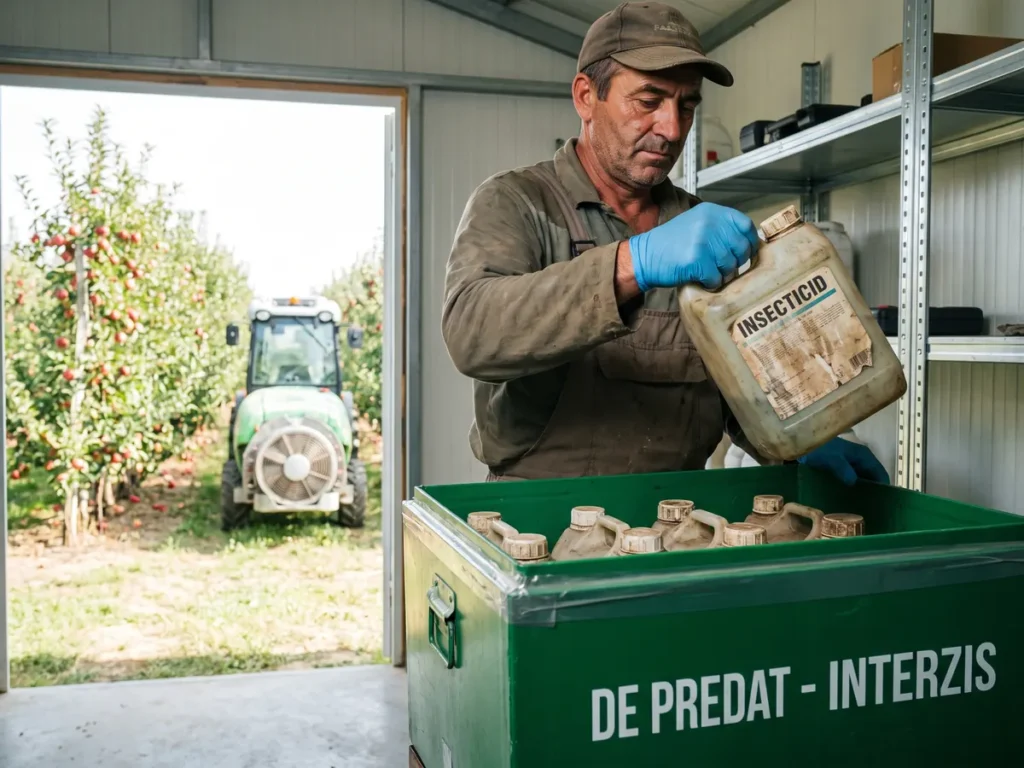
The second effect concerns holders of stockpiles, and it is immediate. Article 5(1) of Regulation (EU) 2019/1021 says that the holder of a stockpile consisting of or containing a substance listed in Annex I whose use is not permitted shall manage that stockpile as waste. Since the new entry provides for no permitted use, any quantity of chlorpyrifos sitting in a warehouse in Romania became, on 30 September 2026, waste. The annual notification regime in Article 5(2), which starts at stockpiles above 50 kg, does not apply here, because that one concerns only substances whose use remains permitted.
The third effect opens a six-month window and is the easiest to miss, because it appears neither in the delegated regulation nor in its annex. Article 4(2) of the basic regulation provides that, for a substance added to Annex I after 15 July 2019, Article 3 shall not apply for a period of six months where the substance is present in articles produced before or on the date on which the regulation becomes applicable to that substance. Counted from 30 September 2026, the window closes on 30 March 2027, that is after 181 days. Until then, a batch of articles manufactured by 30 September 2026 at the latest may circulate even if it carries traces of chlorpyrifos above 0.01 mg/kg. After that, it may not.
The next effect is permanent and works the other way. The second paragraph of the same Article 4(2) takes out of the prohibition a substance present in articles already in use before the date of application. Furniture already assembled, machinery already installed, clothing already worn do not fall under the prohibition and need not be taken out of service. The Member State that identifies such articles does, however, have an obligation to inform the Commission and the European Chemicals Agency.
The fifth effect is missing, and that is precisely why it must be spelled out. Chlorpyrifos enters Annex I, not Annex IV. Annex IV is the list of substances for which Article 7 imposes the severe regime for waste containing persistent organic pollutants: destruction or irreversible transformation of the pollutant content, a ban on any operation that could lead to recovery, recycling or reuse of the isolated substance, concentration limits written into the annex. Checked in the consolidated text of the regulation as at 30 September 2026, chlorpyrifos appears nowhere in Annex IV. Waste contaminated with it therefore stays under the general waste regime, not under the regime for persistent organic pollutants.
The last effect is one of laboratory method and shows up only alongside another piece of European legislation. The value of 0.01 mg/kg is not chosen at random: it is exactly the limit of quantification that the Union reference laboratories confirmed for chlorpyrifos, and Commission Regulation (EU) 2020/1085 of 23 July 2020 set it as the default value for residues in food. The new contamination threshold therefore sits precisely at the level at which a determination starts to be possible. In practice, any quantifiable trace of chlorpyrifos in a substance, in a mixture or in an article is a breach.
What has changed compared with the previous situation
Until 29 September 2026, chlorpyrifos was a substance banned by use. The two doors closed to it were that of plant protection products, through the refusal to renew the approval in Commission Implementing Regulation (EU) 2020/18, and that of biocidal products, through Regulation (EU) No 528/2012. Alongside them, the maximum residue levels in food had been lowered to 0.01 mg/kg by Commission Regulation (EU) 2020/1085. None of the pieces of this set, however, touched the substance as such: manufacturing for export, presence as an impurity in an industrial mixture or in an imported article were covered by none of the three acts.
From 30 September 2026 the prohibition is on the substance. That changes three concrete things. First, exports: Article 3(1) prohibits manufacturing, so there is no longer any production for markets outside the Union either. Second, imports of articles: the container coming through Constanța falls under the prohibition if it carries more than 0.01 mg/kg, whatever the customs declaration says about use. Third, stockpiles: what until now could sit in a warehouse as unusable goods has become waste by the operation of Article 5(1).
The Union’s position towards the international convention has changed too. The decision of the Conference of the Parties in May 2025 included chlorpyrifos with specific exemptions, that is it left open the possibility of notified uses. The European text enters it on the list with no exemption at all. Measured against the neighbouring entries in Part A of Annex I, the difference can be quantified: the brominated diphenyl ethers, from tetra- to deca-, have a tolerance of 10 mg/kg in substances and of 500 mg/kg taken together in mixtures and articles; hexabromocyclododecane has 100 mg/kg; perfluorooctanoic acid and perfluorohexane sulfonic acid, the most strictly treated until now, have 0.025 mg/kg. Chlorpyrifos has 0.01 mg/kg, which makes it the substance with the lowest contamination tolerance in the whole annex.
What has not changed is the waste regime. Annex IV and Annex V, the ones that govern the destruction of waste containing persistent organic pollutants, are untouched, and could not have been touched by this act: Article 15(1) of the basic regulation empowers the Commission to amend by delegated act only Annexes I, II and III, while paragraph (2) of the same article requires it, for Annexes IV and V, to put forward legislative proposals. That road is longer and runs through Parliament and Council.
Advantages and disadvantages
What it improves
- The prohibition becomes verifiable. A listing without a contamination limit value would have left the control authorities with no threshold to measure against, and any detectable trace would have been open to argument. With 0.01 mg/kg written into the entry, the inspector has a figure and the economic operator has a criterion he can require of the laboratory.
- The threshold is the strictest in the annex. At 0.01 mg/kg, that is one gram in a hundred tonnes, the tolerance is 2.5 times lower than that of the perfluorinated compounds and a thousand times lower than that of the brominated diphenyl ethers. For a neurotoxic substance banned in agriculture precisely on grounds of children’s health, the severity is proportionate to the reason.
- The Union does not use the exemptions the Convention would have allowed it. The international listing was made with specific exemptions; the European text takes up none of them, because the uses concerned were closed off in any event. This is a case where alignment with international law does not lower the European standard.
- The act covers a single substance, so it can actually be read. Article 15(1) requires the Commission to adopt a separate delegated act for each substance. The result is a text of two articles and one entry, which an economic operator can go through in a few minutes, instead of an amending regulation with twenty substances mixed together.
- The value chosen can be measured. The threshold coincides with the limit of quantification confirmed by the Union reference laboratories and used for food since 2020, so it calls for no new methods and produces no results that nobody can reproduce.
What remains a problem
- Waste stays outside the severe regime. The substance enters Annex I but not Annex IV, so Article 7 does not require its irreversible destruction and does not prohibit recycling the material it is in. The stockpile-management obligation in Article 5(1) refers to Article 7 a stockpile for which Article 7 has no entry.
- The six-month window has no start date in the act. Article 4(2) of the basic regulation ties the period to the date on which the regulation becomes applicable to the substance, but the delegated regulation does not name that date and does not mention the period at all. An economic operator learns about the six months only if he opens the basic act, not the act that was published.
- Nothing is said about proving the date of production. The six-month window and the permanent exemption for articles already in use both depend on the moment of manufacture, and the burden of proving it falls on the holder, without the act saying with what document that is done.
- The gap between the international decision and application is one year and five months. From 9 May 2025 to 30 September 2026, 509 days passed in which the substance could circulate in imported articles with no contamination limit whatsoever.
- A threshold at the limit of quantification moves the argument into the laboratory. When the limit value coincides with the level at which a method starts to produce results, measurement uncertainty itself becomes a matter for dispute, and the act does not say how a result sitting exactly on the threshold is to be treated.
Practical advice
- Check first whether you hold any stock, however old. A drum of insecticide left in a warehouse, a quantity of technical substance kept for calibration, or an industrial mixture in which chlorpyrifos was an input became waste on 30 September 2026, by the operation of Article 5(1) of Regulation (EU) 2019/1021. It can no longer be sold, no longer used and no longer kept indefinitely as goods.
- Date your batches before 30 March 2027. Articles produced up to and including 30 September 2026 have a six-month window, but the benefit of it depends on being able to prove the date of manufacture. The production record, the delivery note, the supplier’s declaration and the batch analysis report are the only useful evidence, and they are gathered beforehand, not at the inspection.
- Ask the laboratory for a limit of quantification of no more than 0.01 mg/kg, written into the quotation. An analysis certificate reporting „below the limit of quantification” without saying what that limit is proves nothing against the new threshold. The threshold sits exactly at the limit of quantification confirmed by the Union reference laboratories, so a less sensitive method cannot support a claim of compliance.
- Ask your non-EU supplier in writing about chlorpyrifos, not about pesticides in general. Generic declarations about the absence of banned substances do not cover an entry added on 30 September 2026. Ask for the name of the substance, CAS number 2921-88-2 and the value against which the determination was made.
- Do not take out of service articles already installed or in use. The second paragraph of Article 4(2) exempts them permanently from the prohibition. The confusion costs money without buying any compliance.
- Do not rely on the exemptions in the international convention. The Conference of the Parties included the substance with specific exemptions, but the European text took up none of them. An international negotiation that permits something does not mean Union law permits it too.
- Check whether you also have reporting obligations under other lists. Chlorpyrifos remains regulated as a residue in food too, through the 0.01 mg/kg limit in Regulation (EU) 2020/1085, and as a refused active substance, through Implementing Regulation (EU) 2020/18. An operator in the food industry therefore has two thresholds to observe, with the same figure and different legal bases.
Frequently asked questions
Why is the act published on 10 September but applies only from 30?
Was chlorpyrifos not already banned in the Union?
What does 0.01 mg/kg mean in concrete terms?
If a batch of imported articles exceeds the threshold, what happens?
What do I do with a stock of insecticide left over from before 2020?
Do I have to notify the stock to the authorities?
Who applies the penalties in Romania?
Does waste containing chlorpyrifos have to be destroyed by incineration?
Editorial analysis
The act solves a real problem and solves it cleanly. Until 29 September 2026, chlorpyrifos was a substance banned by use and free as goods: it could not be sprayed on a tomato crop in the Union, but it could be manufactured here for export, it could go into an industrial mixture as an impurity and it could arrive in any imported article, with no contamination limit at all. The two articles and the one-line entry close all those routes in a single move, and the fact that the text runs to a few thousand characters does not make it small: the list in Annex I is one of the few places in European chemicals law where the prohibition attaches to the substance rather than to its use.
The best figure in the act is not written in the act. From 30 September 2026, the figure of 0.01 mg/kg becomes the strictest contamination tolerance in the whole of Annex I. The comparison can be made entry by entry in the consolidated text: the brominated diphenyl ethers have 10 mg/kg in substances and 500 mg/kg taken together in mixtures and articles, hexabromocyclododecane has 100 mg/kg, and perfluorooctanoic acid and perfluorohexane sulfonic acid, the most severely treated until now, have 0.025 mg/kg. Chlorpyrifos brings the threshold 2.5 times below the latter and a thousand times below the former. For a neurotoxic substance taken out of agriculture precisely on grounds of children’s health, the severity is explicable. It is worth saying, though, that this severity is measured at the very limit of quantification of the methods: the figure coincides with the value the Union reference laboratories confirmed in 2020 for food, through Regulation (EU) 2020/1085. The legislator therefore chose the only value that could be both verifiable and close to zero, and the practical consequence is that any quantifiable trace becomes a breach.
The weak part of the construction is not in the published text but in what it leaves behind. Article 5(1) of the basic regulation turns into waste, from 30 September 2026, any stockpile of chlorpyrifos in the Union, and refers its management to Article 7. Only that Article 7 ties all its obligations to Annex IV: destruction or irreversible transformation, the ban on recovery and on recycling the isolated substance, the concentration limits. Chlorpyrifos is not in Annex IV, checked in the consolidated text of the regulation as at the date this amendment enters into force. The result is a reference that finds nothing at its destination: the stockpile must be managed „in accordance with Article 7”, and Article 7 has nothing to impose on it. For someone holding a tonne of technical substance, the difference between the two possible readings, incineration with irreversible destruction or treatment as ordinary hazardous waste, is the difference between two invoices.
The Commission could not have repaired that with the present act, and that is exactly where the observation that matters lies. Article 15(1) gives it power to amend by delegated act only Annexes I, II and III. For Annexes IV and V, paragraph (2) of the same article requires it to put forward legislative proposals, that is to go through the European Parliament and the Council. Hence an asymmetry of speed: the market prohibition settles into place in 509 days from the decision of the Conference of the Parties, through a delegated act of two articles, while the waste regime for the same substance waits for a legislative procedure that has not even been announced. The Stockholm Convention requires the Parties, in Article 6, to take measures on waste as well, not only on production and use. That half of the international obligation remains, for chlorpyrifos, uncovered.
The last observation concerns how accessible the text is to the person who has to comply with it. An importer who opens the Official Journal of the European Union on 10 September 2026 reads an act from which he cannot learn that he has a six-month window for articles already produced, nor that articles already in use are permanently exempt, nor that his stock has become waste. All three sit in Articles 4 and 5 of the basic regulation, and the new act mentions none of them. For a substance listing, where the addressees are thousands of economic operators with no legal department, a four-line recital recalling these three consequences would be worth more than the whole annex.
What should be changed
- Chlorpyrifos should enter Annex IV as well, through a legislative proposal announced together with the listing. As long as the substance is in Annex I and absent from Annex IV, Article 5(1) refers stockpiles to an Article 7 that does not cover them, and contaminated waste can be recycled lawfully, including into new materials. A concentration limit in Annex IV would close the loop and turn the market prohibition into effective removal from the materials cycle.
- The new entry should say when the six months in Article 4(2) start to run. The basic text ties the period to „the date on which this Regulation becomes applicable to that substance”, and that date is written nowhere in the act that produces it. One sentence in the specifications column, with the date of 30 March 2027, would spare thousands of economic operators an exercise in interpretation and would make the deadline enforceable beyond argument.
- The act should say with what the date of production of an article is proved. The six-month window and the permanent exemption for articles already in use both depend on a moment that nobody certifies. A reference to a specific document, the supplier’s declaration or the batch record, would move the argument out of the inspector’s judgement and into written evidence.
- The recitals should recall the stockpile-management obligation. A single sentence saying that, from the date of application, stockpiles of chlorpyrifos are to be managed as waste under Article 5(1) would reach the holders through the act they do read, rather than through the one they do not open.
- The treatment of a result sitting exactly on the threshold should be made explicit. Where the limit value coincides with the limit of quantification, measurement uncertainty ceases to be a laboratory detail and becomes the margin within which it is decided whether goods may be sold. A rounding rule, or a reference to the expanded uncertainty of the method, as in other maximum-limit regimes, would cut disputes short before they begin.
Original text of the legal act
The text below is reproduced in Romanian, the official form of publication.
The full text, as published in the Official Gazette of Romania
Official Journal of the European Union, L series, 2026/1423 of 10 September 2026 3 pages PDF, 459 KB
Open the official PDFDownload the PDF
The viewer is not shown on small screens. Use the buttons above to open or download the file.
This article is for informational purposes only and does not constitute legal advice. For specific situations, consult a licensed attorney or tax advisor.