
In brief
- What changes is the measuring method, not the limit. Table 4 in Annex III to the Euro 7 regulation referred to UN Global Technical Regulation No 24 for testing brake particle emissions on light-duty vehicles. From 23 September 2026 it refers to UN Regulation No 179. The values stay as they are in Annex I: 3 milligrams of PM10 particles per kilometre for battery electric vehicles and 7 milligrams for the other propulsion technologies, until 31 December 2029.
- The difference between the two UN texts lies in their legal regime, not in their technical content. A global technical regulation belongs to the 1998 Agreement and harmonises only the content of the test, without approvals travelling anywhere. UN Regulation No 179 is annexed to the 1958 Agreement, under which an approval granted by one Contracting Party is recognised by the others. Romania is a Contracting Party, and the authority it has notified is the Romanian Automotive Register.
- For the car buyer nothing changes on 23 September 2026. The requirement on brake particles starts to apply to new types of passenger cars and light commercial vehicles only on 29 November 2026, and to all new cars on 29 November 2027. The present act arrives 67 days ahead of the first of those deadlines.
Published: Official Journal of the European Union, L series, 2026/1214 of 3 September 2026
In force from: 23 September 2026, on the twentieth day following publication, as Article 2 of the regulation provides
The dust thrown off by brake pads and discs passes through no exhaust filter and does not fall when the engine stops. It belongs to the same family of fine particles for which Romania is already missing two clean air targets, and the Euro 7 regulation was the first European act to put a number on it. From 23 September 2026, the way that dust is measured in the laboratory changes.
The European Commission adopted Delegated Regulation (EU) 2026/1214 on 9 June 2026 and published it on 3 September 2026. The act has a single substantive article: Annex III to Regulation (EU) 2024/1257, that is the Euro 7 regulation, is amended in accordance with the annex to the new text. And that annex replaces a single table, Table 4, the one setting out the conditions under which compliance with the brake particle emission limits is tested. Until now, the box for passenger cars and light commercial vehicles, categories M1 and N1, required testing in accordance with UN Global Technical Regulation No 24. From now on it requires testing in accordance with UN Regulation No 179, published in the Official Journal of the European Union, L series, 2026/1044 of 18 May 2026.
The legal basis is Article 15(1)(e) of the Euro 7 regulation, which allows the Commission to amend by delegated act Tables 4 and 5 in Annex III, that is the very test conditions for brakes and for tyres, on the basis of the data gathered from Euro 7 testing. The Commission could not change the limit values by the same route, because those sit in Annex I and have a basis of their own, in Article 15(2)(a). The present act keeps strictly within the limits of the delegation: it changes the test method and leaves the limit untouched.
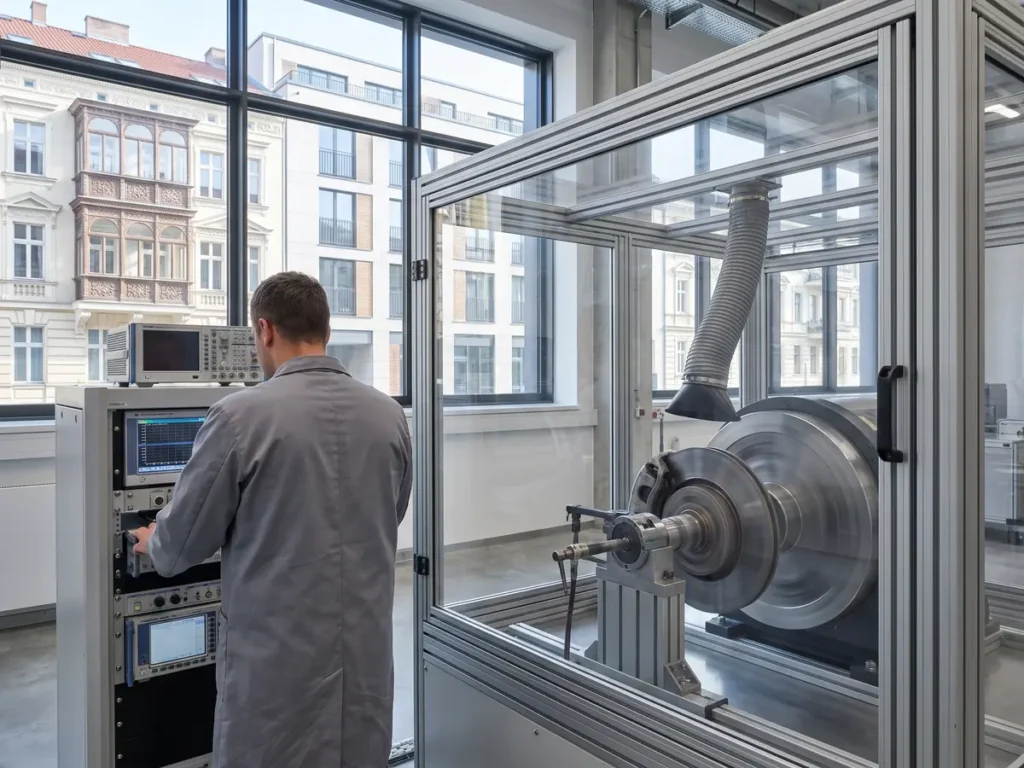
What the new method requires is set out in UN Regulation No 179. The brake is mounted on a dynamometer and runs the WLTP brake cycle, which has ten phases, 15,826 seconds of active speed control, 303 brake applications and an equivalent distance of 192 kilometres, at an average speed of 43.7 kilometres per hour and a maximum of 132.5. The cycle is repeated five times for bedding-in and three more times for measurement, so a complete test means around 1,536 equivalent kilometres and over 35 hours of active speed control, cooling breaks between phases not included. Of the 2,424 brake applications, only the 909 in the last three cycles produce the figure compared with the limit.
What it changes in practice
The first effect is on the type-approval file. A manufacturer seeking type-approval for a new type of passenger car or light commercial vehicle must submit, among the other test reports, one on brake particle emissions. From 23 September 2026, that report is drawn up in accordance with UN Regulation No 179. A report produced under UN Global Technical Regulation No 24 no longer matches Table 4, however similar the two procedures may be.
The second effect is hard to see and weighs the most. A global technical regulation, in the system of the United Nations Economic Commission for Europe, is a text of content: it describes the test, but it creates no approvals and obliges no country to recognise anybody else’s. A UN regulation annexed to the 1958 Agreement does both. Regulation No 179 has an approval mark, a communication form between authorities, and rules on extension, on withdrawal and on conformity of production. Moving from one to the other means that brake testing enters the circuit of mutual recognition between the Contracting Parties, instead of remaining an internal requirement of the Union.
For Romania, this touches one institution directly. The Romanian Automotive Register is the approval authority notified by the Romanian State both to the European Commission, under Regulation (EU) 2018/858, and to the United Nations Economic Commission for Europe, under the 1958 Agreement. An approval for brake emissions granted in Bucharest may therefore be accepted by the other Contracting Parties, and one granted in another Contracting Party is accepted here. The test itself need not be carried out by the authority: it is run by a designated technical service that has the brake dynamometer and the measuring equipment the regulation requires, and the authority assesses the report.
The third effect concerns what is actually measured. The new procedure does not stop at the mass of particles below 10 micrometres, as the earlier method did. It also measures the fraction below 2.5 micrometres, and the particle number, and it has provisions for systems that capture the dust at source, that is for brakes with a filter. European law does not yet use all these figures: Annex I to Euro 7 has a single active limit value, the one for PM10, and the boxes for particle number stay empty until 1 January 2030.
The fourth effect is one of timing, and it explains why nobody needs to rush. The brake particle requirement is part of Euro 7, and Article 21 of Euro 7 says that the regulation applies from 29 November 2026 to new types of vehicles in categories M1 and N1 and from 29 November 2027 to new vehicles in the same categories. Between 23 September and 29 November 2026 there are 67 days. In that interval, Table 4 is in force but has nobody yet to bind.
What has changed compared with the previous situation
In the form published on 8 May 2024, Table 4 in Annex III had two columns, one for vehicles in categories M1 and N1, the other for those in categories M2, M3, N2 and N3. The first column read, on a single line: „Testing in accordance with UN Global Technical Regulation No 24 on brake particle emissions”. The second column was empty. The reference had no footnote, unlike Tables 1, 2, 3 and 5 in the same annex, where every UN regulation cited was given one.
In the form applying from 23 September 2026, the first column requires „Testing in accordance with UN Regulation No 179 on the laboratory measurement of brake emissions for light-duty vehicles”, with a footnote giving the full title, the publication number in the Official Journal of the European Union and the European Legislation Identifier. The second column has stayed empty.
That emptiness is not an oversight. In Annex I to Euro 7, the only active limit value for brake particles sits in Table 4 and concerns only vehicles in categories M1 and N1, excluding those in category N1 class III, that is the heaviest of the light commercial vehicles. Tables 6 and 7, those for buses and lorries, have their boxes unfilled and apply only from 1 January 2030, after the review the Commission has to prepare by 31 December 2027. As long as there is no limit for heavy-duty vehicles, there is no point in any test condition for them.
What a person can read about the test has changed too. The new footnote points to the full text of UN Regulation No 179, which can also be opened in Romanian, because the Romanian version of the Official Journal of the European Union is itself official. Until now, anyone wanting to find out what Table 4 required ended up at a working document of the United Nations Economic Commission for Europe, in English, on the organisation’s website.
What has not changed deserves saying just as firmly. The limit values are the same: 3 milligrams per kilometre for battery electric vehicles and 7 milligrams per kilometre for vehicles with an internal combustion engine, for hybrids and for fuel cell vehicles. The deadlines are the same. The categories covered are the same. And it remains the case that, from 1 January 2035, Table 8 in Annex I requires 3 milligrams per kilometre from every propulsion technology, not only from the electric ones.
Advantages and disadvantages
What it improves
- Moving to a UN regulation annexed to the 1958 Agreement brings brake testing into the circuit of mutual recognition of approvals, so a report drawn up once can be used in every Contracting Party, not only in the Union.
- The text of the test is now available in Romanian, in the Official Journal of the European Union, instead of sitting in a UN working document written in English.
- The reference has been given a footnote with the publication number and the European Legislation Identifier, so it can be opened in a single click. The previous form had nothing of the kind.
- The method now also measures the PM2.5 fraction and the particle number, and the data are gathered before the law asks for them, which makes the 2027 review easier to argue.
- The act arrives 67 days before the requirement becomes applicable to new types of vehicles, so no file submitted so far has to be redone.
What remains a problem
- In the Official Journal of the European Union, UN Regulation No 179 is printed with the note „Date of entry into force: XX September 2026 (to be confirmed)”. A binding European text therefore points to an act whose own date is still a blank space.
- Euro 7 has no official consolidated version, so anyone wanting Table 4 as it stands today has to read the 2024 regulation and, separately, the 2026 act.
- The new footnote in Table 4 carries the mark (*1), which in the same Annex III is already used for UN Regulation No 154, under Table 1.
- Heavy-duty vehicles are left with no test condition for brakes at all, because they have no limit value either. The dust from a bus’s brakes is no less dust.
- UN Regulation No 179 measures three quantities, but European law limits only one, and the boxes for particle number stay empty until 2030 at the earliest.
Practical advice
- If you are preparing a type-approval file for a new type of vehicle in category M1 or N1, ask the technical service for a report drawn up under UN Regulation No 179, not under UN Global Technical Regulation No 24. From 23 September 2026, Table 4 in Annex III to Euro 7 no longer accepts the second option.
- Book your slot on the brake dynamometer well in advance. A complete test means eight WLTP brake cycles, over 35 hours of active speed control and as many again of cooling breaks, and the laboratories with the required equipment are few in Europe.
- Check exactly which category the vehicle falls into. The brake particle limit does not apply to vehicles in category N1 class III, and for those in category N2 with a mass between 3.5 and 5 tonnes derived from an N1 type, approval may be sought, at the manufacturer’s request, under UN Regulation No 179 as well.
- If you import used vehicles, you have nothing to do. Euro 7 concerns new types and new vehicles, and the present act does not touch the individual approval of a vehicle already registered in another country.
- Before relying on an approval obtained in another Contracting Party to the 1958 Agreement, check in the UN status document, TRANS/WP.29/343, whether that State applies Regulation No 179. Mutual recognition works only between the Parties that have acceded to that particular regulation.
- If you make or sell replacement brake pads and discs, follow the 2027 review. The report the Commission has to present by 31 December 2027 prepares the 2030 values, and that is where the particle number appears for the first time, alongside their mass.
- Change nothing in the maintenance schedule of the car you drive. The act concerns the laboratory test that precedes approval, not the periodic technical inspection and not the condition of the brakes of a vehicle in use.
Frequently asked questions
Will my car pollute less from 23 September 2026?
How much brake dust is a new car allowed to produce?
Why do electric vehicles have a stricter limit?
Who approves vehicles in Romania?
What is the difference between a global technical regulation and a UN regulation?
Does anything change for buses and lorries?
Why did it take almost three months from adoption to publication?
Can I challenge the brake particle limit if I make replacement parts?
Editorial analysis
The act is short, keeps within the limits of the delegation and does something necessary: it brings into European law the newest method of measuring brake dust, in a form that can be read in Romanian and that carries a stable identifier. The problem is not in the act, but in what the reader finds at the end of the reference. UN Regulation No 179, published in the Official Journal of the European Union on 18 May 2026, carries at its head the note „Date of entry into force: XX September 2026 (to be confirmed)”. A European act binding in its entirety therefore points to a text whose own date of entry into force is printed as a blank space. Formally, that note is not a rule: the Journal warns in the same place that only the original texts of the United Nations Economic Commission for Europe have legal effect and that the position is to be checked in document TRANS/WP.29/343. In practice, a manufacturer preparing for approval has no official European publication from which to learn the date.
What keeps things in balance is a figure the act nowhere states: 67. That is the number of days between 23 September 2026, when the new Table 4 enters into force, and 29 November 2026, when Article 21 of Euro 7 starts actually to require compliance with the limits for new types of vehicles in categories M1 and N1. In those 67 days the table is in force without binding anyone, and if UN Regulation No 179 does enter into force in September 2026, the gap closes by itself. This margin does not come from a choice explained in the recitals; it falls out of the Euro 7 calendar, adopted two years earlier. A delegated act published two months later would have arrived after the requirement had become applicable.
The second observation emerges from laying the two annexes over each other, not from reading the act. The new procedure measures three things: the mass of particles below 10 micrometres, the mass of those below 2.5 micrometres and the particle number. Annex I to Euro 7 limits a single one, PM10, and only until 31 December 2029. The boxes for particle number in Tables 5, 6, 7 and 8 are empty, and filling them hangs on the report the Commission has to present by 31 December 2027. In other words, from 23 September 2026 laboratories will produce, for every vehicle type, figures that the law requires to be measured and compares with nothing. That is no waste: it is precisely from these data that the review will be built. But it deserves saying plainly, because a manufacturer reading only Table 4 might think a new compliance obligation had appeared, when all that has appeared is an obligation to measure.
The third observation is smaller and concerns drafting. The footnote the act adds under Table 4 is marked (*1). In the same Annex III, the mark (*1) is already used, under Table 1, for UN Regulation No 154. Since each footnote sits attached to its own table, no reader can arrive at two meanings, so this is not an error with legal consequences. It is, though, the kind of detail that multiplies: Annex III has been amended once, it will be amended again for Table 5, on tyres, and every delegated act that replaces a table will bring its own footnotes numbered from one.
That leaves the Romanian side, and here it is fair to say it is thin. From 23 September 2026, the Romanian Automotive Register becomes an authority that can grant an internationally recognised approval for brake emissions, which was not possible before, because a global technical regulation produces no approvals. What is missing is the other half: a technical service with a brake dynamometer and the measuring equipment required by UN Regulation No 179. Legal competence without the equipment means that the files will still be put together in laboratories in Germany, in Italy or in Spain, and that the authority in Bucharest will assess reports rather than produce data. For the ordinary car buyer, the effect of the act on 23 September 2026 is zero, and any other claim would be an overstatement.
What should be changed
- The date of entry into force of UN Regulation No 179 should be printed, not left as „XX September 2026 (to be confirmed)”. The Publications Office could republish the text with the date confirmed, or could publish a corrigendum, and a manufacturer preparing an approval would learn from the Official Journal of the European Union, rather than from a UN status document, since when the regulation to which European law refers has existed.
- Every delegated act that replaces a table in an annex should continue the annex’s footnote numbering instead of starting again at (*1). The practical effect is that in an annex with five tables no two footnotes carry the same mark any longer, and references can be cited without ambiguity.
- The Commission should publish a consolidated version of the Euro 7 regulation at every amendment of an annex. Today, anyone wanting Table 4 as it stands has to read two acts published two years apart and make the substitution themselves, and the number of amendments will grow as the empty boxes in Annex I are filled.
- Table 4 should itself say that the test also applies to vehicles designated „Euro 7ext”. Recital (3) of the act says so, and UN Regulation No 179 brings them within its scope at the manufacturer’s request, but the columns of the table are written by vehicle category, and a Euro 7ext vehicle is, as a matter of classification, an N2. The explanation now sits in a recital and in an article of another act, not in the rule the manufacturer reads.
- The Romanian Automotive Register should announce publicly whether and when it will designate a technical service for brake emission testing. Without such an announcement, manufacturers and importers working with the authority in Bucharest have no way of knowing whether they can plan the test in Romania or have to contract it elsewhere, and the difference is measured in months of waiting and in the cost of transporting a test vehicle.
- The 2027 review should make explicit use of the PM2.5 and particle number data gathered in this period. They will be measured anyway, at every approval, from 2026 on. If the Commission’s report of 31 December 2027 rests on them, the empty boxes in Tables 5, 6, 7 and 8 will be filled with values verified on real vehicles, not with estimates.
Original text of the legal act
The text below is reproduced in Romanian, the official form of publication.
The full text, as published in the Official Gazette of Romania
Official Journal of the European Union, L series, 2026/1214 of 3 September 2026 3 pages PDF, 455 KB
Open the official PDFDownload the PDF
The viewer is not shown on small screens. Use the buttons above to open or download the file.
This article is for informational purposes only and does not constitute legal advice. For specific situations, consult a licensed attorney or tax advisor.