
In brief
- The Constitutional Court dismissed the challenge brought against the provision that penalises driving on the opposite carriageway with a 60-day suspension of the driving licence. The rule stays exactly as it was.
- The driver who raised the plea argued that the law does not say clearly whether an accidental move onto the opposite carriageway, made in order to avoid a collision, still amounts to an administrative offence. The Court replied that this is a matter of fact, weighed by the trial court, not a drafting failure on the part of the legislature.
- Those concerned are all drivers of motor vehicles, agricultural or forestry tractors and trams penalised for moving onto the opposite carriageway, as well as those who challenge such an offence report in court.
Published: Official Gazette of Romania (Monitorul Oficial) no. 690 of 20 August 2026
Delivered: 9 December 2025
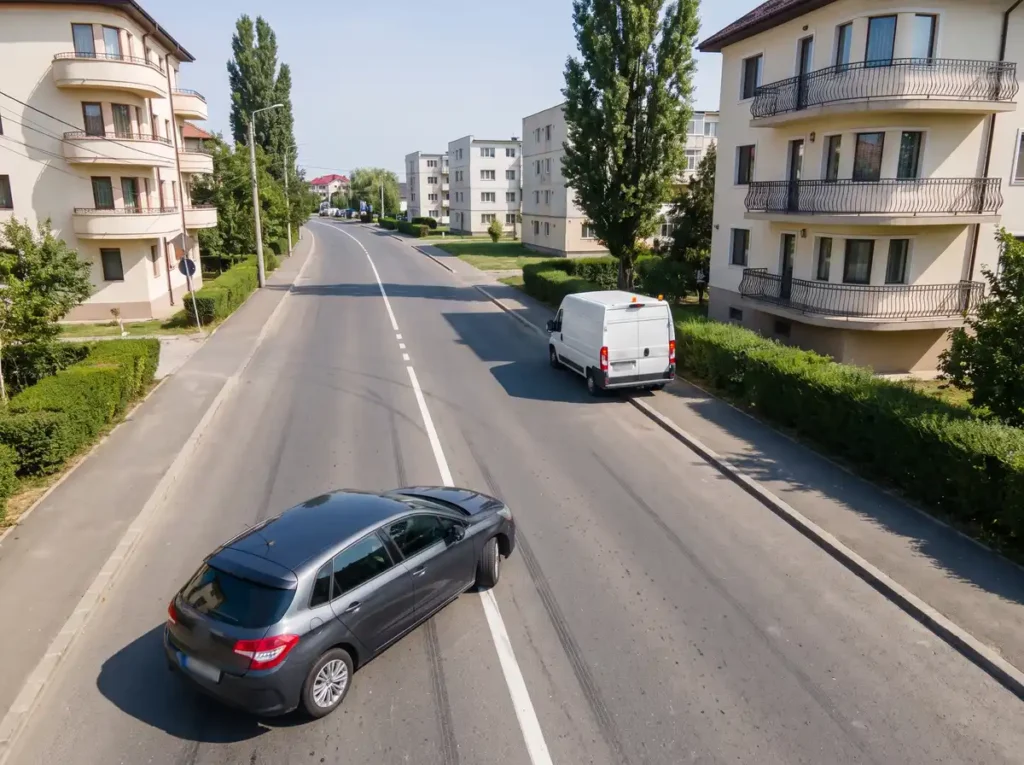
You swerved onto the opposite carriageway so as not to hit a car parked where it should not have been, and the police officer took your licence for 60 days. The Constitutional Court has just said that the law is not at fault, and that relief, if there is any, comes from the judge. Decision no. 719 of 9 December 2025, published in Official Gazette of Romania no. 690 of 20 August 2026, dismisses as unfounded the plea of unconstitutionality raised against art. 101 para. (3) letter d) of Government Emergency Ordinance no. 195/2002 on road traffic. It is the second time in a matter of days that the Court refuses to soften the regime of licence suspensions, after it held that not even the 90 days for exceeding the speed limit by more than 50 km/h can be shortened by a judge.
The provision at issue is short and familiar to anyone who has ever leafed through the road traffic rules. It is an administrative offence, penalised by suspension of the right to drive for 60 days, for the driver of a motor vehicle, agricultural or forestry tractor or tram to travel on the opposite carriageway, except where an overtaking manoeuvre is carried out in accordance with the rules.
The case started in Iași. A driver penalised with a 60-day suspension challenged the offence report and, before the Iași County Court, raised the plea of unconstitutionality. His argument concerned the quality of the law, a requirement derived from art. 1 para. (5) of the Constitution: the wording was said to be ambiguous, because it does not allow a clear distinction as to whether an accidental or involuntary entry onto the opposite carriageway, made in order to avoid a possible collision, falls within the notion of driving on the opposite carriageway. The referring court considered the plea unfounded, the Government took the same view, and the representative of the Public Ministry asked for it to be dismissed as inadmissible. By unanimous vote, the Court dismissed it as unfounded.
In the same line of decisions on traffic offences, the Court has also fixed the reference point for the blood alcohol level of a driver charged under Article 336 of the Criminal Code: the test relates to the hour of driving, not the hour of sampling, according to CCR Decision no. 136/2026.
What it changes in practice
The first effect is that the penalty stands, untouched. The 60-day suspension for driving on the opposite carriageway continues to apply, and the traffic officer who finds the offence does not have to carry out, at the roadside, an analysis of the driver’s intention. The finding remains an objective one: the vehicle travelled on the opposite carriageway without being engaged in a lawful overtaking manoeuvre.
The second effect concerns the place where the discussion about circumstances is held. The Court says explicitly that the concrete situations in which entry onto the opposite carriageway is caused by an accidental or involuntary manoeuvre, such as avoiding an imminent danger, are matters of fact, specific to each case, whose analysis and legal classification fall exclusively to the trial court. In other words, the defence „I did it to avoid the crash” does not disappear, but it is not argued against the text of the law, it is argued before the judge who decides the appeal against the offence report.
The third effect is one of case law. The decision reinforces a line already drawn: by Decision no. 666 of 15 December 2022, the Court had examined the notion of manoeuvre in the same article and had held that it places on the driver the obligation to carry out manoeuvres safely and in compliance with the legal speed. Anyone who raises the same criticisms in a future plea will find two decisions standing in the way, not one.
The fourth effect is the formal one: the decision is final and generally binding from the date of its publication in the Official Gazette of Romania, that is from 20 August 2026, and is communicated to the Iași County Court, which will resume the hearing of the case in which the plea was raised. Another driver’s challenge to the traffic rules ended the same way in September 2026: the Court upheld the measuring of blood alcohol under rules laid down outside a statute.
What has changed compared with the previous situation
In the letter of the law, nothing has changed. Art. 101 para. (3) letter d) of Government Emergency Ordinance no. 195/2002 has today exactly the wording it had before the decision, and the additional penalty has remained 60 days. This is a decision dismissing the plea, not one by which a provision is removed from the statute book.
Something has changed, however, in the way the defence can be run. Until now, a driver who had moved onto the opposite carriageway in order to avoid an impact could try two routes: to attack the text of the law as unclear, or to persuade the court that his conduct does not meet the elements of the administrative offence. The first route is now closed. The Court held that the rule is sufficiently clear and foreseeable for those to whom it is addressed to understand what conduct is prohibited and what legal consequences follow from it.
The second route remains, and the decision confirms it more emphatically than earlier case law did. The wording in paragraph 16, according to which the analysis and legal classification of such circumstances fall exclusively to the trial court called upon to assess whether or not the conduct constitutes an administrative offence, is an argument a lawyer can quote directly in the appeal against the offence report.
Advantages and disadvantages
What it improves
- It confirms, with an express reference to a paragraph of the decision, that the court has the power to assess whether an accidental entry onto the opposite carriageway constitutes an administrative offence or not.
- It preserves a firm road safety rule that is easy to establish, in a situation that frequently produces head-on collisions, the most serious of all.
- It brings foreseeability: drivers and courts know that the provision will not be changed by constitutional means and that the discussion is about the facts.
- It consolidates a standard of legislative drafting that is useful well beyond road traffic law: a law does not become unconstitutional because it fails to list every possible factual situation.
What remains a problem
- The suspension operates from the moment the licence is taken, that is before the judge has any chance to examine the circumstances. The driver who was in the right is still left without a licence for the duration of the proceedings.
- The outcome now depends entirely on the strength of the evidence. Without witnesses, without a dashcam and without a sketch of the scene, the claim that the manoeuvre was involuntary cannot be verified.
- The law still does not distinguish between the driver who overtakes across a solid line out of impatience and the one who pulls the wheel to avoid an obstacle that appears suddenly. The difference between the two remains a matter of proof, not of the text.
- Proceedings of this kind take time, and the decision brings no mechanism by which the licence could be returned provisionally until the case is decided.
Practical advice
- If you ended up on the opposite carriageway in order to avoid an obstacle, gather the evidence immediately, not a week later. Photograph the position of the vehicles, the obstacle and the road markings, take the witnesses’ details and save the dashcam recording before it is overwritten.
- Write your objections in the offence report itself, in the box provided for them. An offence report signed without any mention of the reason for the manoeuvre makes the later defence considerably harder.
- Observe the 15-day time limit, running from the handing over or service of the offence report, for lodging the appeal against it. The time limit runs whether or not you have a lawyer.
- Build the appeal on the facts, not on unconstitutionality. After this decision, a plea repeating the same criticisms will be dismissed as inadmissible, because the question has already been settled.
- Check whether your situation was not, in fact, a lawful overtaking manoeuvre, the only exception expressly provided by the provision. If the manoeuvre complied with the conditions in art. 45 of the ordinance, the conduct does not even fall within the penalised scenario.
- Do not confuse the 60-day suspension with the 90-day one. The durations are laid down by different provisions, for different conduct, and getting it wrong in the appeal weakens your defence.
Frequently asked questions
Can I still lose my licence if I moved onto the opposite carriageway to avoid a crash?
What exactly did the Constitutional Court decide?
Why did the Court say the law is clear enough?
Where, then, are the circumstances in which I ended up on the opposite carriageway discussed?
When does the decision take effect?
Does overtaking across a solid line fall under the same provision?
Original text of the legal act
The text below is reproduced in Romanian, the official form of publication.
The full text, as published in the Official Gazette of Romania
Official Gazette of Romania no. 690 of 20 August 2026 16 pages PDF, 119 KB the act starts on page 2
Open the official PDFDownload the PDF
The viewer is not shown on small screens. Use the buttons above to open or download the file.
This article is for informational purposes only and does not constitute legal advice. For specific situations, consult a licensed attorney or tax advisor.