
In brief
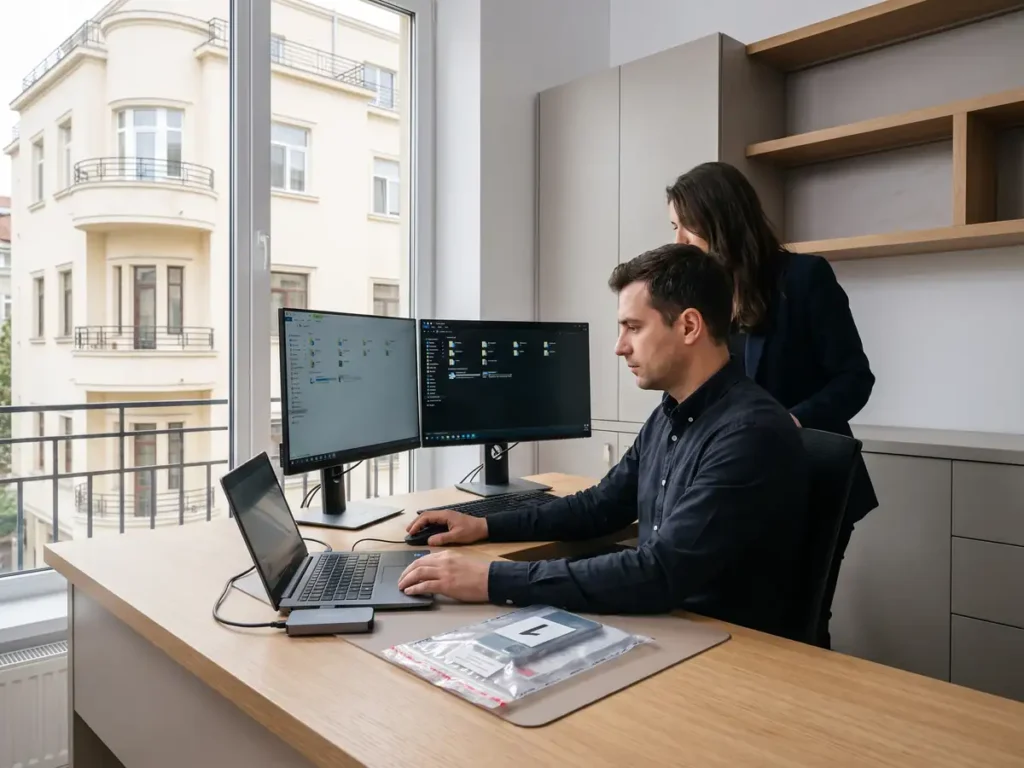
- The Constitutional Court has confirmed that a computer search may also be carried out by a specialist from outside the judicial bodies, as long as that specialist works in the presence of the prosecutor or of the criminal investigation body.
- The second complaint, concerning the reclassification of the offence, was dismissed on the ground that this operation goes to the merits of the accusation, so it can be done only at the trial stage, not in the preliminary chamber.
- Both provisions remain unchanged. Those affected are defendants in cases built on digital evidence, their lawyers and the specialists who assist the prosecuting authorities.
Published: Official Gazette of Romania (Monitorul Oficial) no. 586 of 17 July 2026
Delivered: 4 December 2025
Who is allowed to go through the computer seized by the prosecutor came back before the Constitutional Court, and the answer is the same as before: a specialist from outside the judicial bodies may do it too, provided the prosecutor is watching. Decision no. 679 of 4 December 2025, published in Official Gazette of Romania no. 586 of 17 July 2026, dismisses as unfounded the objection raised in a criminal case pending in the preliminary chamber at the Bucharest Tribunal. The Court keeps to the line drawn in its earlier rulings on the taking of evidence, the same line it relied on when it upheld the protection of a threatened witness through a pseudonym.
Two provisions were challenged in the same case. The first is Article 168 paragraph (12) of the Code of Criminal Procedure, which states that the search of a computer system or of a data storage medium is carried out by a specialist working within the judicial bodies or outside them, in the presence of the prosecutor or of the criminal investigation body. The second is the phrase „during the trial” in Article 386 paragraph (1), in the wording that preceded Law No 201/2023, the provision governing the reclassification of the offence.
The author of the objection argued that using specialists from outside the prosecuting authorities means evidence ends up being taken by persons who do not appear on the list in Article 55 paragraph (1) of the Code of Criminal Procedure, namely the prosecutor, the criminal investigation bodies of the judicial police and the special criminal investigation bodies.
What it changes in practice
The first effect is that the provision on computer searches stays in force, in its current wording. The Court refers to Decision no. 455 of 16 October 2025, in which it had examined the same issue from a similar angle, and adopts those grounds in full.
The second effect concerns the meaning of the word „specialist”. The Court notes that the same phrase, „a specialist working within the judicial bodies or outside them”, also appears in Article 172 paragraph (10), which deals with expert findings. The rules of legislative drafting say that the same notions are expressed through the same terms, and a term used in different articles of the same law cannot carry different meanings unless the legislator expressly provides otherwise. Consequently, what the Court had held about specialists who draw up expert findings applies equally to those who carry out computer searches.
The third effect concerns supervision. A computer search is never carried out on its own: the provision requires the presence of the prosecutor or of the criminal investigation body, and specialists working within the judicial bodies act under the prosecutor’s guidance. The author’s argument that this opens the door to „unidentifiable persons” taking evidence was not accepted.
The fourth effect concerns where such matters are contested. The lawfulness of the taking of evidence and of the acts of criminal prosecution is reviewed in the preliminary chamber, under Article 342 of the Code of Criminal Procedure. That is where absolute or relative nullity can be invoked, along with the exclusion of unlawful evidence, of evidence obtained through torture and of evidence derived from it. What cannot be done in the preliminary chamber is a debate on the merits of the accusation.
The same argument about the limits of evidence came back before the Constitutional Court in March 2026, in a ruling on the use of interceptions from one case in another.
The fifth effect concerns the reclassification of the offence. The Court finds that this operation involves examining the merits of the accusation, because the court accepts or rejects circumstances the indictment says nothing about. That is why it can only be pursued at the first-instance trial stage, not earlier. The information showing that the classification has to change usually surfaces only during the judicial investigation, after the evidence from the prosecution file has been taken afresh or after new evidence has been produced.
The sixth effect is procedural and concerns the defendant directly. When the court raises a new classification, it is obliged to point out that the defendant may ask for the case to be taken later in the list or for the hearing to be adjourned, in order to prepare a defence. If the new classification covers an offence that requires a prior complaint, the court summons the injured person and asks whether they intend to lodge one. Without such a complaint, the criminal proceedings come to an end.
What has changed compared with the previous situation
The first point is that nothing changes in the text itself. Both complaints were dismissed as unfounded, and the challenged provisions remain applicable in the wording they already had.
The second is that a line of case law is being consolidated. The Court cites Decision no. 455 of 16 October 2025 for the computer search, and Decisions no. 253 of 25 April 2017 and no. 616 of 21 November 2023 for the reclassification of the offence. No new elements have emerged that would justify a change of position.
The third concerns the clarity of a term that has been disputed for years. Even though the law does not define the phrase „a specialist working within the judicial bodies or outside them”, the Court considers that its meaning follows from reading it together with the other provisions of the same code, so there is no breach of the requirement of foreseeability laid down in Article 1 paragraph (5) of the Constitution.
The fourth concerns the limits of the preliminary chamber. The decision reinforces the idea that this stage reviews lawfulness, not merits, and that the preliminary chamber judge cannot rule on matters that involve weighing up the accusation.
What does not change is the possibility of challenging the specific way in which a computer search was carried out. The constitutionality of the provision does not extend to the lawfulness of any particular operation, which continues to be argued in the preliminary chamber.
Advantages and disadvantages
What it improves
- It confirms that the specialist does not work alone: a computer search is carried out in the presence of the prosecutor or of the criminal investigation body.
- It settles a single reading of the term „specialist”, valid both for computer searches and for expert findings.
- It leaves the real remedy intact: the lawfulness of a particular search is argued in the preliminary chamber.
- It makes clear to defendants and lawyers that reclassification of the offence has to be sought at the trial stage, not earlier.
- It restates the safeguards that come with reclassification: an adjournment to prepare the defence and, where appropriate, the question put to the injured person.
What remains a problem
- The law still does not define who „the specialist from outside the judicial bodies” is, and the meaning emerges only from reading several provisions together.
- There are no public criteria for selecting, qualifying or holding these outside specialists to account.
- The prosecutor’s presence at a computer search is a formal safeguard, hard to verify afterwards from the case file.
- A defendant who wants a different legal classification has to wait for the trial stage, even though the effects of the classification are felt from the moment of committal for trial.
- Decision no. 455/2025, on which the reasoning rests, had not been published on the date this decision was delivered, which makes verification harder for anyone reading the file at that point.
Practical advice
- If there is a computer search in your case, check the official record to see whether the prosecutor or the criminal investigation body was present during the operation. That presence is required by law, not optional.
- Raise the lawfulness of digital evidence in the preliminary chamber. That is where nullity and exclusion are argued, not at the trial stage.
- Do not confuse the two levels: the constitutionality of Article 168 paragraph (12) is one thing, the lawfulness of the search in your own case is another.
- If you want a different legal classification of the offence, prepare the request for the first-instance trial stage. The Court says explicitly that this is where it belongs.
- When the court raises a new classification, ask for the case to be taken later in the list or for an adjournment. This is a right expressly provided for by Article 386.
- If the new classification concerns an offence prosecuted upon prior complaint, check whether the court has summoned the injured person and put the question to them. Skipping that step matters.
- For your arguments, read Decision no. 455 of 16 October 2025, published in Official Gazette of Romania no. 459 of 29 May 2026, on which the entire reasoning rests.
Frequently asked questions
Who can carry out a computer search?
Can a specialist from outside the institution take evidence?
Where is the way a search was carried out contested?
When can reclassification of the offence be sought?
What rights does the defendant have when the classification changes?
Does the decision change anything in the legal texts?
From when does the decision take effect?
Original text of the legal act
The text below is reproduced in Romanian, the official form of publication.
The full text, as published in the Official Gazette of Romania
Official Gazette of Romania no. 586 of 17 July 2026 16 pages PDF, 113 KB the act starts on page 2
Open the official PDFDownload the PDF
The viewer is not shown on small screens. Use the buttons above to open or download the file.
This article is for informational purposes only and does not constitute legal advice. For specific situations, consult a licensed attorney or tax advisor.