
In brief
- The High Court of Cassation and Justice has held, with binding effect on all courts, that a clinic, a private hospital or a medical practice owed no building tax on the rooms where consultations and treatments take place, throughout the period when the Tax Code was in the form given to it by Government Emergency Ordinance No 168/2022.
- The exception written into the law, the one covering „rooms used for economic activities”, refers to a pharmacy, a canteen, a restaurant or a shop, in other words to something other than the medical act itself. The medical service does not take the building out of the exemption, even where it is paid for by the patient or by the health insurance fund.
- The interpretation concerns the past, not the present. Since 1 January 2026, Law No 239/2025 has removed private healthcare facilities from the automatic exemption and left the decision to local councils.
Published: Official Gazette of Romania (Monitorul Oficial) no. 580 of 15 July 2026
Delivered: 4 May 2026
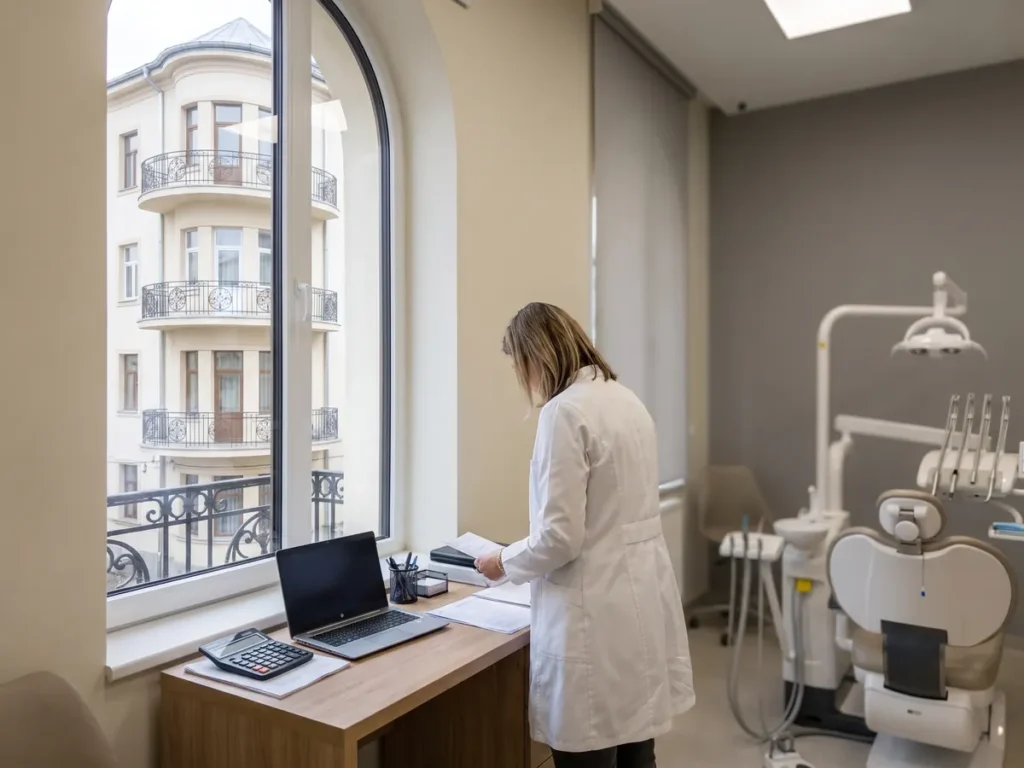
A dental practice in a village in Neamț county was issued a tax assessment for the building it worked in, even though the law exempted the buildings of private healthcare facilities from tax. Courts around the country had split into two camps, and the High Court has just put an end to the dispute. Decision No 67 of 4 May 2026 of the Panel for the Resolution of Points of Law, published in Official Gazette of Romania no. 580 of 15 July 2026, states that medical activity is not the „economic activity” for which the law nevertheless demanded that the tax be paid. The stakes are concrete for any owner of medical premises who has already paid, and the way the tax authority calculates building tax becomes, in this case, a matter of interpretation rather than of arithmetic.
The wording that produced the conflict is Article 456(1)(h) of the Tax Code. It exempted from tax „the buildings of public and private healthcare facilities, with the exception of the rooms used for economic activities”. The difficulty lies in the second half of the sentence: a private clinic lives on money collected for medical services, so, read literally, every room it has is used for an economic activity. The result would have been an exemption that never applies to anyone.
The exemption for private healthcare facilities has not always existed. Until 2020 the law covered only the buildings of public healthcare facilities. Government Emergency Ordinance No 168/2022, published in Official Gazette of Romania no. 1186 of 9 December 2022, added the private sector as well, and it was from that moment that the confusion the High Court is now resolving began.
What it changes in practice
The first effect is that the interpretation becomes binding on the courts. Under Article 521(3) of the Code of Civil Procedure, the resolution given to a point of law is imposed on all judges from the date of its publication in the Official Gazette of Romania. A pending case in which a town hall argues that a clinic owes tax on its consultation rooms can no longer be decided against that interpretation.
The second effect concerns what is actually taxed inside a medical building. The High Court drew a clear line: the exemption falls away only for the rooms in which economic activities „of a different nature” are carried on, and the examples given in the decision are food service, retail and the supply of services. The pharmacy in the clinic’s lobby, the coffee shop, the optical shop or space let to a third party remain taxable. The treatment room, the consulting room, the laboratory and the ward do not.
The third effect is that the way the activity is financed no longer matters. The court of first instance had dismissed the practice’s claim precisely because the activity „generates profit” and is paid for by patients or by the health insurance fund. The High Court held that this reasoning renders the rule ineffective, since no private healthcare facility could ever benefit from the exemption. The argument relied on is the principle that a rule is to be interpreted in the sense in which it produces effects, not in the sense in which it remains a dead letter.
The fourth effect shows up in cases already lost or still open. Tax assessments issued for the tax years during which the form given by Government Emergency Ordinance No 168/2022 was in force can be challenged in pending litigation, and the court is bound by the new interpretation. For those who paid without challenging, the route remains the one set out in the Code of Fiscal Procedure, with its own time limits, not an automatic refund from the town hall.
The fifth effect is one of equal treatment. The decision confirms the reason why Parliament extended the exemption in 2022: a public hospital and a private one do the same thing, and a difference in building tax could not be justified by the form of ownership. The argument appears expressly in the case law cited by the High Court.
What has changed compared with the previous situation
Until this decision, the same provision was being read in two different ways by different courts of appeal. The courts of appeal of Brașov, Bucharest, Constanța, Iași, Pitești, Ploiești and Timișoara sent the High Court judgments from which two opposing views emerged. Under one, private clinics enjoyed the exemption and the exception covered only pharmacies and canteens. Under the other, any medical service provided for a fee was an economic activity, so the exemption practically never applied. A practice in Iași could win, an identical one in Ploiești could lose.
The second thing that has changed is the legal framework itself, though not through this decision. Law No 239/2025, published in Official Gazette of Romania no. 1160 of 15 December 2025 and in force from 1 January 2026, rewrote Article 456. The automatic exemption was kept only for buildings used by public healthcare facilities and for family medicine practices, and that provision was renumbered as point (f).
Private healthcare facilities were moved to paragraph (2) point (n), that is, into the category of reliefs that local councils may grant rather than must. The new wording excludes from the exemption „the rooms that are used for economic activities generating income other than income from the health sector”, which is exactly the distinction the High Court has just imposed for the past. In 2025 the legislature wrote down what the supreme court had to deduce for the period before.
In practice, a private clinic today enjoys the exemption only if the town hall in its locality has adopted a local council decision to that effect, in compliance with the State aid rules. Two identical practices in two neighbouring towns can end up with different outcomes, but this time because of the will of the local council rather than the judge’s reading of the law.
Advantages and disadvantages
What it improves
- It closes a line of contradictory case law that had been running since the end of 2022 and in which the outcome depended on the court of appeal the file happened to reach.
- Small practices, the single-doctor ones, are the biggest winners: for them the building tax was a visible amount measured against their takings.
- The dividing line is easy to apply on the ground. What is taxed is the room housing a pharmacy, a shop or a canteen, not the consulting room.
- The interpretation uses an objective criterion, the actual use of the room, instead of an ambiguous one such as the source of the money or the existence of profit.
- Pending disputes can now be settled predictably, without another trip up to the supreme court.
What remains a problem
- The decision comes late. It clarifies a period that ended on 31 December 2025, and it changes nothing for the current tax year.
- It produces no automatic refunds. Anyone who paid the tax without challenging it has to follow the tax procedure, with its time limits, and may find that those have already run out.
- From 2026 the same clinic can be exempt in one town and taxed in another, depending on the budget and the decision of the local council.
- The current wording speaks of income „from the health sector”, a formula with grey areas of its own, for instance where aesthetic or wellness services are provided in the same building.
- The decision says nothing about how the taxable floor area is to be calculated where the same room is put to different uses in turn.
Practical advice
- If you run a private practice or clinic and paid building tax for the years when the form given by Government Emergency Ordinance No 168/2022 was in force, dig out the tax assessments and check the basis on which they were calculated.
- If you have a pending dispute with the town hall on this point, file the decision in the case. It is binding on the court from the date of publication, 15 July 2026.
- Draw up a plan of your premises setting out the use of each room. The distinction between a consulting room and a pharmacy or coffee shop is exactly what will be discussed in any inspection.
- For the current tax year, ask the town hall whether there is a local council decision granting the exemption provided for in Article 456(2)(n) of the Tax Code. Without one, the tax is due.
- If you let part of the medical building to a third party, treat that floor area separately. It remains taxable whatever the interpretation.
- Do not confuse a family medicine practice with the rest. It has its own exemption in the law, with its own exception for rooms used for another purpose.
- If you work in a local tax office, review the assessments issued for private medical buildings in the period concerned. The binding interpretation applies in the administrative procedure too, not only before the courts.
Frequently asked questions
What exactly did the High Court decide?
Does this mean I no longer pay building tax on my clinic?
Does a dental practice count as a private healthcare facility?
Which rooms remain taxable in a medical building?
Can I claim back the tax I have paid?
From when is the decision binding?
What is a preliminary ruling on a point of law?
Original text of the legal act
The text below is reproduced in Romanian, the official form of publication.
The full text, as published in the Official Gazette of Romania
Official Gazette of Romania no. 580 of 15 July 2026 16 pages PDF, 119 KB the act starts on page 9
Open the official PDFDownload the PDF
The viewer is not shown on small screens. Use the buttons above to open or download the file.
This article is for informational purposes only and does not constitute legal advice. For specific situations, consult a licensed attorney or tax advisor.