
In brief
- Two years and eight months on, Parliament approves the ordinance that introduced a contribution to the Environment Fund for packaging that is not returned through the deposit-return system, twice as high for glass and plastic as for metal.
- The same ordinance updated the lists of non-compliant landfills that Romania has to close after being found in breach by the Court of Justice of the European Union, and it wrote the terms RDF, SRF and CLO into the law.
- For the afforestation campaign under the PNRR, the National Recovery and Resilience Plan, the ordinance brought permanent grassland back into the category of eligible land, apart from natural grassland and land of high nature value.
Published: Official Gazette of Romania (Monitorul Oficial) no. 574 of 13 July 2026
In force from: 16 July 2026
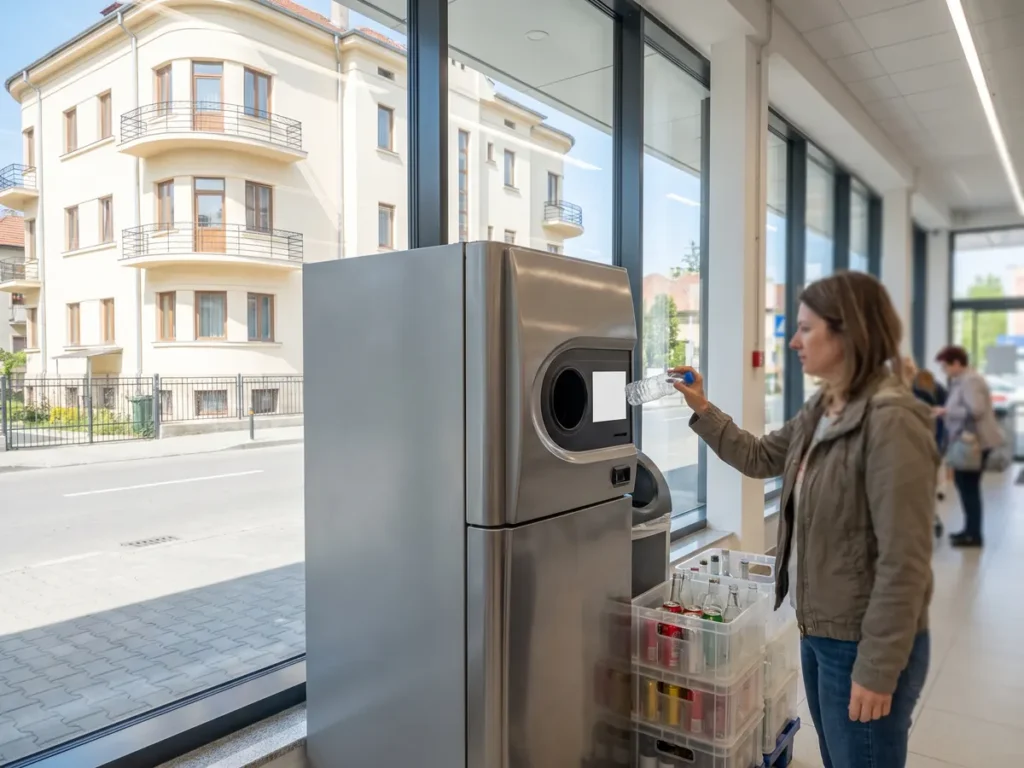
A producer that places drinks on the market in cans, in glass bottles or in PET and misses the annual return target pays into the Environment Fund for every missing item of packaging. For metal it pays the value of the deposit, for glass and plastic it pays double. The rule has been running since 1 January 2024, but the act that set it up has only now been confirmed by Parliament: Law no. 132/2026, published in Official Gazette of Romania no. 574 of 13 July 2026, approves Government Emergency Ordinance no. 96/2023 without a single change. It is one of the seven approving laws in the same issue, alongside the one on the ordinance that created RO e-Transport.
Government Emergency Ordinance no. 96/2023 was published in Official Gazette of Romania no. 1003 of 3 November 2023 and has six articles, which reach into five pieces of legislation: Emergency Ordinance no. 196/2005 on the Environment Fund, Government Ordinance no. 2/2021 on the landfilling of waste, Emergency Ordinance no. 92/2021 on the waste regime, Law no. 249/2015 on packaging and Emergency Ordinance no. 35/2022 on the national afforestation campaign, plus an alignment of definitions in Sanitation Service Law no. 101/2006.
The approving law has a single article. It approves the ordinance as it stands, without touching a single provision.
What it changes in practice
Packaging that is not returned costs the producer money. A new heading was added to the list of Environment Fund revenue, at Article 9(1)(z): a contribution owed by economic operators that place on the market products in non-reusable primary packaging covered by the deposit-return system. It is calculated from 1 January 2024, for every item of packaging in the gap between the minimum annual return target and the quantity actually validated as returned on the basis of the barcode.
Glass and plastic are charged at twice the rate of metal. For every item of non-reusable metal packaging, the contribution equals the value of the deposit set in Article 12(5) of Government Decision no. 1.074/2021. For every item made of glass or plastic, the contribution is twice that same deposit.
Quarterly reporting, annual payment. Economic operators have to declare quarterly, through the system administrator, by the 25th of the month following the quarter, the quantities of packaging placed on the market, the quantities returned and the quantities handed over for recycling, in kilograms, by type of material and as a number of items. The amount owed is paid once a year, again through the system administrator, by 25 January of the following year inclusive.
The „Săptămâna verde” programme, the green week of outdoor and environmental activities in schools, is financed from the Environment Fund. It was added to the list of categories eligible for financing, and the beneficiary is the Ministry of Education. The financing mechanism and the amounts are approved by government decision, on a proposal from the central environmental protection authority.
The Environment Fund also collects the rents of the Environment Fund Administration. Money obtained from renting out movable or immovable property owned or administered by the institution has become revenue of the Fund, a heading that was missing from the act setting it up, even though the Administrative Code gives the right to rent out such property.
The money from the packaging contribution goes to waste infrastructure. The amounts resulting from points (c), (v) and (z) of Article 9(1) are used to finance the development of waste management infrastructure, on the basis of the strategy set by the central environmental protection authority.
The lists of non-compliant landfills can be changed by ministerial order. A new paragraph was inserted in Article 38 of Government Ordinance no. 2/2021: Annex no. 5 is updated by order of the minister for the environment, water and forests, whenever the central authority considers it necessary. At the same time, tables 5.1, 5.3 and 5.4 in that annex were replaced in full.
Six technical terms entered the law. Definitions were added to Annex no. 1 to Emergency Ordinance no. 92/2021 for the mechanical-biological treatment plant, the integrated treatment plant, RDF, SRF, CLO and residual municipal waste. RDF and SRF are alternative fuels obtained from treated municipal waste, SRF being the one that meets the European standard EN ISO 21640:2021. CLO is the compost-like material resulting from mechanical-biological treatment, used to cover landfills and to rehabilitate abandoned mines, which does not meet the criteria for finished compost.
Packaging targets are met exclusively through the system administrator. Law no. 249/2015 now provides that, from the moment the deposit-return system starts operating, producers’ minimum annual targets for the packaging covered by the system are met only through its administrator. Separately, when the declarations on obligations to the Environment Fund are filed, non-reusable primary packaging covered by the system has to be listed separately.
Permanent grassland is back on the list of land for afforestation. Article 1(1)(a) of Emergency Ordinance no. 35/2022 was rewritten: arable land, permanent grassland and permanent crops are eligible, apart from natural permanent grassland, wetlands and other high nature value agricultural land.
What has changed compared with the previous situation
Before the ordinance, a producer that missed the return target owed nothing for the gap left behind. The deposit-return system had annual targets set by Government Decision no. 1.074/2021, but no financial penalty of its own attached to missing them. The ordinance tied the target to a contribution calculated item by item, and the difference in treatment between metal and the other materials was written into the text itself: double for glass and plastic.
The second change concerns the landfill lists. Tables 5.1, 5.3 and 5.4 in Annex no. 5 to Government Ordinance no. 2/2021 held the situation as it stood in 2021. The diagnostic analysis financed from the Environment Fund showed differences in surface area compared with what the tables recorded, and some of the landfills had been closed in the meantime. The ordinance replaced the tables and moved future updates down to the level of a ministerial order, so a government act is no longer needed.
The third change is one of legal vocabulary. Until November 2023, RDF, SRF and CLO circulated in tender specifications and in projects financed from European funds, but had no definition in any piece of legislation. Sanitation Service Law no. 101/2006 was aligned in the same ordinance, so that residual waste and the integrated treatment plant mean the same thing in both acts.
The fourth change corrects a restriction introduced four months earlier. Law no. 236/2023 had removed all permanent grassland from the category of land eligible for afforestation, including grassland with no high nature value, which made the PNRR target of 56,700 hectares hard to reach. The ordinance put ordinary grassland back on the list and kept out only natural permanent grassland, wetlands and high nature value agricultural land.
The law adopted now changes nothing in substance. All it changes is the status of the ordinance, which can no longer be rejected or amended in the approval procedure.
Advantages and disadvantages
What it improves
- It closes off the debate on the legal basis of a contribution that has been calculated since 1 January 2024 and is paid every year by all producers in the deposit-return system.
- It confirms the definitions of RDF, SRF, CLO and residual municipal waste, which are used in sanitation contracts and in projects financed from European funds.
- It keeps ordinary permanent grassland on the list of land for afforestation, without which the PNRR target of 56,700 hectares was hard to reach.
- It amends nothing, so it produces no retroactive effects on contributions already declared and paid.
What remains a problem
- Two years and eight months passed between the ordinance and its approval, in an act that sets up a new financial contribution for economic operators.
- Updating the list of non-compliant landfills has moved down to the level of a ministerial order, so a landfill entering or leaving the closure obligation no longer passes through the Government.
- The contribution is calculated on the basis of the quantities validated by barcode by the system administrator, so a producer depends on someone else’s data for its own payment obligation.
- The difference in treatment between metal on one side, and glass and plastic on the other, is not explained in the preamble to the ordinance.
- An act that mixes the packaging regime, the closure of industrial landfills, technical definitions, a school programme and the afforestation campaign can only be approved or rejected as a block.
Practical advice
- If you place drinks on the market in non-reusable primary packaging, the payment obligation is set annually, on 25 January, for the previous year, and is settled through the administrator of the deposit-return system, not directly with the Environment Fund Administration.
- Reporting is quarterly and separate from payment: by the 25th of the month following the quarter, through the administrator, in three categories of quantities, expressed both in kilograms and by type of material, and as a number of items.
- Check the return data validated by barcode every month. That is where the gap on which the contribution is calculated comes from, and for glass and plastic every missing item costs twice as much as for metal.
- In the declarations on obligations to the Environment Fund, non-reusable primary packaging that falls within the deposit-return system is listed separately from the rest.
- If you work in sanitation or are preparing a waste treatment project, the definitions of RDF, SRF, CLO, the mechanical-biological treatment plant and the integrated treatment plant are at points 40 to 45 of Annex no. 1 to Emergency Ordinance no. 92/2021.
- If you own or run a landfill listed in Annex no. 5 to Government Ordinance no. 2/2021, follow the orders of the minister for the environment, water and forests: since 2023, the lists have been updated at that level, not by government decision.
- For afforestation, what counts is the land use category of the plot. Ordinary permanent grassland is eligible, natural permanent grassland is not.
Frequently asked questions
What does this law do?
Who pays the contribution for packaging that is not returned?
How much does an item of packaging that is not returned cost?
Since when has it been calculated?
What do RDF, SRF and CLO mean?
Why are the landfill lists being changed?
What does the ordinance have to do with afforestation?
Why was it approved only now?
Editorial analysis
The ordinance approved here deals with a real and expensive problem. Romania was found in breach at the Court of Justice of the European Union for not having closed 68 non-compliant landfills, and the preamble to the ordinance puts the figures on the table: a minimum lump sum of 1,643,000 euro and penalties of 29,781.3 euro a day, sought by the European Commission in the case opened in February 2022. Updating the lists and moving them down to the level of a ministerial order are ways of managing a deadline that runs day by day, not bureaucracy.
The packaging part is another matter. A contribution calculated item by item, with a multiplier of two for glass and plastic, is an environmental tax, not an emergency measure. The preamble, almost three pages long, does not explain where the one to two ratio between materials comes from. Nor why metal gets the gentler treatment.
There is one more detail that says something about the way these acts are drafted. The preamble dates the judgment of the Court of Justice to 18 December 2018 and refers, in one place, to Case C-638/18, while the footnotes to the tables in the annex, the only ones that produce legal effects, speak of the judgment of 18 October 2018. The operative part is correct, so nobody can end up with two different legal conclusions, but the approval in 2026 was the moment when these references could have been put right. Parliament voted the text word for word, and them along with it.
What should be changed
- A public justification of the one to two ratio between materials. If the difference is based on different collection costs or recycling rates, the figures should appear in the explanatory memorandum, not only in the text.
- A right to challenge the data validated by barcode. The producer pays on the basis of a quantity calculated by the system administrator, so it should be able to check and challenge that figure before the due date.
- Publication of the updated landfill list after each ministerial order. If the annex changes at the level of an order, the consolidated version should be accessible in a single place, otherwise landowners find out about the obligation from some other act.
- Separation of permanent taxes from compliance measures. Closing landfills under the pressure of a court judgment and setting up a new packaging contribution are two different subjects, with different addressees, which should not sit in the same act.
- Correction of the references to European case law at the moment of approval. The approving law is the only occasion on which Parliament can put right a preamble that has become part of the legislation, and here it passed it by.
Original text of the legal act
The text below is reproduced in Romanian, the official form of publication.
The full text, as published in the Official Gazette of Romania
Official Gazette of Romania no. 574 of 13 July 2026 16 pages PDF, 101 KB the act starts on page 6
Open the official PDFDownload the PDF
The viewer is not shown on small screens. Use the buttons above to open or download the file.
This article is for informational purposes only and does not constitute legal advice. For specific situations, consult a licensed attorney or tax advisor.