
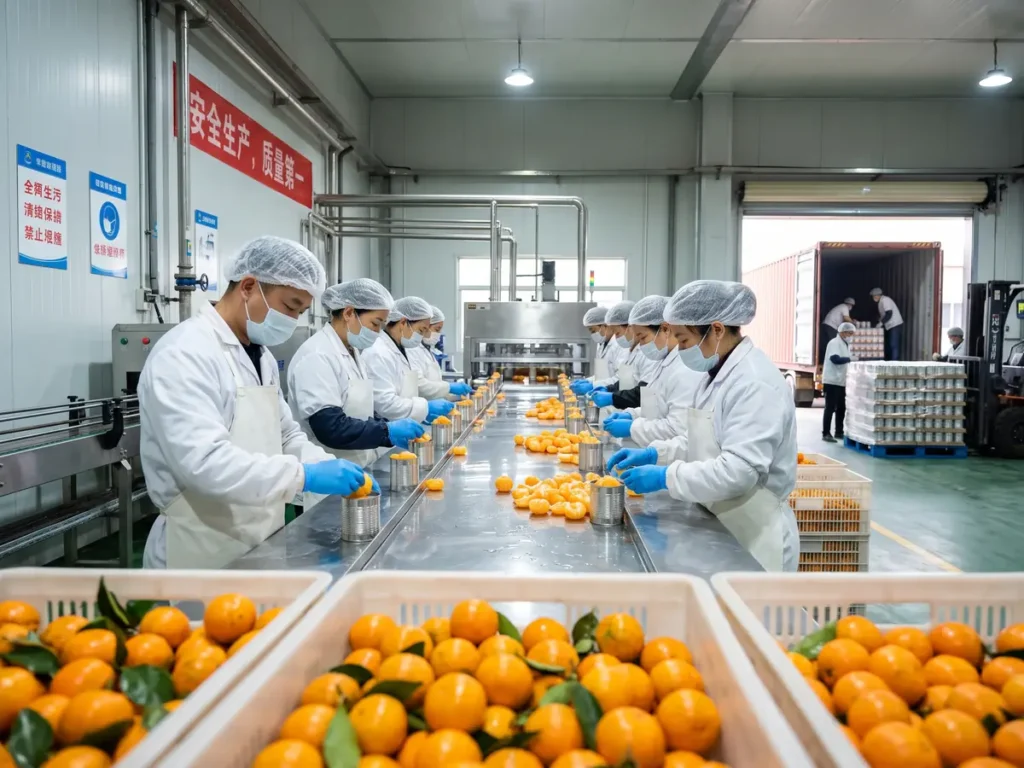
In brief
- The anti-dumping duty on canned mandarins from China is being kept in place, not introduced now. The measure has existed since 2008, and on 21 October 2026 the European Commission decided, after an expiry review, that it stays in force with the same figures. The rates run between 361.4 and 531.2 euro per tonne of net product weight, depending on the Chinese producer, and it is the Union importer who pays them at customs.
- What is covered is the fruit in the tin, not the fresh fruit. It takes in mandarins, tangerines, satsumas, clementines, wilkings and similar hybrids, prepared or preserved, without added spirit, with or without added sugar, under CN codes 2008 30 55, 2008 30 75 and ex 2008 30 90, which means exactly the mandarin segments in syrup sold in tins and in jars.
- Romania appears nowhere in the file, and the effect is felt only on price. The only two producers in the Union are Spanish, from the province of Valencia, and they used 16-18 % of their capacity in the last reference year. China holds 32-35 % of the Union market, Türkiye 41-45 %, and the duty adds between 0.36 and 0.53 euro to every kilogram of net weight, that is around 11-17 euro cents on a tin of 314 grams.
Published: Official Journal of the European Union, L series, no. 2026/2327 of 22 October 2026; CELEX 32026R2327
Who it concerns: importers and distributors of canned fruit in Romania, retailers and store chains that sell canned mandarins, catering firms and confectioners that buy mandarin segments in large tins, the customs offices that classify the goods under the five TARIC codes and the shopper who pays the difference at the shelf
Takes effect: 23 October 2026, the day after publication in the Official Journal of the European Union, under Article 4 of the regulation
The tin of canned mandarins on a shop shelf in Romania stands no chance of being Romanian, because in the European Union canned mandarins are made in two factories, both of them in the Spanish province of Valencia. Everything else comes from imports, and Chinese goods cross customs carrying an anti-dumping duty which, for 18 years, has run as high as 531.2 euro per tonne. The European Commission ruled on 21 October 2026 that the duty stays, and the act takes effect from 23 October 2026. Another trade file closed in exactly the opposite direction in the same week: the duties on solar glass from China were repealed, and importers can claim their money back for 15 months.
The ruling is contained in Implementing Regulation (EU) 2026/2327 and closes a procedure opened a year earlier, on 21 October 2025. An expiry review is the mechanism through which it is checked, every five years, whether an anti-dumping duty still serves a purpose. The Commission’s answer: it does, because dumping continued at a level of over 160 %, because China holds spare capacity that on its own covers the whole of European consumption, and because the two Spanish factories have slipped into loss over the past two years.
For an importer in Romania, nothing changes in what it was paying until now. The value of the act lies in what did not happen: the duty did not expire, did not rise and did not fall. Anyone who had built a cost price on the assumption that the measure would lapse in the autumn of 2026 has to redo the arithmetic, as a rule through to 2031.
One thing that is often confused deserves saying at the outset. The duty does not touch fresh mandarins, which fall under heading 0805 and enter the Union freely, nor does it touch mandarin juice. It covers only the fruit peeled, segmented and packed in syrup, juice or water, that is the product the act speaks of as „canned mandarins”.
On 27 October 2026 the European Commission made imports of PVC from China, South Korea, Mexico and Taiwan subject to customs registration, through Regulation (EU) 2026/2345.
On 27 October 2026 the European Commission made imports of silicon from China subject to customs registration, through Regulation (EU) 2026/2346.
What it changes in practice
Article 1(1) defines the product: mandarins prepared or preserved, including tangerines and satsumas, clementines, wilkings and other similar citrus hybrids, without added spirit, with or without added sugar or other sweetening matter. Tariff classification falls under CN codes 2008 30 55, 2008 30 75 and ex 2008 30 90, and for the last of these under five TARIC codes: 2008 30 90 61, 2008 30 90 63, 2008 30 90 65, 2008 30 90 67 and 2008 30 90 69.
Article 1(2) fixes the duty rates, per tonne of net product weight and for each named exporting producer. Yichang Rosen Foods Co., Ltd of Yichang pays 531.2 euro, under TARIC additional code A886. Zhejiang Taizhou Yiguan Food Co. Ltd of Huangyan pays 361.4 euro, code A887, the lowest rate in the file. Hubei Xinshiji Foods Co., Ltd of Dangyang City, Hubei Province, pays 489.7 euro, code A888. Zhejiang Juzhou Foods Co., Ltd of Sanmen pays 499.9 euro, code C528. The 16 cooperating exporting producers listed in the Annex, from Hunan Pointer Foods to Ningbo Wuzhouxing Group, pay the weighted average rate of 499.6 euro, code A889. For „all other imports originating in the People’s Republic of China” the duty is 531.2 euro, code A999.
The figures are the ones set in 2008. Recital (2) of the act states that the original measures took the form of a specific duty per company ranging from 361.4 to 531.2 euro per tonne, which is exactly the minimum and the maximum of the present table. Neither the 2014 review, nor the 2020 one, nor the current one recalculated the rates.
The duty is specific, not ad valorem, and the difference matters when a cost price is worked out. At the average import price of the reference period, 1,167 euro per tonne, the top rate of 531.2 euro comes to 45.5 % of the value of the goods, the lowest rate of 361.4 euro to 31 %, and the rate of the cooperating companies in the Annex, 499.6 euro, to 42.8 %. On an ordinary tin of 314 grams net weight, the duty works out at 17 euro cents at the top rate and 11 euro cents at the lowest. On a large tin of 850 grams, the kind bought for confectioners and caterers, 45 and 31 euro cents respectively.
Article 1(3) imposes a condition of form that costs money if it is missed. The individual rates, lower than the residual one, apply only if the importer presents the customs authorities with a valid commercial invoice bearing a declaration dated and signed by an official of the issuing entity, identified by name and function, with the volume in tonnes, the name and address of the producing company and the TARIC additional code. Without that invoice, the rate for all other imports applies, 531.2 euro per tonne. For goods bought from Zhejiang Taizhou Yiguan, the difference comes to 169.8 euro on every tonne, close to half the duty owed.
Article 2(1) settles the position of goods damaged before entry into free circulation: if the price actually paid is adjusted for the determination of the customs value, pursuant to Article 132 of Implementing Regulation (EU) 2015/2447, the anti-dumping duty is reduced by the same percentage. Paragraph (2) refers to the ordinary provisions on customs duties, so the duty is added to the normal customs duty and enters the basis on which value added tax is calculated at importation.
Article 3 leaves a door open for new Chinese producers. An exporter that does not appear in the table can be added to the list of cooperating companies in the Annex, at the rate of 499.6 euro per tonne, if it proves three things: that it did not export the product to the Union during the period of the original investigation, 1 October 2006 to 30 September 2007, that it is not related to any exporting producer subject to the measures, and that it has either actually exported to the Union or holds an irrevocable contractual obligation to export a significant quantity. The condition in point (a) is worth reading twice: the reference stays the period in 2006 and 2007, so a company set up in 2015 meets it automatically.
What has changed compared with the previous situation
In figures, nothing. In the calendar, five years.
The history of the measure explains why the file is so well trodden. The Council imposed the duty by Regulation (EC) No 1355/2008. The Court of Justice of the European Union annulled it on 22 March 2012, in GLS, C-338/10, and the Council re-imposed it on 18 February 2013, by Implementing Regulation (EU) No 158/2013. The Commission then maintained it twice, by Implementing Regulation (EU) No 1313/2014 and by Implementing Regulation (EU) 2020/1534. The present act is the third extension.
The procedural window was tight. The 2020 measures would have expired on 22 October 2025, and the Commission opened the review on 21 October 2025, one day before. The opening kept them in force for the whole length of the investigation, a year and a day. The request had come from Fenaval, the Spanish federation of vegetable and processed food producers, lodged on 21 July 2025 on behalf of the producers that account for 100 % of Union production.
The duration of the present measure is missing from the act. Article 4 governs entry into force alone, and no recital fixes a term. It follows from Article 11(2) of Regulation (EU) 2016/1036: a definitive anti-dumping duty expires five years after the conclusion of the most recent review that covered both dumping and injury. For this file, the term falls around 22 October 2031. If a fresh review request is lodged in good time before that date, the measure stays in force until the new procedure is completed, exactly as has just happened.
What has changed since the previous review is the market, not the act. Chinese imports rose from 11,102 tonnes in 2021/2022 to 15,188 tonnes in the reference period, up by 37 %, and their market share climbed from 21-23 % to 32-35 %, that is by 54 % in relative terms and by roughly 12 percentage points in absolute terms. Their import price fell by 13 %, from 1,343 to 1,167 euro per tonne. Union consumption fell by 11 %, down to 41,000 – 46,000 tonnes.
The European industry went the other way. Production fell by 46 %, sales on the Union market by 42 %, market share by 34 %, the number of employees by 30 %, down to 190-210 people. The unit cost of production rose by 39 %, the selling price by only 13 %, so profitability moved from a plus of 11-12.1 % in 2021/2022 to a loss of 9.4-10.4 % in the reference period. Cash flow turned negative. Capacity utilisation dropped to 16-18 %.
Advantages and disadvantages
What it improves
- Predictability for importers: the rates, the TARIC additional codes and the wording of the declaration on the invoice stay identical, so nothing has to be changed in customs clearance systems or in running contracts.
- The specific form of the duty, in euro per tonne, leaves no room for under-invoicing. Goods declared at a low price pay the same amount per tonne, which also shields the honest importer from the competitor who declares below value.
- The two Spanish factories and the roughly 200 jobs in the province of Valencia gain another five years in which the Chinese price at the border stays several hundred euro per tonne above where it would sit without the measure.
- Article 3 keeps access open for new Chinese suppliers, at 499.6 euro per tonne, without a full investigation. An importer looking for an alternative to its current partners can use the mechanism.
- The requirement of an invoice carrying a declaration, under Article 1(3), limits abusive use of the low rates by companies that have not obtained them.
What remains a problem
- The duty has not been reindexed since 2008, and its real effect moves on its own, following the import price. In 2021/2022 the 531.2 euro came to 39.6 % of the value of the goods, and in the reference period, with the price down to 1,167 euro, to 45.5 %. Protection tightened by almost six percentage points without anyone deciding it.
- The date up to which the duty applies is missing from the act. A five-year supply contract is negotiated differently when the year of expiry is printed in the regulation rather than inferred from the basic Regulation.
- The interest of importers and of users was never measured. No importer and no user replied to the questionnaires, and the Commission wrote, in recitals (155) and (157), that „there were no indications” of a significant negative impact. The absence of data was treated as the absence of an effect.
- China’s spare capacity, the centrepiece of the conclusion on the likelihood of continued dumping, is estimated on 2019 season data taken over from the previous review. The 2026 act rests on a snapshot from before the pandemic.
- Türkiye, the largest supplier of the European market, with 41-45 % of it, and of which the Commission itself writes in recital (138) that it is „thus contributing to the injury suffered by the Union industry”, is touched by no measure at all. In the same file, Türkiye is chosen as the representative country for constructing normal value against China.
- For the Romanian shopper, the shelf price stays higher than it would be without the duty, and the benefit goes to an industry that does not exist in Romania and that, even under protection, has used at most a third of its own capacity over the past four years.
Practical advice
- Check the TARIC additional code on the customs declaration, not only the commodity code. A886, A887, A888, C528 and A889 give different duty rates, and A999 is the residual one, 531.2 euro per tonne, which applies automatically whenever something is missing.
- Ask your Chinese supplier for the declaration on the invoice, in the exact form of Article 1(3): dated, signed, with the name and function of the signatory, with the volume in tonnes, with the name and address of the factory and with the TARIC additional code. Without it you pay 531.2 euro per tonne, even if your supplier is entitled to 361.4.
- Confirm the classification to ten digits. The codes in the act are 2008 30 55, 2008 30 75 and the five TARIC codes under 2008 30 90. Fresh fruit, under heading 0805, and juices fall outside the duty, and a wrong classification is usually discovered at a later customs check, with surcharges on top.
- Calculate the duty on the net product weight, not on the drained weight of the fruit and not on the volume of the tin. The syrup counts towards net weight, so a product with plenty of syrup carries duty on the whole content.
- If the goods were damaged before entry into free circulation, claim the proportional reduction under Article 2(1), together with the adjustment of the customs value. It is not granted automatically.
- Compare the landed cost, not the invoice price. Chinese goods at 1,167 euro per tonne plus 531.2 euro of duty reach 1,698 euro, while Turkish goods entered the reference period at 1,522 euro per tonne, with no anti-dumping duty.
- If the duty bears on your business, register as an interested party from the first day of the next notice of initiation. In this file no importer and no user came forward, and the Commission decided on the replies of the two Spanish producers.
- Put a price review clause tied to the expiry of the measure into contracts that run past 2031. If the duty falls then, the difference in cost is of the order of 0.36-0.53 euro per kilogram.
Frequently asked questions
How much is the duty, exactly?
Which products fall under the duty?
Until when does the duty apply?
Will canned mandarins become more expensive because of this regulation?
Is there any production of canned mandarins in the Union and in Romania?
Does Romania appear in the file?
Where do canned mandarins come from, if not from China?
How large is the dumping found?
Why did no Chinese exporter defend itself?
What would have happened if the measure had lapsed?
Do I have to do anything as an importer in Romania?
Errors and inconsistencies in the published text
- Recital (153), both internal cross-references are wrong. The text says „As concluded in Section 4 above, the Union industry is suffering from material injury”, yet Section 4 is the one on the likelihood of continued dumping, while the finding of material injury sits in Section 5, in recital (129). The same sentence goes on with „As concluded in Section 5, a repeal of the measures would result of a renewed influx of dumped imports”, but that conclusion is in Section 7, in recitals (150) and (151). Recital (153) is the foundation of the analysis of the Union interest required by Article 21 of the basic Regulation, and the cross-reference is itself part of the reasoning: whoever checks the statement of reasons by following its own references lands in two sections that do not hold what is attributed to them.
- Recital (102) against recital (148) and Table 5, the share of Turkish imports. Recital (102) writes that imports from Türkiye „represent 62 % of imports from other third countries into the Union”, while recital (148) writes that „95 % of imports from third countries other than the PRC come from Türkiye”. Table 5 confirms the second figure: 19,531 tonnes from Türkiye out of 20,526 tonnes from all third countries except China give 95.2 %. One and the same quantity is stated at two different values inside the same act, and it carries weight in the non-attribution analysis under Article 3(7) of the basic Regulation, where the Commission has to show that injury caused by other factors is not laid at the door of Chinese imports. At 62 % Türkiye is a secondary supplier, at 95 % it is the dominant supplier of the market.
- Recitals (68) and (72) against footnote 36, the year of Frigo-Pak’s financial data. In recital (68) the Commission says it used „the financial data from the Turkish company, Frigo-Pak for the year 2025 as reported in the company’s audited accounts”, with a reference to footnote 36, and recital (72) repeats „for 2025”. Footnote 36, however, identifies the source as the „Consolidated financial statement and independent auditor’s report of year 2023”. Out of those data come the percentages of 21 % for selling, general and administrative costs and of 29 % for profit, applied to the undistorted costs of manufacturing, which is the very material out of which normal value is built and, through it, the finding of dumping. The reference does not say what is attributed to it, and the reader cannot establish which financial year was used.
- Table 5, the market share of imports from other third countries. The row shows the same value, 1.8-2.2 %, in all four periods, although the volumes in the row above it are 992, 668, 218 and 995 tonnes, with an index of 100, 68, 22 and 100. For 2023/2024 the figure is impossible: 218 tonnes out of a consumption of 32,000 – 35,000 tonnes give 0.6-0.7 %, not 1.8-2.2 %. The total share of third countries for that year, 52-58 %, checks out only against the real value, so the error sits in the intermediate row. The same wrong value carries recital (137), which states that for the other countries „the volume remain rather stable”, although its own index shows a collapse to 22 and a recovery to 100.
Editorial analysis
The figure that explains the file is not the duty, it is the ratio between the duty and the loss it defends. The 15,188 tonnes imported from China in the reference period, multiplied by the rates in Article 1(2), bring in between 5.5 million euro, at the lowest rate of 361.4 euro per tonne, and 8.1 million, at the residual rate of 531.2 euro. The industry the duty protects sold 7,000 – 10,000 tonnes over the same period, at an average price of 1,850 – 2,040 euro per tonne and with a unit cost of 2,040 – 2,260 euro, so at a loss of roughly 205 euro per tonne, around 1.7 million euro a year. The duty collected at the border is therefore three to nearly five times larger than the entire annual loss of the two factories, and set against the roughly 200 jobs in Valencia it works out at between 27,000 and 40,000 euro a year for each job. This is not an argument against the measure, since the money goes into public budgets and not to the producers, but it is the proportion that the statement of reasons leaves out.
The second thing invisible to anyone reading the act straight through is that the duty has moved the problem rather than solved it. Chinese goods enter at 1,167 euro per tonne and, with the top rate, reach 1,698 euro. Turkish goods entered over the same period at 1,522 euro per tonne, with no anti-dumping duty at all, so 176 euro below the cleared Chinese price. The cheapest supplier on the European market is therefore not the one being penalised. Türkiye holds 41-45 % of the market, more than China, and the Commission expressly finds, in recital (138), that the fall in Turkish prices exerts downward pressure on Union industry prices and contributes to the injury. In the same act, Türkiye is picked as the representative country for constructing normal value, meaning the benchmark of undistorted costs against which Chinese dumping is measured. The country whose cost level is the standard of fair competition is also, on the Commission’s own finding, part of the problem.
The third element has to do with the form of the duty and with the passage of time. The rates have been fixed in euro per tonne since 2008 and have not shifted through three reviews. Their real effect, though, moves on its own: at the import price of 2021/2022, 1,343 euro per tonne, the residual rate came to 39.6 % of the value of the goods, and at the price of the reference period, 1,167 euro, to 45.5 %. Protection tightened by almost six percentage points in four years without anyone deciding it, simply because the goods became cheaper. The mechanism works in reverse too: a rise in the import price weakens the measure by the same logic. For an importer, the practical consequence is that the level of protection it pays depends on the price at which it buys.
Two checks did not close, and that should be said plainly. The first: the price comparison in recital (100), with a difference of 8.9 % against the Union industry price with the duty included and of 30.1 % without it, cannot be reconstructed from the published tables. The two percentages imply an average effective duty of roughly 354 euro per tonne, below the lowest rate in force, 361.4 euro, and a Union industry price of about 1,670 euro per tonne, nearly 10 % under the bottom of the range in Table 9. The difference probably comes from the mix of product types or from the ranges imposed by confidentiality, but the explanation is missing from the act. The second: in Table 5, the index row for the average Turkish price reads 100, 100, 114 and 96, whereas the prices in the row above, 1,685, 1,846, 1,660 and 1,522 euro per tonne, give 100, 110, 99 and 90. Recital (137), which speaks of a 10 % fall in the Turkish price, confirms the price row and contradicts the index row. The rest of the tables check out without trouble: capacity utilisation, productivity, stocks as a percentage of production and profitability all follow exactly from the ratios of figures in those same tables, and China’s spare capacity really is 5-6 times the sales of the Union industry.
The last observation concerns what was never investigated. No importer, no user and no trader replied, and the Commission writes in recital (156) that for this reason it „was not in a position to analyse the impact of existing measures on their situation”. One recital further down it concludes that there are no indications of a significant negative impact on users. Silence was read as the absence of an effect, although the Commission holds customs data for every Member State and could have estimated for itself how much the duty weighs in the price of a tin of mandarins. On a market of over 40,000 tonnes a year, the duty on the Chinese share is the one figure in the file that reaches the consumer, and it is the one figure the regulation never sets against the shelf price.
What should be changed
- The expiry date of the measure should be written into Article 4, not inferred from Article 11(2) of the basic Regulation. An importer negotiating contracts now that run to 2031 would read the term from the act instead of calculating it. In the published form, the piece of information that matters most for planning is missing precisely from the operative part.
- The cross-references in recital (153) should be corrected to Sections 5 and 7. The analysis of the Union interest is the section most often challenged in court, and a statement of reasons that points to conclusions sitting elsewhere in the act weakens exactly the link on which the maintenance of the measure rests.
- The share of Turkish imports should appear at a single value, the 95 % that follows from Table 5, and recital (102) should be corrected. On the 62 % figure the non-attribution analysis looks different from how it looks on the real one, and recitals are quoted later in other files and in the specialist literature, where the error reproduces itself for years.
- China’s production capacity and spare capacity should be re-estimated on recent data, not on the 2019 season carried over from the previous review. The whole conclusion on the likelihood of continued dumping rests on those figures. An estimate from 2019 used in an act from 2026 is the most vulnerable point of the reasoning, even though the conclusion would probably hold on fresh data as well.
- The Commission should estimate the effect of the duty on importers, on retail and on the consumer even when they do not reply to questionnaires, on the basis of the customs data it holds. An imperfect figure for how much the duty adds to the price of a tin is more useful than the formula „there were no indications”, which describes who filled in a form, not what happens on the market.
- The year of the financial data used for SG&A costs and for profit should be the same in the recitals and in the footnote, and the rate of value added tax applied to the Turkish gas price should be reasoned. The act states that the gas price for October 2024 to September 2025 was adjusted for value added tax of 18 %, while the standard rate in Türkiye is 20 %; we could not verify from official sources whether gas for industrial users attracts a different rate, precisely because the regulation does not say so. The difference would slightly inflate normal value, and so the dumping margin, without changing the outcome at a margin of over 160 %.
Original text of the legal act
The text below is reproduced in Romanian, the official form of publication.
The full text, as published in the Official Gazette of Romania
Official Journal of the European Union, L series, no. 2026/2327 of 22 October 2026; CELEX 32026R2327 27 pages PDF, 920 KB
Open the official PDFDownload the PDF
The viewer is not shown on small screens. Use the buttons above to open or download the file.
This article is for informational purposes only and does not constitute legal advice. For specific situations, consult a licensed attorney or tax advisor.