
In brief
- The Ministry of Education has approved 182 new school curricula for special upper secondary education, plus a master list and an explanatory note, published across 1,080 pages in a separate edition of the Official Gazette of Romania (Monitorul Oficial).
- They apply progressively, starting with grade IX of the 2026-2027 school year, so pupils entering upper secondary school now will study under them, while those in higher grades stay on the old curricula.
- The subjects include Romanian Sign Language, Braille reading and writing, physiotherapy, assistive technologies and psychological assessment and vocational guidance, as part of the specialist curriculum.
Published: Official Gazette of Romania no. 685 of 19 August 2026
Issued: 4 August 2026
Two weeks before the school year begins, special upper secondary schools have received the curricula they will teach from, and those curricula fill 1,080 pages of the Official Gazette of Romania. Order of the Minister of Education and Research no. 4.616/2026 approves the master list of school curricula, the 182 curricula themselves and the general explanatory note, all linked to the subjects in the framework curriculum plans for special upper secondary education. The order has eight articles and was published in edition no. 685 of 19 August 2026, while the annexes appeared the same day, in edition no. 685 bis. It is one of the two acts published that day which directly concern people with disabilities, alongside the one setting out the medical reassessment procedure for adults with disabilities.
The curricula complete the framework curriculum plans approved last year, by Order of the Minister of Education and Research no. 6.873/2025. A framework curriculum plan states which subjects are studied and how many hours each one has; the school curriculum states what exactly is taught in each subject, with which competences and which content. Until now, special upper secondary education had the plans, but not the curricula that would give them substance in grade IX.
The master list in annex no. 1 shows how they are organised. The curricula are grouped by track and profile: the theoretical track, with the science profile and the humanities profile, plus a section common to all profiles, and the technological track, with all the profiles and all the vocational qualifications. Within each section a distinction is drawn between the common core, marked TC, and the specialist curriculum, marked CS. Each curriculum states expressly who it is addressed to, and the recurring formula is “sensory disabilities and intellectual disabilities of mild and moderate severity”.
On 28 August 2026 the ministry also replaced the Romanian language and literature curriculum for schools and classes taught in Hungarian: MEC Order no. 5,111/2026 applies from the 2026-2027 school year.
What it changes in practice
The first effect is that the 2026-2027 school year starts, in special upper secondary education, with curricula in force. Under art. 4 of the order, the curricula in annexes nos. 2-183 apply progressively, starting with grade IX of the 2026-2027 school year. Progressively means that nothing changes for pupils already in higher grades: they finish school under the curricula they started with.
The second effect is duration. Art. 5 establishes that the curricula linked to each year of study are valid for eight years, with an explicit calendar: 2026-2027 for grade IX, 2027-2028 for grade X, 2028-2029 for grade XI, 2029-2030 for grade XII, 2030-2031 for grade XIII, 2031-2032 for grade XIV and 2032-2033 for grade XV. The list confirms something many people do not know: special upper secondary education can run all the way to grade XV. The master list does, moreover, have a section dedicated to the technological track, with all the vocational qualifications.
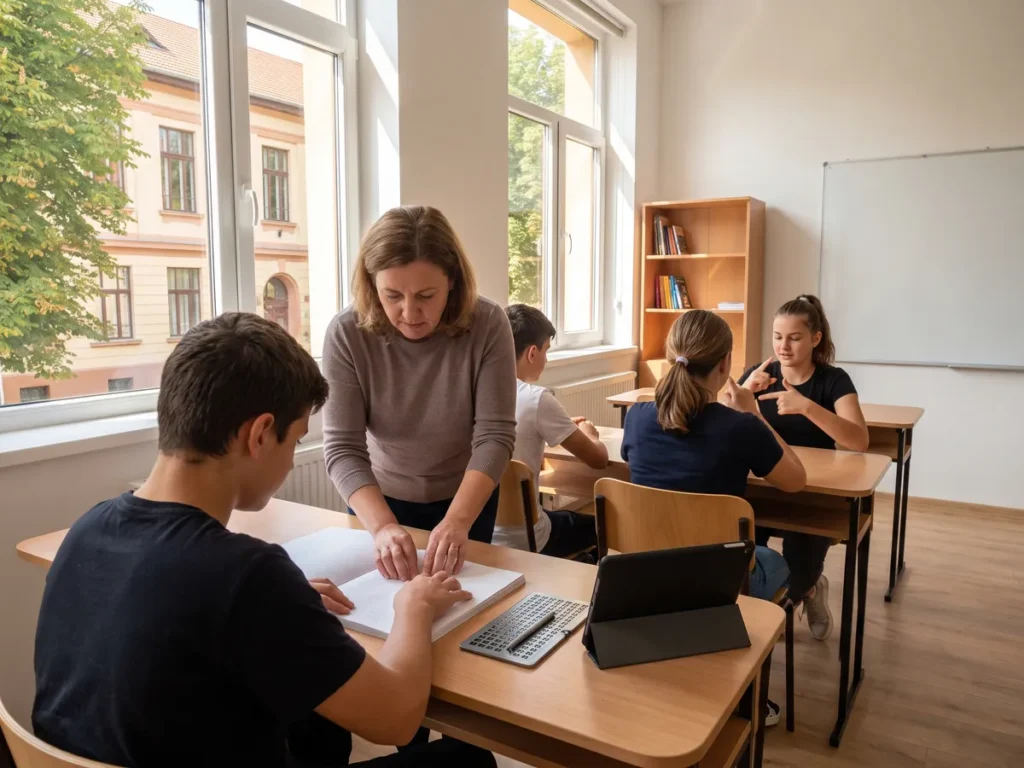
The third effect is the recognition of subjects that do not exist in mainstream upper secondary schools. The master list includes, as separate curricula, Romanian Sign Language and Braille reading and writing, both in the specialist curriculum, alongside specific rehabilitation and compensation therapies, physiotherapy, assistive technologies and psychological assessment and vocational guidance. These are not optional activities noted in the pupil’s file, but subjects with their own curriculum, approved by ministerial order.
The fourth effect concerns the ordinary subjects, which get versions of their own. Romanian Language and Literature, Modern Language 1 English, including a separate version for beginners, Modern Language 2 French, Mathematics, Physics, Chemistry, Biology, History, Geography, Logic, Religion, Physical Education and Sport, Information and Communication Technology and Computer Science each appear with an adapted curriculum, rather than a cross-reference to the mainstream curriculum.
The fifth effect concerns the institutions. Under art. 7, implementation falls to the General Directorate for Equity and Performance in Pre-University Education, the General Directorate for Minorities and Desegregation, the National Centre for Curriculum and Assessment, the National Centre for the Development of Vocational and Technical Education, the county school inspectorates and the schools themselves. It is a long chain, and the practical deadline is the start of the school year.
What has changed compared with the previous situation
The substantive change is the move from plans without curricula to a complete curriculum. Order no. 6.873/2025 had approved the framework curriculum plans for full-time special upper secondary education, but the curricula linked to the subjects in those plans were missing. In their absence, teachers worked on the basis of the transitional measures applicable across the national education system, approved by Order of the Minister of Education no. 6.072/2023, an act expressly cited in the preamble of the present order.
The second change concerns method. The curricula were drawn up within the framework set by Order of the Minister of National Education no. 3.593/2014, which approves the methodology for drafting and approving the school curriculum, and went through the National Centre for Curriculum and Assessment, an institution reorganised by Government Decision no. 251/2025. The underlying legal basis is art. 88 paras. (2) and (10) of Pre-University Education Law no. 198/2023.
The third change, the most visible one for a parent, is that adaptation is no longer improvised on the ground. Until now, a teacher at a special upper secondary school teaching mathematics to a class of pupils with sensory disabilities adapted the mainstream curriculum alone, each in their own way. From now on there is a document approved by ministerial order, identical across the country, which states what is taught and at what level.
What has not changed: the order does not amend the framework curriculum plans, so the number of hours per subject remains the one set by Order no. 6.873/2025. And it does not touch the curricula for higher grades, which come into force year by year, as the cohort now starting grade IX moves up.
Advantages and disadvantages
What it improves
- Pupils in special upper secondary schools have, for the first time at this level, their own centrally approved curricula, rather than adaptations made individually by each teacher.
- Romanian Sign Language and Braille reading and writing become subjects with their own curriculum, which gives them the status of a school subject rather than an optional therapy.
- The eight-year validity, with a calendar written out year by year, brings predictability: schools know how long the textbooks and teaching materials built on these curricula will remain valid.
- Progressive application avoids a break for pupils already in upper secondary school, who finish their studies under the curricula they started with.
- Assistive technologies enter the curriculum as a subject, at a time when such equipment is becoming more affordable.
What remains a problem
- The order was published on 19 August, less than two weeks before the school year begins, for a package of 1,080 pages that teachers have to read through and turn into lesson planning.
- The annexes did not appear in the ordinary edition, but in a separate one, bought from the Official Gazette of Romania’s public relations centre, which adds a step between the teacher and the document they need.
- Through the formula used in the master list, the curricula target sensory disabilities and intellectual disabilities of mild and moderate severity, so they do not explicitly cover every situation in special education.
- The eight articles of the order set out no teacher training measures for the new curricula and no deadline for adapted textbooks or teaching aids.
- The curricula for grade X and beyond do not exist yet; they are to be approved year by year, which leaves schools with planning uncertainty.
Practical advice
- If you have a child starting grade IX at a special upper secondary school in September 2026, ask the school for the curriculum of the subject you are interested in. It is now a public document, approved by ministerial order.
- Check the master list in annex no. 1 first. It gives the annex number for each subject, so it takes you straight to the curriculum you are looking for, without leafing through 1,080 pages.
- Pay attention to the track, the profile and the specialisation. The same subject has different curricula, for instance in mathematics and computer science compared with natural sciences, and within each of them a distinction is drawn between the common core, marked TC, and the specialist curriculum, marked CS.
- If the pupil is in grade X or above in 2026-2027, these curricula do not concern them. Application is progressive and starts with grade IX.
- Teachers preparing their annual planning should start from the general explanatory note in annex no. 184, which explains the logic of the whole package, before going into the subject curriculum.
- Keep the validity period in mind. The grade IX curriculum remains in force until the 2033-2034 school year, that is, eight years starting with 2026-2027.
- For pupils with visual or hearing impairments, ask whether the school has Braille reading and writing and Romanian Sign Language on the timetable. They are subjects with an approved curriculum, in the specialist curriculum.
Frequently asked questions
When do the new curricula start to apply?
My child is in grade XI. Does anything change for them?
Where can I find the curricula themselves?
How many curricula were approved?
How long are they valid?
Does grade XV really exist?
Which subjects are new compared with mainstream upper secondary schools?
Who are these curricula addressed to?
Original text of the legal act
The text below is reproduced in Romanian, the official form of publication.
The full text, as published in the Official Gazette of Romania
Official Gazette of Romania no. 685 of 19 August 2026 16 pages PDF, 102 KB the act starts on page 16
Open the official PDFDownload the PDF
The viewer is not shown on small screens. Use the buttons above to open or download the file.
This article is for informational purposes only and does not constitute legal advice. For specific situations, consult a licensed attorney or tax advisor.