
In brief
- The Romanian language and literature curriculum for schools and classes taught in Hungarian, grades 5 to 8, is being replaced from the 2026-2027 school year, which starts in a few days.
- Content marked in the curriculum as applied and intuitive, that is grammar taught without theory, will no longer be assessed in theoretical terms in the national examinations, only through its use in context.
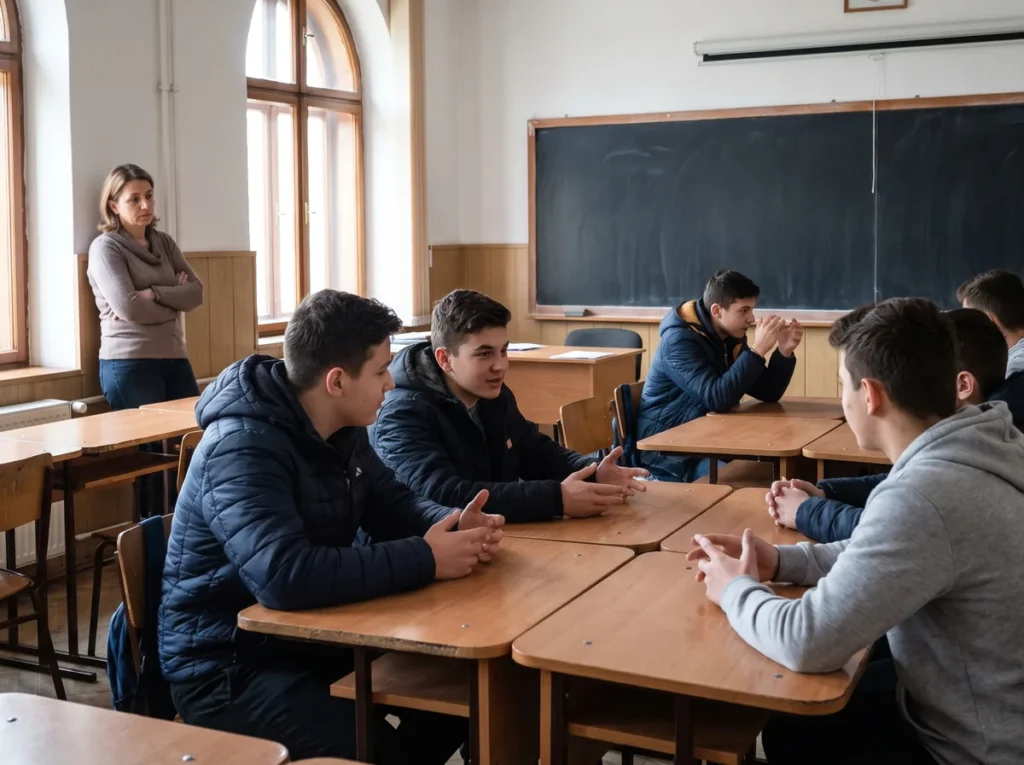
- The curriculum requires Romanian to be the language of contact in the classroom, the teacher to speak less than the pupils, and mistakes no longer to be corrected on the spot while a pupil is speaking.
Published: Official Gazette of Romania (Monitorul Oficial) no. 719 and no. 719 bis of 28 August 2026
In force from: 28 August 2026
A few days before the school year begins, the Ministry of Education publishes a new Romanian curriculum for pupils in Hungarian-language schools, built on the rules for teaching a non-native language. MEC Order no. 5.111/2026 replaces the curriculum approved in 2017 and applies from the 2026-2027 school year. It is the second major curriculum change published in August, after the 182 new curricula for special upper secondary education.
For these pupils, Romanian is not the mother tongue but a second language, learned at school. That is why it has its own curriculum, separate from the Romanian language and literature curriculum in Romanian-language schools, and why the subject is studied for four hours a week, under the 2016 framework plan. The new curriculum says openly what it rests on: the 2018 companion volume to the Common European Framework of Reference for Languages, the document against which levels of knowledge of a foreign language are measured, from A1 to C2.
What it changes in practice
The first effect is the shift of emphasis from theory to use. The methodological guidance requires metalanguage, that is grammatical terminology, to be kept to a minimum, and grammar and vocabulary to remain means of communication rather than an object of study in themselves. In the content tables, almost every grammar chapter carries the note „Aplicativ”, applied, which under the definitions in the curriculum means that the phenomenon is analysed without being theorised.
The second effect concerns examinations. The curriculum expressly provides that „Conținuturile propuse pentru prelucrare aplicativă și intuitivă nu vor fi evaluate teoretic în cadrul examenelor de evaluare la nivel național, ci numai din perspectiva utilizării contextuale”, that content proposed for applied and intuitive treatment will not be assessed in theoretical terms in the national examinations, only from the point of view of its use in context. For a pupil in grade 8, that changes what the paper in this subject looks like at the national assessment.
The third effect is the classroom rule. The first methodological principle calls for Romanian to be imposed as the privileged language of contact during lessons, with the use of the mother tongue significantly limited. The eighth calls for activities to be decentred, so that the teacher’s voice is heard less than the pupils’, and for the teacher to act as a moderator rather than as the centre of the lesson.
The fourth effect is giving up immediate correction. During oral communication activities, pupils will no longer be interrupted to have their mistakes corrected, because such interventions damage fluency and confidence. Errors are noted by the teacher and discussed at the end of the activity. Correction on the spot remains reserved for cases where the mistake gets in the way of understanding the message.
The fifth effect is the sizing of the texts. The curriculum sets lengths for the working materials: for listening, 80 to 120 words in grade 5, 120 to 180 in grade 6, 200 to 240 in grades 7 and 8; for reading, 100 to 140, 140 to 200 and 220 to 260 words. The language level aimed at is A2-B1+, and the vocabulary and grammar exercises are calibrated to it.
The sixth effect is the thematic organisation. Each grade has a general theme, developed through four topics, three compulsory and one optional: „Me and my familiar universe” in grade 5, „Me and the world around me” in grade 6, „The horizons of the world and of knowledge” in grade 7, „Reflections on the world” in grade 8. Each topic starts with a non-literary text and includes at least one literary text.
The seventh effect is the reading list. The curriculum proposes around 90 authors, from Alecsandri, Creangă, Caragiale, Eminescu, Slavici and Sadoveanu through to Rowling, Tolkien, Roald Dahl, Neil Gaiman, Jeff Kinney and David Walliams, alongside contemporary Romanian writers of children’s literature. The types of text allowed include dictionary entries, online posts, leaflets, short messages, comic strips and posters.
What has changed compared with the previous situation
The curriculum being replaced is the one approved in 2017, through Annex no. 2 to MEN Order no. 3.393/2017, published in Official Gazette of Romania no. 164 and no. 164 bis of 7 March 2017. The introductory note to the new curriculum says how much has changed: the revision „vizează până la 25% din conținutul actualei programe, nefiind operate schimbări majore în ceea ce privește structura și finalitățile acesteia”, it covers up to 25% of the content of the current curriculum, with no major changes to its structure or its aims, and the adjustments are „preponderent editorial și metodologic” in character, mainly editorial and methodological.
What has actually changed, according to the same note, is the reorganisation of some content along the descriptors in the companion volume to the Common European Framework of Reference for Languages, published in 2018, that is after the 2017 curriculum, and the rewording of some competences for the sake of clarity. That is also why the change concerns only this curriculum for the time being: it is built on the contrast with the pupil’s mother tongue. The specific competences expressly require pupils to notice the sounds particular to Romanian in comparison with the mother tongue and to recognise the mobile Romanian stress as against the fixed stress of the mother tongue, that is exactly the features that separate Romanian from Hungarian.
What has not changed are the five general competences: receiving oral texts, producing oral texts, receiving written texts, writing texts, and showing an open and respectful attitude towards cultural and linguistic diversity. Nor has the number of hours changed, four a week, set by the framework plan approved in 2016.
Advantages and disadvantages
What it improves
- The curriculum says explicitly that the aim is communication, not theoretical knowledge about the language, which corrects a long-standing practice of teaching Romanian as a mother tongue to children who do not speak it at home.
- Giving up immediate correction of mistakes during speech is a rule from foreign-language teaching that raises the chances of a pupil actually speaking.
- The text lengths are written down in figures, by grade, so the teacher and the textbook author share a benchmark.
- The reading list mixes Romanian classics with contemporary children’s literature, which gives the teacher real room to choose.
- The A2-B1+ levels tie the curriculum to a verifiable European standard rather than to an internal judgement.
- The statement about the national examinations removes an ambiguity that had pupils learning theory the curriculum was not asking of them.
What remains a problem
- The curriculum is published in the last days of the holidays and applies from the first day of school, with no period in which to prepare the teachers.
- The textbooks remain those written for the 2017 curriculum, and the order says nothing about replacing or adapting them.
- The revision of up to 25% is not marked in the text, so a teacher cannot see what has changed without comparing the two curricula line by line.
- The rule that the teacher should speak less than the pupils comes with no supporting tool, in a class of 25 children who do not speak Romanian at home.
- Only the curriculum for Hungarian-language schools changes, without the order saying what happens with the other minorities.
- The published text contains broken links, one of them carrying the prefix of a browser extension, which points to a hurried final check.
Practical advice
- Teachers of Romanian in schools and classes taught in Hungarian: download the curriculum from Official Gazette of Romania no. 719 bis, pages 3 to 47, before your first lesson. It applies from the 2026-2027 school year.
- Read the methodological guidance chapter first, pages 40 to 44. That is where the changes of practice sit: the language of contact, the role of the teacher, the handling of mistakes, the length of texts.
- When choosing the supporting texts, keep to the lengths by grade: 80 to 120 words for listening in grade 5, up to 240 in grades 7 and 8, and between 100 and 260 words for reading.
- Each grade has four topics, three compulsory and one optional. Start each topic with a non-literary text and include at least one literary text.
- Do not build your assessments on grammatical definitions. Applied and intuitive content is checked through use in context, not through reciting the rule.
- Parents of pupils in grade 8: ask the teacher how preparation for the national assessment in this subject changes, because the curriculum expressly excludes theoretical assessment of this content.
- Head teachers: the new curriculum applies from grade 5 to grade 8 in the same year, not gradually, so all four year groups move to it at once.
Frequently asked questions
When does the new curriculum apply?
Who does it concern?
How much changes compared with the 2017 curriculum?
Is grammar still taught?
What language level does the curriculum aim at?
Do the textbooks change as well?
Editorial analysis
The curriculum solves a problem long acknowledged and rarely dealt with head on: Romanian was taught in Hungarian-language schools with the logic of a mother tongue, to children who do not hear it at home. The new text says, in its methodological chapter, exactly what needed saying: grammar and vocabulary are means, not an end, and the end is that the pupil should be able to use the language. The statement that this content is not assessed in theoretical terms in the national examinations closes the loop, because in Romanian schools what gets taught is what comes up in the exam.
What is not visible when reading the curriculum shows up when the bibliography is placed next to the make-up of the working group. Of the 23 scientific references, 11 carry the name of Elena Platon, who is also the scientific coordinator of the group that drafted the curriculum. She is at the same time the author or editor of the reference works on teaching Romanian as a non-native language, published in Cluj, so the overlap is nothing unusual in a field with few specialists. It is worth saying nonetheless, because the bibliography of a national curriculum is also a purchasing list for school libraries.
The second observation concerns what was left unsaid. The order replaces a single curriculum from Annex no. 2 to the 2017 order and says nothing about the other subjects or minorities that would rest on the same non-native-language logic. The argument in the curriculum is a solid one, because the text is built on the contrast with the pupil’s mother tongue, with express references to fixed stress and to the sounds that separate the two languages. A pupil in a school taught in another minority language is nonetheless also learning Romanian as a second language, and stays, for now, on the 2017 curriculum.
The third observation is about the care taken over the published text. In the introductory note, the reference to the companion volume to the Common European Framework of Reference appears with the prefix of a browser extension stuck in front of it, „chrome-extension://efaidnbmnnnibpcajpcglclefindmkaj/https://rm.coe.int/…”, an address copied out of a PDF reader and never checked. In the list of useful links, the address video.elearning.ubbcluj.ro is written „http://.video.elearning.ubbcluj.ro”, with an extra dot that makes it dead, and one of the recommended resources is given complete with the advertising tracking parameter from the original address. None of them changes any legal obligation, which is why they have not been listed as errata, but all three are printed in the Official Gazette of Romania.
What should be changed
- An edition of the curriculum with the changes marked. A teacher who has taught for nine years to the 2017 curriculum needs to see what has changed, not to compare 45 pages line by line.
- A timetable for the textbooks. The curriculum applies from the first day of school while the textbooks remain the old ones; the order should have said by when they are to be adapted or replaced.
- Correcting the three web addresses in the annex. The browser extension prefix, the extra dot in the Cluj address and the advertising parameter in a recommended link can be repaired in half an hour.
- An explicit position on the other minorities. If the argument for the revision is alignment with the teaching of non-native languages, it applies there too; if not, the order should say why.
- Training for teachers before it applies, not after. The classroom rules in the methodological chapter, from limiting the mother tongue to giving up immediate correction, are changes of teaching practice, not of content, and they are not picked up from a text published a few days before the first lesson.
Original text of the legal act
The text below is reproduced in Romanian, the official form of publication.
The full text, as published in the Official Gazette of Romania
Official Gazette of Romania no. 719 and no. 719 bis of 28 August 2026 16 pages PDF, 208 KB the act starts on page 16
Open the official PDFDownload the PDF
The viewer is not shown on small screens. Use the buttons above to open or download the file.
This article is for informational purposes only and does not constitute legal advice. For specific situations, consult a licensed attorney or tax advisor.