
In brief
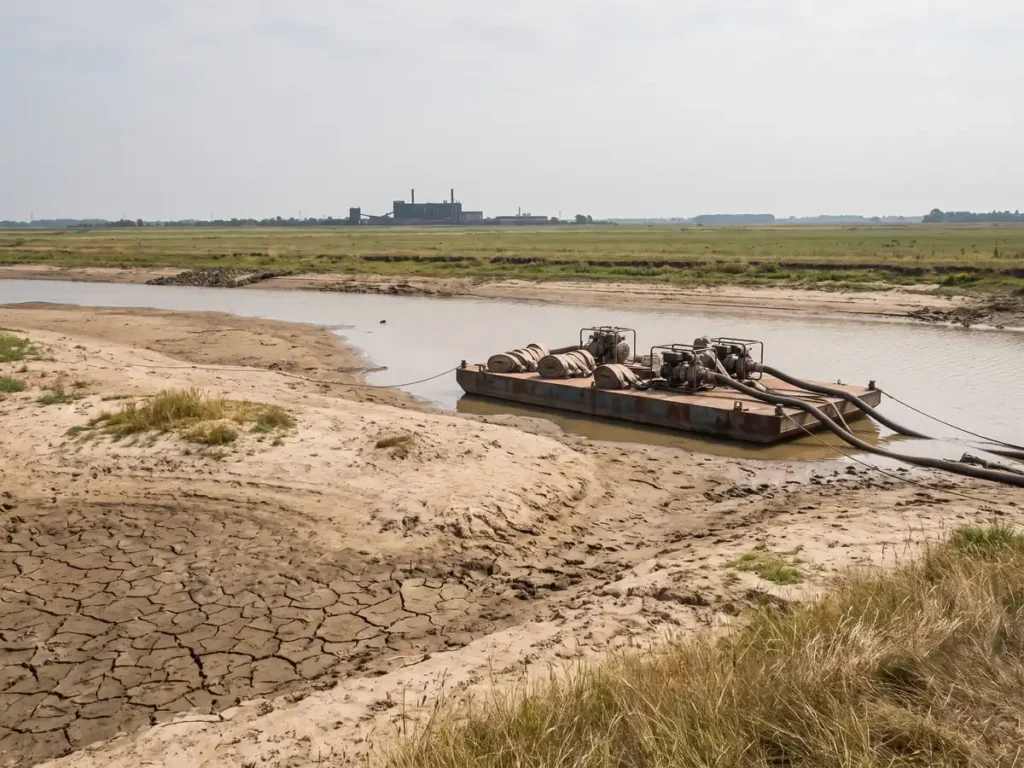
- The State is giving up the flow-directing dyke approved in August for the Old Danube and replacing it with a line of ballasted vessels and barges, laid along an alignment of about 600 m, which narrows the bed and pushes part of the flow towards the intake channel of the nuclear power plant at Cernavodă.
- Everything starts at a level of 1.58 m dMB measured in the intake basin of the plant, 3 centimetres higher than the threshold in the previous decision. At the same level, navigation and lock operations on the Danube-Black Sea Canal are restricted or temporarily stopped.
- In parallel, 4 to 8 high-capacity pumps are being contracted, of around 3 cubic metres per second each, that is between 1 and 2 million cubic metres of water a day. The money is requested from the Government’s reserve fund, but the decision puts no figure on paper.
Published: Official Gazette of Romania (Monitorul Oficial) no. 741 of 2 September 2026
In force from: 2 September 2026, the date of publication
The State is giving up the dyke in the Danube that it had approved in August for the Cernavodă plant and replacing it with a line of barges laid across the riverbed. Decision no. 22/2026 of the National Committee for Emergency Situations, signed by Prime Minister Ilie-Gavril Bolojan on 1 September 2026 and published in Official Gazette of Romania no. 741 of 2 September 2026, stops the measures in Articles 2, 3, 8 and 10 of the decision of 22 August, the one that approved the flow-directing dyke and the emergency dredging, and puts in their place an intervention in three stages, designed so that it can be taken apart again.
The reason for the change is written in the preamble of the decision and comes from a technical report of the National Water Administration „Apele Române” dated 30 August 2026, registered under number 25.901 of 31 August 2026. Measurements on the ground, taken between 27 and 30 August on the Bala sector, the Old Danube, Cernavodă and the entry into the Danube-Black Sea Canal, together with hydraulic modelling, showed that a groyne of about 150 m does not solve the problem. A groyne is a stone spur built out from the bank towards the middle of the bed, which deflects the current. The conclusion of the report: at 150 m it merely pushes the current towards the mouth of the canal, without producing a sufficient backwater effect, that is without raising the water level upstream, which was the whole point. And extending it to something in the order of 450 m does not fit into the time available and brings risks of altering the riverbed, on a work that has to be removed later anyway.
The underlying problem has been the same since the end of July 2026. The Danube is running low, and the Old Danube branch, which carries the water towards the plant intake, has shallow sills and a bed shape that limits how much can pass through it. The forecasts quoted in the decision for the interval 31 August to 28 September 2026 promise no recovery: temperatures above normal, deficient rainfall in the west, south-west and centre between 7 and 14 September, and after that amounts close to normal, not enough for a comfortable hydrological regime. The preamble says plainly why the State is stepping in: protecting the population, continuity of essential public services, securing the water the plant needs in order to run, maintaining energy security and avoiding major effects on critical infrastructure.
It is worth saying from the start what this decision is not. It does not deal with a nuclear risk. The legal basis invoked is point 17 of Annex no. 1 to Government Decision no. 557/2016, which goes under the name „failure of public utilities” and places it with the Ministry of Energy for the major electricity networks. And Article 2(3) says, in its own words, that the threshold of 1.58 m dMB is an operational precautionary marker for setting the works off and that it does not alter the limits, the operating conditions, the nuclear safety requirements or the obligations laid down in the plant’s licences. The operating regime of the reactors stays where it was, in the licences issued by the nuclear authority.
The level is measured in metres above the level of the Baltic Sea, abbreviated dMB, the reference system used in Romania for water levels. The level of 1.58 m dMB is read in the intake basin of the plant and is reported in real time by Nuclearelectrica, through its CNE Cernavodă branch. Alongside it, the decision gives two further reference points, without any power to set the works off: about 1.78 m dMB in the section of the Danube-Black Sea Canal and about minus 261 cm at the Cernavodă gauging station, where the value is negative because it is read against the zero of the station gauge, not against sea level.
What it changes in practice
The approved system has three stages, put into operation one after the other, depending on what the measurements show. Stage I means temporarily narrowing the section through which the Old Danube flows, with vessels and barges ballasted down to a draught set by a technical operating plan, along an alignment of about 600 m. The aim is to produce a local backwater effect and to push an extra part of the flow towards the entry into the Danube-Black Sea Canal and towards the intake channel of the plant. The success criterion is a figure: a gain in the order of 10 cm at the plant, against the reference situation and against the natural hydrological trend, checked through synchronised measurements before and after each phase.
Stage II comes into play if the effect is insufficient or if the level returns to 1.58 m dMB or falls below it. It consists of a modular closure with pontoons and hydro-barriers, that is inflatable dams filled with water, over a section of about 170 m in the area of the link channel towards the plant, coordinated with the operation of the pumps. Anchoring is done in a distributed and redundant way, sized against the real loads of the current. The reserve stage, the last one, is the mechanised closure with rock fill, that is with stone tipped into the bed, and it is activated only if the modular system fails, cannot be installed, cannot be held safely, or if the water supply to the plant cannot be secured otherwise. It is the only stage that is hard to reverse, which is why Article 2(9) keeps it as a last-resort solution, to be activated only on the basis of a documented technical decision.
For people and for businesses, the most visible effect is on the water. Once the threshold of 1.58 m dMB is reached, the Ministry of Transport and Infrastructure, through the „Administrația Canalelor Navigabile” National Company, the Lower Danube River Administration in Galați and the Romanian Naval Authority, order without delay the restriction or temporary suspension of navigation and lock operations on the Danube-Black Sea Canal and on the sectors of the Old Danube affected by the works. The decision requires the procedures and the notices to be prepared in advance, precisely so that activation no longer has to wait for paperwork. Navigation resumes in stages, once a sufficient hydraulic margin and a stable hydrological trend have been established, with no calendar date.
The second line of defence is pumping. The National Water Administration „Apele Române” and Nuclearelectrica, supported by the Ministry of Transport, by the Department for Emergency Situations through the General Inspectorate for Emergency Situations, by the National Agency for Land Reclamation and by the Ministry of National Defence, contract and put into operation a high-capacity pumping system. The reference configuration: a minimum of 4 to 8 pumps of around 3 cubic metres per second each, together with auxiliary installations and staff. At least 4 pumps have to be available for installation within 4 days at most, and the full configuration within a maximum of 7 days from the activation of the contract. The preparation has to be done before the level reaches 1.45 m dMB.
As an order of magnitude, four pumps of 3 cubic metres per second move 12 cubic metres per second, that is about 1.04 million cubic metres of water in 24 hours. Eight pumps take the figure to 24 cubic metres per second and about 2.07 million cubic metres a day. For comparison, at the end of August 2026 the Danube was entering the country at Baziaș with around 1,350 cubic metres per second, according to the decision extending the state of alert. The pumping system does not raise the river, it takes water straight to where it is needed.
The remaining obligations are shared out as follows. The Ministry of National Defence provides topo-bathymetric, hydrographic and geodetic surveys, that is measurements of the shape of the bed and of the depths, makes available naval and engineering capabilities for platforms and pontoon bridges, and divers, and takes part in installing, stabilising and withdrawing the hydro-barriers. Apele Române carries out the support works: temporary access roads, ramps, laying out the working areas and the two support sills for the pontoons, over sectors of 30 to 40 m on each bank. The Ministry of Transport looks for and rents about 150 aluminium elements of around 300 by 100 by 10 cm, for the system that fixes and anchors the hydro-barriers. Put end to end, the 150 elements come to 450 m in length, more than 2.6 times the 170 m section they close off, which shows that the anchoring is designed in several rows, not in a single one.
Technical coordination sits with the inter-ministerial committee for securing the water supply for cooling the reactors at Cernavodă, set up by Prime Minister’s Decision no. 278/2026. It validates the move from one stage to the next, against compulsory „go/no-go” criteria: the hydraulic effect measured, the speeds and the flows, the stability of the vessels and of the anchorages, the absence of accelerated scour, that is of the bed being eaten away at the foot of the structures, the safety of staff and of navigation, the operation and redundancy of the pumps, and the maintenance of the water supply to the plant. Decisions are recorded in documents assumed by the representatives of the institutions. Dredging continues, under the plan approved in the same committee.
What has changed compared with the previous situation
The first change is the technical solution itself. Decision no. 20/2026, published in Official Gazette of Romania no. 698 of 22 August 2026, approved the building of a groyne to direct the current in the bed of the Old Danube. Ten days later, the measurements showed that the work does not produce the effect sought at the length that could be built, and that the length which would have produced the effect could not be carried out in time. The State has moved from a fixed structure to a floating obstacle: 600 m of vessels and barges instead of 450 m of stone, a third more in length, but brought in and taken out with a tug.
The second change is the threshold. The old decision tied the suspension of lock operations to a level of 1.55 m dMB at the plant intake. The new decision moves the trigger to 1.58 m dMB, 3 centimetres higher. In other words, the intervention starts earlier, and between the moment it is triggered and the level of 1.45 m dMB, at which the pumps have to be ready, there are 13 centimetres left instead of 10.
The third change concerns the pumps. The August decision called for high-capacity motor pumps and electric pumps to be identified, transported and put in place in stages, until the level of 1.45 m dMB was reached. The new decision changes the approach: instead of a large number of small machines, a small number of very large pumps, contracted as a system, with auxiliary installations, staff and firm delivery deadlines. Their role is explicitly that of an independent hydraulic reserve, that is a source which works even if the intervention in the riverbed does not give the expected result.
The fourth change is one of method. The old decision approved the work. The new decision approves a procedure: each stage is measured before and after, is compared against the natural trend of the river, and the move to the next stage has written criteria. It is the difference between deciding on a structure and deciding on an algorithm for deciding, and in an unstable hydrological context the second is the more honest of the two.
What has not changed is the state of alert. It was declared by CNSU Decision no. 15/2026, published in Official Gazette of Romania no. 637 of 31 July 2026, for 30 days starting on 31 July 2026, and it was extended by CNSU Decision no. 21/2026, published in Official Gazette of Romania no. 722 of 28 August 2026, by another 30 days, until 28 September 2026. In all, 60 days of state of alert for energy, between 31 July and 28 September 2026.
Advantages and disadvantages
What it improves
- The solution is reversible. The barges, the pontoons and the hydro-barriers can be taken out, unlike a stone groyne, which stays in the bed and changes the flow over the long term.
- Each stage has a numerical success criterion, a gain of 10 cm in level at the plant, checked through synchronised measurements before and after. The effect of the works can be separated from the natural evolution of the river.
- The State admits publicly, in a legal act, that the solution approved ten days earlier does not work, and explains why. That is rare and it is healthy.
- Pumping is treated as an independent reserve, not as a helping hand. If the intervention in the riverbed does not give the expected result, the water supply to the plant does not depend on it.
- The logistics are prepared before the thresholds are reached, not after. Article 10 obliges the institutions to have all the stages ready, even if they put them into operation one after the other.
- No exemption is granted from procurement law, from environmental permits or from the rules on water management. The urgency changes the speed of the procedures, not their content.
What remains a problem
- The decision contains no figure at all. Financing from the Government’s reserve fund is proposed, but what the barges, the pumps and the access roads cost is written nowhere, and the proposal needs a separate government decision before it becomes money.
- The deadlines for the pumps run from „the activation of the contract”, a date the act does not fix. The obligation to be ready before 1.45 m dMB therefore depends on a date that is not written down.
- The restriction of navigation on the Danube-Black Sea Canal has no maximum duration and no review date. Traffic resumes „once a sufficient hydraulic margin has been established”, a formula carriers cannot plan around.
- The reserve stage, closure with rock fill, is the only one that cannot easily be withdrawn. The act does not say who brings the bed back to its original shape after the crisis, or with whose money.
- The technical horizon of the decision stops on 28 September 2026, the day the state of alert expires. What happens to the works installed in the riverbed if the state of alert is not extended is not written in the act.
- The act says nothing about the water supply of the localities in the area. It concerns exclusively the water resource of the plant and navigation, and a reader looking for answers about tap water will not find them here.
Practical advice
- If you have cargo on the Danube-Black Sea Canal, follow the notices of the Romanian Naval Authority and of the „Administrația Canalelor Navigabile” National Company. The restriction is activated at a level of 1.58 m dMB and the decision expressly requires it to be ordered without administrative delay, so without any extra warning.
- Put into your canal transport contracts a clause for the interruption of navigation on hydrological grounds, with clear deadlines and costs. The act gives no maximum duration for the restriction, and the resumption depends on measurements, not on the calendar.
- Follow the level at the Cernavodă gauging station, where the auxiliary reference point is about minus 261 cm. Hydrological data are published by the National Institute of Hydrology and Water Management and by Apele Române, and getting close to this marker signals that the main threshold is near.
- Firms that can make available high-capacity pumps, barges, pontoons or aluminium elements of the type described in Article 6 should get their documents ready now. The purchases are made through the negotiation procedure without prior publication, which is quick, but which requires the contracting authority to document the legal conditions.
- If you live or fish on the sector of the Old Danube between the Bala bifurcation and Cernavodă, treat the area as a temporary building site. There will be ballasted vessels, pontoons, access roads and ramps on the banks, and leisure boating may be restricted along with commercial traffic.
- If you follow the subject for safety reasons, read Article 2(3) in full. It says explicitly that the threshold of 1.58 m dMB does not alter the limits, the operating conditions, the nuclear safety requirements or the obligations in the plant’s licences.
Frequently asked questions
What did the National Committee for Emergency Situations decide on 1 September 2026?
Why was the dyke approved in August abandoned?
What does the level of 1.58 m dMB mean and where is it measured?
Does navigation on the Danube-Black Sea Canal stop?
How many pumps are being brought in and how much water do they move?
Who pays for the works?
Does the decision grant exemptions from public procurement or from environmental permits?
What happens if the barges and the hydro-barriers do not give the expected result?
Is the nuclear safety of the plant affected?
Until when do the measures apply?
Errors and inconsistencies in the published text
- Article 5(3) read together with Article 1: the motor pumps the plant has to fuel are identified nowhere. The paragraph obliges CNE Cernavodă to provide the fuel and the other resources for at least two weeks of continuous operation of the motor pumps „engaged in the operational intervention, other than those contracted by the National Water Administration «Apele Române», named in this decision”. The only pumps the decision describes are the 4 to 8 units contracted by Apele Române under Article 5(2), which is exactly the category excluded. The remaining motor pumps were deployed on the basis of Article 10 of CNSU Decision no. 20/2026, a measure that Article 1 of this decision stops. A reader in good faith can arrive at two opposite conclusions: that the fuel obligation covers the machines already on site, which stay, or that it has no object, since the basis for them has just been extinguished. And the obligation is not symbolic, it means diesel for 14 days of uninterrupted operation, paid for by a commercial operator.
- Article 5(2): the 7-day deadline applies to a „full configuration” that cannot be established. The same paragraph sets the reference configuration at „a minimum of 4 to 8 pumps”, that is a range, and then requires the full configuration within a maximum of 7 days from the activation of the contract, while paragraph (4) leaves the sizing of the system to the conditions on the ground. After seven days, with four pumps installed, one reading says the deadline has been met, because four is the minimum of the reference configuration, and another says it has not, because full means eight. This is not simple imprecision in drafting: Article 7(2) includes „the operation and redundancy of the pumping system” among the compulsory „go/no-go” criteria for moving from one stage to the next, so an undetermined quantity feeds a decision that is either taken or not taken.
Editorial analysis
The decision has a quality that crisis measures rarely have: it shows its own mistake. On 22 August the State approved a groyne, on 1 September it wrote in the Official Gazette of Romania that the groyne does not raise the level, with the technical explanation alongside. Ten days between a solution and its retraction, with four days of measurements on the ground in between, is a pace the Romanian administration does not usually keep. The rest of the act has the same discipline: numerical thresholds, „go/no-go” criteria, synchronised measurements before and after each phase, precisely so that the effect of the works can be told apart from what the river would have done anyway.
The weakness is not in the technical part, but in the parts about time and money, and it only shows when you put two articles side by side. Article 2(3) sets everything off at 1.58 m dMB. Article 5(4) requires the pumps to be mobilised and ready before 1.45 m dMB. Between the two levels there are 13 centimetres. Article 5(2), however, allows 4 days for the first four pumps and 7 days for the full configuration, counted not from a level but from „the activation of the contract”, a date the act fixes nowhere. If the contract is activated only when the threshold of 1.58 m is reached, a fall faster than about 1.9 centimetres a day eats up those 13 centimetres before the full set is on the bank, and one faster than 3.25 centimetres a day eats them up before even the first four pumps arrive. The only real anchor left is Article 5(1), which requires contracting „as a matter of urgency”, that is immediately. An act that counts centimetres to two decimal places could have counted the days as well.
The second observation concerns the horizon. The report on which the decision rests looks at the interval 31 August to 28 September 2026. The state of alert, extended by CNSU Decision no. 21/2026, also expires on 28 September 2026. The two dates coincide to the day, which means that the whole architecture of the intervention is designed to run exactly up to the edge of its own legal basis, not up to the recovery of the Danube. Yet the objects placed in the riverbed are physical: 600 m of ballasted barges, pontoons, redundantly anchored hydro-barriers, possibly stone. They do not vanish on 29 September along with the state of alert. The act says how they are installed and against which criteria, but not on what basis they stay or are withdrawn if the alert is not extended.
On money, Article 9 does what a committee can do: it proposes. The power invoked, Article 20(h) of Government Emergency Ordinance no. 21/2004, is precisely that of proposing the necessary funds to the Government, not of allocating them. The problem lies elsewhere: the proposal covers only the costs of the works under Article 2(1), that is the intervention in the riverbed. The pumping system in Article 5 and the support works in Article 6, access roads, ramps, sills for the pontoons, also contracted by Apele Române, fall outside paragraph (1) and do not come under paragraph (3) either, which concerns „the other institutions”. All they have to rely on is the promise in paragraph (2), that the ministry „analyses and promotes” the replenishment of the funds. And the amount, at neither end, is written down.
What should be changed
- A cost estimate in the body of the decision. Even an order of magnitude for the barges, the pumps and the access works would give Apele Române a limit up to which it can commit spending before the government decision, and would give the public a measure of the effort.
- Deadlines for the pumps tied to a calendar date, not to „the activation of the contract”. With a fixed date, the obligation to be ready before 1.45 m dMB becomes verifiable, and the 13 centimetres of margin acquire an operational meaning.
- An express definition of the „full configuration”: four pumps or eight. The „go/no-go” criterion in Article 7(2) on the redundancy of the pumping cannot be applied honestly for as long as the number that makes it up remains a range.
- Daily publication of the level measured at the plant and at the Cernavodă gauging station. Carriers and local authorities would see the threshold of 1.58 m dMB approaching in good time, instead of finding out from the notice suspending navigation.
- An annex listing the motor pumps already on site for which CNE Cernavodă provides the fuel. It would close the gap in Article 5(3) and would make the cost of that obligation predictable for the operator.
- A clause on what happens after 28 September 2026 to the elements installed in the riverbed. Withdrawal, upkeep and liability for bringing the bed back to its original shape need a legal basis that does not expire along with the state of alert.
Original text of the legal act
The text below is reproduced in Romanian, the official form of publication.
The full text, as published in the Official Gazette of Romania
Official Gazette of Romania no. 741 of 2 September 2026 8 pages PDF, 80 KB the act starts on page 4
Open the official PDFDownload the PDF
The viewer is not shown on small screens. Use the buttons above to open or download the file.
This article is for informational purposes only and does not constitute legal advice. For specific situations, consult a licensed attorney or tax advisor.