
In brief
- The Danube has dropped so far that the water reserve at the intake of the Cernavodă Nuclear Power Plant had come down to 23 centimetres above the level at which the reactors switch to recirculation.
- The National Committee for Emergency Situations has approved emergency dredging, a groyne in the bed of the Old Danube and the mobilisation of more than 60 high-capacity motor pumps.
- If the level falls to 1.55 m dMB, lock operations and traffic on the Danube-Black Sea Canal stop, and Hidroelectrica releases a further 50 mc/s or so from the Olt, for five days.
Published: Official Gazette of Romania (Monitorul Oficial) no. 698 of 22 August 2026
Adopted: 21 August 2026
On 20 August 2026, at 06:00, the water at the intake of the Cernavodă nuclear plant stood at 1.68 metres, only 23 centimetres above the 1.45-metre mark at which the reactors move to the recirculation stage. The state answered with dredgers, military divers and a flow-directing barrier built in the bed of the Danube. Decision no. 20 of the National Committee for Emergency Situations, published in Official Gazette of Romania no. 698 of 22 August 2026, approves a package of emergency intervention measures to secure the flows and the levels the plant needs. It comes on top of the state of alert already declared by CNSU Decision no. 15/2026, against the background of an energy crisis that Romania is managing through dedicated structures, among them the national operational centre for crisis situations in the energy sector.
The figures in the preamble explain the urgency. On 20 August, the National Institute of Hydrology and Water Management forecast a Danube flow at Baziaș of around 1,300 mc/s between 21 and 25 August, with a slight rise towards 1,350 mc/s by 27 August. The decision warns in as many words that this rise must not be read as the start of a recovery of the Danube. At Cernavodă, the forecast for 21 to 27 August showed the level falling from about 250 to 257 centimetres below the reference mark.
On top of that comes an extreme heatwave announced across the whole country, with no rainfall in the Danube catchment, and low water availability on the inland rivers, which hits both hydropower output and any prospect of the Danube rising upstream of the plant.
On 28 August the state of alert was extended by another 30 days, to 28 September 2026.
What it changes in practice
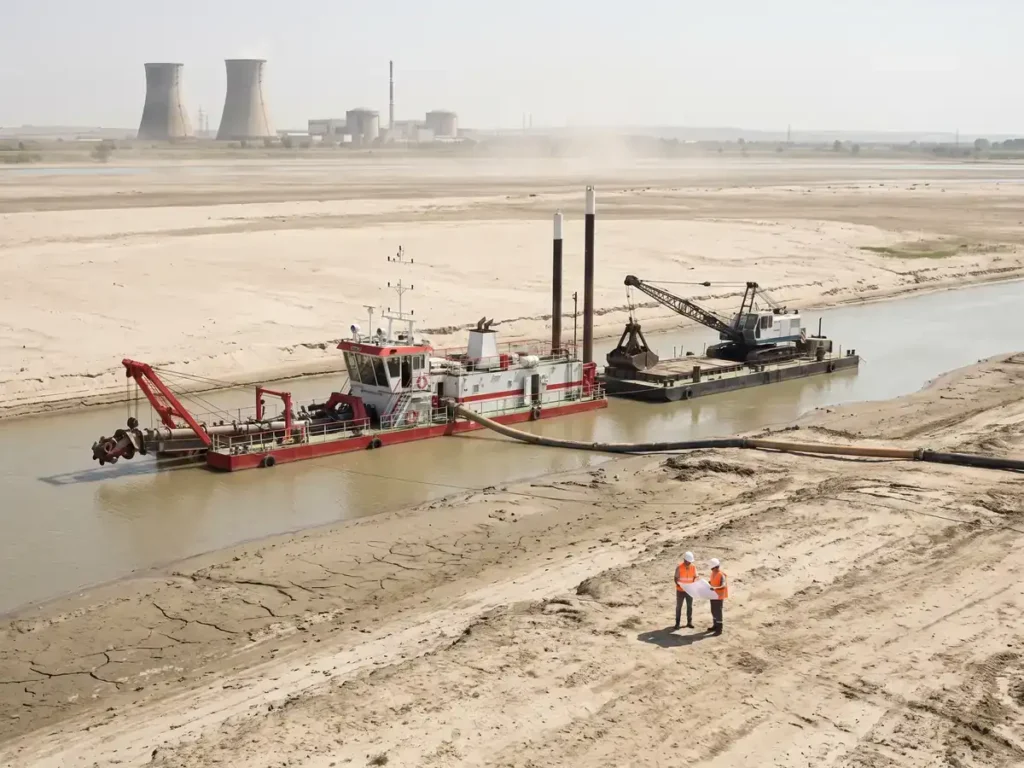
The first effect is dredging. The National Water Administration „Apele Române” and the Lower Danube River Administration in Galați must operate or relocate dredgers, floating grabs and any other support equipment, in order to clear silt and submerged obstacles from the intake channel and the distribution basin of Units 1 and 2, from the deposition area at Cernavodă, from the link towards the Danube-Black Sea Canal and along the entire Izvoarele to Cernavodă sector of the Old Danube. Equipment already under contract for maintaining the navigable channel is redirected to these works as a priority.
The second effect is a new structure in the riverbed. The decision approves the building of a groyne, that is a transverse dyke that steers the current, in the bed of the Old Danube in the Cernavodă area. The works are contracted by Apele Române under the force majeure and extreme urgency regime in Law no. 98/2016 on public procurement, and are carried out including on land in the dyke-bank strip and on protected farmland.
The third effect touches navigation directly. Once the level of 1.55 m dMB is reached at the plant intake, as reported in real time by Nuclearelectrica, the „Administrația Canalelor Navigabile” National Company issues the notice suspending lock operations and traffic on the Danube-Black Sea Canal. Separately, the canal may release, under control, a flow of 3 to 4 mc/s as an operational reserve for the plant intake.
The fourth effect comes from the hydropower plants. The Ministry of Energy and Hidroelectrica must turbine into the Danube additional daily average flows of around 50 mc/s, for five days, starting on 22 August 2026, from the chain of reservoirs on the Olt. The operating schedule is adjusted accordingly, which means water taken out of the reserve of one river so that it reaches another.
The fifth effect is the mobilisation of equipment. The Department for Emergency Situations, through the General Inspectorate for Emergency Situations, together with the National Land Improvement Agency, Apele Române and the Ministry of Transport and Infrastructure, must identify, transport and put in place in stages, until the level of 1.45 m dMB is reached, high-capacity motor pumps and electric pumps, generators and demountable panels. The annex sets out the detail: 59 to 60 motor pumps of 10,000 litres per minute, and a further 2 to 3 of 30,000 litres per minute.
The sixth effect involves the army. The Ministry of National Defence carries out topo-bathymetric and geodetic surveys in the critical sectors of the Old Danube, in the area of the canal and of the plant, and provides divers for the work on the groyne.
What has changed compared with the previous situation
Until now, the response to the hydrological drought had been given at a general level: the state of alert declared by CNSU Decision no. 15/2026 for managing the drop in electricity output, and the measures to raise the water level on the Danube set out in CNSU Decision no. 16/2026. The measures now become specific, with a single target: the water intake of the nuclear plant.
The second change is the move from monitoring to building. A groyne is not an administrative measure, it is a hydrotechnical work carried out in the riverbed, with borrow pits, access roads and a site handed over by Apele Române.
The third change concerns the order of priorities on the Danube. Until now, the dredging equipment was working on the upkeep of the navigable channel, that is for river transport. The decision redirects it as a priority towards securing the cooling water, and the Ministry of Transport has to propose to the Government an amendment to the decision that shares out the dredging volumes between Cochirleni and Caragheorghe, so that the volumes still left can be moved towards the critical areas.
The fourth change is about money. The works are paid for first from the own resources of Apele Române, from budget item 20.22 „Financing of actions in the water sector”, and the amounts are recovered afterwards: those under article 1 from Nuclearelectrica, on the basis of a cost estimate, and those for the groyne from the budget of the Ministry of Environment, Waters and Forests, at the budget revision. The part carried out by the Lower Danube River Administration is financed from the budget of the Ministry of Transport and Infrastructure.
What does not change is the institutional framework. The measures are put into effect through the institutions listed in the annex, as established in the inter-ministerial committee set up by Prime Minister’s Decision no. 278 of 14 August 2026, published in Official Gazette of Romania no. 675 of 16 August 2026.
Advantages and disadvantages
What it improves
- It brings together in a single act who does what and by when, with deadlines counted in days and concrete deliverables for each institution.
- It unlocks the procurement of the works under the force majeure regime, which cuts the time until execution starts from months to days.
- It sets out in advance the level at which navigation on the canal stops, so shipowners and port operators know when to expect restrictions.
- It brings in resources that could not have been contracted quickly on the market: military divers, survey vessels and the motor pumps of the General Inspectorate for Emergency Situations.
What remains a problem
- The margin left when the decision was adopted was around 23 centimetres, and the forecast pointed to a further fall, not to a recovery.
- Suspending lock operations on the Danube-Black Sea Canal blocks freight transport towards Constanța, with knock-on effects on grain exports.
- The additional flow of around 50 mc/s from the Olt is limited to five days and draws on the reserve of another basin, itself already hit by the drought.
- The works are carried out including on protected farmland, and the act does not spell out how the affected owners are compensated.
- The money is advanced from the budget of Apele Române and recovered only later, part of it at the budget revision.
Practical advice
- If you operate vessels on the Danube or on the Danube-Black Sea Canal, follow the notices to mariners. Restrictions and the suspension of lock operations are issued when the level of 1.55 m dMB is reached, not on a calendar date.
- If you have cargo booked through the port of Constanța, talk to your carrier in good time about an alternative by rail or by road. The suspension of river traffic has no fixed date for being lifted.
- If you own land in the dyke-bank strip in the Izvoarele to Cernavodă sector, ask Apele Române in writing for information on the site, the access roads and the borrow pits. The act provides that the administration hands over the site.
- If you have boats moored in the intervention areas, get them ready to be moved. Structures of the Ministry of Internal Affairs and the Romanian Naval Authority may order them to be restricted or relocated.
- Follow the Danube levels at Cernavodă at source, through the bulletins of the National Institute of Hydrology and Water Management, not through second-hand reports.
- Do not confuse the switch to recirculation with shutting the plant down. Recirculation is a technical operating mode that reuses water, and it comes into play below 1.45 m dMB.
Frequently asked questions
Why does the Cernavodă plant need so much water?
What is a groyne?
When does navigation on the Danube-Black Sea Canal stop?
Who pays for the works?
What does the additional flow from the Olt mean?
How many pumps are being mobilised?
Original text of the legal act
The text below is reproduced in Romanian, the official form of publication.
The full text, as published in the Official Gazette of Romania
Official Gazette of Romania no. 698 of 22 August 2026 8 pages PDF, 85 KB the act starts on page 5
Open the official PDFDownload the PDF
The viewer is not shown on small screens. Use the buttons above to open or download the file.
This article is for informational purposes only and does not constitute legal advice. For specific situations, consult a licensed attorney or tax advisor.