
In brief
- The Prime Minister has set up an interministerial crisis committee that has 30 days to find solutions for supplying the water needed to cool the nuclear reactors at Cernavodă.
- The reason stated in the text of the decision itself is the „critical situation” regarding the required water flow, caused by the sharp fall in the level of the Danube, compounded by the delay in the works in the bifurcation area of the Bala branch.
- The committee has 11 members, is led by the head of the Prime Minister’s Chancellery and must deliver a final report setting out technical solutions, an implementation timetable and funding sources.
Published: Official Gazette of Romania (Monitorul Oficial) no. 675 of 14 August 2026
In force from: 14 August 2026
The low level of the Danube has turned into an energy security problem, not merely a navigation one. Through Decision no. 278/2026, published on Friday in the Official Gazette of Romania, the Prime Minister has set up an interministerial committee that has 30 days to identify the solutions for securing the cooling water for the reactors of the Cernavodă plant, both the existing ones and those to come. It is an emergency instrument, from the same family as the risk management tools the Government put in place through the risk preparedness plan for the electricity sector.
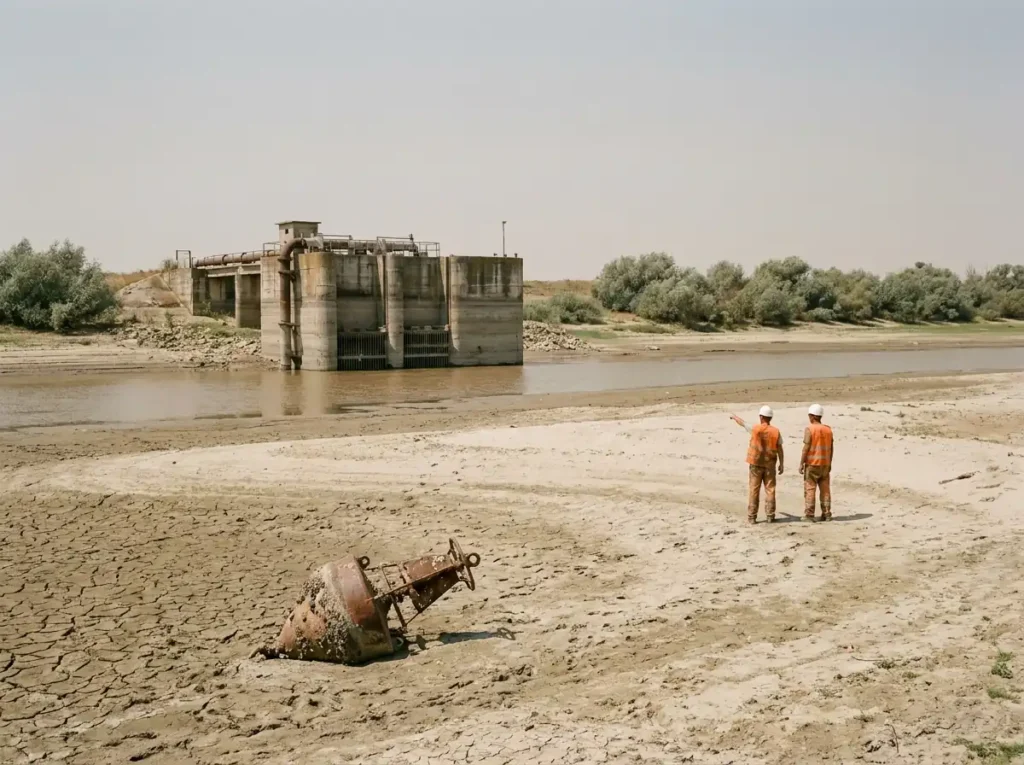
What makes the document unusual is the language of its preamble. Prime Minister’s decisions are, as a rule, organisational acts written in neutral terms. Here, the stated grounds say openly that there is a „critical situation regarding the securing of the water flow needed to cool the reactors, caused by the sharp fall in the level of the Danube” and that there is a „delay in the implementation of the investment projects” planned for the works in the bifurcation area of the Bala branch.
The decision was signed on 14 August 2026, one day after the letter by which the Ministry of Energy flagged the problem, registered under no. 43.506/SDE of 13 August 2026. The speed of the reaction, one day from the alert to publication in the Official Gazette of Romania, says by itself how urgently the matter was treated.
The stakes are spelled out in the act: the „pressing” need to guarantee baseload electricity generation, considered crucial for maintaining the safety of the National Energy System and for the uninterrupted operation of critical infrastructure. Baseload energy means the steady, permanently available output on which the balance of the grid rests.
What it changes in practice
The Bala Interministerial Committee is set up. It is a consultative body without legal personality, so it takes no enforceable decisions. Its role is to analyse and to propose, not to carry out.
It has three concrete objectives. First, analysing and proposing an update of the technical and economic indicators of the feasibility study for the works at critical point 01 Bala. Second, analysing and, where appropriate, reassessing the technical solutions set out in that study. Third, setting an implementation timetable and identifying the funding source.
The works are part of a navigation project, not of an energy one. Critical point 01 Bala belongs to the project „Improving navigation conditions on the Danube between Călărași and Brăila, km 375 – km 175”. In practice, an intervention designed for river transport becomes, through Friday’s decision, a question of water supply for a nuclear power plant.
The deadline is 30 days, with the possibility of an extension. The committee ceases its activity by operation of law once the final report is completed, if that comes sooner. An extension can be granted only through a new Prime Minister’s decision.
It can request data from public institutions and take over studies from outside the administration. The committee requests and analyses the technical information held by public authorities and institutions, but it may also take over studies, analyses or expert reports from private entities, universities or research centres.
It reports directly to the Prime Minister. Briefings whenever the situation requires them, and a final report that has to cover the conclusions of the analyses, proposals for updated technical and economic indicators, the technical solutions, the timetable and the funding sources needed.
The membership mixes the administration with the operator and with academia. The 11 members come from nine institutions, two of them with two representatives each: the Prime Minister’s Chancellery, the Ministry of Energy, the Ministry of Transport and Infrastructure, the Ministry of the Environment, Waters and Forests, the „Apele Române” National Administration, the Lower Danube River Administration, CNE Cernavodă, the National Institute of Hydrology and Water Management and the Technical University of Civil Engineering of Bucharest. The technical secretariat, made up of 3 people, is provided by the Ministry of Transport and Infrastructure.
What has changed compared with the previous situation
Until now, the works in the Bala area were treated as one component of a transport infrastructure project, moving at the pace usual for such a project. Decision no. 278/2026 shifts them into an emergency regime and ties them directly to the operation of the nuclear power plant.
The second change concerns the scope of the problem. The feasibility study already existed, with approved technical and economic indicators. Friday’s act opens the possibility that those indicators will be updated and that the technical solutions will be reassessed, which amounts to admitting that the project, as it was designed, may no longer match the situation on the ground.
The third change is one of horizon. The decision speaks not only about the reactors in operation, but also about nuclear reactors 3 and 4, which are at the development stage. Securing the water flow thus becomes a condition for expanding Romania’s nuclear capacity, not only for maintaining the capacity that already exists.
Advantages and disadvantages
What it improves
- The problem is acknowledged officially and in writing, in an act published in the Official Gazette of Romania, not merely raised in the press.
- The deadline is short and precise, 30 days, which forces a rapid outcome.
- The ministries, the water administrator, the river administrator, the plant operator and academia are all brought to the same table.
- The committee can request and take over studies, analyses or expert reports from private entities, universities or research centres, if the data held by public institutions is not enough.
- The final report has to state the funding source as well, not only the technical solution, which requires the money to be named and not merely the works to be described.
What remains a problem
- The committee is consultative and has no legal personality. It cannot order works to start, it cannot allocate money and it cannot change a contract on its own.
- The act lays down no immediate measure for securing the water flow. It settles how the analysis is organised, not the problem on the ground.
- The decision provides no budget of its own and says nothing about paying the members, and the technical secretariat runs on staff from the Ministry of Transport.
- The cause invoked, the delay in the investments, lies with the very institutions now called upon to propose the solution.
- Under the decision, the final report carries no deadline for putting it into effect. After the 30 days, the timetable depends on other acts.
Practical advice
- If you follow the energy market, note the 30 day deadline running from 14 August 2026. The final report, or a decision to extend the mandate, should appear around 13 September 2026.
- If you work in river transport, watch the reassessment of the technical solutions at critical point 01 Bala. A change there directly affects navigation conditions between Călărași and Brăila.
- Construction and design companies, universities and research centres may be asked to supply studies or expert reports, under Article 2(b) of the decision. This is a formal opening towards the private sector.
- Do not confuse this committee with the permanent structures for managing energy crises. It is a temporary body with a narrow remit and a fixed deadline.
- Follow the Prime Minister’s later decisions. Any extension of the committee’s activity will likewise be made through a decision published in the Official Gazette of Romania.
Frequently asked questions
Is the operation of the Cernavodă plant affected at this moment?
What is critical point 01 Bala?
Who leads the committee?
How long does the committee operate?
Can the committee itself approve the works or the money?
What does the decision have to do with reactors 3 and 4?
Original text of the legal act
The text below is reproduced in Romanian, the official form of publication.
The full text, as published in the Official Gazette of Romania
Official Gazette of Romania no. 675 of 14 August 2026 8 pages PDF, 82 KB the act starts on page 7
Open the official PDFDownload the PDF
The viewer is not shown on small screens. Use the buttons above to open or download the file.
This article is for informational purposes only and does not constitute legal advice. For specific situations, consult a licensed attorney or tax advisor.