
In brief
- The Ministry of Energy and the Ministry of Transport and Infrastructure approved, through a joint order, the Action Plan on using Romanian port infrastructure for manufacturing and building equipment for offshore wind power plants.
- The plan identifies Constanța, Galați, Brăila and Tulcea as the ports best positioned to become industrial hubs for offshore wind, with an implementation timeline across three horizons: 0-12 months, 1-3 years and 3-5 years.
- The 41-page document, drawn up under Article 47 of Law No. 121/2024 on offshore wind energy, is published separately in Official Gazette of Romania (Monitorul Oficial) No. 641 bis, alongside the short order text (2 pages) published in the main edition.
Published: Official Gazette of Romania No. 641 of 4 August 2026 (plan in No. 641 bis)
Issued: 3 June 2026 (Energy) / 7 July 2026 (Transport)
The Ministry of Energy and the Ministry of Transport and Infrastructure approved, through Joint Order No. 517/667/2026, the Action Plan on using Romanian port infrastructure for manufacturing and building the equipment needed for offshore wind power plants. The act, published in Official Gazette of Romania No. 641 of 4 August 2026, implements the obligation under Article 47 of Law No. 121/2024 on offshore wind energy, which requires the Government to set up an inter-institutional working group to coordinate the measures needed to develop the offshore supply chain. The actual plan, a 41-page strategic document, is published separately in Official Gazette of Romania No. 641 bis of the same date.
Romania has set itself a target of 3 GW of installed offshore wind capacity by 2035, with the first construction works expected between 2031 and 2035. The plan starts from the premise that port infrastructure must be modernised and operational several years earlier, to support turbine installation campaigns, and proposes a vision extending beyond the initial 3 GW threshold.
Read also: Romania wants local parts in the Black Sea wind farms, but does not yet know what factories it has
What it changes in practice
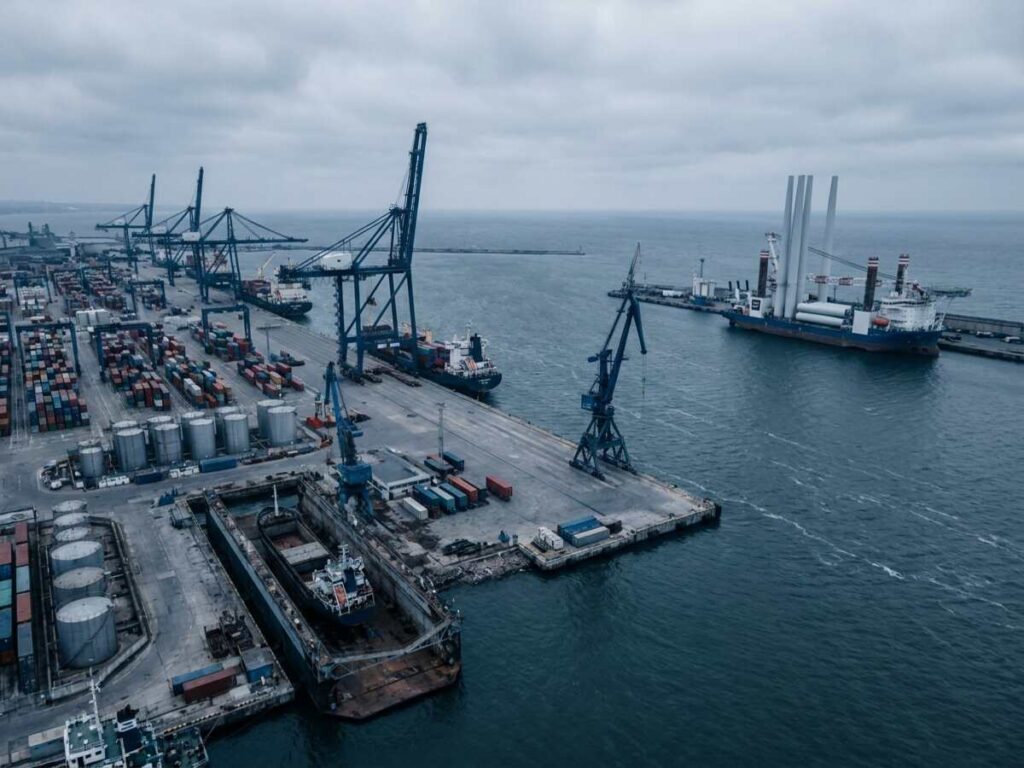
The plan analyses Romania’s four major port groups (the Constanța Complex, the maritime Danube with the ports of Tulcea, Galați and Brăila, the river Danube, and the Danube-Black Sea navigable canals) and identifies a series of weaknesses specific to offshore wind readiness: insufficient space for pre-assembly and storage, low load-bearing capacity of quays for heavy parts (monopiles, foundations, nacelles), limited depth and length for jack-up vessels, insufficient specialised equipment, and limited integration with the national power grid.
For businesses in the sector, the plan confirms that specialised equipment (heavy-lift cranes, installation vessels, transport platforms) generally remains the responsibility of the project developer or its contractors, not the port authority, whose main responsibilities are infrastructure, load-bearing capacity and available space. Investments in the Port of Constanța, the most advanced, already total around EUR 2.5 billion across various stages of preparation, funded from EU instruments (the Connecting Europe Facility, the Cohesion Fund), national resources and, where applicable, private capital.
What has changed compared with the previous situation
- For the first time, a dedicated strategic plan is officially approved, connecting Romanian port industry to the offshore wind supply chain, as required by Article 47 of Law No. 121/2024.
- A timeline with dated milestones is set: completion of feasibility studies and port assessments (end of 2026), first modernisation tenders (mid-2027), start of construction on the first heavy-lift berths (end of 2028), first berth with onshore power supply (OPS) and digital infrastructure (2029), full operational capacity for at least one dedicated port hub (2030).
- Key ports are explicitly prioritised: Constanța as the main production and logistics hub, Galați and Brăila for complementary industrial capacity (metallurgy, shipyards), Tulcea for logistics and related services.
- Performance indicators (KPIs) are introduced for digitalisation, carbon emissions per tonne of cargo, the share of renewable energy used in ports, multimodal logistics capacity and occupational safety, with semi-annual reports to the Ministry of Energy and an independent annual audit.
Advantages and disadvantages
What it improves
- Provides a coherent strategic framework, aligned with the EU Ports Strategy and the EU Industrial Maritime Strategy, which can unlock EU funding (CEF, InvestEU, the National Recovery and Resilience Plan) for port modernisation.
- Identifies a first-mover advantage for Romania in the Black Sea region, where the ports of Bulgaria, Ukraine and Turkey are not yet ready for offshore wind logistics.
- Proposes investments with multiplier effects on the maritime economy: shipbuilding, equipment manufacturing, technical skills training, new jobs in port areas.
What remains a problem
- The plan itself acknowledges major current gaps: insufficient storage space, unreinforced quays for heavy loads, a lack of heavy-lift cranes, and administrative delays in authorisation processes.
- Geopolitical risks are explicitly flagged: the military conflict in the Black Sea region, the risk of cyber sabotage against critical port infrastructure, and possible maritime space disputes with fishing, shipping and tourism.
- At this stage, the document lacks a detailed financial breakdown or a firm funding timeline for all projects, which are to be set once the National Shipping Development Strategy is approved.
Practical advice
- If you work in shipbuilding, wind component manufacturing or port logistics, the action plan published in Official Gazette of Romania No. 641 bis provides the full list of priority projects and target ports (Constanța, Galați, Brăila, Tulcea, Medgidia).
- For EU funding related to ports, note that Connecting Europe Facility (CEF) support does not directly cover the construction of offshore wind farms, but rather associated infrastructure: energy interconnections, submarine cables, high-voltage substations and port hubs.
- If you are an investor or operator interested in the Constanța South area, track the deep-water infrastructure development project, currently under evaluation by the European Commission under the CEF Transport 2024 call for studies.
- Follow the semi-annual progress reports of the inter-ministerial working group, submitted to the Ministry of Energy and the General Secretariat of the Government, for the actual state of plan implementation.
Frequently asked questions
What does Joint Order No. 517/667/2026 approve?
Which are the priority ports for offshore wind development?
Why isn’t the 41-page plan reproduced in full in this article?
Who funds port modernisation for offshore wind?
When will the first port facilities dedicated to offshore wind be operational?
Original text of the legal act
The text below is reproduced in Romanian, the official form of publication.
The full text, as published in the Official Gazette of Romania
Official Gazette of Romania no. 641 of 4 August 2026 (plan in no. 641 bis) 8 pages PDF, 83 KB
Open the official PDFDownload the PDF
The other editions cited: nr. 641 bis/2026
The viewer is not shown on small screens. Use the buttons above to open or download the file.
This article is for informational purposes only and does not constitute legal advice. For specific situations, consult a licensed attorney or tax advisor.