
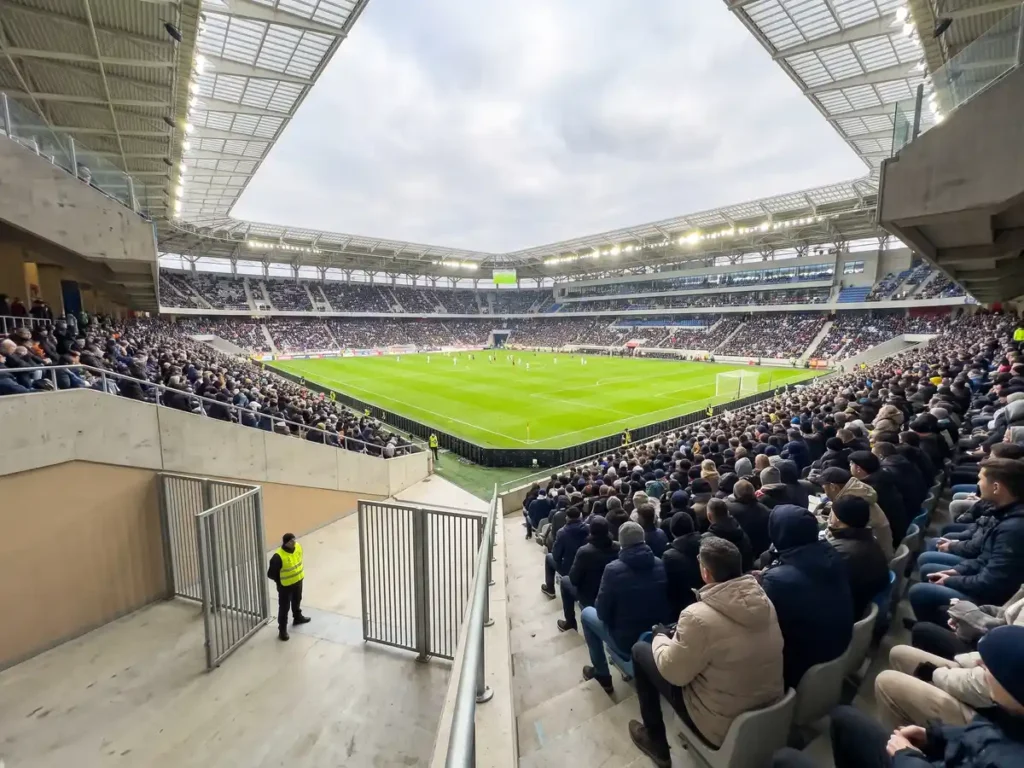
In brief
- The law against violence at stadiums changes its name and its logic: it becomes the law on the sound organisation and conduct of sporting competitions and games.
- Safe standing areas are introduced, covering at least 10% of the home end at national and international level stadiums, and pyrotechnic displays staged by authorised companies are now allowed.
- Evacuation doors and gates must stay unlocked for the whole duration of the match and be guarded by a special steward, while a complaint against a banning order suspends enforcement of the penalty.
Published: Official Gazette of Romania (Monitorul Oficial) no. 592 of 20 July 2026
In force from: 23 July 2026
After the Colectiv fire, any locked door in a hall full of people is a safety problem. The new stadium law settles it explicitly: for as long as spectators are inside, every exit stays unlocked and guarded. Law no. 154/2026, published in Official Gazette of Romania no. 592 of 20 July 2026, rewrites Law no. 4/2008 in nineteen points and changes even its title. It is the second law this summer to touch the relationship between clubs and supporters, after the one that gave athletes the right to be assisted by a lawyer on their contracts and before the sports commissions.
The change of title is not cosmetic. From „the prevention and combating of violence at sporting competitions and games”, the law becomes „on the sound organisation and conduct of sporting competitions and games”. Any reference in other legislation to the old title is deemed to be made to the new one, and the law is to be republished with fresh numbering.
This is the shift from a law built around the supporter treated as a risk to one built around the organiser treated as answerable for the quality of the event.
What it changes in practice
The first effect concerns evacuation. The new paragraphs (31) and (32) of Article 5 require the organiser to make sure that, for as long as spectators are in the stadium, all exit doors and gates, as well as all the gates leading from the spectator areas onto the pitch, remain unlocked. They are guarded at all times by a security steward, referred to as a special steward, both to prevent abuse and to allow immediate evacuation in an emergency.
The second effect is the introduction of standing areas. At stadiums intended for national and international level competitions, at least 10% of the capacity of the home end may be fitted out and certified as a safe standing area, with dedicated protection systems. The purpose stated by the law is greater safety, a better sporting atmosphere and the development of a participatory supporter culture.
The third effect is the legalisation of pyrotechnic displays. The new Article 101 allows the organiser to stage pyrotechnic displays, but only through specialised and authorised companies and only in stadiums. Only articles in categories P1, T1, T2 and P2 are permitted, that is smoke devices, strobes and hand-held torches. The display takes place in a reserved area, mapped out on the basis of the safety distances, access is granted only to authorised persons, and access by minors is strictly forbidden. Authorisation is applied for from the territorial labour inspectorate and from the police.
The fourth effect has to do with alcohol. The general ban stays in place, except for low-alcohol drinks of up to 5.5% alcohol, served only in paper or plastic cups without lids. A new exception appears, however: in the boxes and premium hospitality areas, with exclusive and controlled access and separated from the ordinary stands, alcoholic drinks may be served under a catering arrangement, without the concentration limit and including in glass containers. The prohibitions covering minors and visibly intoxicated persons remain. The organiser must display warnings about responsible drinking in visible places.
The fifth effect concerns the separation of supporters. Beyond separating rival groups, the organiser must now also separate its own supporters when they belong to different supporter associations, by seating them in different sectors, set well apart. Where several associations back the same team, the separation is measured against the largest group.
The sixth effect is about accessibility. The organiser must provide access for people with special needs, together with sanitary facilities and specially adapted places, so that their view of the event is not obstructed.
The seventh effect touches the penalties. A complaint against the official report suspends enforcement of the penalties imposed, including the complementary ones, until a final judgment. The complaint must be lodged within 15 days of the report being handed over or served, and paragraph (5) of Article 47 is repealed.
The eighth effect reaches beyond the stadium. Article 15(c) of Law no. 60/1991 on the organisation and conduct of public gatherings is amended: the ban on serving alcoholic drinks no longer applies inside specially arranged and delimited perimeters where cultural, artistic and sporting events with controlled access take place, on top of the exceptions already provided for New Year’s Eve, town anniversary days and promotional events.
What has changed compared with the previous situation
The first change is one of philosophy. The 2008 law was written as a public order instrument, and its name said so plainly. The new title moves the emphasis onto organisation, and Article III states that references in other legislation are deemed to be made to the new name.
The second change is physical safety. The obligation to keep every exit unlocked and guarded while spectators are present did not exist in the text. Locking the gates in order to stop people getting onto the pitch was, until now, a matter for the action plan, not for the law.
The third change is pyrotechnics. Until now, any pyrotechnic material sat on the list of prohibited items, with no distinction at all. The new law keeps the ban for supporters, but creates a legal framework for a display staged by an authorised company, with articles from a limited set of categories.
The fourth change is the turnstile. The obligation to install rotating metal devices with a counting system is now confined to high-risk events and to international ones, whether they involve national teams or clubs. Previously the requirement was general.
The fifth change concerns season tickets and personal data. The holder’s first name and surname must be printed on every season ticket, in compliance with data protection legislation. For away trips to other towns, the data of individual supporters is disclosed only at the written and reasoned request of the competent bodies, and only for identified individuals, in order to check a banning order or to clarify specific incidents. The person responsible for order consults the representatives of the supporter groups beforehand.
The sixth change is procedural and matters to those penalised. Until now, enforcement of a banning order was not suspended by a complaint on the same terms. From now on, the complaint suspends enforcement, including of the complementary penalties, until the decision becomes final.
What does not change is the regime for items prohibited to spectators: flares, torches, fireworks, firecrackers, explosive or incendiary materials, weapons, electric shock devices, toxic or tear-gas substances and blunt objects remain banned at the entrance.
Advantages and disadvantages
What it improves
- The obligation to keep every exit unlocked and guarded is the single most important safety measure in the text and answers a real problem.
- Safe standing areas bring Romania into line with practice in the Western European leagues, with certified protection systems.
- A legal framework for pyrotechnic displays can cut down on material smuggled into the ground, by offering a controlled alternative.
- Access for people with special needs, with sanitary facilities and unobstructed places, becomes an express obligation.
- Restricting the disclosure of supporters’ personal data to written and reasoned requests protects a group that has been closely monitored until now.
- Suspending enforcement of the penalty while the complaint is pending avoids the situation where someone serves a ban that the court later quashes.
What remains a problem
- The exception for premium boxes, where spirits may be served in glass, creates two different regimes inside the same arena, hard to explain to the crowd on the terraces.
- Confining turnstiles to high-risk and international matches weakens access control at every other competition.
- The law sets no compliance deadlines for safe standing areas or for accessibility, so implementation depends on club budgets.
- The status of the special steward is not spelled out: nothing says who trains them, who certifies them or how they answer if a gate is left locked after all.
- Automatic suspension of the complementary penalties while a complaint is pending may delay the removal of dangerous individuals from the stadium.
- Republication of the law is announced, but without a deadline, and until then practitioners work with a text amended in nineteen points.
Practical advice
- If you are a club or an organiser, check before every match that all evacuation doors and gates are unlocked and that each one has a special steward assigned to it. This is the most direct new obligation.
- Include the pyrotechnic display in the action plan and obtain the authorisations from the territorial labour inspectorate and from the police. Without them, the display is not lawful.
- Check how the pyrotechnic articles are classified. Only categories P1, T1, T2 and P2 are permitted, that is smoke devices, strobes and hand-held torches.
- For safe standing areas, certification follows the safety rules laid down by the authorities and the regulations of the federations. Start the process early, not a week before the match.
- On season tickets, print the holder’s first name and surname and keep clear records of subscribers, in compliance with data protection rules.
- Do not disclose supporters’ personal data except on a written and reasoned request, and only for identified individuals. Handing over lists wholesale no longer has any legal basis.
- If you have been given a stadium banning order, lodge a complaint within 15 days of the official report being handed to you or served on you. The complaint suspends enforcement until the decision becomes final.
- For premium boxes, delimit the area physically, control access and organise the collection of containers. The exception works only on those conditions.
Frequently asked questions
What is the law called now?
What does safe standing mean?
Can torches be used in the stadium?
Is alcohol sold in the stadium?
Do the stadium doors have to stay open?
What happens if I challenge a banning order?
Are turnstiles still mandatory at every match?
Original text of the legal act
The text below is reproduced in Romanian, the official form of publication.
The full text, as published in the Official Gazette of Romania
Official Gazette of Romania no. 592 of 20 July 2026 32 pages PDF, 179 KB the act starts on page 6
Open the official PDFDownload the PDF
The viewer is not shown on small screens. Use the buttons above to open or download the file.
This article is for informational purposes only and does not constitute legal advice. For specific situations, consult a licensed attorney or tax advisor.