
In brief
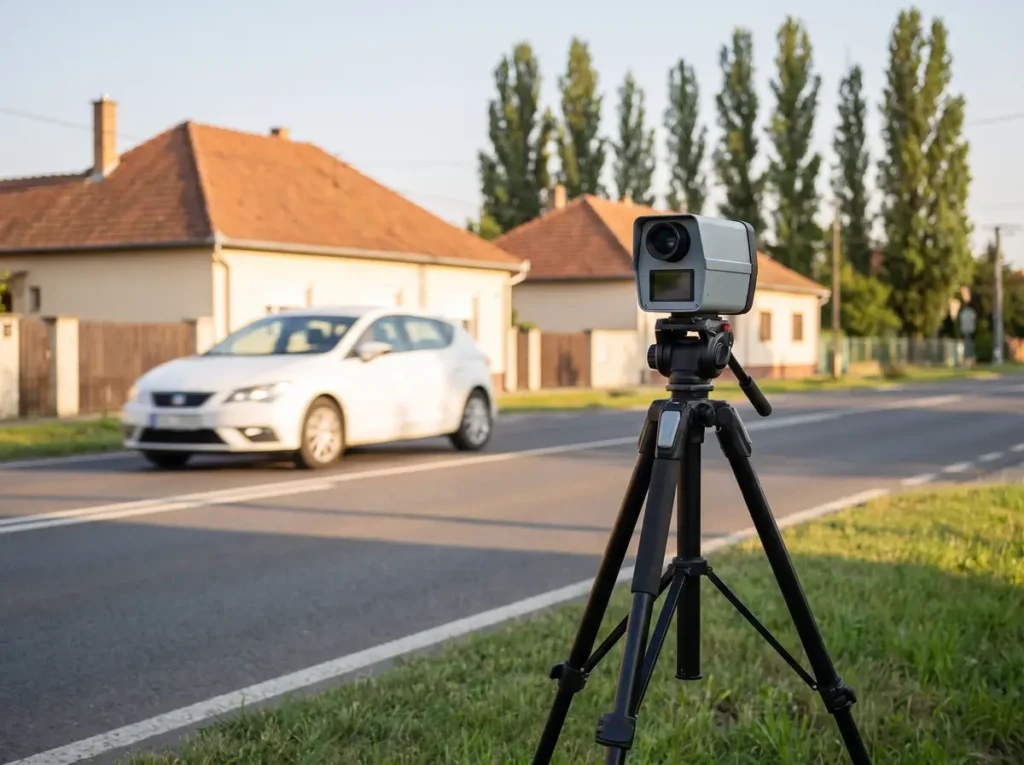
- A driver fined for exceeding the speed limit by more than 50 km/h tried to escape the penalty by arguing that no law regulates the training of the police officer who operates the speed camera.
- The Constitutional Court dismissed his plea as inadmissible: what he complains about is not an unconstitutional provision, but the absence of one, in other words a legislative omission.
- The practical conclusion for drivers: the argument does not work in court. The class IV fine and the 90-day suspension stand, and filling the gap in the law is a matter for Parliament, not for the Court.
Published: Official Gazette of Romania (Monitorul Oficial) no. 692 of 21 August 2026
Delivered: 5 February 2026
The idea that a speeding fine can be quashed because the law does not say what training the officer holding the speed camera must have has just been rejected by the Constitutional Court. By Decision no. 102 of 5 February 2026, published in Official Gazette of Romania no. 692 of 21 August 2026, the Court dismissed as inadmissible the plea raised in a case before the Târgu Mureș District Court, in a minor-offence complaint against an official report imposing a penalty. It is the same statutory provision the Court examined this summer as well, when it held that the 90 days without a licence are fixed and no judge can shorten them.
The provision at issue is Article 102(3)(e) of Government Emergency Ordinance no. 195/2002 on road traffic. It sets out the class IV fine and the suspension of the right to drive for 90 days where the maximum speed permitted on the stretch of road in question is exceeded by more than 50 km/h, as established by type-approved and metrologically verified technical devices.
The driver’s argument started from a real fact. Order no. 301 of 23 November 2005, by which the Romanian Legal Metrology Bureau had approved legal metrology standard NML 021-05 on speed measuring devices, was repealed in 2009 by Order no. 187. From that point on, he argued, a gap has remained: there is no longer any instrument requiring the training and examination of the officer who operates the device, so the judge has no way of checking his qualifications.
A more recent decision of the Court, also on road traffic offences, settles another point in time: for driving under the influence of alcohol under Article 336 of the Criminal Code, the blood alcohol level is measured against the moment of driving, not the hour when the biological samples were taken, as CCR Decision no. 136/2026 shows.
What it changes in practice
The first effect is that the provision remains unchanged and fully applicable. Dismissal as inadmissible means that the penalty for exceeding the speed limit by more than 50 km/h continues to apply exactly in the form set out in the ordinance.
The second effect concerns method. The Court explained that the author’s grievance relates to a lack of regulation, not to the content of the provision challenged. A legislative omission cannot be censured by way of a plea of unconstitutionality, because the constitutional court cannot add to the law.
The third effect concerns the duty to state reasons. The Court pointed out that referrals addressed to it must be reasoned, under Article 10(2) read together with Article 29(1) of Law no. 47/1992, and that it cannot take the place of the author of the plea in order to formulate the grounds of unconstitutionality on his behalf.
The fourth effect is the separation of powers. What the author was asking for, namely rules on the specialised training of the enforcement officers who operate type-approved devices, requires an act of legislation. Under Article 61 of the Constitution and Article 2(3) of Law no. 47/1992, that is a matter for Parliament.
The fifth effect is practical, for minor-offence complaint cases. Since the decision is final and generally binding, a defence built on the absence of a rule about the officer’s training no longer has any prospects before the trial courts. The Court met the same kind of argument again in September 2026: the rules for taking blood and calculating the alcohol level need not sit in a statute, so their absence from the Criminal Code is no defence either.
What has changed compared with the previous situation
In law, nothing. Emergency Ordinance no. 195/2002 remains exactly as it was, and the penalty class and the 90 days of suspension continue to apply.
What does change is the fate of an argument that had been circulating in minor-offence complaints. Until now, the absence of a rule on the officer’s qualifications could be invoked as a ground for the unlawfulness of the official report. The Court does not say that the gap does not exist, but that it is not repaired at the Constitutional Court.
The second change concerns the position of the Public Prosecutor’s Office, recorded in the decision. The prosecutor argued that there is no actual legislative vacuum, since the law expressly refers to type-approved and metrologically verified technical devices, and the absence of rules of lower rank than the law, in a related field, does not render the law unconstitutional.
What does not change are the usual lines of defence in a minor-offence complaint. The metrological verification of the device, the verification certificate, the positioning conditions and the specific manner in which the offence was established remain matters the trial court can examine, because they concern the application of the law, not its constitutionality.
Advantages and disadvantages
What it improves
- It closes off, with clear reasoning, an argument repeatedly used in minor-offence complaints, which shortens the proceedings that were built on it.
- It is a reminder that a referral to the Constitutional Court must be reasoned in concrete terms, not merely flagged as a grievance.
- It draws the dividing line between roles correctly: if a rule is missing, it must be asked of Parliament, not of the constitutional court.
- It leaves the driver’s genuine defences intact, those concerning the type approval and metrological verification of the device, which are argued before the trial court.
What remains a problem
- The gap flagged by the author of the plea is still there: since the 2009 repeal, there is no publicly available rule on the training and examination of the officer who operates the speed measuring device.
- The Court does not rule on whether the gap is a real problem or not, only that it cannot resolve it, so the debate is left without an answer on the merits.
- The decision comes almost five years after the 2021 referral, a period in which the argument was used in the courts without any clarification.
- For a driver without a lawyer, the distinction between an unconstitutional provision and a legislative omission remains hard to grasp, and a badly formulated plea is lost from the outset.
Practical advice
- If you have a minor-offence complaint pending, do not build your defence on the absence of a rule about the officer’s training. The Court has said plainly that this is not a criticism of unconstitutionality.
- Ask the court for the metrological verification certificate for the device and proof of its type approval. These are questions of fact that the judge can check.
- Check the date of the metrological verification against the date the offence was recorded. A device whose verification has expired is a genuine defence, unlike the one dismissed here.
- If you raise a plea of unconstitutionality, give specific reasons for it, citing the constitutional provision infringed and explaining concretely how. An unreasoned plea is dismissed as inadmissible without any examination of the merits.
- Do not confuse inadmissibility with a finding that the plea is unfounded. Dismissed as inadmissible means the merits were never even reached, not that the provision was declared sound.
- Bear in mind that the 90-day suspension for exceeding the limit by more than 50 km/h is a mandatory ancillary penalty, which accompanies the class IV fine.
Frequently asked questions
What did the Constitutional Court decide?
What does the provision that remains in force say?
Why was it dismissed as inadmissible rather than as unfounded?
Is it true that there are no rules on the training of the officer who operates the speed camera?
Can I still challenge a speeding offence notice?
Who can fix the gap that was flagged?
Original text of the legal act
The text below is reproduced in Romanian, the official form of publication.
The full text, as published in the Official Gazette of Romania
Official Gazette of Romania no. 692 of 21 August 2026 16 pages PDF, 122 KB the act starts on page 9
Open the official PDFDownload the PDF
The viewer is not shown on small screens. Use the buttons above to open or download the file.
This article is for informational purposes only and does not constitute legal advice. For specific situations, consult a licensed attorney or tax advisor.