
In brief
- The Government has put a price on the road that will connect the city of Buzău to the A7 motorway: 1,094,604,000 lei including VAT, for 13.079 km. That is almost 1.1 billion lei or, at the exchange rate of 5.0937 lei to the euro used by the annex to the decision itself, around 214.9 million euro. Of that sum, 930 million lei is construction and assembly, and the rest covers design, expropriation, permits and assimilated expenditure.
- Recalculated per kilometre, the road costs 83.7 million lei, that is 16.43 million euro. Execution is set at 24 months, and the money is spread over two perfectly equal instalments, 547.3 million lei in each year. The route includes 3 structures, bridges, overpasses or viaducts, one every 4.4 km.
- The decision takes effect on 21 September 2026, the date of publication, but sets no start date for the works. The money comes from the Transport Programme 2021-2027 and from the state budget, through the budget of the Ministry of Transport and Infrastructure, within the sums approved annually. The beneficiaries are, jointly, the National Company for Road Infrastructure Administration and Buzău City Hall.
Published: Official Gazette of Romania (Monitorul Oficial) no. 800 of 21 September 2026
In force from: the date of publication, 21 September 2026
A decision approving technical and economic indicators does not dig a single metre of road, but without it no execution contract can be signed: it is the moment when the state officially acknowledges what a work costs and out of which money it is paid. The act published on 21 September 2026 does exactly that for the orbital road of the city of Buzău, on sections 2, 3 and 4, and values it at 1,094,604,000 lei including VAT. It is the second infrastructure act in the same Official Gazette of Romania that fixes figures without fixing a calendar, after the one by which the border crossing point at Sighetu Marmației received 172 posts and no opening date.
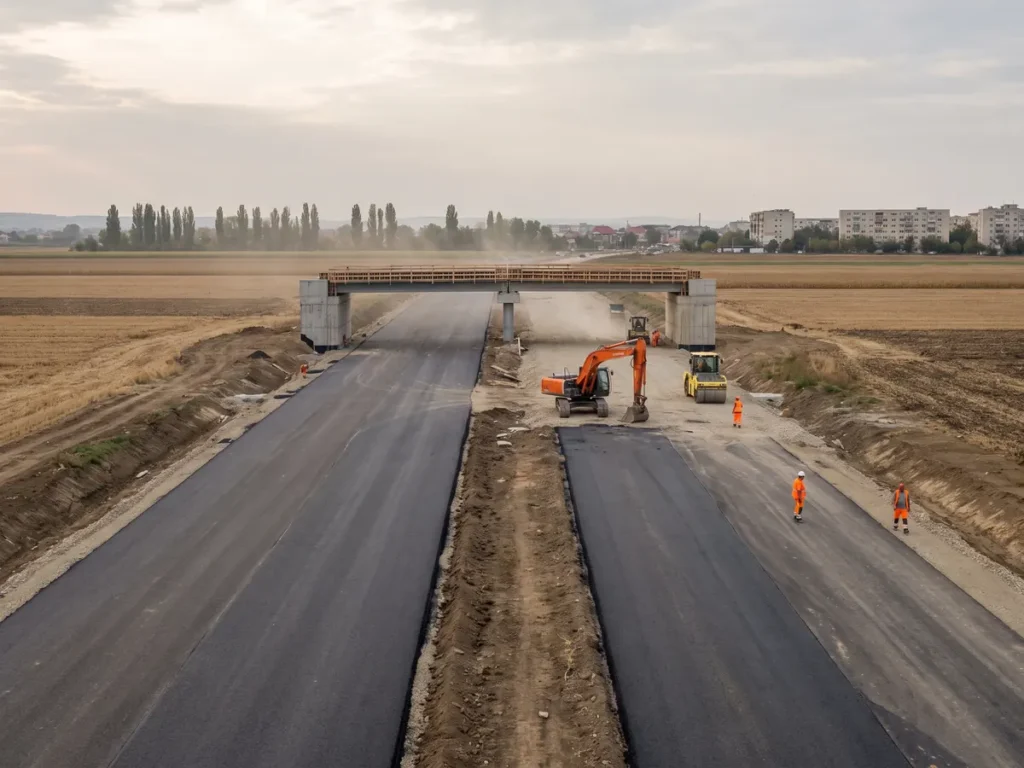
What is being built, according to the annex: 13.079 km of road, with a platform 25.00 m or 30.00 m wide depending on the section, of which a carriageway of 4 lanes of 3.50 m each, that is 14 m of asphalt on which vehicles actually travel. The route includes 3 structures, entered in the annex under bridges, overpasses and viaducts. The site is Buzău County, the principal authorising officer is the Ministry of Transport and Infrastructure, and two entities appear under beneficiary, the National Company for Road Infrastructure Administration and Buzău City Hall.
The legal basis of the decision is Article 108 of the Constitution of Romania, republished, together with Article 42 paragraph (1) letter a) of Law no. 500/2002 on public finance. The text cited reserves to the Government the approval of technical and economic documentation for new investment objectives financed from public funds whose value exceeds a ceiling, a ceiling which paragraph (3) of the same article allows to be updated by Government decision in line with price index movements. For principal authorising officers and for other authorising officers, the law provides powers over lower value brackets. An investment of 1.09 billion lei falls, under any version of the ceiling, within the Government’s remit, so the form of the act is the correct one.
What it changes in practice
The first effect is that the procedure is unblocked. Article 43 of Law no. 500/2002 states that an investment objective is included in the annual investment programmes, annexes to the budget, only if the technical and economic documentation has first been drawn up and approved according to the law. Until 21 September 2026, sections 2, 3 and 4 of the orbital road did not meet that condition. From 21 September 2026 they do, so the sum can enter the investment programme and the award procedures can be launched.
The second effect is a spending ceiling, not a guarantee of payment. Article 2 of the decision links the financing to three sources: non-reimbursable external funds from the Transport Programme 2021-2027, the state budget through the budget of the Ministry of Transport and Infrastructure, and other lawfully constituted sources. The wording used, „within the sums approved annually for this purpose”, shows that the approved value is a recognised maximum framework, while the actual release of the money remains to be done year by year, through the budget law. The decision does not split the sum between the three sources, so the act does not reveal how much is expected from European funds and how much from taxes.
The third effect is the allocation of responsibility. Article 3 makes the Ministry of Transport and Infrastructure, through the National Company for Road Infrastructure Administration, responsible for the way the sums are used. Buzău City Hall, although it appears as a beneficiary in the annex, does not appear in Article 3, so it is assigned no responsibility for the money.
The fourth effect shows up at site level. The schedule in the annex provides for 547,302,000 lei in year I and the same in year II, of which 465,013,000 lei and 465,014,000 lei respectively for construction and assembly. The two instalments add up to exactly the total value and cover exactly the 24-month execution period. For traffic in the Buzău area, the practical effect appears only at handover, that is no sooner than two years after the site actually opens, and that moment is not set in the decision.
What has changed compared with the previous situation
The decision neither amends nor repeals any text in force. It adds an approving act where there was none, and the real change is read against the void that preceded it: until 21 September 2026 there was no official value for sections 2, 3 and 4 of the Buzău orbital road, hence no legal basis for committing expenditure on them.
The numbering of the sections says, indirectly, that the objective is split into pieces and that the first is not covered by this act. That is where what can be learned from the published text stops: the decision refers to no earlier act for section 1, does not mention its value, its length or its stage, and does not say whether it was ever approved. The decision invokes two acts in total, the Constitution of Romania and Law no. 500/2002, and neither concerns another section of the same road. In other words, a reader who wants to know what the Buzău orbital road costs in full cannot find that out here, and any comparison between the price per kilometre of this lot and of the others would be a guess, not a reading of the act.
The price base against which the sum is set also changes. The annex states that the value is expressed in prices as at 5 March 2026, at an exchange rate of 5.0937 lei to the euro. Between that reference date and the date the decision was adopted, 18 September 2026, 197 days passed, and 200 by the date of publication. The approved sum is therefore correct relative to March 2026, not to the moment when it will be spent, and the difference will have to be covered along the way, through updates.
Advantages and disadvantages
What it improves
- It puts a public figure on a work that did not have one until now. Anyone can now check whether a contract signed for sections 2, 3 and 4 fits within 1,094,604,000 lei or goes beyond it.
- The physical indicators are detailed enough to be verifiable on the ground: 13.079 km, a platform of 25.00 m or 30.00 m, 4 lanes of 3.50 m, 3 structures. It is not a generic description but a set of dimensions that can be checked against the technical design.
- The schedule covers the execution period in full. The two instalments of 547,302,000 lei add up to exactly the total value, and the two years of financing match the 24 months on site, so the act does not programme a work longer than the money allocated.
- The structure of the spending looks sound at first glance. Construction and assembly take 84.96% of the total, which leaves 164,577,000 lei, that is 15.04%, for design, expropriation, permits and assimilated expenditure.
- Responsibility for the money is named. Article 3 places the use of the sums with the ministry, through the company that administers the national roads, instead of leaving it in a vague formula.
What remains a problem
- There is no start date at all. The annex speaks of year I and year II, not of calendar years, and the decision does not tie those years to anything. The 24 months may begin in 2027 or in 2029 without the act being breached.
- The three financing sources are not quantified. The act mentions European funds, the state budget and other lawfully constituted sources, but allocates none of the 1,094,604 thousand lei between them, so it is impossible to say how much of the road is paid for out of the Transport Programme 2021-2027.
- Two beneficiaries, one responsibility. The annex enters under beneficiary both the National Company for Road Infrastructure Administration and Buzău City Hall, but divides neither the works nor the resulting assets between them, and Article 3 does not mention the second at all.
- The prices are 197 days old on the date of adoption. The value is set at the level of 5 March 2026, so the difference from the real cost of materials and labour at the time of contracting will have to be covered through later updates, which do not appear in this act.
- The perfectly equal split over the two years does not look like a construction site. A 13 km road with 3 structures consumes little at the start, on site set-up and earthworks, and a lot in the middle, and 547,302,000 lei in each year looks more like an arithmetical division of the total than a works programme.
- There is no way to tell what changes for traffic. The act does not say how many vehicles a day the orbital road takes over, from which national road it takes them, or by how much heavy traffic through the city falls, so the benefit for the residents of Buzău is nowhere quantified.
Practical advice
- If you own land along the route, bear in mind that this decision does not trigger expropriation. It approves the value of the investment, which also includes expropriation costs, but the procedure itself is carried out through a separate act that publishes the list of properties and the sums. Watch the Official Gazette of Romania for an expropriation act mentioning the same objective.
- Firms wishing to take part in the execution need not wait for another normative act. Once the indicators are approved, the next step is publication of the contract notice in the Electronic Public Procurement System by the National Company for Road Infrastructure Administration. The estimated value in the notice should fit within the 930 million lei set aside for construction and assembly.
- When the notice appears, compare the estimated value with the figure in the annex. An estimate far above 930,027,000 lei means the indicators have already been updated by another act, and it is then worth looking for the updating decision, because that is where the real price difference shows.
- Residents of Buzău who want to know what changes for them should ask Buzău City Hall, as the beneficiary entered in the annex, for the feasibility study. The traffic data, the exact route and the connections to the city streets are in the study, not in the decision.
- To follow the European money, the reference point is the Transport Programme 2021-2027. Ask the Ministry of Transport and Infrastructure, through a public information request, for the financing contract for the objective. That is where the breakdown by source, missing from the decision, can be seen.
- Do not confuse this act with the A7 motorway. The decision concerns an orbital road of 13.079 km that links up with the motorway, not a motorway section, and the indicators approved here do not apply to works on the A7.
Frequently asked questions
What does one kilometre of this road cost?
When does construction start and when does it finish?
Who pays, the Romanian state or the European Union?
What changes in practice for anyone driving through Buzău?
Why are there two beneficiaries for the same road?
From what date does the decision apply?
Can the sum rise later?
Editorial analysis
The decision solves a real problem and solves it cleanly on the formal side. The figures close without a remainder: the schedule of 547,302,000 lei in each year gives exactly the total of 1,094,604,000 lei, and the two construction and assembly instalments, 465,013,000 and 465,014,000 lei, give exactly 930,027,000 lei. Construction and assembly account for 84.96% of the investment, a natural proportion for a new road, and the legal basis invoked is the one that applies. On the substance, however, the act has a problem of economic grammar: a perfectly equal split, to the leu, over two years does not describe a construction site, it describes a total divided by two. A 13 km road with three bridges or overpasses does not consume the same in the first year, when the site is set up and earth is moved, as in the second, when the structures are poured and the surfacing is laid. The one thousand lei difference between the two construction and assembly instalments shows where the figure comes from: from rounding a half to the nearest thousand lei, the operation of a spreadsheet, not of a works programme.
The second observation calls for counting the days, because it does not emerge from reading the act. The value is set in prices as at 5 March 2026, while the decision was adopted on 18 September 2026 and published on 21 September 2026, that is 197 and 200 days respectively after the price reference date. The state is today approving a sum calculated more than half a year ago, in a period when construction materials and wages have not stood still. The practical consequence is predictable and recurs on almost every major objective: either the tender closes at a price above the approved indicator and the work is blocked until an update, or it closes below it, with everything that implies for the quality of the bid. The ceiling is not an error of this decision, it is a consequence of the interval between the design cost estimate and the political decision, and that interval is measurable and therefore reducible.
The third observation concerns the asymmetry of deadlines. The act imposes a 24-month period on the contractor, but imposes no date on itself: it does not say when year I begins, sets no deadline for awarding the contract, and does not tie the schedule to identifiable budget years. The administration measures the time of the party doing the work and leaves its own unmeasured. For the reader in Buzău, waiting for heavy traffic to stop passing through the city, this means that the only figure in the act that concerns them directly, the two years of works, starts from nothing.
What should be changed
- Year I and year II should be budget years, not sequence numbers. If the annex said 2027 and 2028, the schedule would become verifiable in the budget law, and any delay would become visible when it occurs, not two years later.
- The sum should be broken down over the three financing sources. A line in the annex showing how much is expected from the Transport Programme 2021-2027, how much from the state budget and how much from other sources would show the Romanian taxpayer’s real exposure and would make the risk visible should the European part fail to materialise.
- The schedule should follow a works programme, not a division by two. A realistic distribution between the two years would reduce payment blockages in mid-execution, where the spending is in fact concentrated, and would eliminate the unused sum from the first year, which is carried over anyway.
- The roles of the two beneficiaries should be separated in the annex. A sentence stating which part of the objective falls to the National Company for Road Infrastructure Administration and which to Buzău City Hall would prevent the familiar situation in which a connection to the street network remains unfinished because each party considers it the other’s.
- The price date should come with an updating clause. A text stating how the value is recalculated when the interval between the price reference date and the award date exceeds, say, 180 days would spare the road an additional decision and would shorten the blockage between a failed tender and its relaunch.
- Traffic indicators should enter the annex alongside the technical ones. The average daily traffic taken over and the estimated reduction within the city are the figures by which it will later be judged whether the investment was worth it. Without them, the post-handover assessment has nothing to measure against.
Original text of the legal act
The text below is reproduced in Romanian, the official form of publication.
The full text, as published in the Official Gazette of Romania
Official Gazette of Romania no. 800 of 21 September 2026 16 pages PDF, 182 KB the act starts on page 2
Open the official PDFDownload the PDF
The viewer is not shown on small screens. Use the buttons above to open or download the file.
This article is for informational purposes only and does not constitute legal advice. For specific situations, consult a licensed attorney or tax advisor.