
In brief
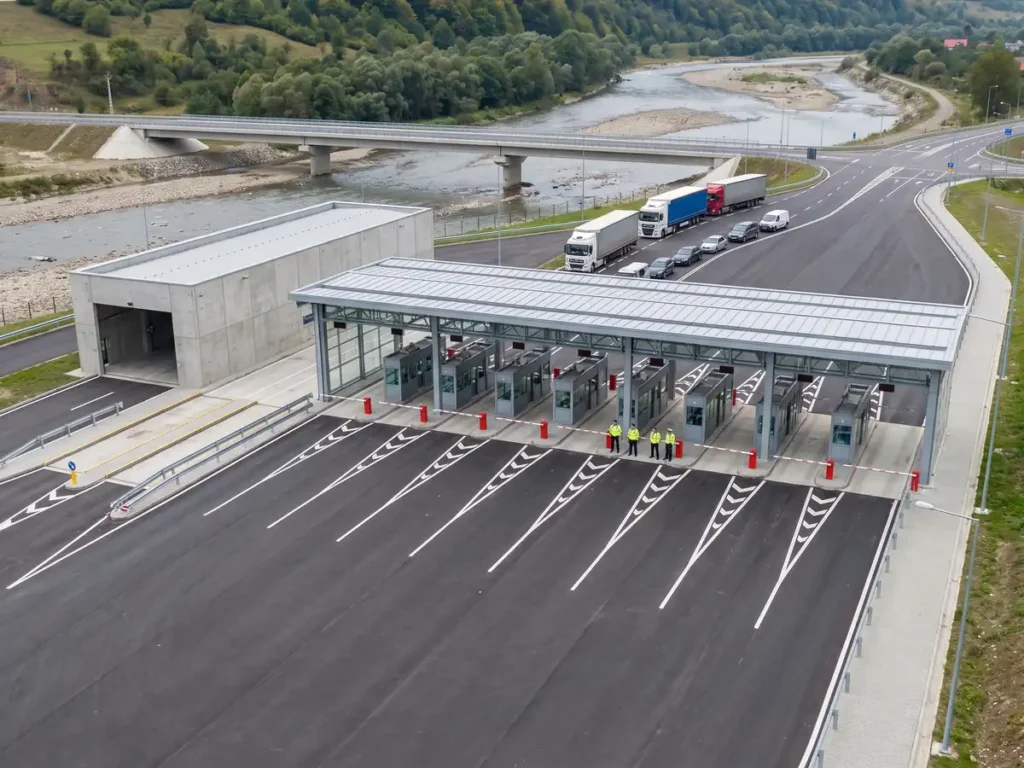
- Romania has a new border crossing point towards Ukraine at Sighetu Marmației, approved on paper from 21 September 2026. It is called Sighetu Marmației II and leads to the village of Bila Țerkva in the Transcarpathia region. It is designed for road traffic, goods, passengers and pedestrians, open around the clock, on six traffic lanes in each direction plus one pedestrian lane each way.
- When traffic will actually run through it, the act does not say. The point „shall be brought into service once the infrastructure, the staff and the utilities are in place”, with no date at all. The only firm dates in the act are 7 October 2026, when the new point joins the national list of crossings open to international traffic, and 31 December 2027, which the act calls „the date of final opening”.
- The historic bridge to Solotvino is cut back from 31 December 2027. It stays open to pedestrians, but road traffic is limited to emergency services and to holders of diplomatic and service passports on official business. Those affected are hauliers, companies trading with Ukraine, the people living around Sighet and the organisations carrying aid across the Tisa.
Published: Official Gazette of Romania (Monitorul Oficial) no. 801 of 21 September 2026
In force from: 21 September 2026, the date of publication, with two provisions deferred to 7 October 2026 and to 31 December 2027
The Government has approved the opening of the second border crossing point from Sighetu Marmației towards Ukraine, together with the customs office that serves it. Decision no. 733/2026, published on 21 September 2026, puts a new crossing over the Tisa on the official list of border points, at the end of the bridge built in the Teplița area, and cuts back, from the end of 2027, what can be done on the historic bridge to Solotvino. It is the second border arrangement to reach the Official Gazette of Romania this autumn, after the one under which Romania and the Republic of Moldova moved to single control at Fălciu station, where again the announcement came after the rule had started to take effect.
The point is called Sighetu Marmației II and pairs with Bila Țerkva, a village in the Teaciv district, Transcarpathia region, on the Ukrainian bank of the Tisa. The decision was adopted at the Government meeting of 18 September 2026 and signed by Prime Minister Ilie-Gavril Bolojan. The legal basis is twofold: Article 9 of Government Emergency Ordinance no. 105/2001, which provides that new crossing points are opened by Government decision, and Article 7(2) of Law no. 86/2006 on the Customs Code of Romania, which says the same for border customs offices. That is why the new customs office does not appear in some amended annex: the decision sets it up directly.
Article 1(1) describes the regime on paper: road traffic, carriage of goods and passengers, pedestrian traffic, permanent operation. Article 1(2) immediately makes it conditional: the point „shall be brought into service once the infrastructure, the staff and the utilities needed for border traffic to run properly are in place”. No date. This is where what appeared in the Official Gazette of Romania parts company with what someone reading only the headline understands: the act approves the opening, it does not record it.
What it changes in practice
The first firm date is 7 October 2026. From then, under Article 6(2), Sighetu Marmației II enters as sub-point 10 in Annex no. 1 to the implementing rules for Government Emergency Ordinance no. 105/2001, approved by Government Decision no. 445/2002, at point V letter A, that is, the list of crossing points open to international traffic on the border with Ukraine. The text added is short: „Sighetu Marmației II, Maramureș county – road and pedestrian.” The date comes from the Romanian-Ukrainian amending agreement, concluded by an exchange of notes verbales apostilled in Bucharest on 23 July 2026 and 19 August 2026, which enters into force on that very day. That is 16 days after the decision was published.
The second firm date is 31 December 2027, which the act calls, twice, „the date of final opening of the Romanian-Ukrainian international State border crossing point Sighetu Marmației II”. From that date Article 5 point 1 and Article 7 apply, and both concern the old crossing, not the new one.
Article 5 point 1 rewrites sub-point 5 of the same annex. Today the official list says only this about Sighetu Marmației: „road”. After 31 December 2027 it will say that the point is „pedestrian and road, in the latter case exclusively for emergency services”, under the Romanian-Ukrainian agreement on cooperation in emergency situations signed in Bucharest on 18 October 2024, „and for the crossing of the border, on official business, by holders of diplomatic and service passports”.
Article 7 performs the same operation in the other act governing the old crossing: it rewrites Article 1 of Government Decision no. 847/2002, the act that set in motion the opening of the Sighetu Marmației – Solotvino point and the funding of the works on the „Podul istoric”, the historic bridge over the Tisa. The new content is identical to the one in the annex, plus a mention of the customs point.
In all, the decision amends exactly two normative acts: Government Decision no. 445/2002, in Annex no. 1, at point V letter A, by rewriting sub-point 5 and adding sub-point 10, and Government Decision no. 847/2002, by rewriting Article 1. The reference to sub-point 9, after which the new one is inserted, checks out: the entry „Isaccea, Tulcea county – port” was added to the list by Government Decision no. 84/2025.
The staff are moved, not created. Article 2 splits the task three ways. The Romanian Border Police provides the posts for border control „by redistribution from the total number of approved posts”, the Romanian Customs Authority does the same, while the National Company for Road Infrastructure Administration provides its own „by increasing the number of posts”. The annexes give the figures: 80 border police officers, 68 customs officials and 24 employees of the road company, 172 posts in all. Of these, 148, or 86%, are taken from other units; only the 24 at the road company are new posts.
The act allocates not a single leu. Staff costs, equipment and services are borne by each institution from its own budget, „within the commitment appropriations and the annual budget appropriations approved”. The road company provides the premises free of charge, as administrator of the crossing point, pays the utilities and recovers them from each institution under a protocol. The only source of funding named in the act is the National Recovery and Resilience Plan, through contract no. 92/41.205 of 23 April 2025, from which come four of the 34 vehicle gauge gantries contracted for all the crossing points, that is, 11.8%.
What has changed compared with the previous situation
Until now the only road crossing to Ukraine in the Sighet area was the historic bridge to Solotvino: one lane, a low weight limit, queues. The new point is built on another scale. The annexes describe six road traffic lanes in each direction, split into two lanes for freight lorries, one lane for buses and coaches, two lanes for cars and minibuses and one lane reserved for the diplomatic corps, plus a separate pedestrian lane each way. There are 14 double control booths, seven in each direction, one of them for the pedestrian flow.
The equipment says what kind of traffic is expected: two X-ray scanning bays for lorries, of the Roboscan type, one in each direction, an X-ray scanning system for cars and minibuses, radiation detection portals at the entrance to and the exit from the point, four weighing systems and four systems for automatic measurement of vehicle dimensions. This is freight machinery, not weekend tourism equipment.
The understanding with the Ukrainian side has changed too. The agreement of 18 August 2023, published in the Official Gazette of Romania no. 1136 of 13 November 2024, provided at point 5 that, once the new point opened, Sighetu Marmației – Solotvino would operate for pedestrian traffic only, daily between 8.00 and 20.00. The amending agreement concluded in the summer of 2026 changes points 1, 3 and 5: the historic bridge stays open permanently, not from 8.00 to 20.00, and the new point also gets pedestrian access, which was not provided for at the outset. For the people who cross the border at Sighet every day, this is the change that matters most.
What has not changed, because the decision does not deal with it, is the actual traffic regime on the first day of operation. In the communiqué of the Government meeting of 18 September 2026, the opening is described as phased: first vehicles carrying passengers up to 3.5 tonnes maximum authorised mass, then vehicles over 3.5 tonnes including buses, and only at the end pedestrian traffic. None of these phases appears in the published text of the decision, which grants the full regime from the outset.
Advantages and disadvantages
What it improves
- A road crossing with real freight capacity appears on a stretch of border that until now had a single narrow bridge with a low weight limit.
- The historic bridge to Solotvino stays open permanently for pedestrians, even though the 2023 agreement would have moved it to daytime hours, between 8.00 and 20.00.
- The new point also gets a pedestrian lane in each direction, which the original agreement did not provide for at all.
- The customs office is set up by the same act, so no separate decision is needed for the new point to have customs.
- The act is written with exact dates for every deferred provision, not with formulas of the „on the date of opening” kind that leave room for interpretation.
What remains a problem
- The decision sets no date for the actual opening of the new point, although it sets one for cutting back the old one.
- The traffic phases and the 3.5 tonne threshold, the only information a haulier cares about, are not in the published act but in a bilateral agreement that had not appeared in the Official Gazette of Romania by the date the decision was published.
- Of the 172 posts, 148 are taken from other units of the border police and the customs service, so a new point opens by thinning out the existing ones.
- The Maramureș Sanitary Veterinary and Food Safety Directorate is given premises by Article 3 but has no annex for staff and equipment, unlike the other three institutions.
- The decision contains no capacity figure at all: vehicles per day, maximum weight on the bridge, target waiting time.
Practical advice
- If you are planning freight runs to Transcarpathia, do not build the schedule around Sighetu Marmației II before an official announcement that it has been brought into service. The act approves the opening, it does not bring it about.
- Watch for the publication of the amending agreement concluded through the notes verbales of 23 July and 19 August 2026. That is where the phases and the first stage weight threshold sit, not in the decision.
- Note the date of 31 December 2027 for the old crossing. From then an ordinary car can no longer use the historic bridge to Solotvino, however many years you have been doing so.
- If you travel on foot, the historic bridge remains an option after 2027 as well, and its hours are not cut back to 8.00 to 20.00, as the 2023 agreement had provided.
- Companies bringing in products of animal or plant origin should check separately with the Maramureș Sanitary Veterinary and Food Safety Directorate which controls can actually be carried out at the new point. The decision promises it space but provides it no staff.
- Emergency services and institutions sending staff on service passports have, after 2027, a route of their own on the historic bridge, expressly provided for. It is worth writing into internal procedures.
Frequently asked questions
From when can you actually cross at Sighetu Marmației II?
What kind of traffic is allowed: lorries, coaches, pedestrians?
Is there a maximum weight?
What are the opening hours of the new point?
Who runs it?
What happens to the historic bridge to Solotvino?
Are new posts created for border police officers or customs officials?
Editorial analysis
The decision solves a real and long standing problem. A single narrow road bridge on a whole stretch of border, at a time when freight and aid traffic towards Ukraine has grown, is a bottleneck you can see on the map. The act is cleanly drafted, with a twofold and correctly chosen legal basis, with references that check out one by one, and with something the Romanian legislator rarely manages: every deferred provision carries an exact calendar date, not the elastic „on the date of opening”. The fact that the reference to sub-point 9 of the annex is accurate, even though that list was completed only in February 2025, points to careful drafting.
Where it falls short becomes visible when you put the staffing figures next to the infrastructure figures. The point has 14 control positions on line I, and Annex no. 1 equips all of them, with 14 workstations, 14 fingerprint devices and 14 document readers. Keeping one position manned without interruption means 168 hours a week, that is, 4.2 people on a 40 hour schedule. For 14 positions that works out at nearly 59 officers on line I alone, out of the 75 provided for; 16 are left for line II, dispatch, screening and days off. At customs the arithmetic is tighter still: the customs supervision and control unit has 46 officials, 13 fewer than the same 14 booths manned at once would require, a shortfall of almost 22%. The point can work, but not with every lane open at the same time, and that contradicts the picture of six lanes in each direction.
The second observation comes from comparing the two parking annexes. On the exit side from Romania there are 46 spaces before the control, 13 of them for cars and 10 for lorries. On the entry side, where the heavy control is done and where the queues build up, there are only 30, with no parking dedicated to cars beyond the administrative one. Customs adds 11 spaces for lorries subject to control on entry, so 21 lorry spaces on the direction imports come in. In the same annex, the car park for confiscated vehicles has 45 spaces, more than twice as many. A crossing point sized with more room for impounded cars than for cars waiting in line says something about the project’s implicit priority.
The third point is about pace, not content. The agreement of 18 August 2023, on which the whole construction rests, reached the Official Gazette of Romania only on 13 November 2024, 453 days after signature. The 2026 amending agreement had not been published by the date the decision appeared, even though the opening phases and the weight threshold depend on it. That is how you arrive at the present position: the State fixes by normative act the date on which it closes an existing route, 31 December 2027, and leaves unstated the date on which it opens the one meant to replace it. The deadline the administration sets itself for building does not exist; the one it imposes on the traveller is a calendar date falling 466 days after publication.
What should be changed
- Tying the restriction of traffic on the historic bridge to the actual bringing into service of the new point. If the infrastructure is not ready on 31 December 2027, the condition in Article 1(2) is not met, yet Article 7 applies regardless and closes ordinary road traffic towards Solotvino. Wording along the lines of „on the date of bringing into service, but no earlier than 31 December 2027” would remove the risk that this stretch of border is left, for a time, with no usable road crossing at all.
- Publishing the amending agreement before the date on which it takes effect. The opening phases and the 3.5 tonne threshold are the information a haulier plans around. Today they circulate through press releases. Publication in the Official Gazette of Romania before 7 October 2026 would make them enforceable and verifiable.
- An annex of its own for the Maramureș Sanitary Veterinary and Food Safety Directorate. Article 4(2) says that the staff, premises, equipment and services of the institutions working at the point „are set out in Annexes nos. 1-3”, but the veterinary directorate appears only in Article 3, for premises. Without an annex, the control of products of animal origin at a point built for freight remains a promise with no staff behind it.
- Matching the number of posts to the number of lanes. If the point opens with 148 redistributed posts, the act should say expressly how many lanes operate at once in each stage. Otherwise the six lanes in each direction stay a design figure, and the queues simply move from Solotvino to Teplița.
- A capacity figure committed to in the act. The Ukrainian side has announced, for the first stage, a capacity of up to 700 vehicles a day. An equivalent figure on the Romanian side, even an indicative one, would give a measurable benchmark for assessing the investment, instead of the list of equipment in the annexes.
Original text of the legal act
The text below is reproduced in Romanian, the official form of publication.
The full text, as published in the Official Gazette of Romania
Official Gazette of Romania no. 801 of 21 September 2026 8 pages PDF, 79 KB the act starts on page 2
Open the official PDFDownload the PDF
The viewer is not shown on small screens. Use the buttons above to open or download the file.
This article is for informational purposes only and does not constitute legal advice. For specific situations, consult a licensed attorney or tax advisor.