
In brief
- 333 lei per hectare for the maize and sunflower dried out by the 2025 drought. The money comes from a scheme worth 155,361,520 lei, that is 29,600,000 euro at the rate of 5.2487 lei fixed in the decision. Half the sum, 77,680,760 lei, is European money from the European Agricultural Guarantee Fund, and the other half comes from the 2026 budget of the Ministry of Agriculture and Rural Development. At the maximum rate, the envelope covers 466,551 hectares.
- The rate is cut proportionately below 90% damage. Anyone whose assessment report shows a degree of damage above 90% receives the whole 333 lei per hectare. Between 30% and 90%, the sum is multiplied by the percentage and divided by one hundred, so a degree of 50% means 166.50 lei per hectare. If the assessment report gives a range rather than a fixed value, the arithmetic mean of the range is taken.
- The application window opens only in a fortnight and closes on 6 November 2026. The county directorates for agriculture have 10 working days from 25 September 2026 to send the Agency for Payments and Intervention in Agriculture the list of producers holding assessment reports, and applications are lodged within 20 working days of that deadline expiring. All the money has to reach farmers by 31 December 2026.
Published: Official Gazette of Romania, Part I, no. 812 of 24 September 2026, pages 5-16
In force from: 25 September 2026, the day after publication, under Article 24
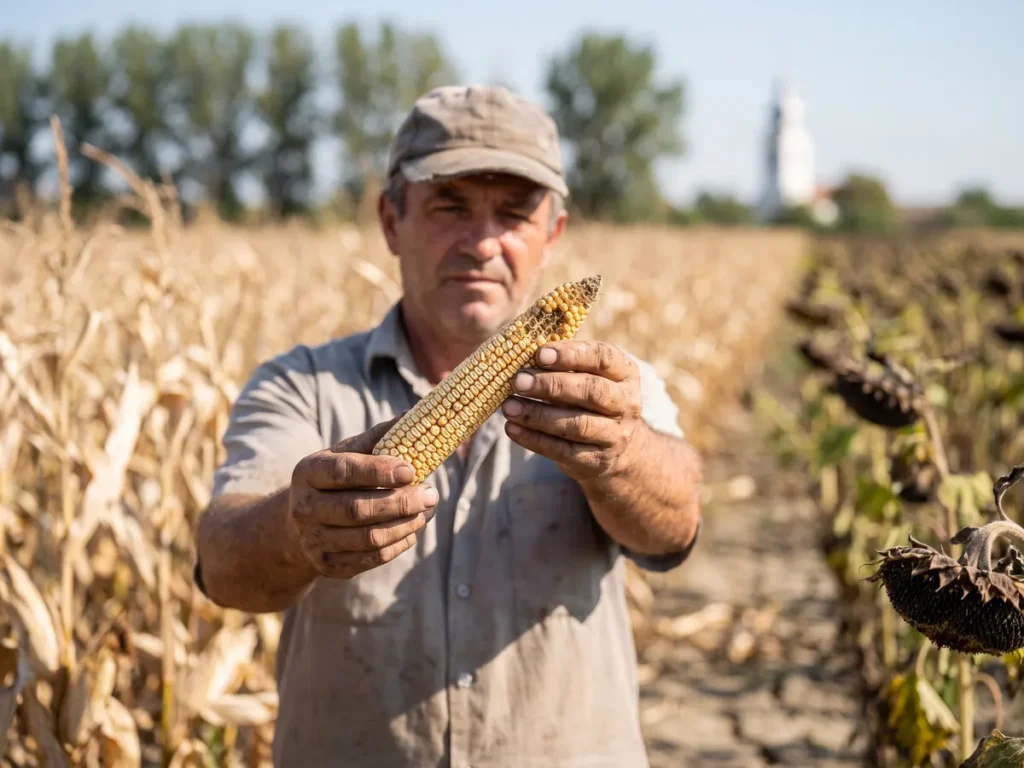
On 18 September 2026 the Government adopted the scheme under which farmers who lost maize and sunflower to the soil drought of the summer of 2025 receive 333 lei per hectare, and the text appeared on 24 September 2026 in the Official Gazette of Romania (Monitorul Oficial). Payment goes through the Agency for Payments and Intervention in Agriculture, the same body that administers the single payment application and the conditionality penalty system rewritten in the summer of 2026, because entitlement to the money is checked precisely against the payment application lodged for 2025. Without that application, a damage assessment report is of no help at all.
The source of the money is Commission Implementing Regulation (EU) 2026/1698 of 10 July 2026, which established emergency financial support for the agricultural sectors hit by adverse climatic events and natural disasters in Croatia, Cyprus, Portugal, Romania and Slovenia. Brussels put up 14,800,000 euro, and Romania added exactly the same amount from the State budget, which the regulation allows. That gives 29,600,000 euro, or 155,361,520 lei at the rate of 5.2487 lei to the euro which the decision fixes in its text. Checking the conversion comes out exactly, with nothing left over.
Soil drought is defined in Article 5 as an adverse meteorological event treated as a natural calamity or a case of force majeure, which destroys between 30% and 100% of the area under the crop and of the corresponding output. The proof is the report on the finding and assessment of the damage drawn up for the period June to August 2025, on the model set out in the Joint Order of the Minister of Agriculture and Rural Development and the Minister of Internal Affairs no. 97/63/2020. That document, until now a mere administrative finding, becomes the title on the basis of which the money is calculated.
Annex no. 1 lists 14 eligible crop codes, seven for maize and seven for sunflower. They cover grain maize and organic maize, seed and hybridisation plots, ordinary and organic sunflower, certified seed, plus the derived codes 502 and 505 used by the Agency for Payments for associated crops. The area for which money is granted cannot exceed the area of the same crop determined for payment in the 2025 campaign, after all the administrative and on-the-spot checks.
What it changes in practice
From 25 September 2026, the county directorates for agriculture have 10 working days to compile, by administrative-territorial unit, the list of producers for whom they drew up assessment reports, and to send it to the county centre of the Agency for Payments, in electronic form and on paper. Copies of the assessment reports go on paper only. The deadline falls on 9 October 2026. From the following day the application window opens, of 20 working days, and closes on 6 November 2026.
The application is lodged with the county or local centre where the farmer lodged the payment application for 2025, on the model in Annex no. 3, and it can also be sent by fax, by post or by e-mail. The Agency provides pre-printed forms, with the areas already filled in from its own records. The only further document required is a copy of the bank details, and only if they have changed since the 2025 application. The rest of the copies from last year’s file remain valid.
The calculation is simple: 333 lei per hectare multiplied by the affected area from the assessment report, capped at the area determined by the Agency for Payments. Above 90% damage the whole sum is granted, between 30% and 90% the percentage is applied. At 30% that comes to 99.90 lei per hectare, at 50% to 166.50, at 75% to 249.75. For a farmer with 40 hectares affected to the extent of 60%, the support is 7,992 lei.
If the total claimed by everyone exceeds the budget ceiling, the Agency’s central office applies a linear reduction coefficient, calculated as the ratio between the amount allocated and the amount claimed, multiplied by 100. If, on the contrary, money is left over, the difference is divided equally among the hectares in the 30% to 90% band, without going above 333 lei per hectare. Farmers with partial damage are therefore the only ones who can receive more than the formula would give them, while those whose crop was destroyed outright can never go above the ceiling.
Anyone who has already received compensation from an insurance company for the same hectares has to declare it in the application, in the section on declarations and undertakings. If the insurance payment arrives after the application is lodged, the farmer has 15 days from receiving it to notify the Agency, and if the support had already been paid, he pays back the sum received as compensation. Sums not due are recovered with interest, under the regime for budgetary receivables in Government Emergency Ordinance no. 66/2011, and the reports finding irregularities are titles to a claim which become enforceable once the payment deadline expires.
What has changed compared with the previous situation
Until this decision, the reports assessing the damage of the summer of 2025 did not, in themselves, give any entitlement to money from the budget. They were documents of record, used as proof of force majeure in relation to other obligations, for instance environmental commitments or guaranteed loans. The decision turns them into a condition of eligibility and into a basis of calculation, and the degree of damage entered in them becomes the multiplier of the sum.
The second change is the method of compensation. The support is set as a fixed rate per hectare, adjusted only by the degree of damage, and ignores each farmer’s actual loss. Article 13 recognises the gap expressly: average eligible costs are around 6,560 lei per hectare, while the loss of income runs between 210 and 890 euro per hectare, depending on how badly the crop was hit. The 333 lei cover 5.08% of the costs, a figure the decision writes out itself and which can be verified by division.
The third change concerns farmers stuck in the system. Article 10(2) opens the scheme to producers recorded as a „caz închis”, a closed case, in the Integrated Administration and Control System, that is, those the Agency could not pay in 2025 because of bank account errors. They come in if they supply the correct account details. Likewise, if the holding has been taken over by transfer in the meantime, the support can be claimed by the new holder, with a copy of the takeover document and of the assessment reports drawn up in the name of the person taken over.
Advantages and disadvantages
What it improves
- The form comes pre-printed from the Agency for Payments, with the areas filled in from its records, and the documents in the 2025 file remain valid. The only new item is a copy of the bank details, and only if they have changed.
- The application can be sent by fax, post or e-mail, so the farmer is not obliged to travel to the county centre within the 20 working days.
- The European money is matched exactly by the national budget, so without the budget contribution the rate would have been 166.50 lei per hectare, not 333.
- The scheme also recovers the closed cases in the administration and control system, that is, producers who could not be paid in 2025 because of wrong bank accounts, and lets them in on the basis of the correct account.
- The decision provides that a payment that has landed in an invalid account can be redirected to the correct one up to 31 December 2026, without the operation counting as a new payment, and therefore without falling outside the European deadline.
What remains a problem
- The rate covers 5.08% of production costs and between 7% and 9% of the loss of income, depending on the band. For a crop destroyed outright, the 333 lei come on top of a loss of roughly 4,671 lei per hectare.
- The application window is short and depends on someone else: if the county directorate for agriculture does not send the list in time, the producers of that county are left out, with no remedy provided for in the decision.
- Copies of the assessment reports are sent on paper only, in a procedure in which every other document travels electronically.
- The budget covers 466,551 hectares at the maximum rate. Above that threshold the linear reduction kicks in, and the farmer learns how much he will get only after applications close.
- The ceiling of 333 lei per hectare is 63.44 euro at the rate in the decision, although Article 9 presents it as the equivalent of „maximum 63 euro/ha”. The difference is small, but it carries over into the euro column of every summary statement.
Practical advice
- Check now, not in November, whether you appear in the records of the county directorate for agriculture with the assessment report from the summer of 2025. The list leaves for the Agency for Payments by 9 October 2026, and Article 7 expressly requires the producer to be entered in the summary statement in Annex no. 2.
- Read what form the degree of damage takes in your assessment report. A fixed value is used as it stands, a range is turned into its arithmetic mean, and the difference between „70%” and „60%-80%” changes nothing, while the difference between „70%” and „60%-90%” changes the sum.
- Compare the area in the assessment report with the area determined for payment in the 2025 campaign. If the first is larger, the second is taken, and the difference is not paid. It is worth clearing up before you apply, not afterwards.
- Declare in the application any compensation from an insurer for the same hectares. Failing to declare it falls under the offence of false statements in Articles 326 and 327 of the Criminal Code, expressly mentioned in the form in Annex no. 3.
- If you have changed bank or account since the 2025 payment application, attach a copy of the new bank details. It is the only further document required, and a wrong account was the reason some farmers were left as a closed case last year.
- Keep all the documents for ten years from receiving the money. The obligation is written into Article 22(2) and applies to the beneficiary, not only to the Agency.
Frequently asked questions
How much do I get per hectare?
By when can I lodge the application?
Do I need to have lodged a payment application in 2025?
Which crops are covered?
I have drought insurance. Do I still get the money?
What happens if the applications exceed the budget?
When does the money reach my account?
Errors and inconsistencies in the published text
- Article 12(1) and Article 14 set two different ceilings, and the repayment mechanism works for only one of them. Article 12 obliges the beneficiary to pay back the sum only where the compensation from the insurer plus the grant exceed 80% of the eligible costs in Article 13(2), that is, 5,248 lei per hectare. Article 14 requires the Agency for Payments to check that the same total value does not exceed 40% of the losses of income estimated for 2025 either, and those losses are, again in Article 13, between 210 and 890 euro per hectare. At the bottom of that range, 40% means 440.89 lei per hectare, that is, almost twelve times less than the threshold in Article 12. A farmer who receives 2,000 lei per hectare from an insurer goes well above the limit in Article 14 but stays below the one in Article 12, so he has nothing to pay back. The two texts cannot be applied at the same time as they are written.
- A degree of damage of exactly 90% falls under both letters of Article 9(1), with two different sums. Letter (a) covers „un grad de afectare mai mare de 90% inclusiv până la 100% inclusiv”, a degree of damage greater than 90% inclusive up to 100% inclusive, and gives 333 lei per hectare. Letter (b) covers „minimum 30% inclusiv și maximum 90%”, a minimum of 30% inclusive and a maximum of 90%, and gives the reduced sum, that is, 299.70 lei per hectare at a degree of 90%. Article 8(3) leans towards the second reading, since it describes the reduced band as „minimum 30% și maximum 90% inclusiv”, a minimum of 30% and a maximum of 90% inclusive, but it does not amend Article 9. The difference is 33.30 lei per hectare for every assessment report showing exactly 90%.
- The note to Annex no. 4 gives column (9) a calculation that produces the value of column (11). The table heading of the annex defines column (9) as the European Agricultural Guarantee Fund share of the support expressed in lei, and column (11) as the total expressed in euro. The note under the table says, however, that „Coloana (9) se calculează prin împărțirea coloanei (8) la curs euro 5,2487 lei”, that column (9) is calculated by dividing column (8) by the euro rate of 5.2487 lei, which describes the conversion into euro. Applied literally, the note would put a sum in euro into a column in lei and would distort the split between European funding and the national budget, which, under Article 8(1), is one half each. The check was made on page 13 of the official edition, where the table is typeset normally, not in facsimile.
Editorial analysis
The decision solves a real problem and solves it quickly: the European money was conditional on payment by 31 December 2026, and Romania chose the simplest way of spending it, a fixed rate per hectare applied on top of documents that already exist. No new valuations are required, no expert reports, the finding of damage is not reopened. The form comes pre-printed from the Agency for Payments’ own records. This is exactly the kind of scheme that can be carried through in a quarter, and that does not happen often.
The problem is not the design but the timetable set against the European deadline. We counted the working days in the act: 10 for the county compilation, 20 for lodging, 5 for the visual check, 5 for compilation at the central office, 5 for the request to the Ministry of Finance and another 5 for opening the appropriations. If each step uses its full allowance, the last link falls on 8 December 2026, that is, 74 calendar days after entry into force and 23 days before the final deadline. Except that two links in the chain have no deadline at all: Article 19, the verification and determination of eligible beneficiaries at county level, and the approval of the opening of appropriations by the Ministry of Finance. The margin of 23 days is all that covers those two unmeasured stages, plus the actual transfer into accounts.
The second observation concerns the size of the envelope. At 333 lei per hectare, the 155,361,520 lei cover 466,551 hectares, while the areas of maize and sunflower in Romania are several times larger. The scheme was designed to distribute a fixed European sum, not to compensate all the damage of 2025, and the linear reduction mechanism in Article 20(2) shows that the Government expects claims above the ceiling. The practical consequence for the farmer: the figure of 333 lei in Annex no. 3, already printed on the form, is the starting point of a calculation, not the sum he will receive, and that calculation closes only after 6 November 2026.
The third point shows up only when two articles are set side by side. Article 8(3) and Article 20(4) say that the money left over is redistributed exclusively to the hectares in the 30% to 90% band, not to all of them. In other words, the farmer whose crop was destroyed outright receives 333 lei per hectare and no more, while the farmer with 40% damage can rise from 133.20 lei up to the same ceiling. The redistribution is made „în mod egal la numărul total de hectare eligibile”, equally across the total number of eligible hectares, so the benefit goes by area, not by severity. It is a defensible choice, because the reduced band is the under-compensated one, but it is explained nowhere in the act.
What should be changed
- Closing the 90% threshold into a single letter. The wording „greater than 90% inclusive” in Article 9(1)(a) should become „above 90%”, and letter (b) should stop at „below 90%”. Without that correction, two county centres can pay different sums for the same assessment report, and the difference of 33.30 lei per hectare becomes a ground for challenge in an act whose payment deadline cannot bear litigation.
- A single cumulation ceiling, written into the article that imposes the sanction. The test of 40% of the loss of income should move from Article 14 into Article 12, alongside the one of 80% of costs, stating which of them applies where they conflict. Otherwise the Agency for Payments is obliged to check a threshold for which it has no recovery instrument, and the beneficiary cannot know what sum he risks having to repay.
- Correcting the note to Annex no. 4. The reference has to be to column (11), not to column (9), and it would be worth adding the rule for calculating columns (9) and (10), that is, the split between the European Agricultural Guarantee Fund and the national budget. The summary statements reach the Ministry of Finance and underpin the request to open appropriations, so a column filled in wrongly carries over into the whole payment chain.
- A deadline for Article 19. The stage of determining eligible beneficiaries is the only one in the procedure with no time limit, although it is the longest, since it means matching the assessment reports against the determined areas. A deadline of 10 working days would close the chain and leave the December margin for the actual transfer, not for checks.
- Publishing the reduction coefficient. Article 20(3) describes how the coefficient is calculated but nowhere says that the farmer is told the result. A duty to publish the coefficient, once, on the Agency for Payments’ website, would turn an administrative figure into information anyone can verify and would cut the number of individual challenges.
Original text of the legal act
The text below is reproduced in Romanian, the official form of publication.
The full text, as published in the Official Gazette of Romania
Official Gazette of Romania no. 812 of 24 September 2026 16 pages PDF, 153 KB the act starts on page 5
Open the official PDFDownload the PDF
The viewer is not shown on small screens. Use the buttons above to open or download the file.
This article is for informational purposes only and does not constitute legal advice. For specific situations, consult a licensed attorney or tax advisor.