
In brief
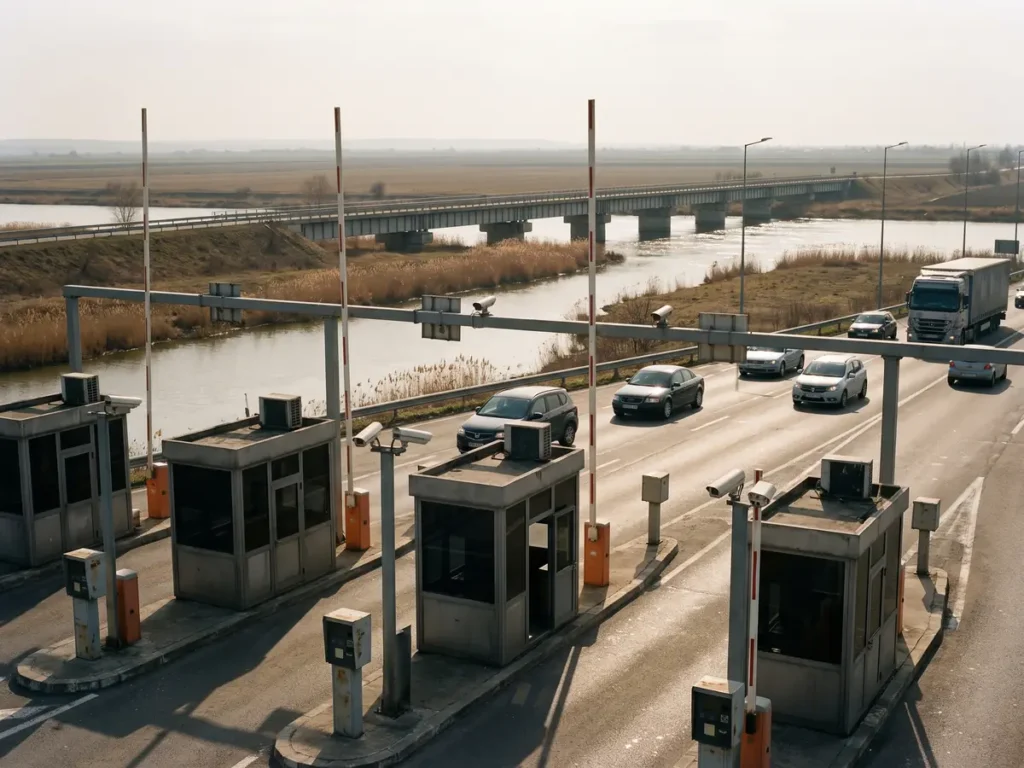
- From 1 October 2026 the tolls on the three State-run bridges over the Danube disappear. Order of the interim minister of transport and infrastructure no. 913/2026 repeals Annexes nos. 3, 4 and 5 to Order of the minister of transport no. 1.836/2018, that is precisely the tables in which the amounts were written for the bridges between Fetești and Cernavodă, for the bridge between Giurgeni and Vadu Oii and for the bridge at Giurgiu towards Ruse.
- For a passenger car, one crossing now costs 13 lei at Fetești, 11 lei at Giurgeni and 15 lei or 3 euro at Giurgiu. From 1 October 2026 there is no longer an amount to pay for any of them, because the table that set it has been taken out of the order. A return trip on the A2 motorway means two crossings, so 26 lei that are no longer paid.
- Those concerned are everyone who crosses the Danube on these bridges, from drivers heading to the seaside to haulage firms and long-distance coaches. The charges paid by companies for oversize transport authorisations and for agreements in the road zone stay untouched: the order does not touch Annexes nos. 1 and 6.
Published: Official Gazette of Romania (Monitorul Oficial), Part I, no. 824 of 28 September 2026, page 6
In force from: 1 October 2026, the date expressly written in Article II of the order
The order runs to one page and six points, and just one of them changes anything for anybody crossing the Danube at Fetești, at Giurgeni or at Giurgiu: point 6, which repeals Annexes nos. 3, 4 and 5 to Order of the minister of transport no. 1.836/2018. That is where the tolls sat, that is the amounts the National Company for Road Infrastructure Administration (CNAIR) collects at the barrier. The measure comes in the same series as the new levels of the rovinietă, published on 25 September 2026, the charge for using the national road network, and it has the same cause: from 1 October 2026 Government Ordinance no. 15/2002 is repealed, the basis on which both the old rovinietă and the bridge tolls were built.
The figures that disappear are those in the tables in force until 30 September 2026. At the bridges between Fetești and Cernavodă, on the A2 motorway, a passenger car or a goods vehicle of up to 3.5 tonnes pays 13 lei for one crossing, 26 lei for two and 208 lei for a package of 20 crossings valid for 12 months. A coach with more than 23 seats pays 64 lei, and a truck with at least four axles, 91 lei. At the bridge between Giurgeni and Vadu Oii, the passenger car pays 11 lei, the large coach 43 lei and the four-axle truck 64 lei. At Giurgiu, on the bridge towards Ruse, the passenger car pays 3 euro or 15 lei, and the four-axle truck 37 euro or 188 lei.
All these amounts fall to zero on 1 October 2026, because the act that provides for them no longer exists. The fall is 100% in every line of the three tables, with no exception and no phasing. The order does not replace the charges with lower ones and postpones nothing: it deletes them.
The legal mechanism is simple to follow. Law no. 226/2023 on the application of certain road charges on the national road network in Romania replaced the old system with two new charges: the rovinietă, a user charge for passenger cars, buses and goods vehicles up to 3.5 tonnes, and TollRo, calculated by the kilometre, for goods vehicles over 3.5 tonnes. The same law repeals Government Ordinance no. 15/2002, and the deadline, postponed twice, has come to 1 October 2026. With the basis go the charges built on it, including the three annexes with tolls.
The new law allows, in Article 3(2), a toll to be charged in addition, on a stretch where the rovinietă is payable, for bridges, tunnels and mountain passes. It allows, but it does not set one. Until 28 September 2026 no act had been published setting such a toll for the bridges over the Danube, so from 1 October 2026 crossing them stays without a price.
What it changes in practice
The first effect shows at the barrier. A family driving to the seaside and back saves 26 lei on the journey, a long-distance coach 128 lei, and a four-axle truck 182 lei for the same return trip on the A2. On the bridge between Giurgeni and Vadu Oii, which links Muntenia with northern Dobrogea, the saving on a return trip is 22 lei for a passenger car and 128 lei for a four-axle truck.
The second effect concerns those who have already bought packages of crossings. The order says nothing about them, but the answer is in the law the order invokes in its preamble: Article 24(3) of Law no. 226/2023 provides that tolls issued on the basis of Government Ordinance no. 15/2002 and left unused cease to be valid, and paragraph (4) requires CNAIR to repay their value at the written request of the user. Anyone who paid 208 lei for 20 crossings at Fetești and used three can claim the money back for the remaining 17, but only if he asks.
The third effect is on the order itself. From Order no. 1.836/2018 only two annexes are left standing from 1 October 2026: Annex no. 1, with the additional charges for vehicles exceeding the permitted weight or dimensions, paid by hauliers together with the special transport authorisation, and Annex no. 6, with the charges for approvals, prior agreements and authorisations for siting and access in the road zone, paid by developers, by utility companies and by advertising companies. Annex no. 2 had been repealed separately, on 29 December 2025, by Order no. 2.272/2025. The act thus turns from an order that touched the general public into a purely technical one, addressed to companies.
The fourth effect is one of infrastructure left without a purpose. On 15 June 2026 the electronic toll collection system at Giurgiu, called eTarifGiurgiuPod, came into service, introduced by Order of the interim minister of transport and infrastructure no. 543/2026. On 30 September 2026 it is left with no charge to collect, after 108 days of operation.
What has changed compared with the previous situation
Until 30 September 2026, anyone crossing the Danube on one of the three bridges pays twice: the rovinietă, for the right to use the national roads, and the toll, for the bridge. From 1 October 2026 a single payment is left, the rovinietă, at the levels approved by Order of the interim minister of transport and infrastructure no. 888/2026: between 228 and 330 lei a year for a passenger car, depending on the emission class.
The last change to these charges was an increase, 118 days before they were deleted. Order no. 543/2026, published on 5 June 2026, replaced Annex no. 3 in full and raised the Giurgiu toll for passenger cars from 14 to 15 lei, that is plus 7.14%, and the package of 20 crossings from 224 to 244 lei, plus 8.93%. For the four-axle truck, one crossing went up from 173 to 188 lei, plus 8.67%. The amounts in euro did not change at all: only the column in lei was recalculated.
For hauliers of goods over 3.5 tonnes, what is lost on the bridge is paid by the kilometre. They escape the fixed charge at the barrier, but come under TollRo, calculated by multiplying a unit rate by the distance travelled, in whole kilometres, across the whole national road network. For passenger cars, the disappearance of the toll has no counterpart: the rovinietă was payable before as well.
The list of definitions changes too. Point 5 of the order rewrites Article 5 of Order no. 1.836/2018 and leaves a single notion in it, the road vehicle. The definitions of the passenger transport vehicle, the goods transport vehicle, the mixed vehicle, the trailer, the semi-trailer, the tractor, the passenger car, the toll and the crossing disappear, because all of them were used in the toll tables. The two remaining annexes rest on none of them.
Advantages and disadvantages
What it improves
- A double payment on the same road disappears. Anyone with a valid rovinietă no longer takes out money a second time in order to cross the Danube.
- The saving is immediate and measurable: 26 lei on a return trip to the coast for a passenger car, 182 lei for a four-axle truck.
- The stop at the barrier disappears as well. Payment was made in cash or by card only on the outside lanes of the Fetești Collection Agency, the ones with an operator and a barrier, and from 1 October 2026 there is nothing left to collect there.
- There is a single date and it is written in the act: 1 October 2026, with no stages and no categories entering later.
- The legislative tidying is real on the definitions side. Article 5 is left with a single notion, exactly the one used by the annexes that survive.
What remains a problem
- The order says nothing about the packages of crossings already bought, although some are valid for 12 months. Anyone who wants the money back has to find Article 24(4) of Law no. 226/2023 himself and make a written request.
- Two paragraphs stay in force referring to annexes that no longer exist. See the section on errors below.
- Hauliers over 3.5 tonnes move from a fixed charge on the bridge to TollRo, reckoned by the kilometre, whose final effect depends on the distances travelled.
- The State gives up a revenue without saying how big it is. Neither the order nor its preamble indicates the amount collected annually from the three charges, so there is no way of checking what the CNAIR budget loses.
- The electronic system at Giurgiu, started on 15 June 2026, is left without a purpose after 108 days, and the order does not say what is to be done with it.
Practical advice
- If you have a package of 2 or of 20 crossings bought at Fetești, at Giurgeni or at Giurgiu and have not used it up, send CNAIR a written request for repayment. The basis is Article 24(3) and (4) of Law no. 226/2023, and the specific conditions are laid down by the implementing rules of the law.
- Do not confuse the disappearance of the toll with the road becoming free. The rovinietă is still payable, and from 1 October 2026 at the levels in Order no. 888/2026. Without it, the fine stays.
- A rovinietă bought earlier, for passenger cars and for goods vehicles up to 3.5 tonnes, stays valid until it expires. For tolls the rule is different: the unused ones lose their validity on 1 October 2026.
- If you carry goods with vehicles over 3.5 tonnes, redo the cost calculation for each route. The fixed toll on the bridge disappears, but TollRo appears, which multiplies with every kilometre of national road travelled.
- Companies that apply for special transport authorisations for excess weight or dimensions and those that apply for approvals or agreements in the road zone have nothing to change: Annexes nos. 1 and 6 stay in force, with the same charges.
- The free-passage permits issued for persons with a pronounced or severe disability for the Fetești barrier have nothing left to exempt after 1 October 2026, because there is no longer a charge from which the exemption can be granted.
Frequently asked questions
Do I still pay a toll when I drive to the seaside after 1 October 2026?
What happens to my package of 20 crossings, bought this summer?
Does the bridge from Giurgiu towards Ruse become free?
Does that mean the national roads become free?
Why is this changing now of all times?
What is left of Order no. 1.836/2018?
Errors and inconsistencies in the published text
- Article I point 1 repeals only one of the three paragraphs that approved the deleted annexes. Point 1 removes from force paragraphs (3) and (6) of Article 1 of Order no. 1.836/2018, and point 6 repeals Annexes nos. 3, 4 and 5. Paragraphs (4) and (5) of the same article, however, stay in force, and they continue to approve „tarifele de trecere pentru utilizarea podului peste Dunăre între Giurgeni și Vadu Oii”, the tolls for using the bridge over the Danube between those two places, provided for in Annex no. 4, and „tarifele de trecere pentru utilizarea podurilor peste Dunăre între Fetești și Cernavodă”, the tolls for using the bridges between the other two, provided for in Annex no. 5. From 1 October 2026 the order therefore approves two charges whose tables no longer exist. A reader in good faith can reach two different conclusions: either the charges are abolished, or the approving rule survives and only the amount is missing. That it could have been done otherwise is visible in the history of the act itself: Order of the minister of transport and infrastructure no. 2.272/2025, published in the Official Gazette of Romania, Part I, no. 1.207 of 29 December 2025, repealed together Article 1(2), Article 2(2), Article 3(2) and Annex no. 2, that is the approving rule and the table at once.
Editorial analysis
The order does what needed doing and does it in time: on 28 September 2026, three days before the legal basis of the charges disappears. The tidying is, on the whole, careful. Point 3 removes paragraphs (3)-(5) of Article 3, that is the payment rules for the three repealed annexes. Point 4 removes Article 4, which updated the charges in Annex no. 3 every year. Point 5 reduces Article 5 to the only definition the act still needs. Checked against the consolidated text, none of the notions removed appears any more in Annexes nos. 1 and 6, so the cut is clean, not hurried.
What is not visible from reading the order is the rhythm of the decisions of the last four months. On 27 May 2026 the ministry signed Order no. 543/2026, which replaced Annex no. 3 in full and brought into service, from 15 June 2026, its own system for collecting the toll electronically at Giurgiu, eTarifGiurgiuPod. At that date the deadline for repealing Government Ordinance no. 15/2002 was 1 July 2026, set by Government Ordinance no. 14/2025. The electronic system thus came into service 16 days before the date on which the charge it collected was due to disappear. It escaped because, on 24 June 2026, seven days before the deadline, Law no. 103/2026 moved that date to 1 October. The balance: eTarifGiurgiuPod works for 108 days, from 15 June to 30 September 2026.
The same Annex no. 3, remade in June, also shows how prices rise without rising. The amounts in euro did not change: 3 euro for a passenger car on one crossing, 48 euro for the package of 20, just as before. Only the column in lei was recalculated, and not at a single exchange rate. One crossing went from 14 to 15 lei, that is from 4.67 to 5.00 lei to the euro, and the package of 20 from 224 to 244 lei, that is to 5.08 lei to the euro. The same annex, two exchange rates, with a difference of 1.7% between them. Nobody is misled, because each cell has its own fixed amount in lei, but the table cannot be rebuilt from an exchange rate, and at the next update the difference is carried forward.
The weak part of the order is not what it says, but what it leaves unwritten. Someone with a package of 20 crossings worth 208 lei in his wallet reads the order end to end and learns nothing about it. The answer is in Article 24(3) and (4) of Law no. 226/2023, that is in exactly the article the preamble cites, but only for paragraph (1). Also in the preamble, the date of 1 October 2026 is attributed to Article 24(1) of the law, although the text of that paragraph says 1 January 2026; the real date comes from the postponement in Article III(1) of Law no. 103/2026. The result is correct, the reference is incomplete, and anyone who checks it in the text of the law finds something other than what the preamble says.
What should be changed
- Repealing paragraphs (4) and (5) of Article 1 of Order no. 1.836/2018. It would close the only real inconsistency in the act and would leave the order without provisions approving charges that do not exist. It is solved with one line in a correcting order.
- Bringing into line Article 9, which still says that „anexele nr. 1-6 fac parte integrantă din prezentul ordin”, that the annexes form an integral part of the order. From 1 October 2026 two of them are left. A reader looking for Annexes nos. 2, 3, 4 and 5 wastes time looking for something that was taken out on two separate occasions, in December 2025 and in September 2026.
- A transitional provision about the tolls already bought, with a time limit and an address for lodging the request. The order ought to say, in two sentences, that unused packages are repaid on request under Article 24(4) of Law no. 226/2023, and where the request is lodged. Otherwise the repayment stays a right used only by those who look for it themselves.
- Citing the legal basis in full in the preamble. If the date of 1 October 2026 comes from the postponement ordered by Law no. 103/2026, the preamble ought to mention it alongside Article 24(1) of Law no. 226/2023. A verifiable preamble spares the reader an hour’s search.
- Announcing the decision on the bridges in good time. Law no. 226/2023 allows, in Article 3(2), a bridge toll on top of the rovinietă. If the ministry intends to reintroduce it, the order that sets it must be published before, not after, the collection investments. The eTarifGiurgiuPod case shows what the reverse order costs.
Original text of the legal act
The text below is reproduced in Romanian, the official form of publication.
The full text, as published in the Official Gazette of Romania
Official Gazette of Romania no. 824 of 28 September 2026, page 6 8 pages PDF, 85 KB the act starts on page 6
Open the official PDFDownload the PDF
The viewer is not shown on small screens. Use the buttons above to open or download the file.
This article is for informational purposes only and does not constitute legal advice. For specific situations, consult a licensed attorney or tax advisor.